AEO for B2B sales: build an AI-citable knowledge base that drives pipeline
AEO for B2B sales means packaging the answers buyers ask AI about (pricing, security, integrations, objections, competitors) into structured, dated, owned pages so answer engines quote you accurately. Anchor every claim to what you actually sell, and measure citations.
Your buyers stopped "searching." They started asking. If your answers are scattered across Notion, Slack, decks, and someone's memory, AI will still answer the question. It just will not be your answer.
TL;DR
- AEO for B2B sales = packaging your sales knowledge so answer engines can quote it with confidence.
- Publish the things revenue actually argues about: pricing, security, integrations, objections, competitors.
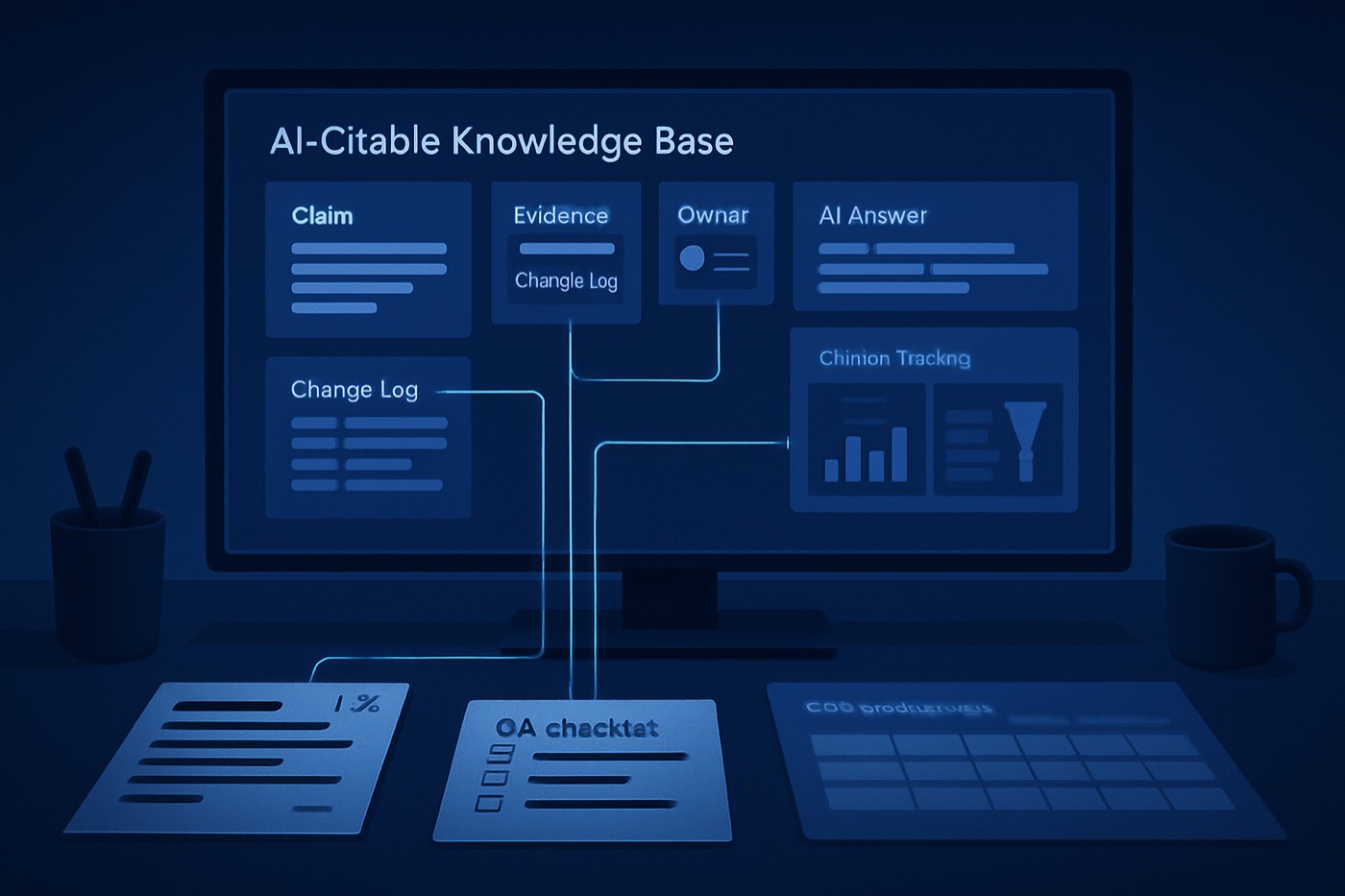
- Structure every page like it might get cross-examined: claim + evidence + timestamp + owner + change log.
- Measure what matters now: mentions inside AI answers, referral quality, assisted conversions, not vanity traffic.
- Anchor every page to what you actually sell today, or your AEO becomes well-formatted guessing.
AEO for B2B sales: what it means (and what it is not)
Definitions in plain English: AEO, GEO, LLMO
You will hear three acronyms. They all point to the same outcome: getting cited when a buyer asks an AI a question.
AEO (answer engine optimization)
Make your content easy for answer engines (Google AI Overviews, Bing Copilot, Perplexity, ChatGPT browsing) to pull, summarize, and cite.GEO (generative engine optimization)
Same idea, different label. Focuses on how generative systems retrieve and assemble answers.LLMO (LLM optimization)
Tuning your content to be usable by large language models, usually by improving clarity, structure, and trust signals.
Call it whatever you want. The job stays the same: ship pages that can survive being quoted out of context.
Why this matters now (the pipeline reason, not the "marketing trend" reason)
AI summaries are eating clicks. That is not a hot take. Ahrefs measured a ~34.5% lower clickthrough rate for the top result when AI Overviews appear, comparing observed CTR against a forecasted baseline. (Ahrefs study)
Gartner put a number on the macro shift too: it predicts traditional search engine volume will drop 25% by 2026 as users move to AI chatbots and virtual agents. (Gartner press release)
So yes, organic traffic still matters. But answers matter more. Buyers want a direct response, plus a source they can trust.
The non-negotiable stance: anchor every page to what you actually sell
Most "knowledge bases" are content museums. Pretty. Stale. Wrong.
Sales truth changes fast:
- Pricing and packaging change.
- Integrations ship and break.
- Security posture tightens.
- Competitors reposition.
- The real objection shifts from "budget" to "we already use X."
If your AEO content is not tied to what your team actually sells today, it will:
- Get ignored by buyers who spot the mismatch.
- Get ignored by answer engines that detect low trust.
- Create support tickets and sales friction when AI quotes outdated claims.
Rule: every answer-engine page needs a single owner and a live source of truth. That source is the reality of your sales motion: what you charge, what you ship, what your security program actually does, and the questions buyers keep raising in real conversations.
If the truth is that your median deal is $18k and your page says "starts at $499/mo," congratulations, you published fiction. If your most-requested integrations are HubSpot and Salesforce and your docs only cover Zapier, you built a library nobody reads.
This is also where an autonomous revenue operator earns its keep. Chronic runs the outbound motion end-to-end: it finds prospects, writes and sends cold email from managed, warmed mailboxes, handles the replies, and books meetings. That means it is sitting on the freshest possible record of what buyers actually ask before they buy: every objection that lands in a reply, every "we already use X," every reason a deal stalls. Your knowledge base should be built on those signals, because that is where the real questions live.
What to publish for AEO for B2B sales (the pages that actually drive pipeline)
You do not need 300 blog posts. You need 30 pages that answer real buying questions.
1) Objection-handling pages (the "sales therapy" section)
These are not "overcoming objections" puff pieces. They are direct answers, written like a closer.
Publish pages for:
- "Why is this so expensive?"
- "Why not just hire SDRs?"
- "We already use Apollo / HubSpot / Salesforce."
- "Is cold email dead?"
- "Will this hurt our deliverability?"
- "How long until we see meetings booked?"
Structure that gets cited:
- One-sentence answer
- 3 to 5 bullets with conditions (when it is true, when it is not)
- Proof points (numbers, screenshots, standards, customer quotes)
- A "who should not buy this" section
Internal link suggestion:
- Tie objection pages to your process assets, like reply handling. Example: link to Cold Email Reply Handling Templates when you address "what happens after a reply?"
2) Pricing pages (stop hiding behind "contact sales")
Answer engines hate ambiguity. Buyers hate it more.
Your pricing page should include:
- A simple plan table
- What is included
- What costs extra (if anything)
- Common pricing questions in plain English
If you do keep "contact sales," fine. Still publish:
- Typical ranges by segment (SMB vs mid-market)
- What drives price (contacts, inboxes, actions, volume)
- Procurement answers (billing terms, tax, invoicing)
This is not just conversion. It is citation bait.
3) Integration docs (buyers ask AI whether you work with their stack)
Publish integration pages for the tools your prospects already use:
- HubSpot, Salesforce, Pipedrive, Attio, Close, Zoho, Apollo, Instantly, Clay, HeyReach
Do not write "we integrate with leading CRMs." Write:
- What data moves where
- Direction (two-way or one-way)
- Objects supported (contacts, companies, deals, activities)
- Setup steps
- Known limitations
- A troubleshooting section
Internal link suggestions:
- Mention your pipeline view and link to Sales Pipeline.
- If you discuss scoring and routing, link to AI Lead Scoring.
4) Security answers (because enterprise deals die in security review)
If you sell B2B, security content is pipeline content.
At minimum, publish:
- A data-handling overview
- Encryption (in transit, at rest)
- Access controls, SSO, SCIM (if supported)
- A subprocessors list
- Retention and deletion policy
- Incident response basics
- Compliance posture (SOC 2, ISO 27001, and so on)
When you reference SOC 2, be precise. SOC 2 reports evaluate controls relevant to the Trust Services Criteria: security, availability, processing integrity, confidentiality, and privacy. (AICPA SOC 2 overview)
If you reference NIST, cite the real document. NIST SP 800-53 is a core catalog of security and privacy controls, and it gets updated. (NIST SP 800-53 Rev. 5 page)
5) Competitor comparisons (write them like an operator, not a hater)
Buyers already compare you. If you do not publish the comparison, Reddit will.
Make comparison pages for the products you actually go up against. For an autonomous revenue operator, that is the set of tools a buyer would otherwise stitch together to run outbound themselves: data and sequencing tools like Apollo, Clay, and Instantly, plus the CRMs deals run through, like HubSpot, Salesforce, Pipedrive, Attio, Close, and Zoho.
Lead with one honest line of contrast, then go straight to value:
- Clay is powerful for building lists, but it is a workbench, not an operator. Someone still has to run it.
- Instantly sends email. After the send, the replying, qualifying, and booking is still your job.
- Salesforce is the system of record deals close in. It does not go find the deals.
The through-line: those tools are pieces of an outbound motion you assemble and run yourself. Position the comparison around the job done end-to-end, not feature checklists.
Internal link suggestions:
- When you mention a competitor, link to the relevant page:
How to structure pages so AI can cite them (and trust them)
If you want citations, stop writing "content." Start writing records.
The AEO page template: claim, evidence, timestamp, owner
Every page needs these fields, visible on the page:
- Claim (one sentence)
- Example: "Chronic runs the outbound motion end-to-end, until the meeting is booked."
- Or: "Our pricing starts at $X per month, with no per-seat fees."
- Evidence (bullets and links)
- Link to relevant docs
- Screenshots where appropriate
- External standards where relevant (SOC 2, NIST)
- Internal proof (case study metrics, if you have them)
- Timestamp
- "Last updated: 2026-04-22"
- Include "next review due" if you want to be serious about it.
Schema supports a dateModified field. That is not a magic ranking hack. It is a clarity signal. (Schema.org dateModified)
Keep your sitemap lastmod accurate too. It is explicitly meant to represent when the page changed, not when you regenerated the sitemap. (Sitemaps.org protocol)
- Owner
- "Owner: Head of RevOps"
- Or "Owner: Security lead"
- Use a role-based owner, not a person's name, so it survives org churn.
Stop over-optimizing for FAQ rich results
Google dialed back FAQ rich results visibility. FAQ structured data eligibility got restricted, and HowTo rich results got dropped from Search entirely. (Google Search Central blog update)
Still publish FAQs, because humans need them and LLMs read them well. Just do not build your strategy on rich-result pixels.
Write in "answer-first" format
For each page section:
- Start with the direct answer.
- Then the context.
- Then the edge cases.
- Then the sources.
Answer engines lift the first clean, complete block that sounds certain and verifiable. Give them that block.
Add "known limits" (it increases trust)
Example pattern:
- "Works best for: outbound teams running 1,000 to 50,000 prospects per month."
- "Not ideal for: inbound-only funnels with no outbound motion."
This is counterintuitive, and it works. Honesty reads like confidence, because it is.
Build a visible "what changed" changelog
This is the simplest freshness and trust system you can ship.
Example:
- 2026-04-22: Updated pricing table. Added SSO details.
- 2026-03-10: Added HubSpot integration steps.
- 2026-02-01: Deprecated legacy API endpoint.
AI systems do not "trust" the way humans do. They still respond to cues of maintenance and specificity. A changelog is one of those cues.
Step-by-step playbook: build an AI-citable knowledge base that drives pipeline
Step 1: Pull the real questions from your sales motion (not from your imagination)
Go to where the actual buying questions live:
- Closed-lost reasons
- Sales call notes (top objections)
- Cold outreach replies (what prospects push back on)
- Security questionnaires (the repeats)
- Integration requests, by frequency
- Pricing pushback patterns
- Competitor mentions
If an autonomous operator like Chronic is running your outbound, the reply stream is a constant feed of these objections in the buyer's own words. Use it.
Then rank topics by:
- Frequency (how often it shows up)
- Revenue impact (does it block deals)
- Answer volatility (how often the truth changes)
High frequency plus high revenue impact wins.
Internal link suggestion:
- If you run dual scoring, connect this to prioritization. Link to Fit + Intent + Timing: The Dual-Scoring Model.
Step 2: Choose 4 "money categories" and ship 5 pages each
This gets you to 20 pages fast. Enough to matter.
The categories:
- Pricing
- Security
- Integrations
- Competitors and objections
You can always add more. Most teams never finish the first 20.
Step 3: Use the "AEO record" format on every page
Mandatory sections:
- One-sentence answer
- Details (bullets)
- Proof and sources
- Last updated
- Owner
- Change log
Optional but powerful:
- "Copy/paste answer for procurement"
- "Email template for reps"
- "Decision checklist"
Internal link suggestions:
- If you mention enrichment quality, link to Lead enrichment.
- If you mention personalization at scale, link to AI Email Writer.
- If you mention defining your ICP, link to ICP Builder.
Step 4: Add citations like a grown-up: sources and scope
When you make a factual claim that is not self-evident, cite it:
- Standards bodies (AICPA, NIST)
- Vendor docs (if you reference a vendor behavior)
- Your own product docs (if it is your capability)
- Your own data, but label it as internal and date it
Also add scope:
- "As of 2026-04-22"
- "Applies to US-based customers"
- "Applies to Salesforce integration v2"
Scope keeps AI from quoting you in the wrong context.
Step 5: Ship a crawlable site, not a Notion graveyard
Answer engines cannot cite what they cannot index.
Minimum requirements:
- Public URLs
- Clean navigation
- HTML text, not image-only screenshots
- Fast load
- A sitemap with a real
lastmod
Step 6: Tie pages to pipeline actions
Every page should route to one of these outcomes:
- Book a meeting
- Start a trial
- Request security docs
- View integration setup
- Compare plans
You are not "educating the market." You are moving deals forward.
Measurement: how to tell if AEO for B2B sales is working
Traffic is not dead. It is just not the only scoreboard.
1) Answer-engine mentions (the new top of funnel)
Track:
- Brand mentions inside AI answers
- Page citations, when available
- Query coverage (how often your category prompts surface you)
Microsoft explicitly positions Copilot Search as providing summarized answers with cited sources. (Microsoft Bing Copilot Search page)
That means "rank" is no longer a list position. It is "did the model quote you."
2) Referral quality (because fewer clicks can still mean more revenue)
If AI reduces clicks, the clicks you do get can be more qualified. Measure that instead of guessing at it.
Track in analytics:
- Time on site from AI referral sources
- Demo conversion rate by referrer
- Sales-qualified rate by referrer
3) Assisted conversions (because buyers read, then buy later)
Set up:
- Content touchpoints in your CRM
- Attribution that counts assists, not just last click
If you do not connect web sessions to accounts and opportunities, you are measuring vibes.
4) Sales-cycle impact (the metric your CFO will actually respect)
For opportunities that consumed AEO assets, compare:
- Days in security review
- Days from first call to proposal
- Close rate when competitor pages were viewed
If your security page cuts a week off review, that is real money.
Operating cadence: keep it fresh without turning it into a second job
AEO fails when the maintenance plan is "we'll update it later." Later never shows up.
Weekly refresh (30 to 60 minutes)
Every week:
- Review the top 5 pages by revenue impact
- Check for drift: pricing, packaging, integrations, security statements
- Update "Last updated" and the changelog entries
Quarterly purge (half a day, no mercy)
Every quarter:
- Remove or merge duplicate pages
- Kill anything that:
- Has no owner
- Has no timestamp
- Conflicts with current product truth
- Targets questions nobody asks anymore
Content bloat lowers trust, internally and externally.
"What changed" changelog discipline (always on)
Every update gets a line item:
- Date
- What changed
- Who changed it
- Why it changed (optional, but useful)
This is how you stop the knowledge base from becoming archaeology.
FAQ
What is AEO for B2B sales, in one sentence?
AEO for B2B sales is building and maintaining sales-critical pages so answer engines can quote your answers accurately, with enough structure and trust signals to drive qualified pipeline.
Do we still need SEO if AI Overviews reduce clicks?
Yes. But you optimize for being cited and trusted, not just being clicked. Ahrefs measured AI Overviews reducing position-one CTR by about 34.5% in their analysis, which changes the value of a "ranking." (Ahrefs)
What should we publish first if we only have time for five pages?
Start with:
- A pricing explanation (with ranges and price drivers)
- A security overview (SOC 2 posture, retention, subprocessors)
- Your most-requested integration
- "Why not hire SDRs instead?"
- A comparison against the tool you lose to most
How do we make content "AI-citable" without gaming anything?
Make it auditable:
- Clear claims
- Evidence links
- A last-updated date
- A named owner
- A change log
- Scope notes ("as of 2026-04-22")
Also follow Google's guidance on creating helpful, reliable, people-first content. (Google Search Central)
Should we add FAQ structured data everywhere?
No. Google reduced FAQ rich results visibility and removed HowTo rich results from Search. Publish FAQs for humans and for LLM readability, not for SERP decorations. (Google Search Central update)
How do we stop our knowledge base from going stale?
Put it on an operating cadence:
- A weekly refresh of the top revenue pages
- A quarterly purge
- A mandatory "what changed" changelog
And anchor every claim to what you actually sell: current pricing, the security program, product release notes, and the objections coming back in real conversations. If it is not tied to truth, it is just well-formatted guessing.
Run the cadence, ship the pages, take the meetings
Pick 20 pages that map to real deals. Build them in the claim + evidence + timestamp + owner format. Tie every page to a real, current buying question. Track citations, referral quality, and assisted conversions.
Then do the boring part everyone skips: weekly refresh, quarterly purge, and a changelog. That is the whole advantage. Consistency beats clever.