Agent-first GTM: the real shift is who owns outbound execution
Agent-first GTM means software owns outbound work end to end (find, write, send, reply, book) while a human sets the goal and approves what matters. The real question: how many handoffs sit between a lead and a booked meeting?
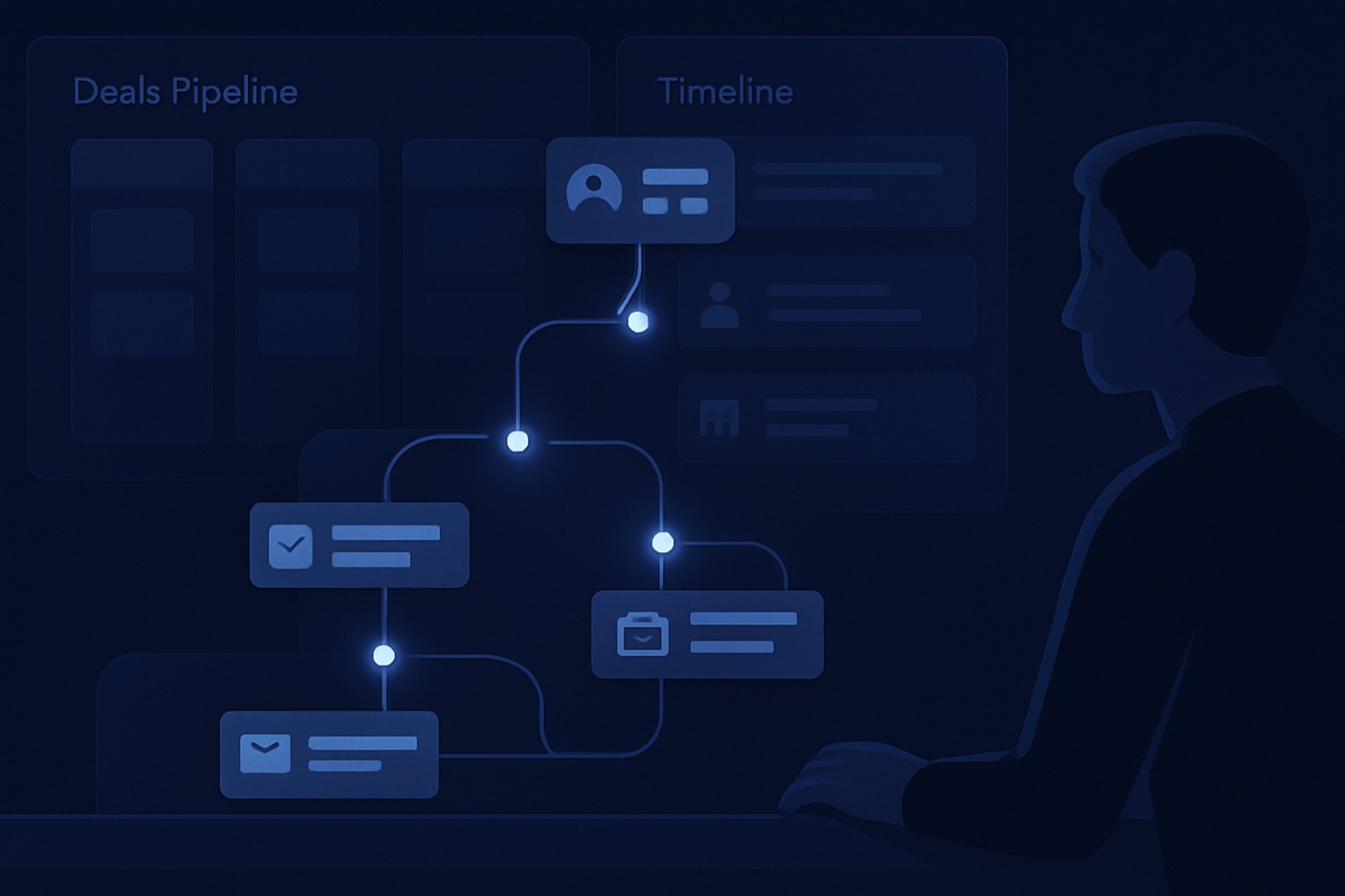
HubSpot says it is going "agent-first." That phrase is doing a lot of work, and it is worth taking seriously.
Not "AI features." Not "copilot." Not "write me an email."
Agents doing real work in the funnel, with humans supervising. HubSpot's own "How we grow with agent-first GTM" post reads like a plan for moving repetitive work from people to agents across the flywheel. (blog.hubspot.com)
When the largest SMB GTM platform reorganizes its story around agents doing the work, it is confirming a shift the rest of the market already feels: the value is moving from the place you record what happened to the thing that does the next action. The interesting question is not whether agents are coming. It is who ends up owning the outbound loop, and how many human handoffs are left inside it.
What is actually changing
For years, outbound has been a relay race across tools. A person finds leads in one app, enriches them in another, sequences in a third, and replies land in an inbox while notes maybe make it back into the system of record. Each handoff is a place to drop the baton.
The shift agent-first GTM points at is the end of that relay. Instead of a human stitching fragments together, one system carries the work from a lead to a booked meeting and reports back. The owner of the actions changes from "a rep with a stack" to "an operator that runs the stack."
That is the lens worth using for the rest of HubSpot's announcements, and for anyone else's.
The product direction matches the story
HubSpot has been building toward this since Breeze launched at INBOUND 2024, with Copilot, Agents, and Breeze Intelligence for enrichment and intent. (ir.hubspot.com)
The Spring 2026 Spotlight pushed further: "Growth Context," new agents including a Prospecting Agent, and "Smart Deal Progression" that turns post-meeting follow-up and record updates into an assisted workflow. (hubspot.com)
The specifics line up:
- Prospecting Agent for outbound prospecting in Sales Hub. (hubspot.com)
- Breeze Intelligence for one-click enrichment plus buyer-intent attributes. (hubspot.com)
- Smart Deal Progression for suggested record updates, follow-ups, and next steps drawn from call transcripts. (hubspot.com)
Gartner has framed the same move at the industry level: stop building chatbots, start building agents that do work. (gartner.com)
Buyer behavior moved first; vendors are reacting
The old GTM belief was that more volume wins. Buyers have made that expensive.
Intent shows up in messier places. It is no longer just "visited the pricing page." It is review sites, security questionnaires, community threads, and AI answer engines. HubSpot's push into answer-engine optimization, with tools to measure how a brand shows up in ChatGPT, Gemini, and Perplexity, is a tell. (hubspot.com) You do not build that tooling because search is thriving. You build it because discovery is moving into AI interfaces.
Response speed and context matter more. Buyers expect a relevant, context-aware reply quickly, not a templated "thanks for your email." That is the job Smart Deal Progression is trying to do: take a rep task and make it an automated, transcript-aware workflow. (hubspot.com)
Generic outreach gets punished harder. Large language models made everyone competent at writing, so writing is no longer the differentiator. Relevance is. That moves the burden onto targeting, enrichment, scoring, and reply handling, not onto yet another email generator.
Four jobs to watch (this is where the real shift lives)
Ignore the hype and watch who owns these four jobs.
1) Who owns the actions?
The shift is from rep-driven tasks to agent-driven runs. HubSpot's Prospecting Agent does not just draft; it participates in prospecting workflows and consumes credits as it works. (knowledge.hubspot.com) That points at a new contract: you pay for work done, not for seats.
Chronic's stance is the same principle taken further. It runs as an autonomous revenue operator: you set the goal, the budget, the offer, and the approval level, and it owns the outbound run end to end while surfacing the decisions that need a human.
2) How intent gets scored, and whether scoring does anything
Most "AI lead scoring" is static fit scoring, simple engagement scoring, or a black-box number nobody trusts. Useful scoring is dual: fit (does this match the ICP) plus intent (signals that correlate with booking). HubSpot positions Breeze Intelligence as enrichment plus intent, with firmographic and technographic attributes refreshed over time. (hubspot.com)
That is directionally right, but the question to ask any vendor is blunt: does the score trigger the next action automatically, or does it just populate a dashboard? If the number does not change what happens next, it is decoration. The point of AI lead scoring is to decide who gets touched next and then act on it, not to produce another report you have to read and route by hand.
3) How replies get handled
This is where most "AI SDR" stories quietly fail. Everyone demos finding leads, writing an email, and starting a sequence. Almost nobody demos a real reply: a hard question, a reschedule, a "not me, talk to Sam," a price anchor, a security concern, or a competitor mention.
Handling replies well means the system classifies the reply, pulls context, drafts a response in the right voice, escalates when the risk is high, updates the stage, and only creates a task when one is actually needed. Without that, "autonomous" just means spamming faster. HubSpot's acquisition of Frame.ai, aimed at bringing real-time conversational data into the platform, is an admission that reply context is part of the work, not an afterthought. (ir.hubspot.com)
4) What "booked meeting" really means
Booked-meeting automation is not handing over a Calendly link. Done properly it means the system proposes times, handles time zones, confirms the right attendee, answers basic pre-call questions, drafts the agenda, updates the record and next steps, routes to the correct owner, and sends reminders to cut no-shows, all inside one flow rather than five handoffs. Anything less automates friction, not booking.
The gap: AI features vs a closed loop
HubSpot is moving in a sensible direction, and buyers should still stay skeptical, because the market is full of agent theater: AI writes, summarizes, and suggests, and then humans do the hard parts anyway, the list building, the enrichment cleanup, the sequence ops, the reply handling, the routing, and the booking.
Gartner has been blunt about this phase, predicting that more than 40% of agentic AI projects will be canceled by the end of 2027 because of cost, unclear value, and weak risk controls. (gartner.com) The translation is that pilots demo well and production breaks trust. So the buying question is not "who has the most AI?" It is who has the fewest human handoffs per booked meeting.
What changes inside the org
Going agent-first is an operating-model change, not a feature rollout.
Sales leadership manages policy, not activity. Instead of "make 60 calls" and "send 200 emails," the inputs become the ICP definition, the disqualifiers, what needs human approval, what counts as a qualified meeting, and what the agent must never say. That is why a real control plane matters. If you cannot set permissions, see an audit trail, and hit a kill switch, you do not have an agent, you have a liability. Chronic's own write-up on agent oversight covers that checklist: The agent control plane: permissions, audit logs, and kill switches for autonomous outbound.
RevOps shifts from CRM admin to automation engineering. The job becomes defining signals, building routing logic, setting escalation rules, running QA on outbound, watching deliverability, and tuning scoring. If your ops team is still updating lifecycle-stage values by hand, you are not ready. Deliverability ops in particular stops being optional once a system can send at scale; Chronic laid out that weekly motion here: Cold email deliverability ops in 2026: the SOP your team runs weekly (not a checklist).
SDR work splits. The agent runs the repetitive volume; people concentrate on high-context conversations and enterprise complexity. A smaller, more senior team handles the parts that genuinely need judgment.
HubSpot vs an agent-native operator
Give HubSpot credit. It is building a native agent layer inside a CRM that already owns a large share of SMB GTM, and that is a strong position.
It also carries the weight of being a broad platform: more surface area, more configuration, and added pricing complexity from credit-based agent usage. (ir.hubspot.com) If you choose HubSpot, be honest about what you are buying: a powerful platform with improving agents, plus your team's ability to stitch the workflows into closed loops.
An agent-native operator makes a narrower promise: pipeline outcomes, fewer tools, less glue work. Chronic is built around outbound running end to end until a meeting is booked, with the core capabilities built as execution rather than UI on top of a database:
If you already run HubSpot, the honest first step is a reality check on what you pay and what you still bolt on. Chronic keeps the head-to-heads plain:
One line of contrast, then move on: HubSpot is adding agents to a CRM. Chronic started as the operator.
The evaluation rubric buyers should use
If a vendor claims "agent-first," run this rubric. No vibes, no demos with perfect data.
1) Lead supply. Can it source leads that match your ICP without list uploads, explain why each lead matches, and refresh the pool over time? If the answer is "export from Apollo," you have a connector, not an operator.
2) Data quality. One-click or automatic enrichment at the record level, firmographics plus technographics, refreshed rather than filled once. HubSpot points at 40+ attributes via Breeze Intelligence, which is the right direction. (hubspot.com)
3) Personalization. Test it on a niche persona, a regulated industry, a competitor-displacement angle, and a no-fluff brand voice. If it compliments the prospect's "impressive growth," that is spam with punctuation, not relevance.
4) Sequencing. Multi-step and multi-branch, inside the system, stopping when intent triggers and pausing when deliverability risk spikes. If you still need a separate tool to actually send, you are stitching.
5) Reply triage. This is the dealbreaker. Ask for a live run on "not interested," "send pricing," "we use competitor X," "talk next quarter," "remove me," "who are you?", and "loop in my CTO." The system should classify, draft, escalate, update the stage, and create a task only when one is needed.
6) Booking. Real booking, not a calendar link: finds time, confirms attendees, updates the record, routes to the owner, and logs context and the next step.
7) Closed-loop learning. It should connect actions to outcomes: which signals predict replies, which personalization patterns convert, which segments hurt deliverability, which sequences book meetings. A system that cannot tie actions to outcomes cannot improve; it just produces more activity.
FAQ
What does "agent-first GTM" mean in plain English?
Software does the repetitive GTM work across the funnel while people supervise and handle exceptions. HubSpot describes it as agents doing real work at every stage so humans can operate at higher impact. (blog.hubspot.com)
Is HubSpot actually agent-first today, or just marketing it?
HubSpot has shipped real agent products: Breeze, the Prospecting Agent, the Customer Agent, and workflow-level AI, with continued updates like Smart Deal Progression and agent integrations. (ir.hubspot.com) Whether it is agent-first for you depends on whether you can run a closed outbound loop without handoffs in your own setup.
What is the difference between an AI feature and a closed-loop workflow?
An AI feature produces an artifact: a draft, a summary, a suggestion. A closed-loop workflow produces an outcome: a qualified reply, a routed task, an updated stage, a booked meeting. If a person has to copy-paste between tools to finish the loop, it is not closed.
Why are so many agentic AI projects predicted to get canceled?
Governance, cost overruns, unclear ROI, and weak risk controls. Gartner has publicly predicted that more than 40% of agentic AI projects will be canceled by the end of 2027. (gartner.com)
How should buyers evaluate AI prospecting specifically?
Force a demo that starts from zero and ends in pipeline movement: a new lead found, enriched, a personalized message written, a sequence run, a reply triaged, a meeting booked, and the record updated. If any step requires exporting a list or switching tools, the agent is not owning the workflow.
What is the cleanest way to reduce tool sprawl if you already run HubSpot?
Pick one system to own execution. Either commit to HubSpot's agents, workflows, and routing so it becomes the execution layer, or keep HubSpot as the system of record and run outbound in a dedicated autonomous operator. Half-and-half is where stacks go to die.
Run the "no handoffs" test
Take one segment from your ICP and run it through your current stack. Count the human handoffs between lead sourcing, enrichment, writing, sending, reply handling, booking, and updating the record.
If that number is above zero, you do not have an operator running the loop. You have a subscription bundle held together by people. Buy accordingly.