Salesforce Agentforce for SMBs: what it means, and the playbook that skips the enterprise tax
For an SMB, Agentforce means agents now run sales work, not just store records. You can copy that operating model with three workflows (ICP, enrichment, outbound), judged by cost per booked meeting, without buying the enterprise suite.
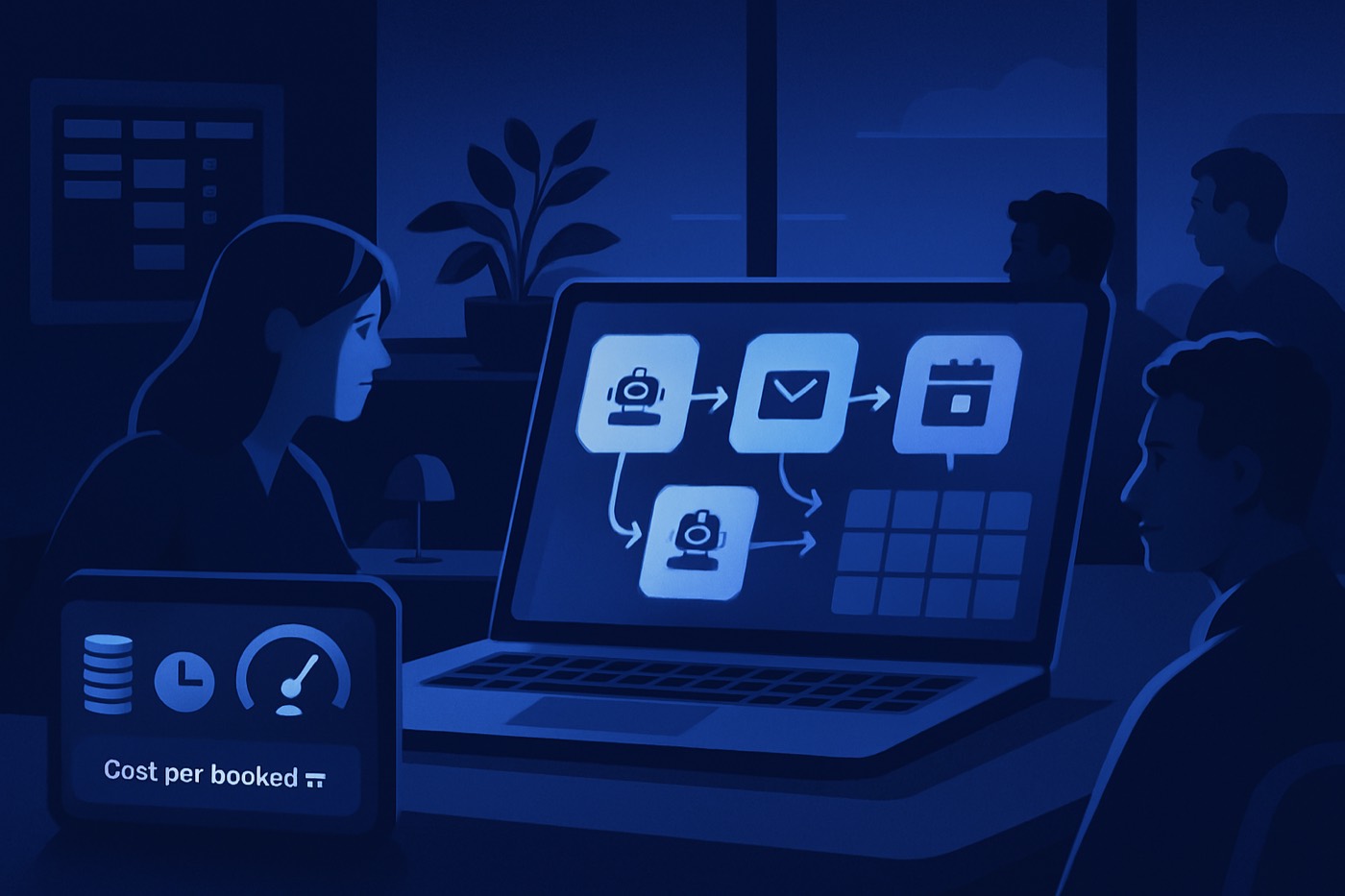
Salesforce made "agentic CRM" the default enterprise story. Not a feature. Not a tab. The operating model.
Agentforce is Salesforce planting a flag: agents sit on top of the CRM, read context, take actions, and run work across sales, service, marketing, and ops. That shift matters more than any single capability, because Salesforce has the distribution to turn its narrative into the market's expectations. (investor.salesforce.com)
The useful question for a small team is not "should we buy Agentforce." It is "what does this signal, and how do we copy the good part without paying the enterprise tax." This post answers both: the plain-English meaning, where SMBs get burned, and a 30-day playbook with three workflows, three guardrails, and one metric that ends the arguments.
What Agentforce means for an SMB, in plain English
Agentforce turns the CRM into a place where software agents do work, not just store records.
In Salesforce's own framing, that includes:
- answering questions grounded in business data
- taking actions across Salesforce apps
- running out-of-the-box agents for sales, service, marketing, and commerce
- operating inside surfaces like Sales Cloud and Slack (salesforce.com)
Salesforce also folded the branding: Einstein Copilot became Agentforce in the product narrative and release notes. That is not cosmetic. It is Salesforce saying, "stop asking for copilots, ask for agents." (help.salesforce.com)
Why it matters even if you never buy Salesforce
Because Salesforce normalizes a set of expectations for everyone:
- outbound runs in systems, not spreadsheets
- agents execute workflows, instead of a person clicking through them
- AI earns budget when it touches pipeline, not when it writes a tidy summary
SMBs win when an enterprise vendor teaches the market what to demand. Then a smaller team buys a simpler, cheaper version that actually ships meetings.
One distinction to hold onto before we go further. Agentforce makes the CRM the place agents live. That is the right answer for a company whose center of gravity is a record database. A founder or small sales team has a different center of gravity: the meeting that didn't get booked yet. So the playbook below copies the operating model, not the suite.
The market signal: agents moved from feature to operating model
For a decade, a CRM sold two things:
- a database with workflows
- a per-seat tax for using it
Agentforce pushes a third thing into the default story: digital labor. Salesforce frames it as autonomous agents that connect to data and take actions across functions (investor.salesforce.com), and it is putting Slack in the middle so agents show up where work happens, not where admins live. (itpro.com)
The quiet consequence: once agents do the work, buyers stop comparing CRM feature lists and start comparing how much work gets done per dollar. That is good for operators and awkward for any vendor whose business still runs on selling seats.
Where SMBs get burned: the enterprise tax, now with agents
Agentic CRM sounds simple until the invoice lands.
1) Per-seat pricing stacks fast
Salesforce has several Agentforce pricing constructs: per-user licenses, add-ons, and consumption credits. Its pricing page has shown an Agentforce user license (with examples around $5 per user per month) and Flex Credits (for example, $500 per 100,000 credits), alongside earlier per-conversation pricing depending on the model and availability. (salesforce.com)
SMB failure mode: you buy "agentic CRM," then ration usage because every seat is a line item.
2) Add-ons and bundles create budget fog
Salesforce's flexible-pricing announcements lean on new licenses and add-ons designed to spread Agentforce across more employees. (salesforce.com) Not evil. Just enterprise.
SMB failure mode: your CRM turns into a procurement project before it books a single meeting.
3) Integration overhead eats the gains
Agents only work when they can read clean data, write back to the system of record, and trigger actions across tools. In the Salesforce world that usually means more moving pieces (Slack, Data Cloud, MuleSoft, industry clouds), and Salesforce markets the integration across that ecosystem as a selling point. (salesforce.com)
SMB failure mode: you pay for services hours to connect tools you never wanted.
4) Governance theater replaces results
Everyone says "trust." Few teams ship controls that actually prevent damage. Gartner has been blunt that a large share of agentic AI projects are at risk of being scrapped over escalating costs, unclear value, and weak risk controls. (techradar.com)
SMB failure mode: you drown in policy decks while the pipeline stays empty.
The SMB playbook: copy the operating model, skip the suite
Copy this from Salesforce's direction:
- agents running workflows end to end
- decisions grounded in your real data, not generic text
- actions tied to outcomes, not activity
Skip this:
- seat-based expansion math
- add-on sprawl
- consultant dependency
- AI-strategy decks
Now the tactical part.
Three workflows that book meetings in 30 days
These are not "AI for productivity." They are pipeline workflows. Build them, ship them, measure them.
1) ICP build (stop guessing who to target)
Outcome: tighter lists, higher reply rate, fewer spam complaints, more booked meetings.
What the agent does:
- pulls your closed-won customers
- finds the patterns (industry, headcount, tech stack, triggers)
- outputs an ICP spec you can prospect against
- updates it as replies and meetings come back
What to do this week:
- Define two ICPs, one primary and one secondary, no more.
- Write ten disqualifiers and have the agent enforce them.
- Require a "why this account" reason for every target segment.
In Chronic this starts with the ICP Builder, which keeps targeting tied to pipeline instead of vibes.
Trade-off: a tighter ICP means fewer leads. That is the point. Inbox placement punishes sloppy targeting, so read the Cold Email Infrastructure Checklist for 2026 and stop treating sending volume like a strategy.
2) Enrichment (incomplete leads do not book meetings)
Outcome: higher connect rate, better personalization, fewer dead records.
What the agent does:
- fills missing firmographics
- appends contacts and phone numbers
- detects technographics
- flags bad fits before they hit a sequence
Salesforce frames Agentforce as grounded in trusted, connected data, and the principle is the same here: an agent is only as good as the context you feed it. (salesforce.com) In Chronic this maps to Lead Enrichment plus AI Lead Scoring, so enrichment turns into prioritization rather than a data-hoarding hobby.
30-day execution:
- Week 1: enrich your last 500 outbound targets, mark bounces and bad fits
- Week 2: add technographic filters tied to your pitch
- Week 3: route high-fit, high-intent accounts to the fastest sequence
- Week 4: cut the bottom 30% of the list, even if it stings
For the deeper take, read Cold Email Deliverability in 2026 Is a Targeting Problem.
3) Outbound (end to end, until the meeting is booked)
Outcome: meetings booked without a rep babysitting a sequence tool.
What the agent does:
- writes personalized email per account
- runs the multi-step sequence
- routes replies
- pushes qualified prospects to a booked meeting
This is where an agent either prints pipeline or becomes an expensive demo. Chronic's lane is blunt: pipeline on autopilot. The system runs outbound end to end, until the meeting is on the calendar.
- AI Email Writer generates messages tied to your ICP and enrichment context.
- Sales Pipeline keeps the work connected instead of scattered across five tools.
Also read The Outbound Stack Is Collapsing: From Sequences to Systems. Sequence tools send emails. Systems book meetings.
A simple five-touch frame:
- Day 1: the problem, plus one proof point
- Day 3: a short question tied to their tech stack or a trigger
- Day 6: a two-line case snippet
- Day 9: a direct breakup email
- Day 12: a new angle, same ask
Every step needs a stop condition, which brings us to guardrails.
Three guardrails that matter (not compliance cosplay)
Agents fail three ways: they run too long, they act too freely, and they leave no trace. Fix those.
1) Stop rules
Stop rules keep an agent from spamming, looping, or "being proactive" in the worst way. The minimum set:
- stop after a positive reply
- stop after an opt-out
- stop after a meeting is booked
- stop after N touches with no engagement
- stop if enrichment confidence drops below a threshold
If you cannot explain your stop rules in 30 seconds, you do not have stop rules. You have hope.
2) Approval thresholds
Not everything needs approval. High-risk actions do. Set thresholds like:
- Auto-send when fit score is high, intent is solid, and personalization confidence is high
- Require approval for regulated industries, sensitive keywords, competitor mentions, or pricing claims
- Block when unsubscribe language or a business address is missing, or domain health is flagged
This is how you avoid the classic SMB disaster: an agent sends 2,000 emails with the wrong merge field and your domain dies on a Tuesday. For the QA mindset, read Agent QA for RevOps: The Test Suite Your AI SDR Needs.
3) Audit log
Every agent action needs a timestamp, a snapshot of the input context, the generated output, the action taken (sent email, updated field, booked meeting), a reason code, and who approved it if approval was required.
Without an audit log you cannot debug performance, prove compliance, or explain a mistake. You can only argue.
The one metric that ends the hype: cost per booked meeting
Everything else is entertainment. Track three numbers:
- total outbound cost (tools, data, domains, time)
- meetings booked (qualified, not "someone clicked a calendar link")
- cost per booked meeting, which is total cost divided by booked meetings
This metric wins because it makes per-seat pricing visible, exposes integration bloat, and forces agents to earn their compute. For the full template, read Cost per Meeting Is the Only Outbound Metric That Survives Budget Season.
A benchmark frame for SMBs: pick a number that makes sense next to your ACV. If your ACV is $12,000 and you close 20% of meetings, the expected value of a meeting is about $2,400. At that math, $300 per booked meeting works comfortably and $900 had better come with unusually high conversion. No magic, just arithmetic that ends the debate.
A 14-day rollout
Days 1-3, define the target and the metric: lock ICP v1, set a cost-per-booked-meeting baseline, and write your meeting qualification rules (title, company size, pain).
Days 4-7, build the workflow: the enrichment pipeline, the fit-plus-intent scoring, the sequence steps, and the stop rules.
Days 8-10, add approvals where it counts: regulated industries, high-risk claims, and any new domains still warming up.
Days 11-14, ship, measure, cut: launch to 200 to 500 accounts, cut the weak segments fast, and reroute budget to whatever books meetings.
If you want "show up in AI answers" as part of the same loop, read AI Buyer Research Is Eating Your Funnel.
Where Chronic fits, and where Salesforce fits
Salesforce is built for enterprise reality: complex org charts, large data estates, heavy governance, and the services budget to run it all. Agentforce is consistent with that world, and it carries enterprise packaging and pricing dynamics even with the newer pricing options. (salesforce.com)
Chronic is built for the other reality: a small team, limited ops bandwidth, no appetite for tool sprawl, and one goal, which is meetings booked. Chronic is not a cheaper CRM. It is an autonomous revenue operator. You give it a goal and it runs discovery, enrichment, outreach, reply handling, and booking, and surfaces only the approvals that matter.
The one-line contrast:
- Enterprise suites sell seats and services.
- Chronic books meetings. $99. Unlimited seats.
If you are weighing your options, here is the straight path:
- Chronic vs Salesforce for the "do we really want the enterprise stack" question
- Chronic vs HubSpot if you already live in HubSpot and want autonomous outbound on top
- Chronic vs Apollo if your current system is a lead database plus sequences
Clay is worth a mention as the other extreme: powerful, flexible, and complex. If you want the cost mechanics there, read Clay's New Pricing Model Explained.
FAQ
What does Agentforce mean for an SMB, specifically?
It means Salesforce wants smaller businesses to expect agents inside CRM workflows, not just a database plus a chatbot. Agentforce is positioned as autonomous agents that take actions across Salesforce apps, grounded in business data. (salesforce.com)
Is Agentforce just a rebrand of Einstein Copilot?
Salesforce renamed Einstein Copilot to Agentforce in its release notes and product surfaces. The bigger shift is the positioning, from copilot assistance to agent autonomy. (help.salesforce.com)
What is the biggest way SMBs overspend on agentic CRM?
They pay for seats, add-ons, and integrations before they have a working pipeline loop. Then they measure activity instead of cost per booked meeting, so the spend never gets challenged.
Which three workflows should an SMB deploy first?
ICP build, enrichment, and outbound with stop rules. Those three create meetings inside 30 days when you keep the workflow tight and the list disciplined.
What guardrails actually matter for AI agents in outbound?
Stop rules, approval thresholds, and an audit log. Skip those and you will eventually spam someone important, break compliance, or fail to debug what went wrong.
How do we know if the agents are working?
Cost per booked meeting drops over time while meeting quality holds or improves. If that number does not move, the agents are theater.
Run the play, not the procurement cycle
Agentforce made one thing clear: agents are now the default CRM narrative. Fine. The SMB move is to copy the operating model, deploy the three meeting-driving workflows, add the three guardrails that prevent chaos, and judge everything by cost per booked meeting. Then skip the enterprise tax.
Chronic runs outbound end to end, until the meeting is booked. Pipeline on autopilot. $99. Unlimited seats.