Agentic AI governance for revenue work: the buyer checklist (permissions, ROI, guardrails)
Before you let an AI agent act on your pipeline, require five things: a scoped identity, approval gates for anything customer-facing, full audit logs, observability metrics, and a runbook. Buy on governance and outcomes, not demos.
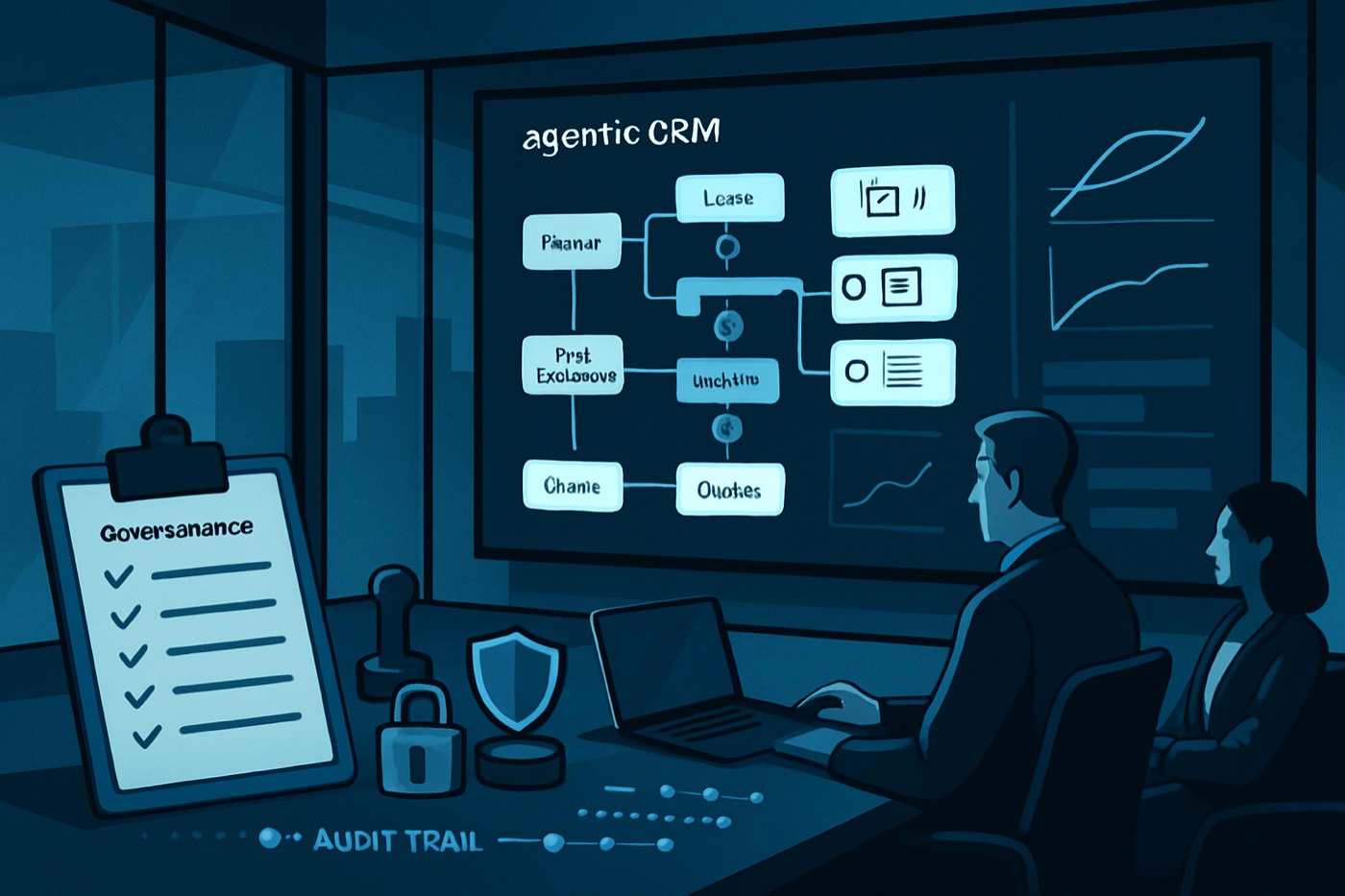
Budget is moving from "AI experiments" to "AI execution," and revenue work is one of the first places that shift gets real. In Salesforce's 2026 CIO research, full AI implementation jumped from 11% to 42% since 2024, and leaders reported dedicating 30% of their AI budget to agentic AI. (salesforce.com) That is not a tooling decision. It is an operating-model decision: you are about to let software take actions that used to require a person.
The question that follows is not "which AI feature do I add to my CRM?" It is "what controls do I need before an autonomous agent touches my prospects, my domains, and my pipeline data?" This is the checklist for that decision.
A quick framing note. The most useful version of this technology is not a smarter CRM. It is an autonomous operator that works across your stack: it finds prospects, drafts and sends outreach from warmed mailboxes, handles replies, books meetings, and writes the results back to your CRM, surfacing approvals for the decisions that matter. Chronic is built that way. The CRM stays the system of record. The agent does the work. Governance is what keeps that delegation safe, and it is the same whether the agent lives inside a CRM or alongside it.
What this checklist gives you
- A procurement-ready scorecard for governing an autonomous revenue agent: permissions, approvals, auditability, and data boundaries.
- A measurable ROI model that ties time saved to meetings, pipeline, and revenue.
- A RevOps agent runbook template: how the agent should behave, escalate, and prove why it did what it did.
- A 30-60-90 day rollout plan for B2B SaaS and agencies.
- Common failure modes (hallucinations, bad routing, compliance drift) and how to prevent them.
The shift: implementation, not pilots
The important change is not that companies want AI agents. It is that buyers want implementation, not pilots, and they want controls that look like enterprise software controls, not "prompt best practices."
Three signals stand out:
- Budgets are explicitly shifting to agents. Salesforce reports leaders allocating 30% of their AI budget to agentic AI, and 96% say their company uses or plans to use agentic AI within two years. (salesforce.com)
- Governance is the bottleneck. Salesforce also reports only 23% of CIOs are completely confident they are investing in AI with built-in data governance. (salesforce.com)
- Scale keeps stalling because of security and observability gaps. Dynatrace's agentic AI pulse report shows observability adoption is highest during implementation (69%). (dynatrace.com) Industry coverage of the same theme finds security and compliance among the biggest blockers to scaling. (itpro.com)
The practical reading for revenue leaders: if your agent (or the vendor providing it) cannot show enforceable boundaries, traceability, and measurable outcomes, the project will not clear a budget review.
What "implementation, not pilots" actually means
A pilot usually looks like:
- Two reps using an AI email writer.
- A bot that answers "who owns this account?"
- One-off enrichment scripts with no audit trail.
Implementation looks like:
- Production workflows with defined scope, owners, and controls.
- A non-human identity with permissions that map to a business role.
- Repeatability across teams (Sales, CS, RevOps) without re-architecting each time.
- Provable impact that survives finance scrutiny.
If you want the project funded, design the rollout so it can pass an audit and a budget review, not just a demo.
Define the terms (so the eval stops talking past itself)
Skip definitions and you will buy the wrong thing or govern it incorrectly.
- Assistant: suggests content or insights, but does not execute actions in your systems.
- Automation: executes a predefined workflow (if X then Y) with limited variation.
- Agent (agentic AI): plans and completes multi-step work, can choose tools, and can act with partial autonomy.
For a clean taxonomy and to avoid "agentwashing," use: Assistant vs. agent vs. automation: a clear definition guide (plus a buyer checklist to spot agentwashing).
The agent governance checklist
Use this as a scorecard. If you cannot check most boxes, you are not evaluating an autonomous operator. You are evaluating a content feature with a chat box.
1. Identity, permissions, and data boundaries (the "blast radius" layer)
The first governance question is not "how smart is the model?" It is "what can it touch?"
Minimum requirements:
- Agent identity: a distinct, revocable identity (service account) that shows "acting as" context per user or workflow.
- RBAC pass-through: actions inherit the relevant user's permissions where appropriate, not bypass them.
- Scoped credentials: separate credentials per tool (CRM, email, enrichment, calendar) with least privilege.
- Data segmentation: enforce boundaries by region (EU vs US), business unit, and customer tier where required.
- Write controls: granular create/update/delete controls and field-level restrictions (example: the agent can move a stage but cannot edit contract value).
Why this matters: OWASP calls out "excessive agency" as a top risk for LLM applications, meaning too much autonomy creates unintended consequences. (owasp.org)
Eval test: ask the agent to access a restricted field, watch it fail, and confirm it produces an audit event that explains the denial.
2. Approval loops and human sign-off (where a person must decide)
You do not want humans approving everything. You want humans approving the right things. A workable pattern is tiered autonomy:
Tier 0 (no autonomy): draft only
- Cold email drafts
- Call summaries
- Next-step suggestions
Tier 1 (bounded autonomy): execute within strict rules, no external impact
- Enrich a lead
- Tag an account
- Create tasks
- Route inbound leads on explicit rules
Tier 2 (approval required): any action with customer or revenue impact
- Sending email sequences
- Changing opportunity amount or close date
- Updating contract terms
- Creating discounts, quotes, or order forms
Tier 3 (restricted): never autonomous
- Deleting records
- Changing the owner of strategic accounts
- Editing legal or compliance fields
- Exporting lists
Eval test: ask to see the policy engine. Where do you define what requires approval, and can you do it per workflow, per segment, and per risk tier?
3. Audit logs, traceability, and "why this happened" evidence
For governance, if it is not logged, it did not happen.
Minimum audit log requirements:
- Who initiated (user, system, agent, workflow)
- What data was accessed (objects, fields, records)
- What tools were called (email provider, enrichment, calendar, dialer)
- What action was taken (create/update/send)
- When it happened (timestamps)
- Why it happened (reason codes, rule matches, model rationale summary)
- Outcome (success, failure, rollback, approval denied)
This aligns with the EU AI Act's emphasis on logging, traceability, and human oversight for certain AI systems. (digital-strategy.ec.europa.eu) Even if you sell US-only today, many B2B teams sell into the EU, and enterprise buyers will ask.
To go deeper on workflow-grade auditability, approvals, and logs, see: Agentic CRM workflows in 2026: audit trails, approvals, and "why this happened" logs (a practical playbook).
4. Model risk: hallucinations, bad routing, and silent failure
The real worry is not "the AI made a typo." It is "the AI quietly did the wrong thing at scale."
The three common failure classes:
- Hallucinated facts
- Inventing technographics, intent, or buying signals
- Assuming a persona or pain point without data
- Bad routing
- Wrong territory, segment, or owner
- Wrong SLA priority (a hot lead treated as cold)
- Compliance drift
- Unapproved claims in outbound email
- Missing required disclosures
- Contacting suppressed or do-not-contact records
Controls that actually work:
- No-invention policies: require a source from enrichment before a claim appears in an email or a field.
- Deterministic routing: rules first, model second. The model can suggest; rules decide.
- Guardrail prompts plus validation: treat model output as untrusted until validated.
- Canary releases: roll out to 5% of leads, then 25%, then 100%, with monitoring gates at each step.
OWASP's LLM Top 10 is a good baseline for aligning security and RevOps on real risk categories (prompt injection, sensitive data disclosure, excessive agency). (owasp.org) For broader structure, map your program to the NIST AI Risk Management Framework and its Generative AI Profile. (nist.gov)
5. Observability and evaluation (agent performance is not "uptime")
Buyers fund what they can measure. For an agent, "emails sent" or "tasks created" is not enough.
Your evaluation stack should include:
- Task success rate: share of runs that complete without human rework
- Tool-call accuracy: correct API calls, parameters, and objects
- Escalation rate: how often the agent hands off to a human, and why
- Policy violation rate: attempts to access restricted data or send to suppressed contacts
- Cost per outcome: tokens plus enrichment plus email volume per meeting booked
- Latency: time-to-complete for research, list building, and follow-up creation
Dynatrace frames observability as the layer that enables trust and scale across development, implementation, and operationalization. (dynatrace.com)
Eval test: ask to see dashboards for agent runs, a failure taxonomy, and reason codes, not just a chat transcript.
Measuring ROI: turn time saved into pipeline
Finance wants ROI that looks like finance, not vibes. Build a model that turns operational metrics into pipeline and revenue.
Step 1: pick the unit of value (per rep, per week)
Example: lead research, personalization, and follow-up logging. Track:
- Minutes saved per lead
- Leads touched per week
- Extra touches enabled
- Conversion deltas (reply rate, meeting rate, stage conversion)
Step 2: convert time saved into meetings and pipeline
- Hours saved/week = (minutes saved per lead x leads handled/week) / 60
- Extra touches/week = hours saved/week x touches/hour
- Extra meetings/week = extra touches/week x meeting conversion rate
- Extra pipeline/week = extra meetings/week x SQL-to-pipeline rate x average deal size
Then validate with cohort testing (agent vs control group).
For a calculator-ready structure, adapt: AI SDR agent ROI calculator: a simple model to turn hours saved into meetings and pipeline.
Step 3: report leading and lagging indicators
Leading (implementation):
- Adoption (weekly active users)
- Agent run success rate
- Human approval throughput time
- Data completeness improvement
Lagging (business):
- Meetings booked
- Pipeline created
- Win rate impact
- Sales cycle length
- Gross margin impact (for agencies: hours delivered vs hours sold)
A note on what to optimize for: it is easy to chase emails sent and open rates because they move fast. They also reward volume that can burn your domains and your brand. The metric that matters is qualified meetings held with the right prospects, with your reputation intact. Report that, and the rollout earns its budget.
The RevOps agent runbook (the document most rollouts skip)
If the mandate is implementation, the mandate is also operational ownership. The runbook is how an autonomous system stays governable.
A good agent runbook contains:
1. Purpose and scope
- What the agent is allowed to do
- What it is not allowed to do
- Which teams it serves (SDR, AE, AM, RevOps)
2. Inputs and system boundaries
- Source systems (CRM, product analytics, data warehouse, email)
- Allowed objects and fields
- Data retention and masking rules
3. Decision policy
- Routing rules
- Scoring thresholds
- Escalation triggers
- Approval requirements by tier
4. Failure handling
- What happens on partial failure (example: an enrichment API is down)
- Rollback rules for CRM updates
- Incident severity levels (SEV1: emails sent to the wrong segment)
5. Audit and evidence
- What gets logged
- Where logs live
- How long logs are retained
- How to produce evidence for a customer security review
6. Change management
- Who can change prompts, rules, or tools
- How changes are tested
- Versioning and release notes
- Recalibration cadence
For teams adding conversational access to the CRM (which often becomes the front door to agentic work), pair this with: Salesforce put CRM in ChatGPT. Here's the playbook for conversational CRM without losing data governance.
30-60-90 day rollout plan (B2B SaaS and agencies)
This assumes you are running agentic workflows across your stack, not just adding an AI writing tool.
Day 0-30: pick two workflows, define guardrails, ship to a small cohort
Outcomes to target (choose two):
B2B SaaS:
- Inbound lead triage, routing, and first-touch email draft
- Pipeline hygiene: next-step capture and stage-exit validation
Agencies and consultants:
- Lead enrichment and account-brief generation
- Proposal follow-up sequencing with approval gates
Governance to implement first:
- Service accounts and RBAC pass-through
- Tiered autonomy (draft vs execute)
- Approval queues for anything outbound
- Audit logs for every write and send
Measurement baseline:
- Current time per lead touched
- Current meeting rate by segment
- Current routing error rate (wrong owner, wrong segment)
- Current compliance incidents (if any)
Deliverable: a one-page runbook per workflow and an initial dashboard.
Day 31-60: expand scope, add observability, harden controls
Scale targets:
- 25% of the SDR team
- One region or one segment
- One agency pod
Add controls:
- No-invention validation rules (a source is required)
- Suppression-list enforcement for outbound
- Canary release and rollback for prompt or policy changes
- An incident response playbook for agent-caused issues
Add deeper metrics:
- Agent run success rate by workflow step
- Human rework time
- Approval cycle time
- Policy violation attempts
Deliverable: a monthly governance review with a security or finance stakeholder, even if informal.
Day 61-90: roll out to the majority, connect to revenue reporting, set the cadence
Scale targets:
- 70-90% of the team for the proven workflows
- Expand from two workflows to four to six
Tie to business outcomes:
- Pipeline created per rep
- Meetings booked per segment
- Sales cycle time and stage conversion
- For agencies: billable utilization and margin
Operationalize:
- Quarterly access reviews (agent identities included)
- Prompt and policy versioning
- Vendor SLA checks (enrichment, email, CRM APIs)
- An ongoing evaluation suite (golden datasets for routing and messaging)
Deliverable: clear program ownership in RevOps with a standing change-review process.
Common failure modes (and how to prevent them)
1. "We bought an agent, but it is just a chatbot"
Cause: no tool access, no workflows, no write permissions. Prevention: evaluate by workflow outcomes and controls, not UI. Require tool-call demos and audit logs.
2. The agent spams and burns deliverability
Cause: autonomy to send without approval, weak suppression enforcement, no deliverability governance. Prevention: approval gates for new sequences, domain warmup policies, deliverability dashboards. An autonomous operator that owns its own warmed infrastructure can enforce these by default rather than hoping a rep does. Useful reading: Cold email deliverability engineering: SPF, DKIM, DMARC, list-unsubscribe, and monitoring (2026 setup guide).
3. Bad routing quietly destroys speed-to-lead
Cause: model-driven routing without deterministic constraints, or unclear territories. Prevention: rules-first routing, the model as a suggestion layer, a weekly audit of misroutes, and a routing golden-set test suite.
4. The agent changes CRM data and nobody trusts the CRM anymore
Cause: no field-level controls, no explanations, no rollback. Prevention: restrict writes, require reason codes, and keep a revert path for each workflow step.
5. A security review kills the rollout late
Cause: governance bolted on after workflows ship. Prevention: start with least privilege, logging, and documented runbooks in the first 30 days. Use NIST AI RMF concepts to structure controls. (nist.gov)
The questions to ask before you buy (copy and paste)
Use these in vendor eval and internal architecture review.
- Identity and access
- How does the agent authenticate to each system?
- Does it support RBAC pass-through and least privilege?
- Can I restrict by object, field, segment, and region?
- Approvals and autonomy
- What actions require approval by default?
- Can I configure approval loops per workflow and risk tier?
- Can I enforce draft-only mode?
- Auditability
- Do I get a complete log of reads, writes, sends, and tool calls?
- Can I export logs to my SIEM or data warehouse?
- Can I explain why an action occurred in a way sales ops can understand?
- Safety and security
- How do you mitigate prompt injection and sensitive data disclosure?
- What prevents excessive agency and unintended actions? (Ask them to address OWASP LLM08 explicitly.) (owasp.org)
- Measurement
- What is your native ROI reporting?
- Can I attribute time saved to pipeline outcomes?
- Do you support cohort tests and holdouts?
- Operational ownership
- Who owns failures, and what is the incident process?
- How are prompts, tools, and policies versioned?
- What does rollback look like?
Build your buying motion around governable autonomy
Budget is showing up, but it is conditional. Autonomy has to be bounded, measurable, and auditable.
To get a project funded and keep it alive through rollout:
- Treat agent governance as a first-class requirement, not a security afterthought.
- Ship two workflows in 30 days with tight guardrails.
- Prove ROI with a defensible pipeline model.
- Maintain an agent runbook like you would any production service.
FAQ
What is agent governance for revenue work?
It is the set of controls that make an AI revenue agent safe and auditable in production: identity and access management, permission boundaries, approval loops, audit logs, observability metrics, and change management for prompts and policies. The agent does the outbound and pipeline work; governance is what keeps it bounded.
What does "implementation, not pilots" mean for revenue teams?
It means buyers expect production workflows with defined owners, measurable outcomes, and enforceable controls, not isolated experiments. Salesforce's 2026 CIO research reports full AI implementation rose from 11% in 2024 to 42%, with 30% of AI budget going to agentic AI. (salesforce.com)
What controls are non-negotiable before an AI agent can update CRM records?
At minimum: least-privilege access, RBAC pass-through where possible, field-level write restrictions, approval loops for high-impact changes, and full audit logs of reads and writes with reason codes.
How do you measure ROI for an AI revenue agent without guessing?
Measure minutes saved per workflow step, then convert that time into additional touches, meetings, and pipeline using your historical conversion rates. Validate with holdout cohorts (agent group vs control) and report pipeline impact, not just productivity.
What are the biggest risks of an autonomous revenue agent?
Hallucinated facts in outbound messaging, bad routing that damages speed-to-lead, compliance drift (messaging or suppression violations), and silent failures where the agent does the wrong thing at scale. OWASP flags "excessive agency" as a key LLM risk category. (owasp.org)
What should be in a RevOps agent runbook?
Scope, system boundaries, decision policies, approval requirements, escalation and failure handling, audit and retention requirements, and a change-management process with versioning, testing, and rollback. Write it so RevOps and Security can both sign off.
Put this checklist into your next buying cycle
Use the checklist as your scorecard, then run a 30-60-90 day rollout with two workflows, strict approval gates, and audit-first implementation. For a fast alignment step before you evaluate vendors, standardize definitions and learn to spot agentwashing first: Assistant vs. agent vs. automation: a clear definition guide (plus a buyer checklist to spot agentwashing).