Agentic CRM, honestly: where the agent stops suggesting and starts doing the work
An "agentic CRM" adds an AI agent onto a system of record so it can act, not just draft. The bigger shift is an autonomous operator that runs the outbound itself, end to end, and books meetings under guardrails.
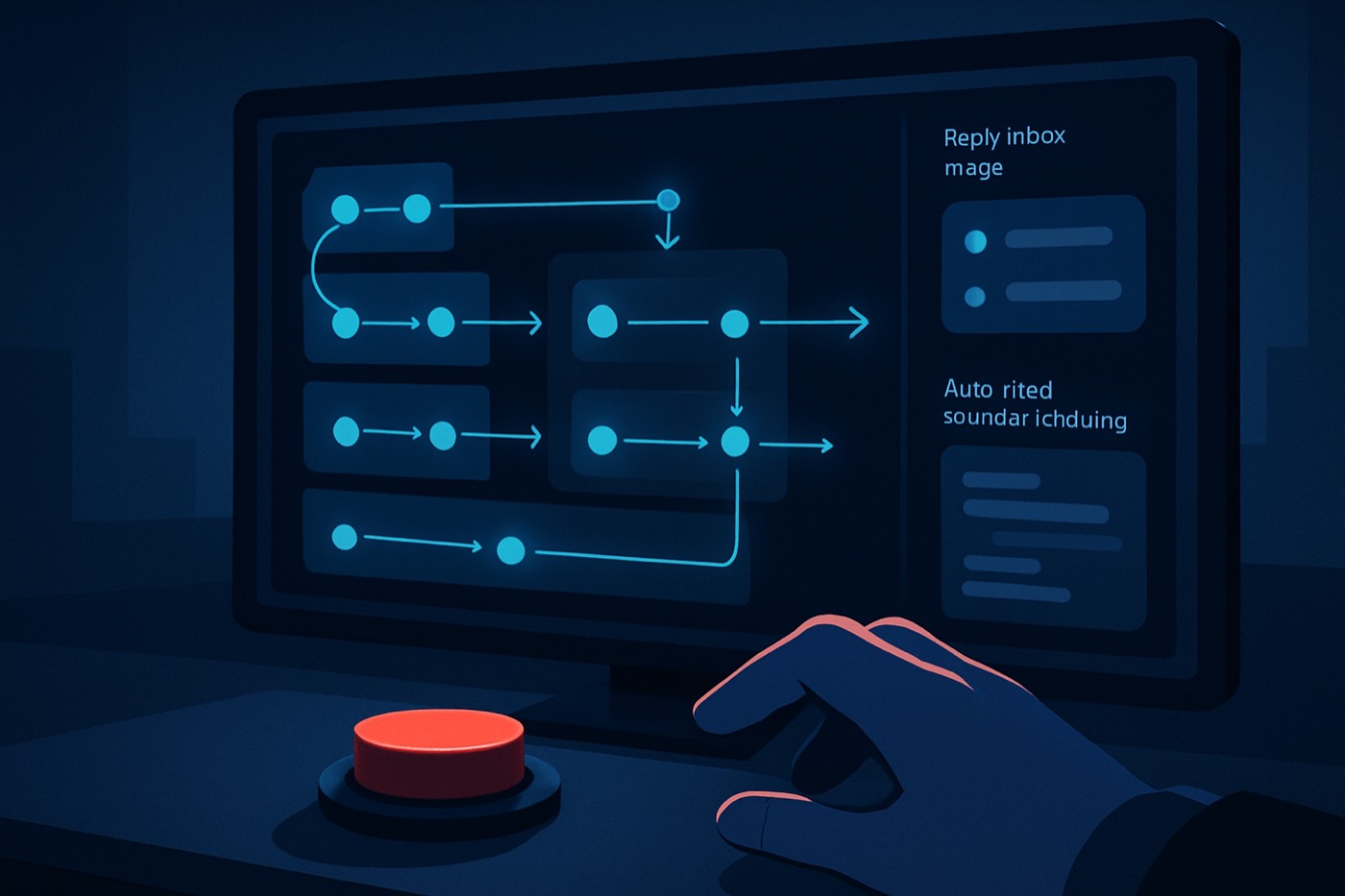
Copilots had a real run. They suggested. They summarized. They drafted emails that often never got sent. The harder question buyers started asking is the only one that pays the bills: did it book the meeting?
That is the shift everyone is circling: from assistants that talk to systems that act. The label most CRM vendors are using for it is "agentic." It is worth being precise about what that does and does not mean, because the gap between a chat sidebar and software that actually runs your pipeline is enormous.
What vendors mean when they say "agentic"
The market stopped selling "AI that drafts" and started selling "AI that completes." Salesforce planted a flag with Agentforce and pushed it further with Agentforce 2.0 and its agentic enterprise messaging. (salesforce.com)
Microsoft makes the same argument in plainer terms: agents that scale need governance, security, and operations, not just better prompts. (microsoft.com)
Oracle has joined in with proactive enterprise agents of its own. (itpro.com)
And Gartner has put numbers on the trajectory: it predicts 40% of enterprise apps will include task-specific AI agents by the end of 2026, up from under 5% in 2025. (gartner.com)
The reason the framing changed is that copilots hit a ceiling. They depend on a human to act on every suggestion. Humans forget, get busy, and deprioritize. Pipeline dies quietly in the gap. An agent that can actually take the next step closes that gap, as long as it runs under rules.
"Agentic CRM" is a layer, not a worker
Here is the distinction that matters once you get past the slide deck. A CRM is a system of record: it stores accounts, contacts, deals, and activity. An "agentic CRM" bolts an agent on top of that record so it can read and write to it and trigger some actions, instead of only answering questions.
That is genuinely useful, but notice what it is: the agent is a feature inside a system whose job is still to remember things. The work of generating pipeline still depends heavily on the seat-holder who logs in, builds the list, writes the messages, and chases the follow-ups.
Chronic is built the other way around. It is not a CRM with an agent feature. It is an autonomous revenue operator: you give it a goal, an offer, an ICP, and the level of approval you want, and it runs the outbound motion itself. It finds the right accounts, writes and sends cold email from managed, warmed mailboxes, handles the replies, and books the meetings, surfacing only the decisions that actually need you. The record-keeping is a byproduct of the work, not the product.
So when you read "agentic," it is worth asking which one you are looking at: an agent that helps you operate a CRM, or an operator that does the outbound and keeps you out of the weeds.
What "acting" actually requires
Whether it lives inside a CRM or runs as a standalone operator, software only earns the word "agentic" if it can do four things:
- Decide what to do next, based on context and scoring, not a fixed if-this-then-that recipe.
- Act across tools: email, calendar, enrichment, routing, sequences.
- Recover when it hits an edge case, by handing off, retrying, or escalating.
- Prove what it did, with an audit trail of what it saw, why it chose, and what happened.
If it cannot take action and account for that action, it is a copilot in an agent costume. A chatbot in a sidebar, a writing assistant with a Send button, and a prompt box that generates call scripts are all still suggestion layers. They wait for you.
What an operator can own today
If you want the honest version of "let the agent do the work," start with the tasks that are repetitive, measurable, and low-judgment. These are the parts of outbound that should already be running without a human babysitting them.
Prospecting: ICP to live lead pool
The operator builds and refreshes lead lists from your ICP definition, updates accounts when firmographics change, and surfaces newly relevant accounts on signals. Nobody should spend Monday mornings exporting CSVs. Chronic does this with ICP Builder and Lead Enrichment, so the output is a live prospect pool instead of a stale spreadsheet.
Fit and intent scoring
It scores fit (industry, size, tech, geography, buyer role) and intent (hiring, funding, tooling changes, engagement), then prioritizes by the combined score and your suppression rules. The point of AI Lead Scoring is not a vanity number: it is touching fewer wrong people and more right ones.
Routing
Routing by territory, vertical, round-robin, or account ownership, with conflict rules so two reps never hit the same account, plus dedupe and clean merges. Routing is plumbing, and plumbing is exactly what software should run.
Follow-ups that never drop
Multi-step sequences that pause, resume, or stop based on replies and risk signals, and that change the next step when context changes. If you rely on a person to remember to follow up, you have chosen a leak. Chronic owns this end to end in Sales Pipeline, through to the booked meeting.
Reply handling
Classifying replies (positive, objection, not now, wrong person, unsubscribe, angry), drafting and sending responses inside guardrails, and escalating when the stakes are high. Most "AI SDR" tools stop at drafting a reply, which is copilot behavior. The value shows up when the operator moves the conversation forward on its own for the low-risk cases. For the tactical side, the structure in The positive reply playbook is worth borrowing.
Scheduling
Offering times, handling timezone friction, confirming attendees, sending the invite, and rescheduling when the prospect inevitably moves it. If the system cannot get to a calendar invite on its own, it is content, not an operator.
What stays with you
Delegation is not abdication. The operator runs execution; you keep the high-judgment moves:
- ICP ownership. Not a fantasy TAM slide, the real "we close these people" definition, including exclusions.
- Offer and positioning. Software cannot fix a weak offer. It can only distribute it faster.
- Message strategy. Core narrative, proof points, disqualifiers, pricing posture.
- Edge-case judgment. Regulated industries, sensitive accounts, executive outreach.
- Discovery and closing. The meeting matters because the close matters.
The operator produces pipeline. You convert it. That division is the whole game.
The guardrails, because this is where it goes wrong fast
Software sending outbound on your behalf is powerful, and it is also how you burn domains, collect spam complaints, and get blocked across an org in a week. Guardrails are the difference between a competent operator and a liability.
Deliverability
Google and Yahoo rolled out bulk sender requirements starting in 2024, including authentication and keeping spam complaint rates under 0.3%, with 0.1% as the safer target. (blog.postmaster.yahooinc.com) Independent deliverability research keeps repeating that line because it is the threshold you do not want to cross. (images.g2crowd.com)
So the operator needs hard policies: suppression that never emails competitors, customers, partners, prior unsubscribes, or do-not-contact lists; frequency caps per domain and per persona; relevance gates that only send when fit and intent clear a threshold; and auto-stop rules that pause the workspace if complaints spike. Relevance is doing more of the work than DNS now. DNS still matters, but relevance is what decides whether someone hits "spam." The case is in Cold email deliverability: relevance beats DNS now.
Brand voice
The operator follows a painfully specific style guide: no fake familiarity, no invented details, no "I loved your recent post" unless it can cite the post, no pressure language that triggers reports, and no personalization beyond what it can verify. For personalization that does not read like a bot, use tiering, which Personalization tiers: level 0 to level 4 lays out as a ladder.
Compliance and data access
Agentic workflows widen data access, and that is fine until it is not. Copilot-style tools have already raised data governance concerns inside real organizations, so "the agent has access" should be treated like production credentials, not a setting. Minimum guardrails: least privilege (only the fields it needs), redaction of sensitive fields in generated output, audit logs of what it saw and did, and approval gates before the first touch on enterprise accounts. Microsoft's own framing for scaling agents calls out governance and operations as first-class requirements, not afterthoughts. (microsoft.com)
A framework you can put in front of RevOps
Split the work into three columns and the arguments mostly end.
Tasks the operator owns now. Start with outbound meeting booking, because it is measurable: list building from ICP, enrichment and contact selection, fit and intent scoring, sequence enrollment, first-touch sending inside templates, follow-ups, low-risk reply handling, scheduling, and CRM hygiene (logging, dedupe, status). Chronic covers the building blocks: ICP Builder, Lead Enrichment, AI Email Writer, AI Lead Scoring, and Sales Pipeline, through to the booked meeting.
Tasks you keep. ICP changes and exclusions, message architecture, offer creation, objection handling for high-stakes accounts, deal strategy, and discovery through close.
Guardrails you install before scaling volume. A deliverability gate with complaint and bounce thresholds tied to a kill switch; suppression for DNC, customers, partners, competitors, job seekers, and press; a content policy of forbidden claims and personalization limits; risk tiers (SMB and mid-market can run more autonomously, enterprise gets approvals); observability for sends, replies, complaint proxies, meeting rates, and domain health; and instant escalation of angry replies to a human.
A plan for SMBs and agencies: one motion at a time
You do not "roll out agentic CRM." You ship one motion and prove it.
Pick one motion: outbound meeting booking. It has a clear outcome, it exposes data-quality problems fast, and it forces deliverability discipline. If you cannot book meetings with one ICP on one channel, adding channels just multiplies the failure.
Lock one tight ICP. Industry, employee range, geography, tech stack if relevant, trigger signals, and dealbreakers (consultants, students, competitors). Then build it in ICP Builder.
Choose one channel. Email first, because it is the easiest to measure and iterate. Add LinkedIn next, then phone. Do not start with all three.
Install the kill switch before sending anything. Triggers: complaint-rate risk signals (watch Postmaster where you can), bounce spikes, a rise in angry replies, and a drop in inbox-placement proxies. Opens are unreliable; replies are the better signal. The operator should be brave; the controls should be ruthless.
Run a two-week pilot with hard numbers. New prospects contacted, positive reply rate, meeting booked rate, meetings held rate, cost per meeting (time plus tooling), and suppression catches (how many "saves" your guardrails made).
Expand one variable at a time. Same ICP plus one more message angle, then one more persona, then one more channel, then a second ICP. Agencies should clone the same motion per client, not build a snowflake workflow for each one. Snowflakes are how you become an expensive spreadsheet. For the "stop adding tools" argument you will eventually have with yourself, see The new outbound stack: why "one more tool" kills pipeline.
"Agentic washing" is everywhere
A large share of the market now says "agentic." Much of it is a sequence tool with an LLM copywriter, a CRM with a chat sidebar, or a workflow builder that still needs a human to run it. The litmus test is one sentence: can it own the loop until the meeting is booked, and can you shut it off instantly? If not, it is a copilot.
Where the alternatives fit
You can assemble an agent-ish stack from Apollo, HubSpot, Salesforce, Clay, Instantly, and a few automation tools. You will also get tool sprawl, broken attribution, competing sources of truth, and per-seat pricing that punishes growth.
Chronic runs the whole motion for one flat price with unlimited seats, end to end, through to the booked meeting. If you are comparing: Chronic vs Apollo for data plus outbound execution, Chronic vs HubSpot for CRM overhead and seat costs, and Chronic vs Salesforce for enterprise complexity and the four other tools it still assumes you have. Clay is powerful and complex. Instantly sends email. Chronic runs the operation.
FAQ
What is an agentic CRM in one sentence?
A CRM (a system of record) with an AI agent layer on top, so it can act on the data, route, follow up, and respond, rather than only answer questions.
How is that different from an autonomous revenue operator?
An agentic CRM is a record that can act. An autonomous operator like Chronic is built to do the outbound itself: find accounts, send from warmed mailboxes, handle replies, and book meetings, with the record as a byproduct rather than the product.
Are AI copilots useless now?
No. Copilots are still good at drafting and summarizing. They just do not move pipeline on their own, because a human has to act on every suggestion, which caps output.
What is the first workflow to hand off to an agent?
Outbound meeting booking. It is measurable, repeatable, and it forces you to build the guardrails that keep deliverability and brand intact.
What guardrails matter most for outbound agents?
Suppression lists, relevance gates (fit and intent thresholds), frequency caps, and a kill switch tied to complaint risk and bounce spikes. Google and Yahoo's bulk-sender rules made spam complaint rate a hard constraint; see the 0.3% threshold guidance. Yahoo Postmaster announcement
How do you keep an agent from damaging your brand voice?
Hard templates, forbidden phrases, and personalization tiers. Require a citation for any "I noticed X" claim, and route high-stakes accounts to human approval.
Should agencies run one agent per client or one shared system?
One shared system with per-client policies: same motion, same guardrails, separate domains and suppression. Agencies lose money when every client becomes a custom workflow snowflake.
Run the play
If you want the honest version of agentic outbound, stop shopping for "AI features" and ship execution: pick outbound meeting booking, define one tight ICP, run email only, install the kill switch, prove booked meetings in two weeks, then expand one variable at a time. Copilots can keep writing drafts. An operator books the meeting.