Salesforce made “agentic CRM” official. Here’s what buyers will demand next.
An agentic CRM runs sales work autonomously with approvals and audit trails, but it is still a database with an agent on top. Buyers will demand five jobs end to end: research, outreach, sequencing, reply handling, and booked meetings.
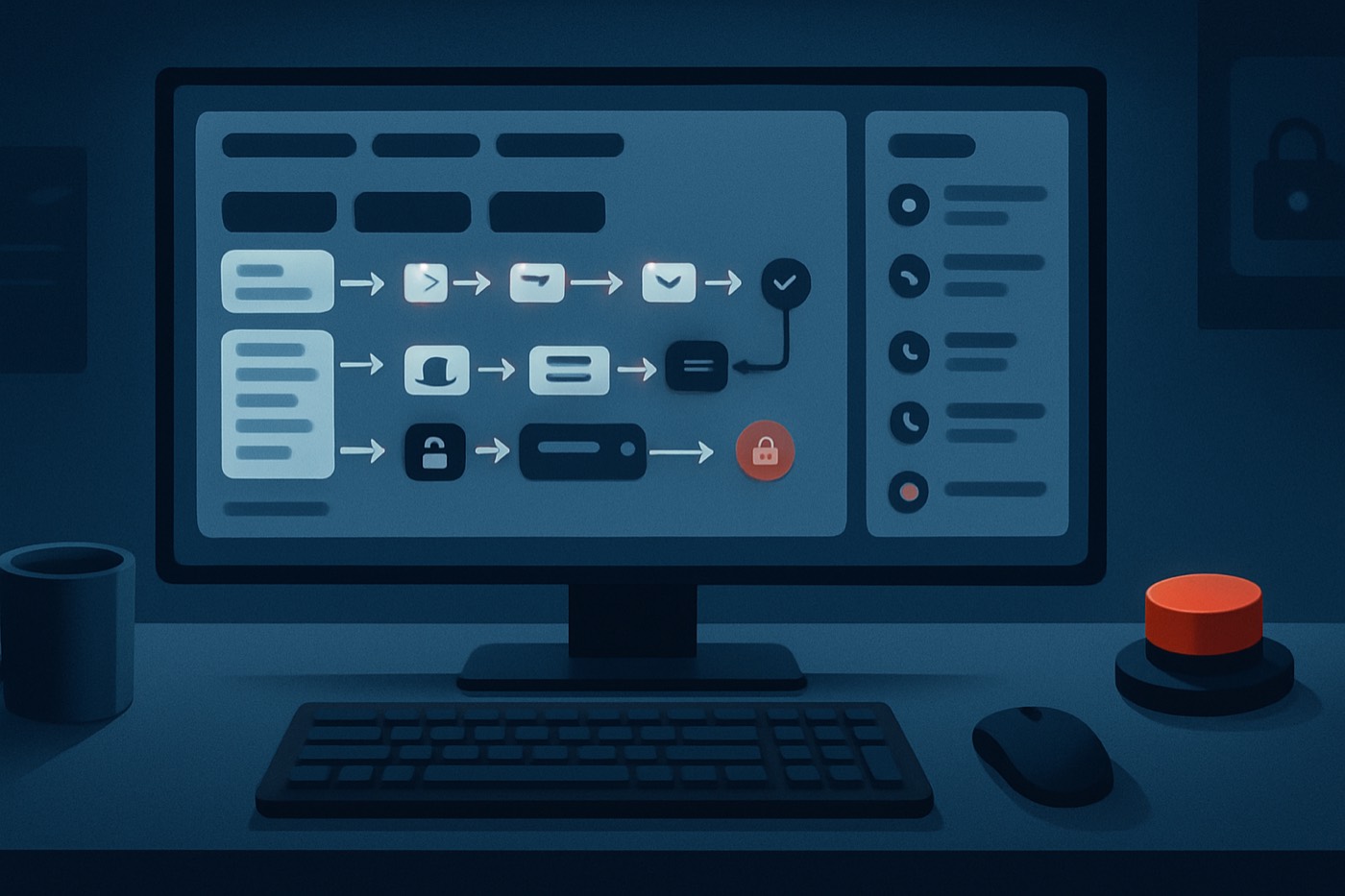
Salesforce has made it official: the CRM category is shifting from "AI that suggests" to "AI that does." Not in a cute demo. In production. With workflows. With governance. With the phrase they want every exec repeating in board meetings: agentic enterprise. (investor.salesforce.com)
That is the right read of where enterprise software is going. It is also where the wording gets slippery. "Agentic CRM" is a system of record that grew an agent. An autonomous revenue operator is a different thing: software built from the start to run outbound end to end and book meetings, not a database with a chat box bolted on. This post is about what buyers will actually demand once the marketing settles, and how to test for it.
What "agentic" really means, in plain English
Strip the branding and an agent is software that completes multi-step work on its own, using tools and data, and asks a human only when it hits a defined gate.
Not "summarize this account." Not "suggest an email." Not "draft a call script."
Agentic means:
- The software picks the next action.
- It runs the action.
- It records what happened.
- It stops when it should.
- A human can prove what it did and why.
Salesforce's direction lines up with that: agents that act directly inside business workflows, plus a trust layer that includes audit-trail concepts. (investor.salesforce.com)
Copilot vs agent (the mental model buyers will use)
Copilot
- Suggests next steps
- Drafts content
- Answers questions
- Lives in a sidebar
- Fails quietly, then you clean it up
Agent
- Executes the workflow end to end
- Moves stages, tasks, sequences
- Takes actions in systems, not just text output
- Logs every action
- Escalates with approvals
The bet across the industry is that "agentic" becomes the default expectation for business software within a few years. Analysts are projecting fast adoption, and a brutal cancellation rate for projects that skip governance. (itpro.com)
So yes, it is real. And yes, a lot of it will fail.
CRM with an agent is not the same as an operator that owns outbound
Here is the distinction that matters for a founder or a small sales team. A CRM, agentic or not, is built around a database and reporting. The agent is a layer on top, and you still bring the sending infrastructure, the enrichment, the deliverability work, the routing, and the people to wire it all together.
An autonomous revenue operator inverts that. The job is not "store records and surface insights." The job is "find the right accounts, write and send the outreach from warmed mailboxes, handle the replies, book the meeting, and protect the domains the whole time." The records are a byproduct of the work, not the point of it.
That is the lens for the rest of this checklist. When a vendor says "agentic CRM," the useful question is not "does it have an agent." It is "does the agent actually run outbound, or does it hand the hard parts back to me."
The five jobs that show up in every outbound eval now
No one buys software "for AI" anymore. They buy it for pipeline output. The evaluation turns into five non-negotiables.
1) It does the research (ICP, account, contact, triggers)
Buyers will demand:
- Automatic lead discovery against an ICP
- Enrichment that pulls firmographics, roles, tech stack, and contact data
- Trigger detection (hiring, funding, new tools, job posts, intent signals)
In a real operator this is not a separate workflow in a separate tool. It is native, traceable, and tied to scoring and sequencing.
How Chronic handles it:
- Find and qualify accounts against your ICP with AI prospecting
- Auto-enrich records via lead enrichment
The expectation is simple: "I wake up to new qualified accounts, already researched."
2) It drafts outreach that is specific, not "AI scented"
Buyers will demand:
- Message generation tied to enrichment fields and triggers
- Personalization that references proof points, not compliments
- Variant testing that does not turn into 200-template chaos
Every vendor will ship more content generation. The hard part is constraints and repeatability.
For patterns that hold up when reply rates are ugly, read Chronic's breakdown of proof-based personalization: 9 proof-based personalization patterns that get replies in 2026.
Chronic's native workflow:
- Generate drafts with the AI email writer, tied to enrichment and fit signals
Buyer expectation: "The first draft is most of the way there and not embarrassing."
3) It runs sequences (multi-step, with deliverability constraints)
Running sequences is table stakes. Running them without wrecking deliverability is the difference between pipeline and self-harm.
Buyers will demand:
- Multi-step sequences tied to persona and segment
- Automatic throttling and sending rules
- Built-in deliverability guardrails and ops checks
This is why the agent conversation turns into an infrastructure conversation fast. Chronic provisions and warms the mailboxes itself, so the sending side is the operator's problem, not yours: deliverability.
For the weekly checklist teams actually run, see: Cold email deliverability in 2026: the 12-point ops checklist teams run weekly.
Buyer expectation: "Outbound runs every day. Deliverability stays stable."
4) It handles replies (classification, routing, safe responses)
This is where fake agent demos go to die.
Buyers will demand:
- Reply classification (positive, objection, out of office, unsubscribe, spam risk)
- Auto-updates to the right fields and pipeline stage
- Suggested responses with tone and compliance controls
- Hard stops for legal, pricing promises, and weird edge cases
Salesforce itself has flagged the need for testing and trust controls as agents become autonomous. (investor.salesforce.com)
Governance matters more than raw "model quality" here. A great model with no stop rules is just a faster way to create brand damage.
Buyer expectation: "Replies don't rot in the inbox."
5) It books meetings (calendar, qualification gates, handoff)
Buyers will demand:
- Scheduling that respects territory, owner, and meeting type
- Qualification checks before booking
- Clean handoff notes, fields updated, next steps created
This is the end state. End to end, until the meeting is booked. That is the line Chronic optimizes for: qualified meetings held with relevant prospects, with the domains and customer relationships kept safe the whole way.
Where systems of record will still fall short (even after they shout "agentic")
The category move makes "agentic" official as a direction. It does not fix the three reasons outbound projects fail.
1) Tool sprawl gets worse before it gets better
Enterprises already run CRM, sales engagement, enrichment, intent, data warehouses, an iPaaS, calendars, dialers, and conversation intelligence.
Now add: agents.
The platform-and-ecosystem strategy can be powerful. It can also become AppExchange-era sprawl with a new coat of "agentic" paint. Most small B2B teams do not want an agent marketplace. They want meetings.
If you are cleaning up the Frankenstack, start here: The Frankenstack cleanup plan.
2) Setup tax: "agentic" still needs data, routing, policies, and owners
Agents do not remove ops work. They move it.
- Bad ICP means the agent generates garbage leads faster.
- Bad fields mean the agent enriches into the void.
- Bad routing means the agent books the wrong rep.
- No governance means the agent does something you cannot explain to legal.
Salesforce is explicitly pushing more structured agent building to make behavior more predictable. That is a direct response to early "the model felt like it" chaos. (developer.salesforce.com)
An operator earns its keep by absorbing that setup work, not handing you a builder and a center-of-excellence deck.
3) Pricing and packaging stays a blood sport
Buyers will demand predictable pricing. Vendors will try to monetize "actions," "credits," "conversations," and "editions."
Salesforce's own pricing shows both per-user pricing and credit-based concepts around actions, plus premium tiers like Agentforce 1 Sales. (salesforce.com)
That is not inherently evil. It is inherently risky for a buyer:
- Usage spikes are success, then they become a renewal penalty.
- Every extra agent add-on becomes another procurement cycle.
- Finance hates a variable bill.
Chronic's stance is the opposite. The agent, the AI drafting and scoring and replies, and the deliverability work are included in the plan, not metered. You do not watch a token meter while the agent works. Plans scale on send volume and seats, not on how often the agent thinks. Sending infrastructure is provisioned for you and passed through at cost. See the pricing for the real numbers.
When buyers inevitably want the side-by-sides:
How to evaluate an autonomous operator with guardrails
This is the part buyers get wrong. They run a bake-off where each vendor shows a perfect demo on perfect data.
Then the agent hits a weird reply, a wrong persona, a sensitive industry, a compliance edge case, or a deliverability dip, and the project dies. Industry commentary already warns that a meaningful share of agentic projects get canceled within a couple of years. (techradar.com)
Here is the evaluation framework that actually matters.
Guardrail 1: an audit trail a human can read
Ask for:
- A per-action log: which tool the agent used, which record it touched, what it changed
- Input and output capture: prompt, context, retrieved fields, generated content
- Who approved what, and when
Salesforce's Einstein Trust Layer documentation explicitly calls out audit-trail and feedback capabilities as part of the safety story. (developer.salesforce.com)
If you cannot audit it, you cannot scale it.
Guardrail 2: stop rules, kill switches, and escalation paths
Demand explicit stop conditions:
- If sentiment is negative, stop the sequence and escalate
- If a reply mentions a lawsuit, a breach, GDPR, or HIPAA, show a red gate
- If deliverability metrics dip, throttle and alert
- If a contact asks to be removed, enforce suppression
That is what "agentic" really means operationally: autonomy inside a cage.
Guardrail 3: human approval gates where they matter
Approvals should not be "approve every email." That kills the speed you bought the agent for. Reserve them for:
- New accounts in regulated segments
- High-risk messaging (claims, pricing promises, compliance language)
- New sequence templates
- New data sources and integrations
Think "human on the loop," not "human as the agent." Governance commentary across the industry is converging on that model. (fintechfutures.com)
Guardrail 4: testing in sandboxes, plus regression tests
Agents need tests the way code needs tests. Ask:
- Can we test the agent against historical conversations?
- Can we replay scenarios and compare outputs?
- Can we confirm a workflow still behaves after a change?
Salesforce has positioned Agentforce Testing Center around testing autonomous agents at scale. Use that as the bar. (investor.salesforce.com)
Guardrail 5: permissions and data boundaries that match the org chart
Agent permissions must mirror real permissions:
- Role-based access control
- Field-level security
- Data masking and retrieval rules
- "This agent can update the pipeline stage but cannot export contacts"
If the agent has god-mode access, it is not an agent. It is an incident.
The new scorecard: five live-fire tests to run in a pilot
Stop buying on slides. Run these in week one.
- Prospecting test (48 hours). Give it an ICP. Measure qualified accounts created, enrichment completeness, duplicates avoided.
- Outreach quality test (50 emails). Require 3 personas and 3 angles. Measure specificity, hallucinations, compliance issues, edit distance.
- Sequence execution test (7 days). Run throttled sends. Measure deliverability signals, bounce rate, spam complaints, suppression handling.
- Reply handling test (real inbox). Feed it positives, objections, out-of-office, and angry replies. Measure correct classification, safe behavior, clean updates.
- Meeting booking test (calendar and routing). Measure booked rate, no double-books, correct owner, correct notes, correct stage.
If a vendor cannot pass these, the "agentic" claim is branding, not capability.
Why this matters: agentic is the buyer's revenge arc
For 15 years, sales software sold dashboards, reports, a "single source of truth," and endless admin work.
Now buyers want payback: pipeline, meetings, autonomous execution, proof, and control.
The biggest incumbent moving its whole story to agents is the clearest sign yet that the execution layer is becoming the product. The catch is that a system of record will still tend to sell you three editions, five add-ons, two credit systems, a partner implementation, and a center-of-excellence slide deck, while your reps still do research by hand.
The standard to set in every evaluation this quarter:
- One system owns the workflow.
- The agent does the work.
- Humans approve the risky steps.
- Every action is logged.
- Meetings get booked.
If the software cannot run outbound end to end and book the meeting, the "agentic" label is doing a lot of lifting.
FAQ
What is an agentic CRM?
An agentic CRM is a system of record that runs multi-step sales work autonomously across the CRM and connected tools, with defined approvals and an audit trail. It goes past AI suggestions and actually runs the process, but the agent is a layer on a database. An autonomous revenue operator like Chronic is built the other way around: outbound and meetings are the product, and the records are a byproduct.
How is an agent different from a CRM with an AI assistant?
An AI assistant answers questions and drafts content. An agent takes actions: it enriches leads, launches sequences, handles replies, updates stages, and books meetings, and it stops when a guardrail triggers.
What should we demand in an evaluation?
Five jobs end to end: research and enrichment, outreach drafting, sequence execution, reply handling, and meeting booking. Then governance: audit trail, stop rules, approval gates, and testing.
What guardrails matter most for autonomous sales agents?
Four non-negotiables: per-action audit logs, stop rules and escalation paths, human approval gates for high-risk steps, and testing and replay in a sandbox.
Why do agentic projects fail in real companies?
Tool sprawl, setup tax, and unclear governance. Agents amplify whatever process you already have; if the process is broken, the agent breaks it faster. Analysts also warn that many agentic projects will be canceled when trust and oversight are missing. (techradar.com)
How should we compare Salesforce Agentforce-style workflows to a simpler outbound system?
Salesforce can be a powerful platform for complex enterprise workflows, especially once you invest in governance, testing, and implementation. The trade-off is cost and complexity. If your goal is outbound meetings with a minimal stack and minimal setup, evaluate a system built to run outbound end to end, like Chronic's autonomous sales pipeline and AI lead scoring, rather than stitching five tools together.