AI agent governance for sales: permissions, approvals, and audit trails that keep an operator from doing something dumb
AI agent governance for sales is a runtime control problem, not a prompt problem. An autonomous operator that sends email and updates pipeline needs identity, action-level permissions, approvals for irreversible actions, an audit trail, evidence, and rollback.
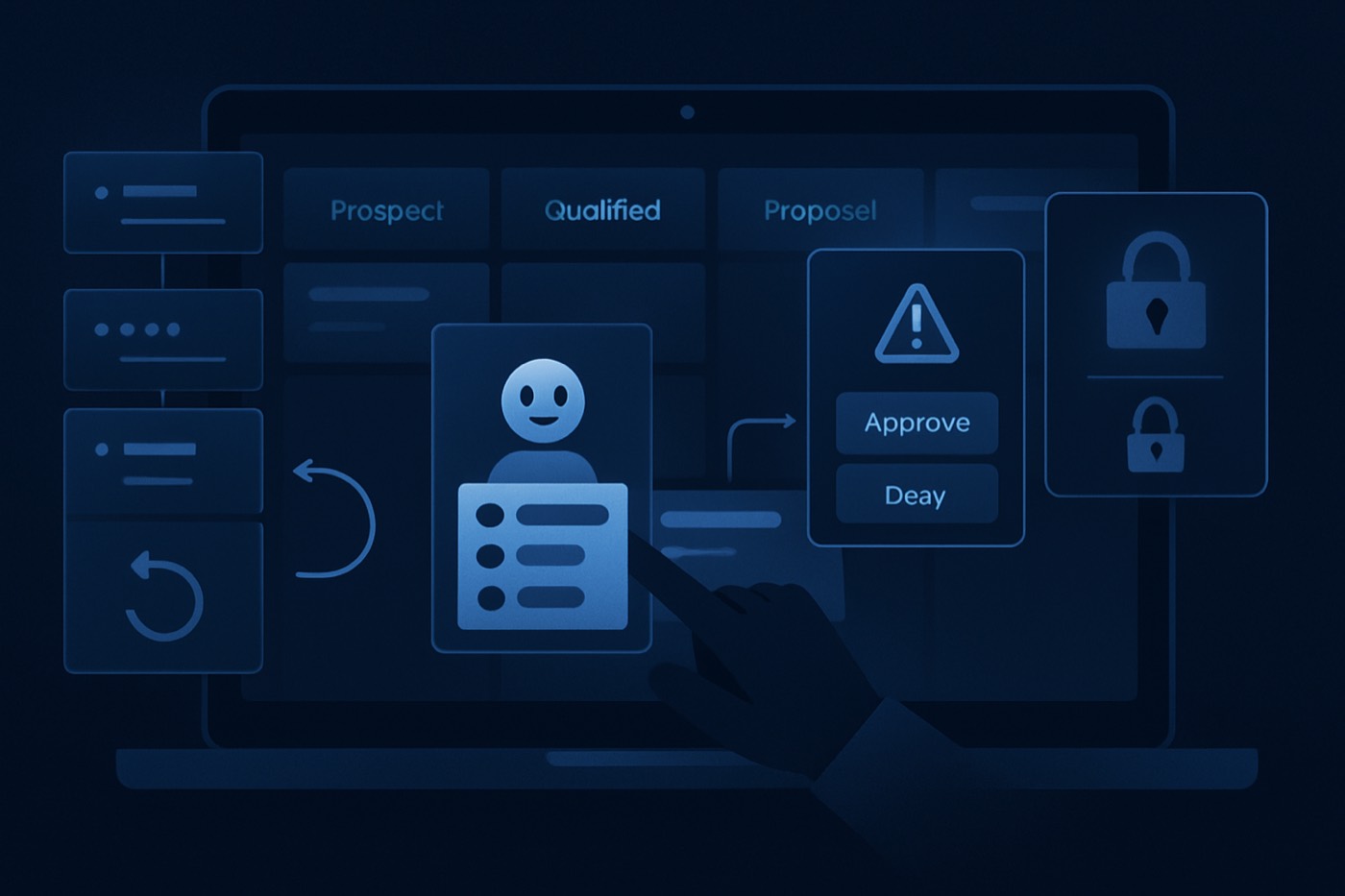
Agents that only “suggest” copy are cute. An operator that sends email, updates your pipeline, and touches customer data is a different species.
That’s the shift: from AI features to agents that execute. Execution drives pipeline. Execution also breaks things at machine speed.
So the market is converging on one unavoidable layer: a control plane for autonomous sales agents. Identity. Permissions. Approvals. Audit trails. Rollback. Evidence. The controls an operator needs so the agent doesn’t do something dumb, expensive, or illegal.
Even the big CRM vendors see the same wall. Salesforce’s “Agentic Enterprise” narrative puts trust, governance, and orchestration in the foundation, not as a checkbox, and they document an audit trail for generative AI usage tied to the Einstein Trust Layer. That’s the tell: autonomy without controls is a breach waiting to happen, and a CRM is not the thing that solves it. The agent that acts is what needs governing. (Salesforce news story, Salesforce Architects: Agentic Enterprise, Salesforce Help: Generative AI Audit Trail)
The trend: control beats vibes
In 2023 and 2024, most sales AI shipped as “assist.” Write an email. Summarize a call. Suggest next steps.
In 2025 and 2026, buyers started demanding “do.” Research accounts. Enrich contacts. Launch sequences. Update stages. Route inbound. Book meetings. That’s an autonomous revenue operator, and it forces a governance upgrade.
Gartner’s 2026 view of agentic AI is blunt: adoption is accelerating, and enterprise concern is shifting to accountability and control. They call out governance as a rising category. (Gartner: Hype Cycle for Agentic AI, 2026)
Security people are even more direct. OWASP’s Top 10 for LLM applications lists risks that translate to “don’t give an LLM a loaded gun without monitoring.” Logging and monitoring show up as first-class controls. (OWASP Top 10 for LLM Applications v2025 PDF)
Regulators are heading the same way. The EU AI Act includes event-logging requirements for certain high-risk systems. Even if sales automation isn’t always “high-risk,” the architectural direction is clear: traceability becomes a product requirement. (EU AI Act logging explainer, NIST AI RMF hub)
Translation: autonomy is easy to demo. Governed autonomy is the product.
What “AI agent governance for sales” actually means
In sales, governance is not a 40-page policy doc. It’s a set of runtime controls that answer five operator questions:
- Who is the agent acting as? (identity)
- What actions can it take? (permissions by action)
- When does a human need to sign off? (approvals)
- What exactly happened? (audit trail)
- Can we undo it, and prove why it happened? (rollback plus evidence)
If your “agent” cannot answer those, it’s not production-ready. It’s a toy with API keys.
The control plane: what it is, and what it gates
A control plane is the layer that sits above tools and below outcomes. It decides what’s allowed, what’s blocked, what’s reviewed, and what’s recorded. For an autonomous sales operator it should gate five surfaces:
- Identity and session context
- Tool access
- Outbound communications
- Pipeline and CRM writes
- Data access and export
Now the practical blueprint.
1) Identity: one agent, many “actors”
Agents cause chaos when nobody knows who did what. You need three distinct identities.
System identity (the agent itself)
- Used for automation actions.
- Has explicit scopes.
- Never shares credentials with humans.
Delegated identity (acting on behalf of a rep)
- Used when actions must reflect a rep’s ownership or territory.
- Requires explicit delegation and expiry.
Service identity (connectors and enrichment providers)
- Separate keys for enrichment, email sending, CRM API, calendar, and data warehouse.
- Rotated. Scoped. Audited.
Operator rule: no shared inbox passwords, no “one API key for everything,” no mystery “automation user” with admin permissions.
If you run Salesforce, note how they frame trust and governance around an agentic layer and trust-hub concepts. That architecture is identity and control boundaries made explicit. (Salesforce Architects: Agentic Enterprise)
2) Permissions by action (not by tool)
Most teams do permissions wrong. They think in apps: “Agent can access the CRM.” Agents don’t operate at the app level. They operate at the action level. Here’s the model that maps to real sales workflows.
Action category A: research
- Read public web data.
- Read internal knowledge base.
- Read CRM objects (accounts, contacts, opportunities) with field-level masking.
Default: allow, but log.
Action category B: enrichment
- Append phone, title, verified email.
- Pull technographics.
- Attach data-source attribution.
Default: allow only from approved vendors; log source and confidence.
Action category C: write drafts
- Draft cold emails.
- Draft LinkedIn messages.
- Draft follow-ups.
Default: allow.
Action category D: send messages
- Send email.
- Send sequences.
- Send calendar invites.
Default: block unless policy says otherwise. Sending is the irreversible act.
Action category E: pipeline and CRM writes
- Create or update leads and contacts.
- Change lifecycle stage.
- Create tasks.
- Modify opportunity fields.
- Write notes and summaries.
Default: restricted. Many writes should require approval or be limited to specific fields.
If you want “pipeline on autopilot,” the system must still treat “send” and “write” as privileged operations.
Chronic’s view is simple: autonomy is fine. Unbounded autonomy is malpractice.
The Chronic building blocks that sit naturally inside a governed control plane:
- ICP Builder for defined targeting inputs, so outreach isn’t random.
- Lead Enrichment for attributed data.
- AI Email Writer for controlled drafting.
- AI Lead Scoring to prioritize without “spray and pray.”
- Sales Pipeline to keep actions tied to stages.
3) Approvals: review-before-send patterns that don’t kill speed
Approvals fail when they feel like finance. The trick is to match approvals to risk. Not everything needs a human.
Approval pattern 1: send requires a human, drafts don’t
- Agent drafts.
- Rep clicks approve.
- System sends.
This is the easiest on-ramp. It gives you speed without catastrophic mistakes.
Approval pattern 2: risk-based approvals
Require approval if any of these trip:
- New domain or new persona
- Mention of pricing, legal terms, or security claims
- Attachments
- Unverified email address
- High-value accounts list
- First-touch email (but not follow-ups)
- Any PII in the body
Approval pattern 3: batch approval
- Agent proposes 50 sends.
- Rep approves in chunks of 10 with a quick scan.
- Control plane logs approvals as a single event with a manifest.
Approval pattern 4: two-person rule
For high-risk actions:
- Bulk sends over a threshold
- CRM stage changes on enterprise opportunities
- Data exports
This isn’t paranoia. It’s standard practice in financial controls. Agents just drag sales into the grown-up world.
Microsoft’s write-up on indirect prompt injection is a useful reminder: tool-using systems can be manipulated by the content returned from tools. That’s another reason to gate high-impact actions behind approvals and policy checks. (Microsoft MSRC: indirect prompt injection defenses)
4) Audit trails: logs that answer “what happened” on one screen
A real audit trail is not “we store chat transcripts.” It’s structured, queryable, and tied to actions. At minimum, capture:
- Actor: agent id, delegated user, workspace
- Time: timestamp, timezone
- Intent: the task request
- Plan: steps the agent proposed
- Tools called: tool name, endpoint, parameters (redacted where needed)
- Data accessed: object types, record ids, field groups
- Decision: allow, deny, or needs approval
- Action: what changed, what was sent
- Outcome: delivery status, bounce, reply class, write success or failure
- Evidence: links to sources, enrichment providers, signals used
- Versioning: model version, prompt template version, policy version
Salesforce positions its generative AI audit trail as a way to track usage and trust-layer functionality. That’s the direction. Your stack needs equivalent visibility even if you are not on Salesforce. (Salesforce Help: Generative AI Audit Trail)
OWASP also flags missing monitoring and logging as a material risk for LLM apps. If your agent touches CRM and email, you are an LLM app with consequences. (OWASP Top 10 for LLM Applications v2025 PDF)
5) Evidence linking: “why did the agent do it?” (receipts, or it didn’t happen)
This is the missing piece in most agent demos. Operators don’t just need the output. They need the chain of custody. Every outbound message and CRM write should attach:
- Signals used (intent, fit, timing)
- Sources (URL, internal doc id, CRM record id)
- Extracted facts (with confidence)
- Reasoning summary (short, structured)
- Policy check results (passed or failed)
This is how you stop “hallucinated personalization” that sounds specific but isn’t true, the kind that gets your domain roasted on LinkedIn.
If you want a concrete playbook for turning signals into outbound moves, this pairs well with Chronic’s post: 18 high-intent buying signals and the exact play to run. Signals without governance become spam faster, just with better grammar.
6) Rollback: the difference between automation and damage control
Agents will make mistakes. Your system must be built for that. Rollback is not a nice-to-have. It’s the only sane way to run autonomous writes.
What rollback looks like in sales ops
- CRM writes: store before-and-after diffs. Revert in one click.
- Sequences: pause, cancel, retract future steps.
- Data enrichment: revert fields to prior values, keep provenance.
- Lead routing: restore the previous owner, log both changes.
Operator rule
If an action cannot be reversed, it must require approval. That includes “send,” because you can’t un-send. You can only mitigate.
7) Guardrails that actually work (not “don’t be evil”)
Guardrails must be deterministic at the action boundary. Practical controls:
- Rate limits: per domain, per sender, per segment
- Budget caps: enrichment spend, API calls, tokens
- Allowlists: enrichment vendors, sending domains, CRM objects
- Blocklists: regulated terms, restricted industries, competitor names where needed
- Field-level protection: never expose or send certain fields
- Tool firewall: validate tool inputs and outputs, sanitize retrieved content before it becomes instructions
That last one matters. Indirect prompt injection is real because tool outputs can carry malicious instructions. Defensive layers at the tool boundary are becoming standard research direction. (Microsoft MSRC: indirect prompt injection defenses)
A maturity model for AI agent governance in sales
Most teams need a blunt model. Here it is.
Level 0: manual everything
- Humans research, write, send, and update the CRM.
- AI is a chat tab nobody trusts.
Control plane reality: none. Risk: low. Pipeline: slow.
Level 1: draft-only agents
- Agent drafts emails and notes.
- No sending.
- No CRM writes.
Controls required: identity, basic logging, content policies (blocklists).
Best for: regulated teams dipping a toe in.
Level 2: send-with-approval
- Agent drafts.
- Human approves sends.
- Limited CRM writes (tasks, notes) allowed.
Controls required: action-level permissions, an approval workflow, a structured audit trail, evidence linking for drafts.
Best for: most B2B teams that want speed without brand risk.
Level 3: autonomous within guardrails
- Agent can send without approval in bounded cases.
- Agent can write to the CRM in bounded fields.
- Humans handle exceptions, not busywork.
Controls required: risk scoring per action, rate limits and budgets, rollback and diff-based change tracking, a full audit trail with policy versions, continuous monitoring and alerts.
Best for: teams that already run tight ops and have clear ICP and messaging rules.
If you want to operate at Level 3, fix your list quality first. Garbage targeting plus autonomy equals faster failure. Chronic has a blunt take on this: Cold email in 2026: the list is the strategy.
The control plane checklist
If you are buying or building an autonomous sales operator, use this list in demos. Make vendors prove it.
Identity and access
- SSO and SAML support
- Separate agent service accounts
- Delegation with expiry
- Least-privilege scopes per action
Permissions by action (must be explicit)
- Research read
- Enrichment write
- Draft creation
- Send email
- Sequence enrollment
- CRM create and update (by object and field)
- Calendar scheduling
- Export
Approvals
- Review-before-send UI
- Batch approvals
- Risk-based auto-routing to approval
- Two-person approvals for high-risk actions
Audit trail (structured, searchable)
- Tool calls logged
- Data accessed logged
- Model and policy version logged
- Who approved what, logged
Evidence linking
- Sources for claims in messages
- Signals used for prioritization
- Confidence and provenance
Rollback and incident response
- Revert CRM writes
- Pause sequences
- Quarantine agent actions
- Alerting on anomalies
If a vendor can’t show this, they’re selling vibes with a UI.
Where Chronic fits, and why this beats another “AI feature”
Most stacks still look like this:
- Apollo for data
- Clay for workflows
- Instantly for sending
- HubSpot or Salesforce for CRM
- Random spreadsheet glue
- A rep praying nothing breaks
That’s not a system. That’s a pile, and the controls live in none of it.
Chronic is an autonomous revenue operator: it runs the motion end to end, until the meeting is booked, but governed. It finds the right accounts, drafts and sends from managed, warmed mailboxes, handles replies, books meetings, and surfaces approvals for the decisions that matter. Pipeline on autopilot, not pipeline on accident, because the control plane is the product, not a setting buried inside a CRM.
If you’re comparing approaches:
- HubSpot has ecosystem gravity, but agent execution without tight controls turns into “context theater.” (Chronic take, Chronic vs HubSpot)
- Salesforce has the enterprise narrative and deep permissions, but it’s expensive and heavy, and it still expects you to bolt the agent on. (Chronic vs Salesforce)
- Apollo is strong on data, but execution still needs tight governance across send and CRM writes. (Chronic vs Apollo)
The point: the control plane has to sit above the whole motion, owned by the operator that acts, not inside one tool.
What to do next: ship autonomy without becoming a cautionary tale
- Map your agent actions. List every action it can take: enrich, draft, send, CRM write, sequence enroll, schedule.
- Assign risk tiers. Sending and CRM stage changes are high-risk. Drafting is low-risk.
- Start at Level 2. Send-with-approval gets you speed and safety fast.
- Implement evidence linking. Every claim in outbound needs receipts. If the agent can’t cite, it can’t say it.
- Add rollback before you add autonomy. If you can’t revert, you can’t trust.
- Monitor like security monitors prod. Alert on volume spikes, domain changes, new sequences, or unusual CRM edits.
- Only then move to Level 3. Autonomy inside guardrails, not autonomy as a personality trait.
If you want the measurement layer that keeps this honest, pair governance with attribution and outbound ROI tracking. Otherwise you’ll “go autonomous” and still not know what booked meetings. (Email ROI tracking stack)
FAQ
What is “AI agent governance for sales” in plain English?
It’s the set of controls that decide what a sales agent can do, when it needs approval, how actions get logged, and how you prove why it acted: identity, permissions, approvals, audit trails, rollback, and evidence linking.
What’s the single most important control to start with?
Review-before-send. Drafts are reversible. Sends aren’t. Gate outbound sends behind human approval first, then expand autonomy later.
How is a control plane different from standard CRM permissions?
CRMs govern human users clicking buttons. Agents operate through tool calls and workflows. You need action-level permissions (draft vs send vs CRM write) plus structured logging of tool calls, policy decisions, and evidence.
Why do audit trails matter if we “trust the model”?
Because trust doesn’t survive incident response. OWASP explicitly flags missing monitoring and logging as a major risk for LLM apps. Without an audit trail, you can’t reconstruct what happened, contain it, or prove compliance. (OWASP Top 10 for LLM Applications v2025 PDF)
What does “evidence linking” look like for outbound?
Each email attaches the facts it used (company news, tech stack, job postings, intent signals), the sources (URLs or internal docs), and a short reason the agent chose that angle. No receipts, no send.
How do we move from approvals to autonomy without taking on huge risk?
Use a maturity model. Start at draft-only, then send-with-approval, then allow autonomous sends only inside strict guardrails: rate limits, allowlists, risk scoring, and rollback for anything writable. Log model and policy versions so you can explain behavior changes over time.
Build the control plane, then let the agent run
Agents that execute will win. Agents without controls will get your domain blocked, your CRM polluted, and your security team in your Slack at 2 a.m.
Build the control plane first:
- identity that’s real
- permissions by action
- approvals that match risk
- audit trails you can query
- rollback you can trust
- receipts for every “personalized” claim
Then ship autonomy. Relentless, but not reckless.