Consensus + Saleo and the Rise of the Demo Agent: What Counts as MQL and SQL Now?
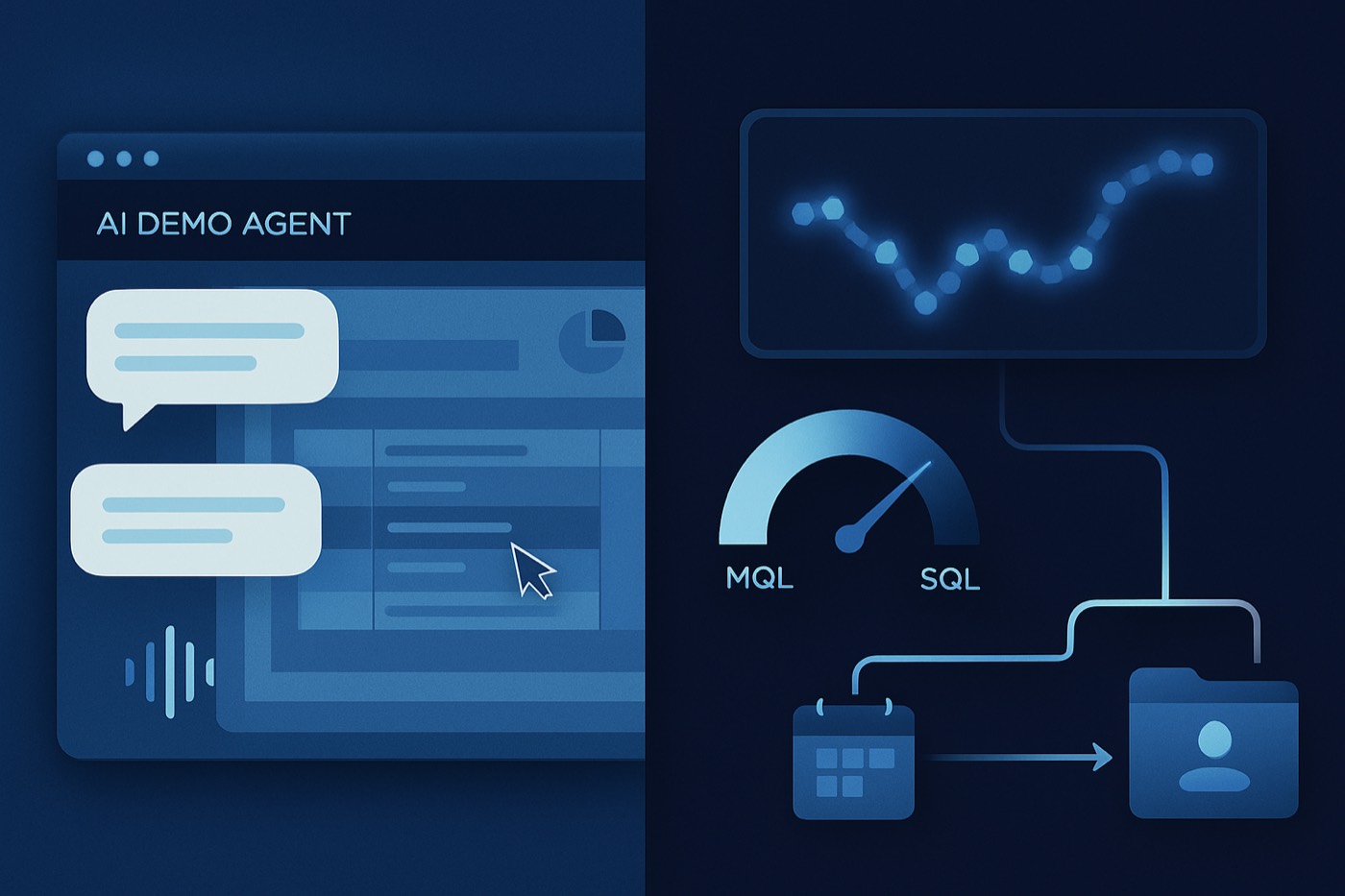
The demo stopped being a meeting.
It became a channel. Always-on. Autonomous. And brutally honest about intent.
Consensus and Saleo sit right in the middle of this shift. They are not “demo tools.” They are turning the product demo into an automated sales interaction with analytics, routing, and follow-up. When buyers prefer self-serve, the demo becomes the new qualification layer, not the thing you do after qualification. Gartner’s 2025 survey put the headline in plain English: 61% of B2B buyers prefer a rep-free buying experience. (gartner.com)
If your MQL and SQL definitions still revolve around “filled out a form” and “accepted a meeting,” you are scoring the wrong behavior. You are literally rewarding low intent.
TL;DR
- The AI demo agent is turning demos into an always-on buying experience, not a calendar event.
- Qualification shifts from “who raised their hand” to “who behaved like a buyer inside the demo.”
- New intent signals matter: time in demo, feature paths, repeat sessions, stakeholder invites, objection categories, and deep-click actions.
- Route demo signals straight into outbound. Trigger sequences by what they explored, not what they downloaded.
- SDRs stop “booking any meeting.” They triage high-intent accounts and accelerate buying groups.
- Use a simple map: Demo intent signals + fit = priority queue.
The trend: the demo becomes autonomous, and qualification changes with it
Two forces collide:
- Buyers keep moving upstream into self-serve.
- Demos keep moving downstream into automation.
Forrester has been tracking the self-guided shift for years. Their 2025 predictions called out that more than half of large B2B purchases will be processed through digital self-serve channels. (investor.forrester.com) That is not “content marketing.” That is the purchase motion changing.
At the same time, buyers are using AI to do the early work. Forrester’s 2024 Buyers’ Journey Survey data said 89% of B2B buyers have adopted generative AI, and they use it as a self-guided source across the journey. (forrester.com)
So if the buyer journey starts with self-guided research, and the product experience becomes self-guided too, the demo turns into the highest-signal behavior you can capture before a human ever shows up.
What Consensus signals about where the market is going
Consensus positions itself as a “Product Experience Platform” with AI-powered demo automation and analytics. (goconsensus.com) On Gartner Peer Insights, Consensus is described in terms that matter for qualification: interactive demos, simulations, and “Demolytics” that surface buyer intent and stakeholder engagement, including heat maps and persona-level view data. (gartner.com)
That word matters: engagement is no longer a proxy. It is the dataset.
Consensus also publishes material that splits automated demos into types, including “qualifying demos,” and explicitly frames them as tools buyers use to compare vendors while sellers use the engagement data to decide what to do next. (goconsensus.com)
What Saleo signals about where the market is going
Saleo’s message is blunt: run interactive demos in your live product with AI-generated demo data, then push high-intent engagement data into CRM and marketing automation so sales can prioritize accounts. (saleo.io)
More importantly, Saleo is now leaning into an “AI Demo Agent” concept. Coverage describes it as doing discovery and personalizing a demo in real time based on buyer intent. (martech360.com)
You can argue about how “autonomous” these are today. Fine. The directional trend is obvious:
- Demos become interactive and self-guided.
- Then they become adaptive.
- Then they become agent-led, with discovery, objection handling, and next-step capture.
That is the rise of the AI demo agent. And it breaks your funnel math.
Define it like an operator: what is an AI demo agent?
An AI demo agent is a self-serve demo experience that:
- Personalizes the walkthrough based on who the buyer is and what they ask.
- Captures intent signals from behavior inside the demo.
- Routes those signals into sales motions automatically.
It is not a product tour. It is not a video. It is not “chat on the pricing page.”
It is a sales interaction that happens without a rep. And it runs 24/7.
MQL and SQL are not forms anymore. They are behaviors.
Classic definitions:
- MQL: “Marketing says this lead looks good.”
- SQL: “Sales says this lead is worth time.”
In 2026, those labels still exist because dashboards die hard. But what qualifies is shifting.
The new MQL: “engaged with the product experience in a way that implies a real evaluation”
A modern MQL is not “downloaded the ebook.” That is a procrastination artifact.
A modern MQL looks like:
- Completed a role-based demo path for a core use case.
- Returned for a second session within 7 days.
- Spent time on the “hard parts” of the product, not the hero screen.
- Shared the demo internally or invited stakeholders.
This lines up with how buyers want to operate. Gartner’s 2025 survey says 61% prefer rep-free buying. (gartner.com) That preference forces you to treat self-serve interactions as primary signals, not top-of-funnel noise.
The new SQL: “buying group behavior plus escalation triggers”
A modern SQL is less about “requested a demo,” because the demo is now always available.
A modern SQL looks like:
- Multiple stakeholders from the same account engaged.
- Engagement clustered around decision drivers (security, integrations, admin, reporting, governance).
- Objection categories surfaced, and the buyer kept going anyway.
- The buyer asked the demo agent for pricing, procurement steps, timelines, or implementation details.
SQL becomes “sales-ready account behavior,” not “sales-ready person.”
The intent signals AI demo agents create (and why they beat pageviews)
Your website analytics lie. Your form fills lie. Your “lead score” lies.
Demo engagement is harder to fake, harder to outsource, and harder to accidentally do.
Here are the signal categories that matter, with examples you can instrument.
1) Time in demo, but measured like an adult
Stop scoring “minutes watched” as if attention equals intent.
Track:
- Active time (clicks, inputs, navigation) vs passive time (tab left open).
- Time-to-value (how fast they reach the first meaningful outcome).
- Depth time (time spent in configuration, integrations, permissions).
Why it matters:
- High-intent buyers spend time where adoption risk lives.
- Low-intent buyers bounce after the shiny screens.
2) Feature paths (the sequence of what they explored)
A demo is a map. Buyers leave footprints.
Track:
- Which modules they hit.
- The order they hit them.
- Where they loop back.
- Where they drop.
Interpretation examples:
- Integration first usually signals technical validation.
- Reporting first often signals leadership evaluation.
- Permissions and roles screams “this is real, and we have multiple teams.”
Consensus’s “Demolytics” framing of intent and stakeholder engagement is basically built for this kind of analysis. (gartner.com)
3) Stakeholder invites and internal sharing
The best buying-intent signal in B2B is simple: other people show up.
Track:
- Number of unique viewers from the same domain.
- Forward events.
- Invite events.
- Repeat viewers.
Why it matters:
- Deals close with buying groups.
- Buying groups show up before meetings, if the experience makes it easy.
This is also why demo agents are a threat to your SDR team’s identity. The “booking” function gets replaced by “orchestrating the group.”
4) Objection categories, captured in the moment
This is where “demo agent” beats “product tour.”
If the buyer asks:
- “Does this work with Okta?”
- “Where is data stored?”
- “Can we restrict access by role?”
- “How long does implementation take?”
- “Do you support SOC 2 / ISO 27001?” You just captured qualification gold.
The key is taxonomy. You need a consistent set of objection categories, for example:
- Security and compliance
- Integrations and data
- Admin and governance
- Workflow fit
- Pricing and packaging
- Switching cost
- Implementation and timeline
Now route those objections into follow-up that actually answers the question, not your generic “just circling back” email.
5) High-friction actions: the moments that signal purchase planning
Score actions that imply the buyer is doing internal math:
- Exported something.
- Opened pricing.
- Asked about procurement.
- Viewed implementation docs.
- Requested a security packet.
- Looked at role-based access or audit logs.
- Compared plans.
McKinsey’s B2B Pulse research has been pointing at the same meta-trend: buyers are willing to spend big through remote and self-serve channels, including 35% willing to spend $500k+ via those channels. (mckinsey.com) If buyers will spend big without a rep, then the behaviors that precede those decisions must count.
What “counts” as MQL now: a clean definition you can implement
Use this definition:
MQL (2026): A contact or account that demonstrated repeatable, role-aligned product evaluation behavior inside an AI demo agent or automated demo experience.
Minimum bar example (pick your thresholds):
- At least 1 demo session with active engagement
- At least 2 high-intent feature interactions
- At least 1 “depth” area touched (integrations, governance, admin, reporting)
- Optional: second session within 7-14 days
This definition works because it is observable, consistent, and tied to evaluation.
What “counts” as SQL now: stop pretending it is a person
Use this definition:
SQL (2026): An account with buying group behavior plus a clear escalation trigger captured from demo intent signals.
Minimum bar example:
- 2+ stakeholders engaged from the same account
- 1+ high-friction action (pricing, security, implementation, integrations)
- Fit score above threshold
SQL is the moment you route to an AE. Not because someone asked nicely, but because the account is behaving like an active deal.
How demo signals should route into outbound sequences (the part most teams botch)
Most teams do this:
- Buyer watches demo
- SDR sends generic follow-up
- Buyer ignores
- SDR sends “bumping this”
- Buyer blocks domain
- RevOps blames deliverability
Do this instead: route by intent category, not lifecycle stage.
Routing rule #1: Objection-triggered sequences
If the demo agent logs a security objection:
- Trigger a 3-step sequence:
- Confirm requirement and provide the one-pager
- Offer a 15-minute security review with your security lead
- Provide a checklist and ask who owns security approval
If the demo agent logs integration questions:
- Trigger a technical validation sequence:
- Send integration overview plus the 2 most relevant native connectors
- Ask what systems are source of truth
- Offer a scoped sandbox session
The tone matters. You are not “checking in.” You are answering what they asked.
Routing rule #2: Feature-path sequences
If they explored “X” module deeply, your outbound should be about “X” outcomes.
Examples:
- Explored reporting: send a short “how teams operationalize reporting” note plus 2 screenshots.
- Explored permissions: send governance and admin setup guidance.
- Explored workflow automation: send example workflows by role.
This is where personalization stops being cringe and starts being relevant. Chronic has a strong stance on this in our post on why relevance beats fake personalization. The buyer’s clickstream is relevance. Use it. (Relevance Beats Personalization)
Routing rule #3: Stakeholder expansion sequences
If the buyer shared the demo:
- Trigger a multi-threaded motion.
- Invite the next likely stakeholders into the same demo path.
- Send role-based summaries.
This ties directly to multi-threading best practices. Buying groups are normal now. Act like it. (Multi-Threaded Outbound in 2026)
Routing rule #4: SDR triage queue, not SDR spray
Stop tasking SDRs with “book a meeting.” Task them with:
- Verifying fit.
- Expanding stakeholders.
- Converting intent into next-step commitment.
That is the real job in an AI demo agent world.
The SDR job changes: from meeting setters to intent operators
The SDR of 2022:
- Hunts emails
- Spams sequences
- Books whoever says yes
The SDR of 2026:
- Works a priority queue
- Orchestrates buying groups
- Escalates high-intent accounts fast
- Stops wasting touches on dead intent
Dry truth: the AI demo agent did the discovery. The SDR now runs triage.
This shift also changes how you structure your stack. Consolidate tools around signals and execution. Point tools that only “send” are losing ground. (The Modern Outbound Stack in 2026)
Where Chronic fits: pipeline automation that actually uses these signals
AI demo agents create signals. Most teams do nothing with them. The data sits in a dashboard. The SDR never sees it. Or worse, sees it and still sends the same template.
Chronic is built for end-to-end outbound that runs off fit plus intent:
- Build and refine your ICP with ICP Builder.
- Enrich the account and contacts with Lead Enrichment.
- Score accounts with AI Lead Scoring.
- Write follow-up sequences that mirror the demo path with the AI Email Writer.
- Track and route everything through the Sales Pipeline.
If you are still treating demo engagement as “nice to know,” you are volunteering to lose deals to teams that treat it as the primary qualification layer.
If you want the deeper model behind dual scoring, this breaks it down without the MBA fog. (Fit vs Intent Scoring)
A simple scoring map: demo intent signals + fit = priority queue
Stop worshipping the perfect model. You need a model your team will actually run.
Use two scores:
- Fit (0-100): do they match ICP?
- Demo Intent (0-100): did they behave like a buying group in evaluation?
Then create a priority queue.
Fit score (example inputs)
- Company size in target band: +20
- Industry match: +15
- Tech stack match: +15
- Buying center roles present (Ops, RevOps, IT, Security): +20
- Geography, compliance needs, budget proxy: +30
Fit scoring is table stakes. The win is demo intent scoring.
Demo intent score (example inputs and weights)
Engagement depth
- Active demo session over 8 minutes: +10
- Touched 3+ key features: +10
- Visited high-friction areas (security, integrations, admin): +15
Evaluation behavior
- Returned for a second session within 14 days: +15
- Viewed pricing or packaging: +10
- Asked implementation timeline or onboarding questions: +10
Buying group signals
- 2+ unique stakeholders engaged: +15
- 4+ unique stakeholders engaged: +25 (replace prior)
- Stakeholder invite or forward detected: +10
Objection signals
- Raised 1 objection category and continued: +10
- Raised 2+ objection categories and continued: +20 (replace prior)
Cap at 100. Keep it boring.
Priority queue rules (simple and ruthless)
Fast lane (SQL now): Fit ≥ 70 and Demo Intent ≥ 70
- Route to AE in minutes, not days.
- SDR goal: add 1 stakeholder, confirm timeline, book next step.
Nurture with teeth: Fit ≥ 70 and Demo Intent 40-69
- Trigger objection-based sequences.
- SDR goal: drive back into demo path, expand stakeholders.
Product-led expansion watchlist: Fit 40-69 and Demo Intent ≥ 70
- They love it but might be the wrong account.
- SDR goal: qualify hard, disqualify fast.
Background noise: everything else
- Suppress heavy outbound.
- Let marketing automation run.
- Do not burn domain reputation on fake intent.
That is it. Demo signals plus fit. Priority queue. Real work.
FAQ
What is an AI demo agent, in plain terms?
An AI demo agent is a self-serve demo that adapts to buyer input, captures intent signals during the walkthrough, and routes next steps into sales motions. It replaces the “book a demo” gate with an always-on product experience.
Does this mean MQLs are dead?
No. The form-fill MQL is dying. The behavior-based MQL is winning. Gartner’s data on rep-free preference makes this inevitable. (gartner.com)
What are the most reliable demo intent signals?
The top four:
- Stakeholder expansion (multiple viewers from the same account)
- High-friction feature exploration (integrations, security, admin)
- Repeat sessions within a short window
- Objection categories raised and pursued, not raised and bounced
How should SDRs change their workflow with AI demo agents?
SDRs should work a priority queue based on fit plus demo intent. The job becomes triage, stakeholder expansion, and fast escalation. “Book anything with a pulse” becomes a waste of touches.
How do we route demo signals into outbound without spamming people?
Route by category and context:
- Feature path determines messaging.
- Objection category determines content and CTA.
- Buying group expansion determines multi-threading. If the follow-up does not answer what they did in the demo, do not send it.
What’s the simplest scoring model to start with?
Two numbers:
- Fit score (ICP match)
- Demo intent score (behavior) Then four queues: fast lane, nurture, expansion watchlist, and suppress. Keep it consistent. Iterate monthly.
Build the priority queue, then run it daily
Stop arguing about whether a demo agent “counts” as a demo.
Buyers already voted. They want self-serve. Forrester predicts self-serve will process more large purchases. (investor.forrester.com) Gartner says most prefer rep-free. (gartner.com)
So redefine qualification:
- MQL = behavior inside the AI demo agent.
- SQL = buying group behavior plus escalation triggers.
- Routing = objection and feature-path sequences.
- SDR work = triage, not calendar filling.
Then do the only thing that matters: demo intent signals + fit = priority queue. Run it. Book the right meetings. Close faster.