Agent-ready data: the 18 objects and fields to standardize before you turn on scoring or an autonomous sales agent
Data is agent-ready when its objects, fields, relationships, and timestamps are standardized enough that an autonomous sales agent can score and act without guessing. Standardize the 18 objects, enforce dedupe and validation, then gate autonomy behind a 30/40 readiness score.
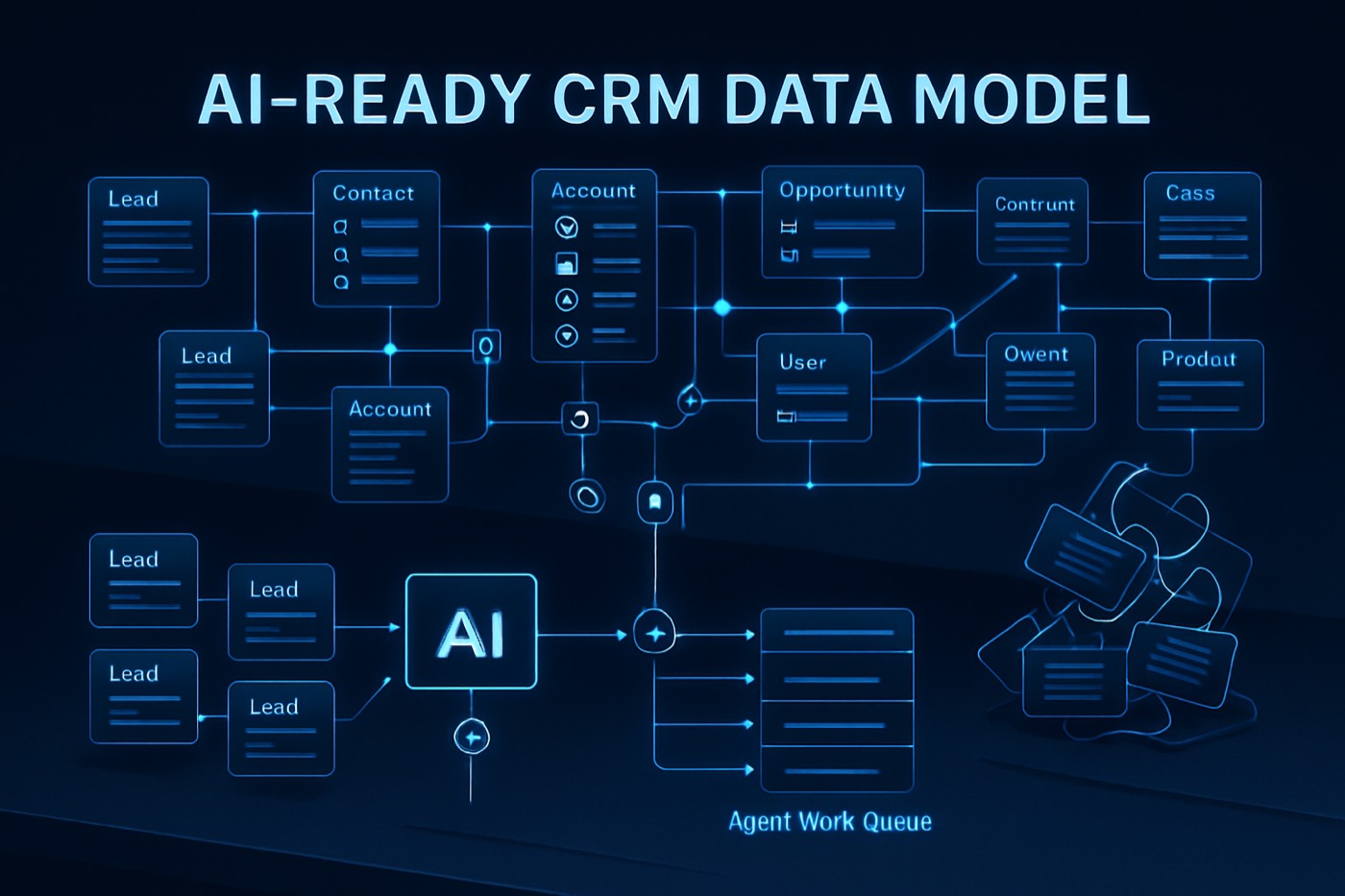
Handing a revenue goal to an autonomous operator only works if the data it reads is clean, connected, and standardized. Whatever system holds your accounts, contacts, and pipeline, the agent can only act as well as that data lets it. If the schema is messy, an autonomous operator will route the wrong way, prioritize the wrong people, and fill gaps with guesses.
This guide is the data foundation to get right before you let an agent run discovery, scoring, outreach, and meeting booking on your behalf. It covers the objects to standardize, the fields that matter most, the dedupe and governance rules that keep an agent safe, and a readiness rubric to decide when it's time to turn autonomy on.
Why your data model is the real bottleneck, not the model
Autonomous sales work fails less because "the AI is bad" and more because the underlying data is inconsistent. A capable agent reasoning over contradictory fields will still make confident, wrong moves.
- Data quality is a prerequisite, not a nice-to-have. Gartner estimates poor data quality costs organizations $12.9M per year on average (gartner.com). Every downstream decision an agent makes inherits that cost.
- Selling is already squeezed. Salesforce research reports reps spend less than 30% of their time actually selling, with the rest lost to admin, research, and data entry (salesforce.relayto.com). Reclaiming that time is exactly the promise of an autonomous operator, but only if it can trust the fields it reads.
- Buying groups are large and messy. Forrester reports the typical B2B buying decision now involves 13 internal stakeholders and 9 external influencers (forrester.com), and that 73% of purchases involve three or more departments (forrester.com). An agent multi-threading a deal needs roles and relationships represented, not implied.
If your data can't reliably answer:
- Who is the economic buyer on this account?
- What is the account's normalized industry and employee band?
- Which signals show active demand, and how recent are they?
- What happened in the last 7 and 30 days?
then an autonomous operator will fall back to weak proxies (opens, random titles, messy sources). You get noisy prioritization and risky automation. Clean the schema first and the same agent gets far more useful.
What "agent-ready data" actually means
Agent-ready data is a schema where:
- Objects are normalized (accounts, contacts, opportunities, activities, campaigns, sequences, meetings, signals).
- Critical fields are standardized (picklists, naming conventions, required fields, enums).
- Relationships are explicit (contact-to-account, stakeholder roles on opportunities, activity-to-person and activity-to-account).
- Time is queryable (engagement recency, signal recency, stage entry dates).
- Identity resolution is deterministic (dedupe and merge rules, integration lineage, golden-record logic).
- Governance is enforceable (validation rules, field ownership, change control for picklists).
That is the difference between "we connected an AI tool" and "an agent can safely act on our behalf."
The minimum 18 objects to standardize (and why each exists)
These concepts apply whether your data lives in Salesforce, HubSpot, Attio, Pipedrive, Close, or a warehouse-first stack, and whether an autonomous operator like Chronic reads from it directly or syncs against it. The names vary; the intent must be consistent.
1) Account
The selling unit for B2B. Scoring needs account-level fit, intent, and engagement rollups.
2) Contact
People with roles, seniority, and influence. Required for multi-threading and personalized outreach.
3) Lead
Pre-contact or pre-account people. If you use Leads, standardize conversion rules. If you don't, replace them with a "Prospect" lifecycle stage on Contact.
4) Opportunity
The forecasting and decision workflow object. An agent needs stage definitions, next steps, and stakeholders to reason about a deal.
5) Activity (Task + Email + Call)
The atomic evidence of engagement. Scoring depends on correct activity linking and timestamps.
6) Company (firmographic profile)
Some systems store this inside Account. You still need a distinct firmographic layer conceptually: industry code, employee band, revenue band, HQ geo, technographics.
7) Persona
Your internal segmentation schema for messaging and routing: "RevOps Leader," "Sales Manager," "Founder," and so on.
8) Buying Role
The role someone plays in the deal: Champion, Economic Buyer, Technical Evaluator, Security, Procurement, Legal.
9) Intent / Signals
A normalized event stream: web visits, job changes, funding, hiring, product usage, ad clicks, reviews, email replies.
10) Source
A canonical attribution object: channel, subchannel, partner, UTM mappings.
11) Campaign
Marketing container for spend, targeting, and reporting. Must map cleanly to Source and Signals.
12) Sequence
Outbound automation container (steps, variants, compliance). Needed to govern agent-driven outreach.
13) Meeting
A special case of activity with structured fields: outcome, attendees, next meeting date, stage impact.
14) Product Interest
What they want, not what you sell. A many-to-many between Account/Contact and Product Line.
15) Competitor
Competitors involved in a deal, plus disposition and threat level.
16) Integration Source (data lineage)
Where each field came from (form, enrichment, manual, sync, enrichment vendor). Required for debugging and trust.
17) Opportunity Contact Role (junction object)
If your system supports it, treat it as first-class: connects Contact to Opportunity with a Buying Role and influence score.
18) Account-Contact Relationship (junction object)
For multi-org contacts (consultants, agencies, advisors). Even if you only allow one Account per Contact today, plan for it.
The 18 objects and the fields to standardize (copyable checklist)
This is the minimum viable schema to make scoring and autonomous actions dependable. Use it as a build sheet.
Object 1: Account
- Account ID (system)
- Account Name (normalized casing, no legal suffix in display name unless required)
- Domain (primary, lowercase, no protocol)
- Normalized Industry (picklist or NAICS-based mapping)
- NAICS Code (optional but recommended, supports normalization). NAICS is a US federal standard for classifying business establishments (census.gov).
- Employee Band (picklist: 1-10, 11-50, 51-200, 201-500, 501-1000, 1001-5000, 5000+)
- Revenue Band (optional, but standardize if present)
- HQ Country (ISO code), HQ Region/State, HQ City
- ICP Fit Score (numeric 0-100) and ICP Fit Tier (A/B/C/D)
- ICP Fit Reasons (structured tags beat free text)
- Lifecycle Stage (Target, Engaged, Pipeline, Customer, Churned)
- Engagement Recency (last engaged date, last inbound date, last outbound date)
- Data Freshness Date (last enriched/verified)
- Owner, Team, Territory
- Do Not Contact / Compliance flags (especially for agency and outbound-heavy teams)
Object 2: Contact
- Contact ID
- Email (lowercase, validated)
- Email Status (valid, risky, invalid, unknown)
- First Name, Last Name
- Job Title (raw) and Normalized Title (VP Sales, RevOps, IT, etc.)
- Seniority (IC, Manager, Director, VP, C-level)
- Department (Sales, Marketing, Finance, IT, Security, Ops)
- Persona (lookup to Persona)
- Buying Role (lookup or multi-role junction via Opportunity Contact Role)
- Phone (E.164 format recommended)
- Country (ISO code)
- Primary Account (or Account-Contact Relationship)
- Engagement Recency fields (last email reply date, last meeting date, last activity date)
- Opt-in / unsubscribed + lawful basis (if applicable)
- Source (first-touch) and Source (last-touch)
Object 3: Lead (if you use Leads)
- Email, Name
- Company Name (raw) and Matched Account (lookup when resolved)
- Lead Status (New, Working, Nurture, Qualified, Unqualified)
- Disqualification Reason (picklist)
- Persona guess (optional)
- ICP Fit Tier (inferred) and Fit reasons
- Conversion mapping rules (Lead to Contact + Account + Opportunity)
Object 4: Opportunity
- Opportunity Name (standard format:
{Account} - {Product} - {Use case}) - Pipeline (New Biz, Expansion, Renewals)
- Stage (strict picklist)
- Stage Entry Date (per stage, or at least current stage entered date)
- Amount, Close Date, Probability
- Primary Product (lookup to Product Interest)
- Use Case (picklist)
- Next Step (required text)
- Next Activity Date (required)
- Competitors Involved (junction/lookup)
- Buying Group Coverage % (derived, see rubric)
- Forecast Category (if applicable)
- Loss Reason and Loss Competitor (required on Closed Lost)
Object 5: Activity
- Activity Type (call, email, linkedin, task, note)
- Direction (inbound, outbound)
- Timestamp (start/end)
- Related To (Account and/or Opportunity)
- Who (Contact/Lead)
- Outcome (connected, no answer, replied, booked)
- Content Tags (optional but powerful: "pricing," "security," "timeline")
Object 6: Company (firmographic profile layer)
If you keep it as a separate object (or a structured field group on Account), standardize:
- Industry standard reference (NAICS)
- Employee estimate source (self-reported vs enrichment)
- Technographics (core tools, cloud, data stack)
- Growth signals (hiring velocity, funding events)
Object 7: Persona
- Persona Name
- Primary pains (tag list)
- Primary value props
- Disqualifiers
- Preferred channels (email, phone, linkedin)
Object 8: Buying Role
- Role Name (Champion, Economic Buyer, Technical Evaluator, Security, Procurement, Legal, User)
- Default objections
- Required assets (security doc, ROI model, etc.)
Object 9: Intent / Signals
- Signal Type (website visit, pricing page, funding, hiring, tech install, content download, reply)
- Signal Strength (1-5)
- Signal Timestamp
- Signal Source (Integration Source)
- Entity Type (Account, Contact)
- Entity Link
- Recency bucket (0-7d, 8-14d, 15-30d, 31-90d)
Object 10: Source (canonical attribution)
- Channel (Paid Search, Paid Social, Organic, Partner, Outbound, Event)
- Subchannel
- UTM Source, Medium, Campaign mapping
- Partner Name
- Self-reported source (contact-provided)
- Confidence score
If you rely on UTMs, standardize naming conventions and forbid free-text drift. Use at least utm_source, utm_medium, utm_campaign consistently, enforced via forms and link builders.
Object 11: Campaign
- Campaign ID
- Campaign Name
- Channel
- Target Persona
- Start/End
- Spend (optional)
- Primary CTA
- UTM defaults (locked)
Object 12: Sequence
- Sequence Name
- Sequence Owner
- Persona
- Steps and timing
- Compliance mode (auto-pause rules, reply detection)
- Variant ID (for analysis)
Object 13: Meeting
- Meeting Type (discovery, demo, security review, exec alignment)
- Outcome (held, no-show, rescheduled)
- Attendees (contacts)
- Next meeting date
- Opportunity impact (stage advanced Y/N)
Object 14: Product Interest
- Product Line
- Priority (primary, secondary)
- Use case
- Timeline (now, quarter, later)
- Integration needs (tags)
Object 15: Competitor
- Competitor Name
- Competitor Type (status quo, direct, indirect)
- Threat level (low/med/high)
- Disposition (win/loss attribution)
Object 16: Integration Source (lineage)
- System Name (HubSpot, Salesforce, website form, enrichment vendor)
- Ingest method (API, CSV, native sync)
- Last sync time
- Field-level provenance (ideal) or record-level provenance (minimum)
Object 17: Opportunity Contact Role (junction)
- Opportunity
- Contact
- Buying Role
- Influence level (1-5)
- Champion flag
- Economic buyer flag
Object 18: Account-Contact Relationship (junction)
- Account
- Contact
- Relationship type (employee, contractor, advisor, agency)
- Primary flag
- Start/end date
Standardize these field groups first (the ones an agent leans on hardest)
Normalized industry
Do not let "industry" be free text. An agent scoring fit on "SaaS," "Software", and "B2B SaaS" as three separate values learns the wrong correlations.
Recommended approach
- Store Raw Industry (from forms, enrichment, imports).
- Map to Normalized Industry (strict picklist).
- Optionally store NAICS for reference and re-mapping. NAICS is widely used for industry classification by US statistical agencies (census.gov, bls.gov).
Picklist example (Normalized Industry)
- Software (B2B SaaS)
- IT Services
- Marketing Agencies
- Financial Services
- Healthcare
- Manufacturing
- Retail and eCommerce
- Education
- Public Sector
- Other
Employee band and geo (for routing and fit)
Scoring needs bucketed firmographics, not flaky exact counts.
- Employee Band: enforce a picklist
- Revenue Band: optional but picklist
- Country: store ISO codes (for example, ISO 3166-1 alpha-2) (en.wikipedia.org)
ICP fit signals (make them explicit, not implied)
Store both:
- Fit inputs (industry, size, geo, technographics, exclusions)
- Fit outputs (ICP Fit Score, Tier, reasons)
That way scoring is explainable and overrideable, which matters when you are deciding whether to trust an agent's prioritization.
Engagement recency (the scoring backbone)
Create explicit fields (derived nightly or in real time):
- Last Activity Date (any)
- Last Inbound Date (reply, form submit, inbound call)
- Last Outbound Date
- Last Meeting Date
- Engagement Recency Bucket (0-7, 8-14, 15-30, 31-90, 90+)
An autonomous operator uses these to avoid spammy follow-up and to time outreach windows, which directly protects your domains and sender reputation.
Stakeholder role and buying group coverage
Given how large buying groups are, your data must represent roles per opportunity. Forrester's latest buyer research highlights the size and cross-functional nature of these buying networks (forrester.com).
Minimum:
- Store Buying Role per contact on each opportunity.
- Track coverage: do you have at least a Champion + Economic Buyer + Technical Evaluator?
Stage definitions (no custom stage chaos)
Stages must be:
- mutually exclusive,
- clearly entry/exit defined,
- tied to required fields.
If your team runs 12 micro-stages nobody follows, deal predictions become noise.
Validation rules to implement (minimum set)
These rules prevent garbage in, which means garbage actions out.
Account validation rules
- Domain is required for accounts in ICP tiers A-C.
- Normalized Industry is required when Lifecycle Stage is Engaged or beyond.
- Employee Band required when ICP Fit Tier exists.
- Country required for routing territories.
- Data Freshness Date required if enrichment was applied.
Contact validation rules
- Email required unless explicitly marked "No Email Available."
- Email must be lowercase and match a regex pattern.
- Seniority + Department required for Personas used in sequences.
- Do Not Contact blocks enrollment in sequences.
Opportunity validation rules
- Stage requires Next Step + Next Activity Date (non-negotiable).
- Closed Lost requires Loss Reason + Primary Competitor.
- Security Review stage requires a "Security Owner Contact Role" or a "Security Review Meeting" record.
- Stage change requires Stage Entry Date set (automated).
Signal validation rules
Each signal must have:
- Signal Type
- Timestamp
- Entity link
- Integration Source
If you can't trust timestamps and entity links, recency scoring collapses, and so does an agent's sense of "what just happened."
Dedupe and identity resolution rules (practical and safe)
Duplicates routinely run 10% to 30% without a formal data quality program, and they break routing, scoring, and outreach. HubSpot, citing Experian, notes duplication rates of 10% to 30% are not uncommon (blog.hubspot.com). For an autonomous operator, a duplicate is worse than a gap: it can mean the same person gets emailed twice from two records.
Golden rules
Accounts
- Match on domain (exact).
- Secondary match: normalized name + HQ country (fuzzy).
- Never auto-merge accounts with active opportunities unless the domain matches.
Contacts
- Match on email (exact, lowercase) and auto-merge.
- If no email: match on (first + last + account domain) with human review.
- Preserve original source fields before merge.
Leads
- Block duplicate lead creation if the email already exists as a contact, or route to the existing owner.
"Integration Source" as a dedupe accelerant
Add fields:
source_systemsource_record_idfirst_seen_at
This prevents re-creating duplicates when tools sync the same people repeatedly.
Picklist governance (how to stop entropy)
Picklists are where schemas go to die. "VP Sales," "VP of Sales," and "Sales VP" become three segments, and any system reasoning over them learns the wrong correlations.
Governance policy
- One owner per picklist (RevOps).
- Change control: additions require a reason and a mapping plan.
- No free text for: industry, employee band, stage, loss reason, department, seniority, buying role.
- Deprecation rules: deprecate values, do not delete (keep reporting continuity).
- Mapping table: raw to normalized, stored and versioned.
Normalize titles without boiling the ocean
Store both:
title_rawtitle_normalized
Then build a mapping library over time. That is faster than trying to fix every title globally in week one.
The readiness rubric (use this to decide when to turn autonomy on)
Score each category 0 to 5. Add them up (max 40). This gives you a defensible answer to "are we ready to let an agent act?"
1) Object coverage (0-5)
- 0: Only leads + contacts, no activities
- 3: Accounts, Contacts, Opps, Activities, Campaigns exist
- 5: All 18 objects present or logically represented
2) Field completeness for core inputs (0-5)
Check completion rates for:
- Account: normalized industry, employee band, country, ICP tier
- Contact: email, seniority, department, persona
- Opportunity: stage, next step, next activity, loss reason
- 5 = 80%+ completion in required segments (ICP A-C, active pipeline)
3) Normalization quality (0-5)
- 0: free text everywhere
- 3: normalization exists but inconsistent
- 5: controlled picklists + mapping tables + deprecation policy
4) Identity resolution and dedupe (0-5)
- 0: unknown duplicate rate
- 3: dedupe monthly, manual
- 5: automated detection weekly + safe auto-merge rules + human review queue
5) Relationship integrity (0-5)
- 0: activities not linked to accounts/opps reliably
- 3: most activities linked, but meetings live in calendars only
- 5: activities, meetings, sequences, and signals all link to people + accounts + opps
6) Time and recency (0-5)
- 0: no recency fields
- 3: last activity date exists
- 5: explicit inbound/outbound/meeting recency + buckets + signal timestamps
7) Stage discipline (0-5)
- 0: reps freestyle stages
- 3: stages exist but weak enforcement
- 5: validation rules + stage entry dates + close reason hygiene
8) Governance + auditability (0-5)
- 0: anyone can create fields and values
- 3: partial governance
- 5: owners, change log, integration lineage, monitoring dashboards
Interpretation
- 0-19: Don't let an agent take actions yet. Fix the schema first.
- 20-29: Start with conservative scoring and prioritization only, no autonomous outreach.
- 30-35: You can pilot agent workflows with approvals and stop rules.
- 36-40: You're ready for scaled scoring, routing, and agent-run outreach with guardrails.
For rollout sequencing, pair this rubric with a phased implementation plan in How to roll out an autonomous sales agent in 30 days.
How Chronic uses this model
Chronic is an autonomous revenue operator: you set a revenue goal, budget, offer, and approval level, and the agent runs discovery, enrichment, signal scoring, deliverability, outreach, reply handling, and meeting booking, surfacing approvals only for the decisions that matter. Every one of those steps reads the data described above.
What enrichment expects
- A stable Account domain to attach firmographics
- Clean Contact identity (email, name, account association)
- Standardized industry and employee band to calculate fit
- A place to write back:
enrichment_confidence,data_freshness_date,source_system
What scoring expects
- A consistent way to roll up fit (firmographics + technographics), intent (signals), and engagement (activities + meetings + replies)
- Clean timestamps for recency logic
What the agent needs before it acts (safety)
An autonomous operator should never act on ambiguous data. Before you grant autonomy, define:
- the required fields that gate "the agent may act"
- approval rules for the decisions you want to keep
- auto-stop conditions that pause the agent on anomalies
Chronic optimizes for one outcome: qualified meetings held with relevant prospects, while protecting your domains, mailboxes, and customer relationships. Clean data is what lets it pursue that without recklessness.
For the guardrail patterns themselves, see:
- Autonomous sales agent SOP: guardrails, approvals, and stop rules you can copy
- AI governance for RevOps in 2026: what to automate, what humans must approve, and how to set guardrails
To measure impact and catch problems early, see:
Step by step: build your data foundation in 10 work sessions
Session 1: Decide canonical IDs and relationships
- Domain is canonical for accounts
- Email is canonical for contacts
- Decide lead-first vs contact-first strategy
- Define junctions: opportunity contact roles, account-contact relationships
Session 2: Lock picklists (industry, band, stage, roles)
- Create picklists
- Create raw-to-normalized mapping tables
- Assign owners and change-control rules
Session 3: Implement validation rules (start with pipeline)
- Opportunity stage rules
- Next step and next activity enforcement
- Closed Lost hygiene
Session 4: Implement dedupe rules (block and merge safely)
- Exact email merge for contacts
- Domain-based detection for accounts
- Human review queue for fuzzy matches
Session 5: Build recency fields and buckets
- Create last inbound/outbound/meeting fields
- Add buckets (0-7, 8-14, 15-30, 31-90, 90+)
Session 6: Standardize signals and intent ingestion
- Define signal types and strengths
- Ensure timestamps and entity links
- Store integration source lineage
Session 7: Define buying group coverage metrics
- Require at least a Champion, Economic Buyer, and Technical Evaluator
- Add "coverage %" rollups to opportunities
Session 8: Standardize attribution (Source object)
- Lock channel taxonomy
- Map UTMs and partners
- Split first-touch vs last-touch
Session 9: Run a backfill and remediation sprint
- Normalize industries
- Band employees
- Fix missing domains
- Merge duplicates
Session 10: Turn on scoring first, then autonomy
- Start with read-only scoring and routing suggestions
- Then supervised agent actions (drafts, approvals)
- Then limited autonomy with stop rules
Common failure modes (and how to avoid them)
Failure mode 1: "Industry" is a junk drawer
Fix: store raw + normalized + optional NAICS, and enforce normalized for ICP accounts.
Failure mode 2: Activities aren't linked correctly
Fix: require "Who" and "Related To" on logged activities, and sync meeting attendees into your records.
Failure mode 3: Stages are vibes, not definitions
Fix: implement stage entry criteria and required fields per stage.
Failure mode 4: Dedupe is treated as a one-time cleanup project
Fix: shift dedupe left. Block obvious duplicates at creation time.
Failure mode 5: The agent acts before governance exists
Fix: approvals, stop rules, and audit trails first. See the SOP and governance posts linked above.
FAQ
What does it mean for data to be agent-ready?
Agent-ready data is a standardized schema where core objects, required fields, relationships, timestamps, and picklists are consistent enough for an autonomous operator to score, prioritize, and act without guessing or fabricating missing context.
Do we really need all 18 objects to start?
No, but you need the equivalent concepts. Most teams can start with Accounts, Contacts, Opportunities, Activities, Meetings, Campaigns, Sources, and Signals. The junction objects (opportunity contact roles, account-contact relationships) become critical as soon as you sell into multi-stakeholder buying groups.
Which fields matter most for scoring and prioritization?
The highest-impact fields are: normalized industry, employee band, geo, ICP fit tier, engagement recency (inbound and outbound), signal recency, buying role on opportunities, and strict stage definitions with stage entry dates.
How do we standardize industry without a massive project?
Store both raw industry and normalized industry, then map gradually using a controlled picklist. Optionally store NAICS as a reference standard and remap as you learn. NAICS is maintained as a standard classification approach by US statistical agencies (census.gov).
When is it safe to let an agent take actions?
When your readiness score is at least 30/40, your dedupe rules are active, opportunity stages are enforced, and you have guardrails in place (approvals, stop rules, audit logs). Below that, start with scoring and prioritization only.
Run the readiness audit this week
- Score your data using the 8-category rubric above.
- List the top 10 missing fields by volume (ICP accounts, active pipeline).
- Implement the minimum validation and dedupe rules.
- Backfill normalization (industry, employee band, country).
- Turn on scoring in read-only mode for two weeks.
- Only then let the agent act, with approvals and strict stop rules.
Get the data foundation right and an autonomous revenue operator stops guessing and starts working the way a strong outbound team would, while keeping your domains and customer relationships safe.