AI sales agent pricing: the cost model that survives a CFO review
Price an AI sales agent by cost per booked meeting, not per seat or per action: multiply actions per lead by cost per action, divide by your meeting rate, then cap and audit usage to avoid surprise bills.
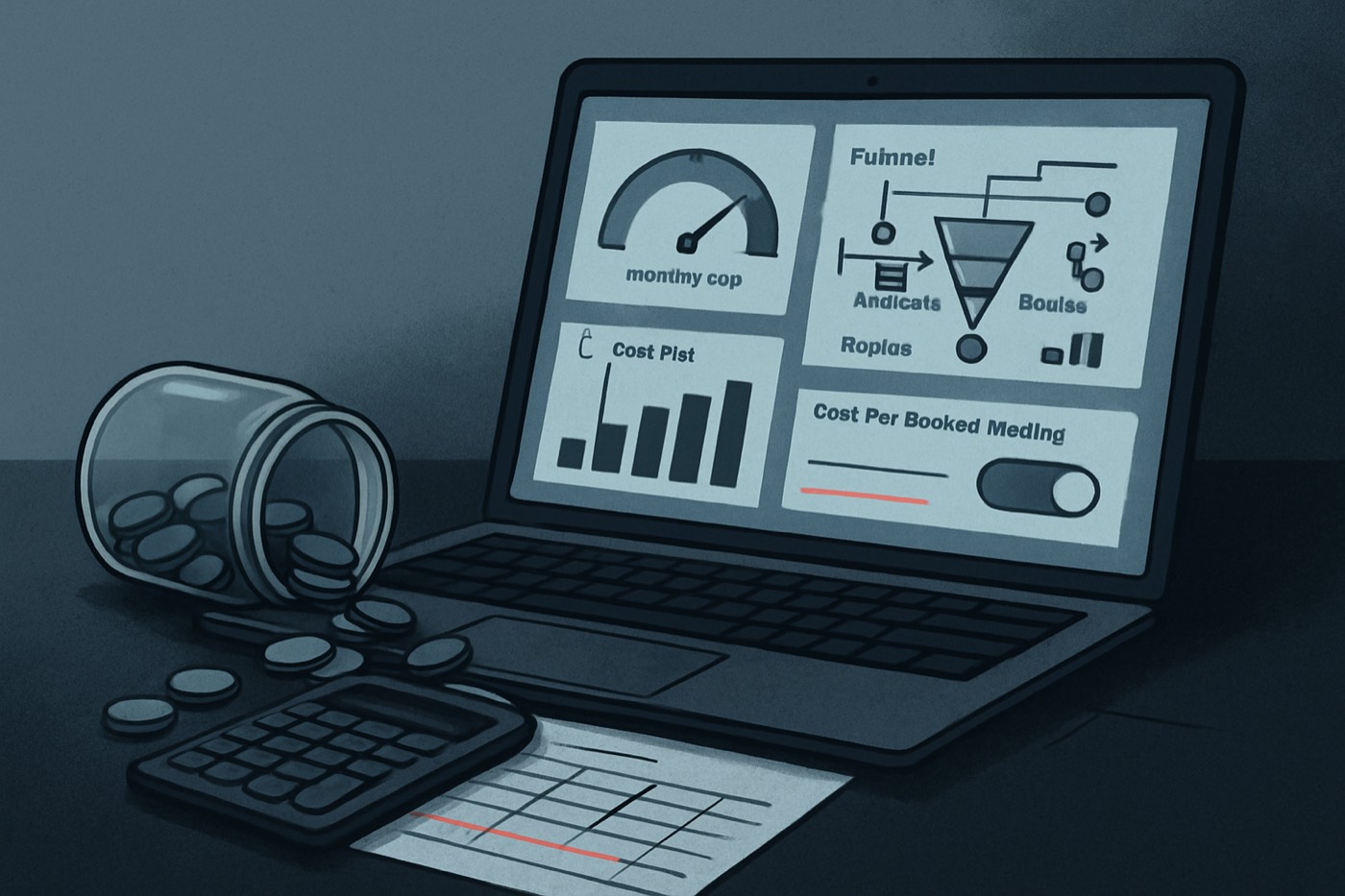
Seat-based pricing was built for software that waits for a human to click. An autonomous sales agent does the clicking itself, all day, so the work stops tracking headcount and the meter moves to what got done. That is the shift behind Salesforce Flex Credits and HubSpot Credits: every step the agent takes becomes a billable line item.
The vendor packaging will keep changing. The math underneath does not. This is a durable cost model you can reuse no matter whose rate card you are reading, built on the one unit a CFO will sign off on: cost per booked meeting.
Why seat pricing broke
Seat pricing made sense when a license meant one person doing a fixed amount of work. Autonomous agents break that in two ways.
- Work decouples from headcount. One operator can run the output of several SDRs. Seats stay flat while usage climbs.
- Value shows up as throughput. More leads researched, more emails written, more replies handled, more meetings booked.
So vendors moved the meter from "who logs in" to "what got done." Salesforce anchors this with Agentforce Flex Credits, a consumption model tied to Actions. HubSpot anchors it with HubSpot Credits and an outcome-based model where you pay when the agent completes its assigned task. Same destination, different packaging.
How the two main meters work today
Salesforce Flex Credits (pay per action)
Salesforce defines an Action as a specific function the agent performs on-platform: updating a record, summarizing a case, answering a question, running a prompt or flow. Each Action draws down a pool of Flex Credits.
Salesforce's published pricing references Flex Credits at $500 per 100,000 credits, and its rate guidance puts a standard production action at around 20 credits. Work that through:
- $500 / 100,000 credits = $0.005 per credit
- 20 credits per standard action = roughly $0.10 per action
That is the meter. Every time the agent does a thing, the clock ticks. Salesforce also leans on usage insights and demand forecasting in its own pitch, which tells you the bill can get unpredictable fast unless you watch it. Confirm the current rate and per-action consumption in your own contract before you model on it.
HubSpot Credits (pay on task complete)
HubSpot moved Breeze Customer Agent and Breeze Prospecting Agent to outcome-based pricing, where you pay when the agent completes the task it was assigned, and it standardized usage billing across the platform via HubSpot Credits. HubSpot's announcement describes a model of 50 credits per resolution for the Customer Agent.
HubSpot's own docs focus more on administration than on a public per-credit list price, so the dollar figure you will see quoted (commonly around $10 per 1,000 credits, which would make 50 credits about $0.50 per resolved item) comes from ecosystem reporting rather than a headline rate card. Treat it as a working estimate and validate it in writing.
One caution worth more than the price itself: "pay when the task is complete" is not the same as "pay only when you get pipeline." Completion usually means the agent produced its deliverable, not that a prospect booked a meeting. Pin down exactly which event triggers a charge before you sign.
The cost model that survives a CFO review
Start with a unit finance respects: cost per booked meeting. Everything else is an input.
Step 1: define billable work
Write one definition you will reuse across vendors:
Action (billing unit): a metered agent operation that consumes credits. A prompt, a flow, a record update, an enrichment call, a classification, or a completed task.
For Salesforce these are Actions. For HubSpot the unit is credits per completed task or per deliverable, depending on the agent. The point is to name your unit, not to adopt a vendor's label.
Step 2: map actions per lead
Moving a lead from raw to ready-for-outreach usually triggers a chain like this:
- ICP fit check, 1 action
- Enrichment of company and contact, 1 to 3 actions
- Write the personalized email, 1 to 2 actions
- Build the sequence steps, 1 action
- Log activity and update fields, 1 to 2 actions
That lands around 6 to 9 actions per agent-prepped lead. Your stack will differ, which is exactly why you map it once for your own workflow.
At about $0.10 per action, that is $0.60 to $0.90 per lead processed. Those are small numbers. Volume is what makes them matter.
Step 3: get to cost per booked meeting
Meetings come from conversion rates, not optimism. Define:
- L = leads processed
- M = meetings booked
- A = actions per lead
- C = cost per action (or per completed task)
- r = meeting rate (M / L)
Then:
- Total cost = L × A × C
- Meetings booked = L × r
- Cost per booked meeting = (A × C) / r
That last equation is the whole game.
Per-action example. A = 8 actions, C = $0.10, r = 1% (1 meeting per 100 leads):
- (8 × $0.10) / 0.01 = $80 per meeting
Let the meeting rate slip to 0.5%:
- (8 × $0.10) / 0.005 = $160 per meeting
Same agent, same workflow, double the cost per meeting, purely because conversion dropped. Targeting and copy quality move this number more than the rate card does.
Task-complete example. Say a prospecting agent charges per lead recommended for outreach at roughly $1 (commonly quoted as about 100 credits per lead at standard rates, again worth confirming). Your A × C collapses into $1 per qualified lead:
- 2% of recommended leads book: $1 / 0.02 = $50 per meeting
- 0.5% book: $1 / 0.005 = $200 per meeting
Outcome-based billing still punishes weak targeting. It just hides the meter behind nicer language.
Budget moves from seats to forecasted workload
The real change is how you plan spend.
Old world: "We have 6 SDRs, so we buy 6 seats."
New world: "We process 12,000 leads a month, we expect a 1.2% meeting rate, and each lead triggers about 8 actions. That is our monthly burn, and here is the meeting count it should produce."
Both vendors push usage monitoring and forecasting inside their products for exactly this reason: consumption pricing needs operational control. If your finance team cannot forecast usage, they will default to the safe move and cap it, delay it, or kill it.
Buying checklist: prevent surprise invoices
You want autonomous outbound. Then buy it like an operator.
Budget guardrails
- A monthly credit cap by workspace, business unit, or pipeline stage.
- Auto-pause rules at 80%, 90%, and 100% of budget.
- Pre-buy credit packs when volume is predictable; reserve pay-as-you-go for the genuinely spiky months.
Throttles
- Max leads processed per day.
- Max emails sent per domain per day (deliverability wants this anyway).
- Max research tasks per hour.
- No retries after N failures on bounces or missing data.
Audit logs
Require a log of every billable event with a timestamp, the object ID (lead, contact, or deal), the agent or workflow name, and the reason it ran, exportable to CSV for finance. If a vendor cannot show you the raw usage events, it cannot defend the invoice.
Define billable work in writing
This is where teams get burned. Get clear answers, in the contract:
- Is a lead billable when it is recommended, enriched, emailed, replied to, or qualified?
- Do retries count?
- Do internal test runs count?
- Is sandbox usage billed differently? (Salesforce, for one, distinguishes production from sandbox consumption.)
Operational hygiene
- Send spend-threshold alerts to Slack and email.
- Give one owner the budget, RevOps or finance, not "everyone."
- Run a weekly burn review: credits consumed against meetings booked.
- Insist on a billing-preview view that reconciles against the invoice line items.
Why cost per action is a trap metric
Vendors love per-action pricing because it sounds cheap. "Only $0.10 per action." "Only $1 per lead." Cool story. Now show actions per lead, leads per meeting, meetings per close, and close rate. Autonomous agents make it trivial to run huge volume, and volume is not automatically good. A bad ICP plus cheap actions still burns cash, just faster.
Operator take
If you remember one thing: buy the pricing model that keeps cost per booked meeting predictable. Not cost per seat, not cost per action, not credits "included for free." You want stable unit economics, hard caps, clean audit logs, throttles you control, and clear definitions of what triggers a charge.
One practical lever sits underneath all of this: the more meters running in parallel across stitched-together tools, the harder the forecast. Keeping the work end-to-end in one place, from ICP to booked meeting, means one model to reason about instead of five.
Chronic is an autonomous revenue operator. You set the goal, the budget, and the approval level, and it runs the outbound system end to end, up to the booked meeting:
If you are comparing platforms:
Related operator reads:
- AI SDR ROI: the only scorecard that matters
- Open tracking is the new spam trigger: what to measure instead
- Outbound deliverability governance: the SOP that keeps your pipeline alive
FAQ
What is an AI sales agent pricing model?
It is how a vendor bills for autonomous work. The market is shifting from seat-based licenses to consumption billing, either pay-per-action (Salesforce Flex Credits) or pay-when-the-task-completes (HubSpot Credits). The durable way to compare them is to convert any rate into cost per booked meeting.
What counts as an action in Salesforce Agentforce Flex Credits?
Salesforce defines an Action as a specific function the agent performs on-platform, such as updating a record, summarizing, answering an inquiry, or running a prompt or flow. Each Action consumes Flex Credits.
How much do Salesforce Flex Credits cost?
Salesforce's published pricing references $500 per 100,000 credits, and a standard production action is guided at roughly 20 credits, which works out to about $0.10 per action. Confirm the current rate and per-action consumption in your contract.
How does HubSpot's pay-when-the-task-is-complete billing work?
HubSpot moved Breeze Customer Agent and Breeze Prospecting Agent to outcome-based pricing where you pay once the agent completes its assigned task, billed through HubSpot Credits (the announcement describes 50 credits per resolution for the Customer Agent). Note that "complete" means the deliverable was produced, not that a meeting was booked.
What KPI should finance use to evaluate autonomous sales spend?
Cost per booked meeting. Seats no longer correlate with output. If you cannot forecast both consumption and your conversion rate, you cannot forecast spend.
How do we avoid surprise invoices with credits-based AI agents?
Before rollout, put in place monthly caps with auto-pause rules, daily throughput throttles, exported audit logs for every billable event, written definitions of what triggers a charge, and spend-threshold alerts. Both Salesforce and HubSpot position usage monitoring and forecasting as core parts of these systems; use them.
Run the numbers, then scale
Build the spreadsheet. Define your action. Estimate actions per lead and meetings per lead. Calculate cost per booked meeting. Then set the caps, throttles, and audit logs before you turn the agent loose.
Autonomous outbound prints pipeline. It also prints invoices. Choose the model that makes the first number go up and the second one predictable.