Ask Attio can take action. Here's how to test it, and where it stops short of booked meetings.
Ask Attio can answer questions, update records, create tasks, and draft emails inside Attio. That is real action, but it stops at CRM hygiene. Booked meetings come from running outbound end to end, not from chatting with the database.
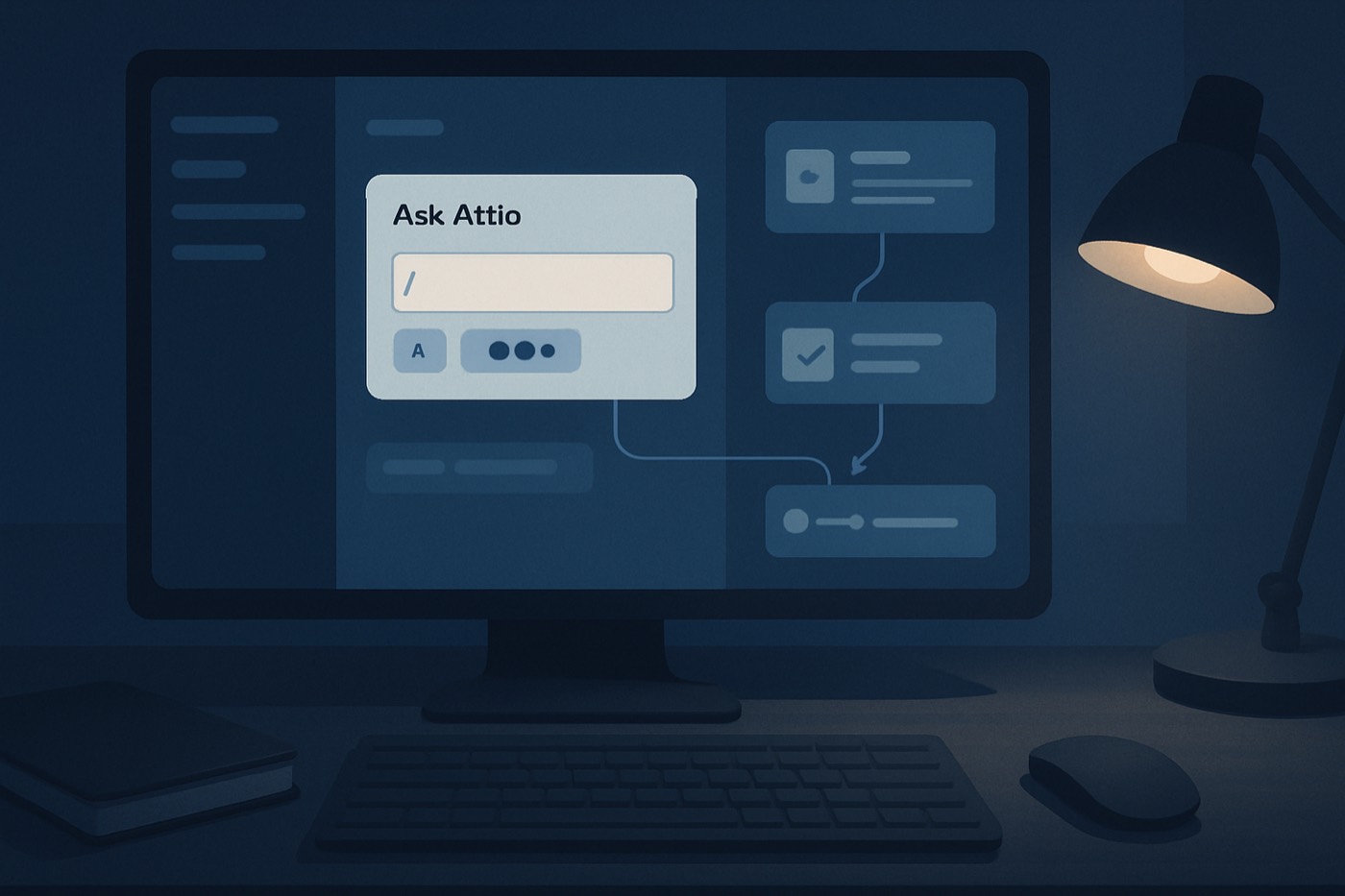
Ask Attio is not "AI bolted onto a CRM." Attio is changing what the CRM does. The old deal was simple: reps type notes, ops builds fields, the database stores it. The new one is louder: you ask, the CRM answers, then it updates itself, then it queues the next step.
That is a bigger shift than the chat box suggests. The CRM is moving from a place you record work to a place that does some of the work, one plain-language request at a time. Attio made it explicit, framing the launch as "Ask Attio in plain language and it'll do the work for you," and noting that it carries context across steps. That is agent behavior, not search. (Attio changelog)
This post is a buyer's guide, not a hype piece. If a CRM assistant can write to your records and trigger work, you are no longer evaluating a feature. You are evaluating who gets to act on your data and what stops them when they get it wrong. Below is a five-layer test you can run in any demo, plus an honest line on where an action-capable CRM ends and where booked pipeline actually begins.
What Ask Attio actually claims
Here is what Attio says Ask Attio can do, straight from its own documentation:
- Answer questions and summarize CRM data.
- Create and update records.
- Create tasks.
- Draft emails.
So Ask Attio is not a sidebar search bar. It crosses the line from "tell me about the data" to "change the data." That line is the whole fight in CRM right now.
Attio is not alone. Salesforce telegraphed the same direction with Einstein Copilot and its actions, wrapped in a trust layer: audit trail, masking, and mediation between the model and your data. Different product, same gravity. (Salesforce press release) And Gartner put a number on the macro trend: it predicts that by 2028, a third of interactions with generative AI services will use action models and autonomous agents to complete tasks. (Gartner press release)
So "chat inside the CRM" is not the story. The story is that the assistant can now write and execute. Which means the real questions are about control, not conversation.
Three kinds of "AI in the CRM," and only one is real
Most AI launches in this category fall into one of three buckets. It helps to name them before a sales call so you do not mistake one for another.
Bucket 1: search with a nicer wrapper. Natural language over your objects. Summaries. "What is at risk this week?" Useful, but it is retrieval, not an agent.
Bucket 2: drafting. Write emails, write call follow-ups, rewrite notes. Also useful, also not an agent. It is content generation.
Bucket 3: action with state change. Update records, create tasks, trigger workflows, keep context across steps. This is the one that changes your risk profile.
Ask Attio puts itself in bucket 3. "Ask Attio to take action" is the phrasing Attio uses. (Attio changelog) And Attio documents a detail most vendors leave vague: Ask Attio has the same viewing permissions as the user who invokes it. That is not full governance, but it is a concrete permission model rather than a promise. (Attio Help Center)
Here is the blunt version. Once write access exists, every vendor will call itself an agent vendor. The thing worth paying for is not the label. It is who can prove control when the assistant gets something wrong.
The five-layer test: read, write, execute, govern, outcomes
This is the framework that survives a procurement review. Run the layers in order. Each one raises the stakes.
1. Read (question and answer)
This is where most teams start, and it is the easy part.
What to demand:
- Grounded answers with links back to the source records.
- Cross-object queries that behave like real joins, not a plausible story.
- Explainability: it can tell you which data it used.
What to force in the demo:
- "Show me the pipeline for enterprise accounts in healthcare, excluding subsidiaries." Watch it handle hierarchy, filters, and definitions, or watch it choke.
- "Which deals have no next step?" Watch whether it confuses task due date with next meeting with last activity.
Attio says Ask Attio can handle complex cross-feature queries and chooses which sources to use based on the question. That is genuinely capable, and it is also the surface where a confident wrong answer hides best. (Attio Help Center) Read access is necessary. It is also the floor, not the product.
2. Write (updates)
The moment a CRM can update itself, you stop buying software and start buying policy.
What real write access looks like:
- Updates the correct object and the correct record.
- Uses your actual field definitions.
- Refuses ambiguous instructions instead of guessing.
- Shows a preview before committing, or logs a clear diff after.
What to test:
- Hallucinated updates: "Set ARR to $250k" on a record with no ARR field, or the wrong one. Does it create junk, or fail safely?
- Incorrect joins: "Update the decision maker's title" when several contacts exist. Does it guess, or does it ask?
- Missing context: "Move to Qualified" when your definition requires specific fields. Does it enforce your rules, or bulldoze them?
Attio states Ask Attio can create or update records. Your job as a buyer is to find out whether that is cautious write access or confident chaos, and the only way to find out is to break it on purpose. (Attio Help Center)
3. Execute (tasks and outreach)
Writing to the CRM is internal hygiene. Execution is where the next sales motion actually happens.
Execution means:
- Create tasks with owners, due dates, and context.
- Draft outreach and attach it to the right record.
- Trigger workflows.
- Run multi-step actions without losing state.
Attio lists task creation and email drafting among Ask Attio's capabilities. (Attio Help Center) That is the wedge, and the next steps are obvious to imagine: "start the sequence," "follow up in three days if no reply," "book the meeting."
That is also where the gap opens. Drafting an email inside a CRM and running outbound that lands a meeting are different jobs. The second one needs mailbox warming and deliverability monitoring, enrichment that does not rot, lead scoring, sequencing logic, send throttling, and compliance discipline. A chat box does not supply any of that. It just gives you a new way to ask for it.
This is the line Chronic draws. A CRM that drafts an email is fine. Pipeline comes from running the whole motion until a meeting is on the calendar, which is a different system than a CRM assistant.
4. Govern (audit, rollback, permissions)
Governance is the difference between an AI feature and a production system you can defend to your team and your auditors.
Minimum requirements:
- Permissions: the assistant inherits the user's permissions, plus admin-controlled scopes for what actions it may take.
- Audit log: who asked, what it read, what it wrote, what it triggered.
- Rollback: revert fields, stage changes, created tasks, drafted emails, and any workflow it set off.
Salesforce sells trust as a product layer, including a customer-owned audit trail. That is the enterprise bar now. (Salesforce press release) Attio's stated model, the assistant inherits the user's viewing permissions, is a start, but it covers read. Buyers still need to demand governance over write and execute, not just read. (Attio Help Center)
Note the direction of travel: Attio publishes MCP documentation, which means the CRM is being set up as a surface that other tools and agents can call into. (Attio MCP docs) Once external agents can act on your CRM, governance stops being a nice-to-have and becomes table stakes. If you want the academic framing, auditing generative AI applications is now treated as layered work across governance, the model, and the application itself, with the application layer being the part you cannot skip. (arXiv: A Blueprint for Auditing Generative AI)
5. Outcomes (meetings booked)
For anything outbound, one KPI matters: did it produce a meeting.
Not time saved. Not emails drafted. Not notes summarized. The outcomes that count are meetings booked, pipeline created, cycle time reduced, and win rate improved.
Ask Attio is a strong signal that CRMs are becoming places where things happen. The blunt question is whether it books meetings, or whether it makes the CRM feel smarter while a human still runs every hard part of the motion. If a vendor cannot connect "ask" to "booked," you are buying a better interface, not more pipeline.
What this signals about where CRMs are going
CRMs are converging on the same shape: a natural-language interface, an action library, a workflow engine, a permission model, and an audit-trail story. Attio has it. Salesforce has it. HubSpot is pushing agents and workflows too, even if the packaging shifts by tier and credits. (Salesforce press release, HubSpot 90-day GTM workbook)
So a chat box inside the CRM is no longer a differentiator. The differentiator is execution quality under real constraints: messy data, duplicate contacts, multi-entity account hierarchies, inconsistent lifecycle definitions, reps writing freehand in structured fields, compliance requirements, and the plain reality of email deliverability.
Ask Attio is, in effect, an admission that the old CRM interface is on its way out. The new interface is intent expressed in language, and the CRM's job is to turn that intent into safe action on the data it holds.
The demo checklist: what to demand
Print this. Use it. Be the annoying buyer.
Ask for a failure demo, not a happy path. Tell them up front: "We are going to try to make it fail. If it fails safely, we keep talking." If they refuse, you already have your answer.
Then run the five layers in order.
Read, under cross-object complexity. "List open deals where last activity is older than 14 days, grouped by owner, and include the last email subject line." "Which accounts match our ICP but have zero touches in 30 days?" Look for correct filters, correct joins, links to source records, and a clean "I don't know" when it should not guess.
Write, under ambiguity. "Set next step to 'Security review' for Acme" when several Acmes exist. "Update ARR to 300k" when ARR could mean several things. It passes if it asks a clarifying question, previews the specific records, and refuses to guess.
Execute, the play. "Create tasks for the owner: send pricing, schedule technical validation, confirm legal contacts." "Draft a follow-up referencing the last call notes and the objection raised." It passes if ownership is right, due dates are right, and it pulls the correct context.
Govern, the proof. "Show me the audit log of what the assistant changed." "Revert the last action." "Restrict the assistant from changing stages." It passes if you can prove what happened, undo damage, and scope what it is allowed to touch.
Outcomes, the only KPI. "Show me a cohort where this increased meetings booked." "Show leading indicators tied to meetings, not activity spam." If the answer is "time saved," push back hard.
The three ugliest failure modes, and how to smoke them out
Hallucinated updates. It confidently writes values that were never in the system, or writes to the wrong field. To test it: ask it to update a field that does not exist, a record that does not exist, and a field that exists on one object but not another. Safe behavior is to refuse, ask for a specific record, or show a preview.
Incorrect joins. It answers cross-object questions with plausible nonsense. To test it: ask for "the decision maker" when several contacts exist, ask for parent-account logic, ask for attribution across touchpoints. Safe behavior is to show which records it joined and ask for definitions instead of pretending.
Missing context. It acts without pulling the relevant notes, calls, or stage definitions. To test it: ask it to draft an email referencing "the last call," then check that it actually used the last call; ask it to advance a stage, then check whether required fields are enforced. Safe behavior is to cite what it used and flag what is missing.
Where Chronic picks up where the CRM stops
Ask Attio is a good move, and it proves the direction of the market. But most CRMs stop at "AI inside the CRM," which is a nicer place to do manual work, not pipeline on autopilot.
Chronic is not a CRM and not an "AI CRM." It is an autonomous revenue operator. You give it a revenue goal, and it runs the outbound motion end to end, surfacing approvals only for the decisions that matter:
- Finds and enriches prospects that fit your ICP, and keeps that data fresh.
- Scores them on fit and intent so effort goes where it has a chance.
- Writes and sends cold email from managed, warmed mailboxes, protecting your domain and deliverability.
- Handles replies and books meetings while you close.
The Ask Attio assistant can draft an email and update a record. Chronic owns the part the CRM was never built for: the deliverability, scoring, sequencing, and follow-up discipline that turn outreach into a meeting.
If you want the execution layer, not just the chat layer:
- ICP definition that does not drift: ICP builder
- Enrichment that does not rot on day two: Lead enrichment
- Scoring that prioritizes action: AI lead scoring
- Outbound copy that maps to real relevance, not "nice email": AI email writer
- A pipeline view that matches how outbound actually works: Sales pipeline
If you are weighing Attio specifically, the side-by-side is here: Chronic vs Attio. The one-line contrast: Attio is a modern CRM with an action-capable assistant; Chronic is autonomous outbound that produces booked meetings.
For deeper operator guidance:
- Relevance patterns that beat "nice email" in 2026: Cold email personalization patterns
- Sort targeting from deliverability before you blame the AI: Outbound debugging triage
- The 30-day playbook for agent-first GTM: Agent-first GTM playbook
FAQ
What is Ask Attio?
Ask Attio is Attio's AI interface that can answer questions about your CRM data, summarize it, and take actions: creating or updating records, creating tasks, and drafting emails. (Attio Help Center, Attio changelog)
Why does Ask Attio matter if other CRMs already have AI assistants?
Because the contest is not who has chat. It is who can safely take action. The moment an assistant writes to your CRM and triggers work, you are buying governance and execution quality, not a search box.
What is the difference between read access and write access?
Read access means the assistant retrieves and summarizes data. Write access means it changes records and creates new data. Write access introduces real risk, which is why you need audit trails, scoped permissions, and rollback before you trust it.
What should I demand in an Ask Attio demo?
Ask for a failure demo: ambiguous records (duplicate company names), cross-object questions that need real joins, write actions like stage changes and field updates, and proof of governance through an audit log and permission scoping. If the demo only shows summaries and drafted emails, you are looking at a content tool, not an operator.
What are the biggest risks with a CRM assistant that can take action?
Three common ones: hallucinated updates, incorrect joins across objects, and acting without the right context. Test all three directly, in front of the vendor, using your messiest sandbox data.
Is a CRM chat assistant enough to get more meetings booked?
No. Meetings come from running outbound: enrichment, scoring, sequencing, deliverability, compliance, and follow-up discipline. A CRM assistant can draft and update inside the database. It does not run that motion. That is the job Chronic does.
Run the demo like you mean it
Treat any action-capable CRM assistant as a change in who gets to touch your data:
- If it can act, it must be governable.
- If it can write, it must be reversible.
- If it can execute, it must connect to outcomes.
In your next demo, do this in order: make it answer a cross-object question and verify the sources; make it update a record with ambiguity and watch whether it guesses; make it create tasks and check ownership and context; make it prove governance with an audit log; make it tie its work to meetings booked. That is the bar. Ask Attio did not invent it. It just made it obvious. And once you have set that bar, ask the harder question: do you want a CRM that can act, or an operator that runs the whole motion until the meeting is booked?