Autonomous CRM vs AI features: the only buyer framework that matters in 2026
AI features assist a rep; an autonomous revenue operator runs the outbound itself, end to end, and books meetings under guardrails. Score any vendor on four things: inputs, decisions, actions, and proof (audit log, stop rules, rollback).
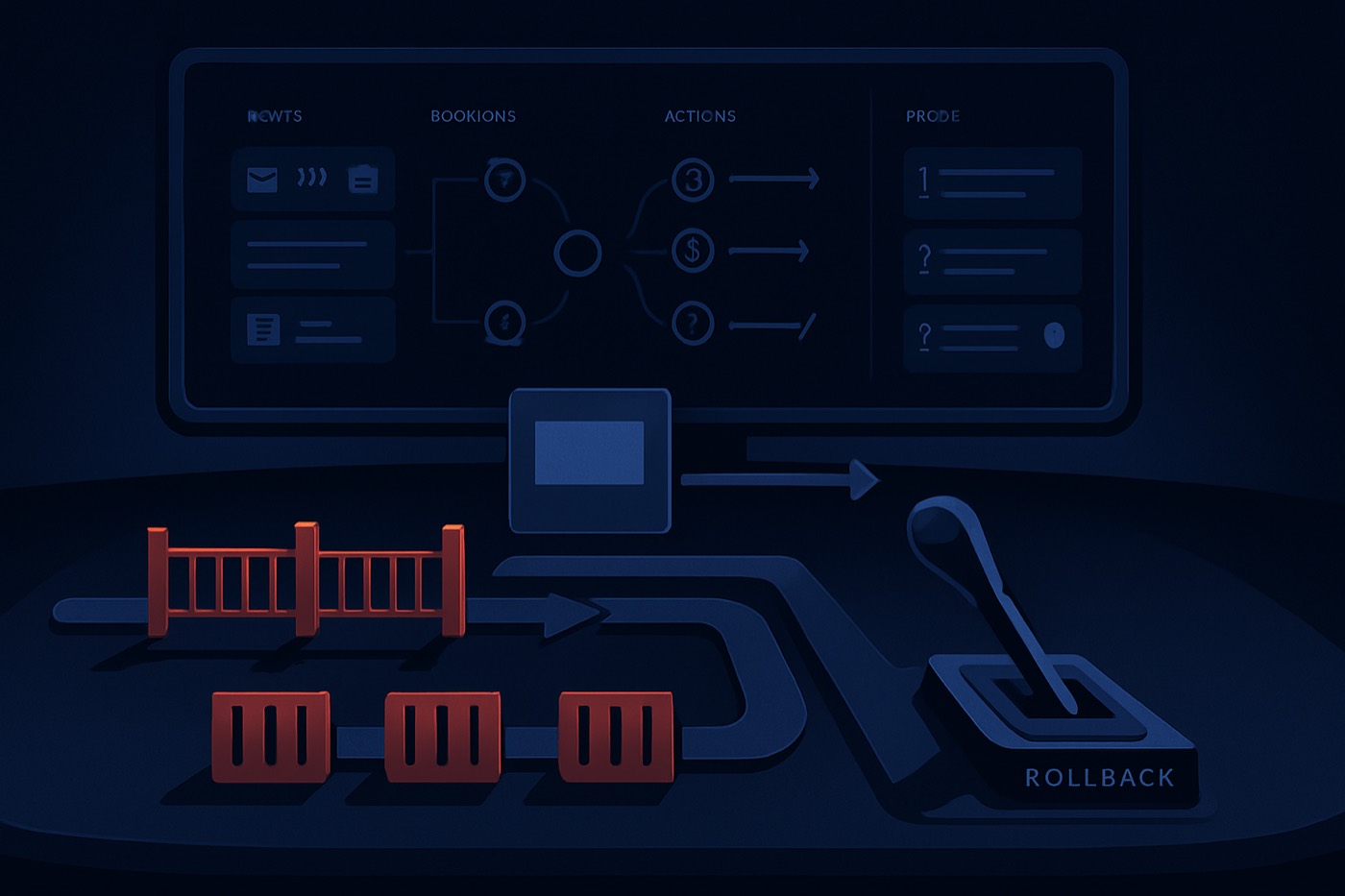
AI features make reps faster. An autonomous operator makes pipeline happen. That difference decides whether your "AI rollout" turns into a weekly status meeting, or a calendar with booked calls on it.
The 2026 split: assistant vs operator
The word "autonomous CRM" is doing a lot of work in vendor decks right now, and most of it is marketing. So strip the label and ask what the software actually does. There are only two answers.
AI features (the assistant)
AI features inside a CRM are assistive: they generate content or insights but do not reliably run multi-step work without a person approving, routing, or babysitting every step.
Think summaries, drafts, "next best action" suggestions, a chat box. A human still drives.
Microsoft positions Copilot in Dynamics 365 Sales as an AI assistant focused on day-to-day productivity, which is exactly what "AI features" are. Useful, but assistive. (Microsoft Learn - Copilot in Dynamics 365 Sales overview)
An autonomous operator (the worker)
An autonomous revenue operator is a system that continuously turns data and signals into decisions and actions across the outbound workflow, with governance (auditability, controls, stop rules) and measurable outcomes.
It does not just recommend. It runs the play: finds the right accounts, writes and sends the email, handles the replies, books the meeting, and shows you why each step happened.
That is the category Chronic is in. Not a system of record with an AI button bolted on. A system that does the outbound work end to end and asks for your approval only on the decisions that matter.
The hard line buyers need in 2026
Most vendors will blur this line on purpose. "Agentic." "AI-powered." "Automations." Fine. Show the autonomy.
The rule
If the product cannot take action on your behalf based on live signals, with clear stop rules and an audit trail, it is not autonomous. It is a CRM with AI features.
Salesforce is openly pushing this direction with its "agentic enterprise" narrative and Summer '26 release messaging, which is a signal that the market is moving from assist toward agents. (Salesforce Summer '26 release announcement)
The buyer's job is simple: stop buying marketing words. Buy a system that acts.
The buyer framework that matters: Inputs, Decisions, Actions, Proof
This is the framework to bring into every demo. Four buckets. No fluff. It works whether the vendor calls itself a CRM, an agent, or an operator, because it scores what the software does, not what it is named.
1) Inputs: data and signals (what it knows)
Autonomy dies without inputs. AI without fresh data becomes confident nonsense.
Minimum inputs an autonomous operator needs:
- Firmographics: industry, headcount, geo, funding
- Technographics: tools used, stack changes
- Contact data: verified emails, phones, roles
- First-party activity: replies, meetings booked, site visits, product events (opens are weak)
- Intent signals: job posts, tech install and uninstall, review activity, competitor comparisons, keywords, content consumption
- Deliverability health: domain reputation, bounce rates, spam signals
- CRM history: past sequences, objections, stages, outcomes
Demo demand (inputs):
- "Show me the exact sources of the signals you use."
- "Show me how often they refresh."
- "Show me what happens when a field is missing or wrong."
If the answer is "we integrate with everything," that is not an answer. That is an integration slide.
Chronic angle: autonomy starts with automatic ICP definition and continuous enrichment, not manual list uploads and hope. See ICP Builder and Lead Enrichment.
2) Decisions: scoring and prioritization (what it decides)
This is where AI features usually stop. They generate a summary. They recommend a task. Then your rep ignores it.
An autonomous operator has to decide:
- Who to contact next
- Which channel to use (email, call, LinkedIn, route to an AE)
- Which message to send
- When to follow up
- When to stop
- When to escalate or ask for human approval
Salesforce's Agentforce direction is explicitly about building and deploying agents across apps, which is the market admitting that decisions are the core product. (Salesforce Developers Blog - Summer '26 guide)
The decision test. Ask one question:
- "Where does the system decide the next action, and what variables drive that decision?"
If they cannot point to a decision layer (deterministic rules blended with reasoning), you are looking at AI frosting.
Chronic angle: decisions should be explicit and measurable. Chronic uses dual fit and intent scoring to prioritize, so it does not spray and pray. See AI Lead Scoring, and the deeper logic in Intent and fit scoring in 2026.
3) Actions: research, write, send, follow up, route (what it does)
Autonomy means the system executes work end to end.
Minimum action set for outbound autonomy:
- Research the account and persona
- Write and personalize the first touch
- Launch the sequence
- Adapt follow-ups based on engagement and intent changes
- Handle replies: classify, respond, route, or book
- Book meetings on calendars
- Update pipeline stage and fields
- Create a task only when a human is required
If it only drafts, you still have a rep-shaped bottleneck.
Microsoft's Copilot roadmap shows "sales agent" capabilities like summaries and research features, but you still have to validate whether it is taking end-to-end action or assisting inside the workflow. (Microsoft Learn - Copilot for Sales 2026 wave 1 planned features)
Chronic angle: don't pitch templates, pitch outcomes. Chronic runs outbound end to end, until the meeting is booked, with AI Email Writer and a managed workflow that feeds Sales Pipeline. Deliverability is part of the action set, not an afterthought: see Cold email deliverability in 2026.
4) Proof: audit log, stop rules, rollback, outcomes (what you can verify)
Autonomy without proof is risk. Legal risk, brand risk, revenue risk, and the most dangerous one, internal-politics risk.
This is why governance standards are getting real. NIST's AI Risk Management Framework is built around trustworthy AI and risk-management practice, which maps directly to what sales leaders need once an agent starts taking actions. (NIST AI RMF)
ISO/IEC 42001 is now the formal AI management-system standard. Translation: show your work. (ISO - ISO/IEC 42001:2023)
Proof buyers should demand:
- Audit log: every action, timestamped, with the inputs and the reasoning
- Policy and permissions: what the agent can do, where, and when
- Stop rules: hard brakes for risk conditions
- Rollback: the ability to undo changes and quarantine outputs
- Outcome reporting: meetings booked, reply rate, spam complaints, pipeline created, cost per meeting
Gartner's agent coverage is increasingly centered on "guardian" patterns, meaning oversight layers that monitor and block unsafe actions. That is the enterprise telling you what it will require in procurement. (Gartner press release on guardian agents)
The framework as a scoreboard
Bring this into every demo. Score 0 to 2 per line. Anything under 14 out of 20 is AI features, not an operator.
Inputs (0 to 2 each)
- Signal freshness and coverage (first-party plus third-party)
- Enrichment accuracy and verification
- Data hygiene automation (dedupe, field normalization)
Decisions 4. Transparent scoring model (fit plus intent) 5. Prioritization that changes with signals 6. Decision governance (policies, approvals)
Actions 7. End-to-end outbound execution 8. Reply handling and routing 9. Meeting booking and pipeline updates
Proof 10. Audit log with reasoning 11. Stop rules 12. Rollback and remediation 13. Outcome dashboard tied to revenue 14. Deliverability safeguards
If they dodge "stop rules," you have your answer.
The 10-question demo script for 2026
Use these exact lines. They force clarity.
"Show me where it decides the next action." Not suggests. Decides.
"What inputs does that decision use?" List the fields and signals, on screen.
"Show me how prioritization changes when intent spikes." Pick a lead. Flip the signal. Watch the queue reorder.
"Show me what it does when intent drops." Does it pause, change the message, switch channels, or keep spamming.
"Show me the stop rules." Hard brakes: negative intent, unsubscribe risk, legal keywords, role mismatch, competitor customer, do-not-contact.
"Show me the permissions matrix." What the agent can do without a human, what needs approval, who owns it.
"Show me the audit log for one prospect, first touch to meeting booked." Every action, every reason.
"Show me the rollback." Undo a sequence launch. Revert CRM field updates. Quarantine an email variant.
"Show me outcomes for the last 30 days." Meetings booked, reply rate, spam complaints, pipeline created. No vanity graphs.
"Show me what humans still do." A real operator reduces human work to exceptions and closers. Everything else is theater.
If the sales engineer gets uncomfortable, good. That is your signal.
What buyers get wrong: feature checklists instead of autonomy
Mistake 1: Buying drafts instead of decisions
Email drafts are cheap. Decisions are hard. Decisions need inputs, models, and governance.
Mistake 2: Confusing workflow automation with autonomy
"When field changes, create task" is automation, not autonomy. Autonomy chooses the action and executes it.
Mistake 3: Ignoring governance until procurement blocks the deal
Systems that act need accountability. The standards are moving toward that, not away from it. NIST AI RMF and ISO/IEC 42001 exist because "trust me" is not a control. (NIST AI RMF, ISO 42001)
Mistake 4: Letting the vendor pick the demo path
Vendors love a curated demo. You need uncurated reality. Bring your own:
- 50 accounts you actually want
- 1 disqualified segment
- 5 existing customers (to test suppression)
- 1 compliance constraint (industry, region)
The usual suspects, one line each
You will evaluate tools like Apollo, HubSpot, Salesforce, Pipedrive, Attio, Close, and Zoho. Some have serious AI. Most still orbit human-driven workflows, which means the work still lands on your reps.
- Salesforce: a large platform moving hard into agents, which also means complexity and governance overhead. Chronic's take: Salesforce Summer '26 and "agentic CRM".
- HubSpot: strong CRM and automation, but autonomy depends on how far the agent acts without babysitting. Comparison: Chronic vs HubSpot.
- Apollo: strong data and outbound workflows. Real autonomy depends on decisioning, stop rules, and proof. Comparison: Chronic vs Apollo.
- Enterprise CRMs in general: per-seat pricing stacks up fast, and you still bolt on four other tools to run outbound. Comparison: Chronic vs Salesforce.
That is enough. Buyers do not need a 40-row table. They need the framework.
What autonomous outbound looks like when it is real (the Chronic model)
The category is abstract until you map it to a workflow that books meetings. Here is the loop Chronic runs:
- Define the ICP with real constraints, not vibes: ICP Builder
- Find and enrich leads automatically, with contacts and firmographics: Lead Enrichment
- Score with fit and intent, and reorder the queue as signals change: AI Lead Scoring
- Write personalized outbound at scale: AI Email Writer
- Run sequences from managed, warmed mailboxes with guardrails and stop rules, update pipeline fields, and push booked meetings in: Sales Pipeline
- Prove outcomes: meetings booked, pipeline created, and the audit trail that explains why each action happened
Want the signal layer behind it? Read The 2026 outbound scorecard. Want infrastructure that holds up under volume? Read Cold email domain rotation in 2026.
The buyer checklist you should actually use
If you buy AI features, optimize for:
- UX inside the CRM
- Draft quality
- Summary accuracy
- Easy adoption
That purchase makes reps faster.
If you buy an autonomous operator, optimize for:
- Signal quality and refresh rate
- Decision transparency
- Action coverage across the full workflow
- Governance: audit log, stop rules, rollback
- Outcomes tied to meetings and pipeline
That purchase makes pipeline happen.
FAQ
What is an autonomous revenue operator in one sentence?
It is software that turns sales signals into decisions and actions automatically, runs outbound end to end, and proves what happened with audit logs, controls, and measurable outcomes, asking for approval only on the decisions that matter.
How do I tell if a vendor is selling AI features instead of autonomy?
Ask "show me where it decides the next action." If it cannot point to a decision layer plus stop rules and an audit trail, it is assistive AI inside a CRM.
What are stop rules and why do they matter?
Stop rules are hard constraints that pause or block actions when risk appears, like negative intent, suppression lists, compliance flags, or deliverability threats. Without them, autonomy turns into spam against your own domains.
Do I need ISO 42001 or NIST AI RMF for a sales tool?
You do not need certification to buy software, but you do need the behaviors these frameworks push: transparency, accountability, oversight, and documentation. NIST AI RMF and ISO/IEC 42001 exist because unmanaged AI risk gets expensive fast. (NIST AI RMF, ISO 42001)
Can Salesforce or Microsoft do this on their own?
They are moving toward agents, especially in the 2026 releases, but autonomy depends on implementation, permissions, governance, and whether the system actually executes end-to-end workflows in your environment. Start with the demo script and force proof. (Salesforce Summer '26 announcement, Dynamics 365 Sales Copilot overview)
What should I demand as proof that autonomy is working?
A per-prospect audit trail from first touch to meeting booked, stop rules that trigger in real time, rollback for mistakes, and outcomes reported as meetings booked and pipeline created, not "AI activity."
Run the demo. Force the truth.
Bring the framework. Ask the 10 questions. Do not let the vendor steer.
If the product acts end to end and shows proof, it is an autonomous operator. If it assists and asks your reps to do the real work, it is AI features.
Pipeline does not care about your feature list. It cares about booked meetings. Chronic runs the work end to end, until the meeting is booked. Pipeline on autopilot.