Autonomous outbound guardrails: what they actually are, what vendors fake, and 12 questions to ask before you buy
Guardrails for an autonomous sales agent come down to five things: policy, permissions, verification, auditability, and rollback. If a vendor cannot show deterministic stop rules, a sandbox, and a real audit trail, it is a chatbot with a calendar.
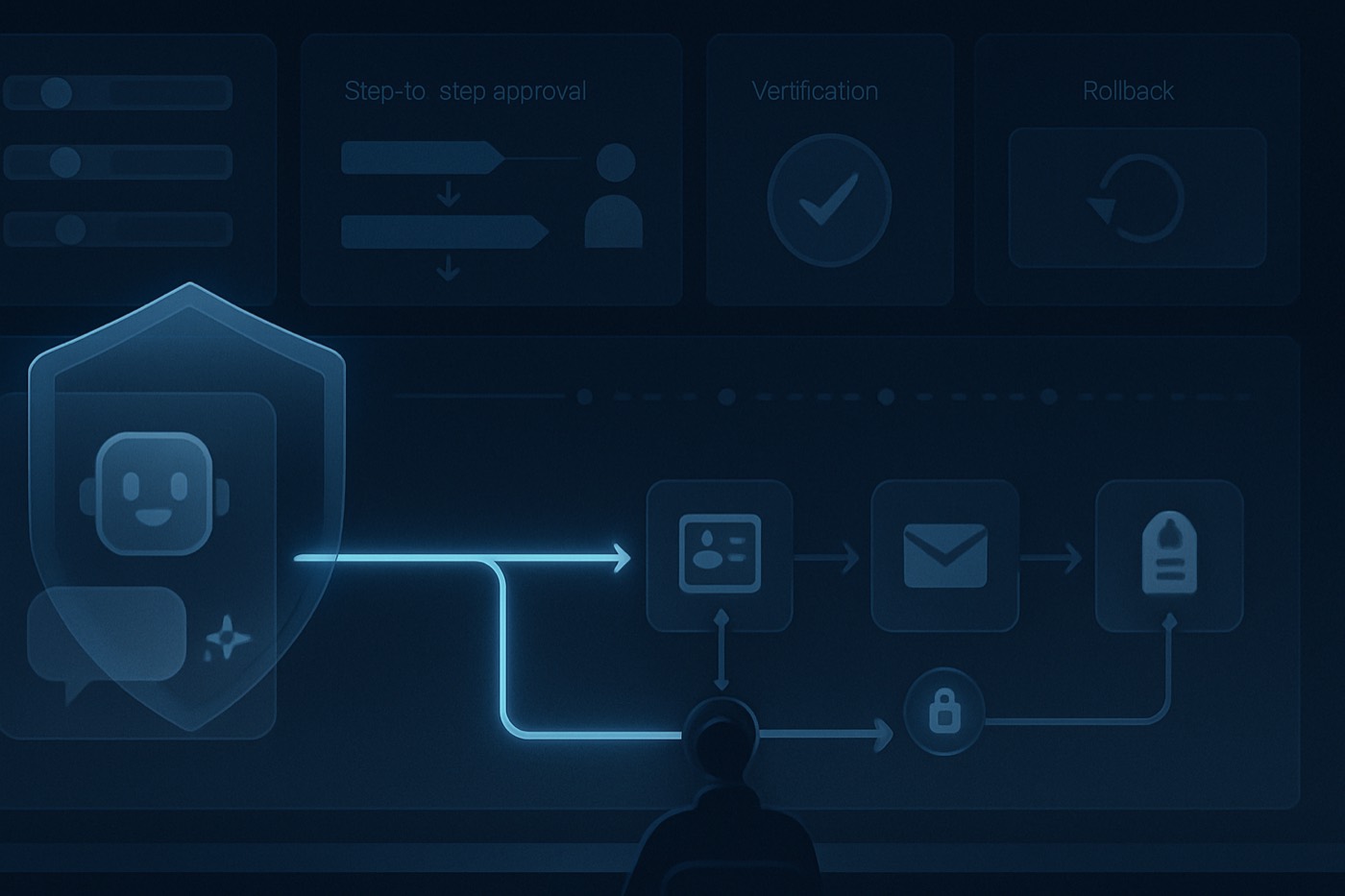
Enterprise vendors have started saying the quiet part out loud: advisory AI alone has run its course. ServiceNow, pitching its CRM line, frames the goal as agents that "sense, decide, and securely act in accordance with organizational guardrails." Translation: less chat, more execution, with boundaries. (newsroom.servicenow.com)
The market is shifting from "AI features" (summaries, drafts, copilots) to autonomous work: multi-step jobs that actually complete. The big platforms are anchoring that shift in their CRM messaging. (techtarget.com)
The only problem: most vendors fake autonomy. They ship prompt templates and call them agents. They demo "book a meeting" and quietly skip the parts that matter: stop rules, approvals, audit trails, rollback, and a sandbox.
That missing layer is the whole game. This guide is about the layer, not the logos. Whether the thing acting is bolted onto a system of record or, like Chronic, runs outbound as a standalone operator, the same five controls decide whether autonomy is safe to turn on.
The shift: vendors are selling "finish the work," not "assist the rep"
The framing across enterprise vendors is aggressive: software should stop being a record system where humans babysit handoffs. ServiceNow's CRM messaging is "built to finish the work," spanning sales and service. (newsroom.servicenow.com)
They are also attacking a real operational pain: reps live in tool soup. ServiceNow's own CX research claims 80% of service reps toggle between three to five systems to answer one customer question. (servicenow.com)
That context matters because autonomy only pays off when:
- The agent can touch multiple systems.
- The agent can take action, not just draft text.
- The agent can prove what it did, why, and how to undo it.
ServiceNow is not alone. Salesforce pushes Agentforce and explicitly talks about visibility and control as the blockers at scale. (investor.salesforce.com) Gartner projects that 40% of enterprise apps will feature task-specific AI agents by 2026, up from less than 5% in 2025. (gartner.com)
The direction is not subtle. Neither is the buyer trap: teams will buy "autonomous" tooling that cannot be governed.
What an autonomous operator actually does (no theater)
An autonomous sales agent is not a chatbot bolted onto a database. A real one:
- Observes signals (email, calls, web, intent, account status).
- Decides next actions against a stated objective.
- Executes actions across systems.
- Checks results.
- Records everything.
- Can be stopped, constrained, and reversed.
If it cannot execute safely, it is not autonomous. It is assistive. Which brings us to the part that decides whether you can ever leave it running.
Guardrails: the only definition that holds up in production
Guardrails are the controls that keep an agent useful at scale instead of dangerous at scale. Use this definition, and do not negotiate with vendors who want to "define it together."
Guardrails = policy + permissions + verification + auditability + rollback
- Policy Written rules for what the agent can do, when, and why.
- "Never email current customers from outbound domains."
- "Do not contact accounts with an open security incident."
- "No discount offers without human approval."
- "Stop outreach after an unsubscribe, hard bounce, or legal hold."
- Permissions Real access control. Not "admin can toggle it."
- Role-based access, least privilege.
- Scoped credentials per action.
- Environment separation (production vs sandbox).
- Verification Proof before action, and proof after action.
- Validate that a lead matches the ICP before sequencing.
- Validate that an email domain is safe before sending.
- Confirm the calendar slot is real before booking.
- Confirm the write succeeded and did not violate schema rules.
This is where vendors hand-wave most. Verification costs engineering time. Demos are cheaper.
- Auditability A human can answer: what happened, who authorized it, what inputs were used, what actions were taken, what changed in which systems, and what the agent "saw" at the time.
Salesforce markets a customer-owned audit trail as part of its enterprise AI story. (salesforce.com) Whether you use Salesforce or not, the standard is correct: autonomy needs audit.
- Rollback Undo capability, cleanly.
- Revert field changes.
- Stop sequences immediately.
- Pull scheduled messages.
- Restore previous routing rules.
- Recreate prior pipeline state.
Rollback is the difference between "we tried an agent" and "we can run an agent." If a vendor cannot show rollback, assume your team becomes the rollback.
What vendors fake (and why it works in demos)
Here is the standard sleight of hand. You have seen it. You maybe bought it.
1) Prompt templates sold as "agents"
If the "agent" is a prompt, it is not an agent. It is a text generator. A prompt can be useful; it is not autonomous. A real agent needs:
- Action tools (APIs, workflows, writes).
- State (what happened earlier).
- Policies and constraints.
- Execution monitoring.
Without that, you get pretty emails and a messy pipeline.
2) No action sandbox
Vendors demo actions in production because it looks real. A real system supports:
- Dry runs that generate an execution plan.
- Simulated side effects.
- Diff views before committing changes.
No sandbox means every "test" becomes an incident.
3) No deterministic stop rules
This is the line in the sand: if it cannot enforce stop rules, it is not autonomous, it is a chatbot with a calendar.
Stop rules must be deterministic, not "the model will probably do the right thing." Examples:
- Stop if bounce rate exceeds X% over the last Y sends.
- Stop if an account enters an opportunity stage.
- Stop if a legal flag is set.
- Stop if a reply says "stop" or reads as a clear opt-out.
Deterministic rules are not flashy. They are what keeps you employed.
4) Missing human approvals where they matter
Autonomy does not mean "no humans." It means "humans approve the right things." Approval gates should exist for:
- New domains and inbox ramp.
- Messaging changes above a threshold.
- Discounting, pricing, and contract steps.
- High-risk vertical outreach.
- Data exports.
McKinsey's State of AI reporting finds that high performers are more likely to define when outputs require human validation. That is the grown-up move. (mckinsey.com)
5) Weak audit trails (or none)
"Logs" are not audit trails. An audit trail needs:
- Inputs (data context, prompts, retrieved docs).
- Tool calls (which APIs it hit).
- Outputs (what it wrote, what it sent).
- Timing and actor identity.
- Exceptions and retries.
- Approval records.
NIST's AI Risk Management Framework frames governance and risk management as core to trustworthy AI. It is not sales-specific, but the principle lands hard: you need accountability mechanisms, not magic. (nist.gov)
The maturity model: assistive, semi-autonomous, autonomous
Most teams buy "autonomous" at level 1 and wonder why nothing changes.
Level 1: Assistive
What it does
- Summarizes calls.
- Drafts emails.
- Suggests next steps.
- Fills fields.
Guardrails you need
- Data access policies.
- Redaction.
- Basic logging.
Failure mode
- Everyone loves it for two weeks.
- Nobody trusts it enough to change the process.
Level 2: Semi-autonomous
What it does
- Executes actions with approvals.
- Runs playbooks with clear gates.
- Updates records based on verified triggers.
Guardrails you need
- Policy engine (rules).
- Scoped permissions.
- Approval workflows.
- Action sandbox.
- Strong audit trails.
Failure mode
- Approval bottlenecks.
- Teams blame the tool, not the fact that they never defined policy.
Level 3: Autonomous
What it does
- Runs multi-step workflows end to end.
- Self-monitors, self-stops, escalates.
- Books meetings, routes replies, updates pipeline, triggers handoffs.
Guardrails you need
- All of Level 2.
- Deterministic stop rules.
- Continuous verification.
- Rollback and incident response.
- Governance reporting.
Failure mode
- It works, then someone asks "who approved this," and you realize you never instrumented the system.
Where Chronic fits: autonomy that books the meeting, with guardrails that keep it sane
Chronic is not a CRM. It is an autonomous revenue operator: you give it a revenue goal and it runs the outbound system end to end, from finding the right prospects to writing and sending cold email from managed, warmed mailboxes, handling replies, and booking the meeting, surfacing approvals only for the decisions that matter.
The guardrails show up in the unsexy parts:
- Clear ICP constraints via the ICP Builder
- Verified data before action via Lead Enrichment
- Prioritized execution via AI Lead Scoring
- Controlled messaging via the AI Email Writer
- Observable execution state in the Sales Pipeline
Protecting the client's domains, mailboxes, and customer relationships is the point, not an afterthought. If you want the operator view on consolidation, read The 2026 Outbound Stack Collapse. Too many "agent" tools are just new tabs for old work.
The 12 questions to ask before you buy (print this and ruin a demo)
These questions force specifics. If the vendor answers with philosophy, you found the fake.
1) What actions can the agent take, exactly?
List the tool calls:
- Send email
- Pause sequence
- Create deal
- Update stage
- Write notes
- Assign owner
- Book meeting
- Create tasks
- Route replies
If the answer is "it can do a lot," that means "it cannot do much."
2) Show me your action sandbox
Ask for:
- Dry-run mode
- Execution plan preview
- A diff of proposed changes
- Simulated sends without deliverability risk
No sandbox means no controlled rollout.
3) What are the deterministic stop rules, and where are they enforced?
You want:
- The rules list
- Rule evaluation timing
- Whether rules run before every action
- Evidence that rules override the model
If rules are "guidelines," you are buying hope.
4) What requires human approval, and can I configure it per team?
You want per-role gates: an SDR approves messaging changes, an AE approves pricing, ops approves routing rules. No gates means no production safety.
5) Where do permissions live, and what is the least-privilege model?
Ask:
- Are credentials scoped per agent?
- Per action?
- Per workspace?
- Can you restrict by object, field, and account?
"Admin controls everything" is not a security model.
6) What does the audit trail contain?
Require inputs, retrieved context, tool calls, output actions, approvals, timing, and actor IDs. Salesforce markets auditability as part of trusted enterprise AI, so the standard is now public. (salesforce.com)
7) Can I export audit logs to my SIEM or data warehouse?
If you cannot export, you cannot govern. You are renting visibility.
8) How do you verify identity and intent on inbound signals?
Agents love spoofed signals. Ask how they verify:
- Reply authenticity
- Domain alignment
- Calendar booking intent
- Spam traps
9) What is your rollback story?
Not "we can undo mistakes." Show:
- Reverting writes
- Canceling scheduled sequences
- Restoring assignments
- Recovering from partial failures
10) How do you handle incidents?
Ask for:
- An incident workflow
- Notification rules
- Kill-switch scope (global vs team vs agent)
- Root-cause reporting
Management standards are pushing audit trails and oversight into common practice. ISO/IEC 42001 calls out human oversight and logging controls at the management-system level, which tells you where enterprise buyers are headed. (iso.org)
11) What data do you store, and what data do you not store?
Be precise:
- Prompt retention
- Model training
- Log retention
- Redaction
- Customer-controlled storage
Salesforce has published details on security and architecture for its AI platform. Use it as a benchmark for the questions, even if you never buy Salesforce. (salesforce.com)
12) Show me a failure case
Ask them to demo a wrong ICP match, a risky message, and a bad routing decision. Then make them show:
- The stop rule firing
- The approval gate
- The audit-trail entry
- The rollback
If they only demo success, assume they cannot handle failure.
Common buying mistakes (the ones that burn quarters)
Mistake 1: Buying "autonomous" before you define policy
Policy is not documentation. It is operational law. Start with ICP exclusions, compliance rules, outreach limits, approval thresholds, and stop conditions. Then buy.
Mistake 2: Confusing "agent builder" with "agent guardrails"
Builders are fun. Governance is the job. If you want the governance angle in plain English, Chronic has already made the case: governance is permissions, boundaries, and audit trails. The novelty is not the agent, it is the control plane. See AI Agent Studio Sounds Fun. Governance Is the Job.
Mistake 3: Thinking autonomy is a feature instead of an operating model
Autonomy changes who owns pipeline hygiene, how playbooks run, how exceptions escalate, and how reporting works. If you keep the same org design, autonomy becomes another tab.
Positioning reality check: incumbents vs the agent pile-on
ServiceNow's angle is credible because they already live in workflows and cross-department execution; their CRM messaging is about a unified platform and agents completing tasks across sales and service. (newsroom.servicenow.com)
Salesforce's angle is credible because they own the CRM gravity well and are pushing Agentforce as a broad agent layer with visibility and control messaging. (investor.salesforce.com)
What is not credible is the mid-market pile-on where every outbound tool now calls itself "agentic" because it can write an email.
Chronic sits in a different lane. It is not a system of record you staff and maintain; it is the operator that runs the outbound motion for you, from a published flat price with unlimited seats, until the meeting is booked. Check vendors' current published pricing before you compare, since list prices change. If you are weighing it against a legacy stack, start with the direct comparisons:
- Chronic vs Salesforce
- Chronic vs HubSpot
- Chronic vs Apollo
- Chronic vs Pipedrive
- Chronic vs Attio
- Chronic vs Close
- Chronic vs Zoho CRM
Operator take: autonomy starts where stop rules start
Here is the test that ends the debate: if it cannot enforce stop rules, it is not autonomous, it is a chatbot with a calendar.
ServiceNow can call it Autonomous CRM. Salesforce can call it Agentforce. Gartner can publish curves all day. None of it matters if your agent cannot be governed.
So run the 12 questions. Demand sandboxes. Demand deterministic stops. Demand audit trails you can export. Demand rollback. Then let the agent work, because the win is simple: fewer handoffs, cleaner pipeline, more meetings booked, less human middleware.
Guardrails are not a nice-to-have. They are the price of admission.
FAQ
What are autonomous agent guardrails?
Guardrails are the controls that constrain and prove agent behavior in production: policy + permissions + verification + auditability + rollback. Without those five, "autonomous" is marketing.
How do I spot fake agents during a demo?
Ask for deterministic stop rules, an action sandbox, and rollback. If the demo only shows perfect outcomes and cannot show failure handling, you are looking at prompt theater.
Do we need human approvals forever?
No. Use approvals as training wheels. Start with approvals on high-risk actions, then tighten policy and verification until the system earns more autonomy. Semi-autonomous is a real endpoint for many teams.
What is the difference between assistive and autonomous?
Assistive tools draft and suggest. Autonomous systems execute multi-step workflows across systems and monitor outcomes. Assistive tools can live without rollback. Autonomous systems cannot.
Which standards matter for governance and auditability?
Use NIST AI RMF as a baseline for trustworthy AI practices. (nist.gov) If you want a formal management-system structure, look at ISO/IEC 42001 concepts like human oversight and logging, then map them into your agent program. (iso.org)
What is the first guardrail to implement if we are starting from zero?
Deterministic stop rules tied to objective signals: unsubscribe, bounce thresholds, customer status, legal flags, deal-stage changes. Stop rules prevent the failures that turn autonomy into a fire drill.
Run the buying play, not the vendor script
Pick one workflow that prints pipeline. Define the policy. Lock the permissions. Add verification. Require audit trails. Demand rollback. Then expand. Guardrails decide whether autonomy becomes compound growth or compound mistakes. Choose accordingly.