Best CRM for cold email outreach in 2026: 7 options (and when you don't need one)
The best CRM for cold email enforces data hygiene, stores deliverability signals (bounce, complaint, unsubscribe) as fields, syncs both ways with your sequencer, and auto-suppresses bad addresses. Salesforce and HubSpot lead on governance; Close and Attio suit outbound-native teams.
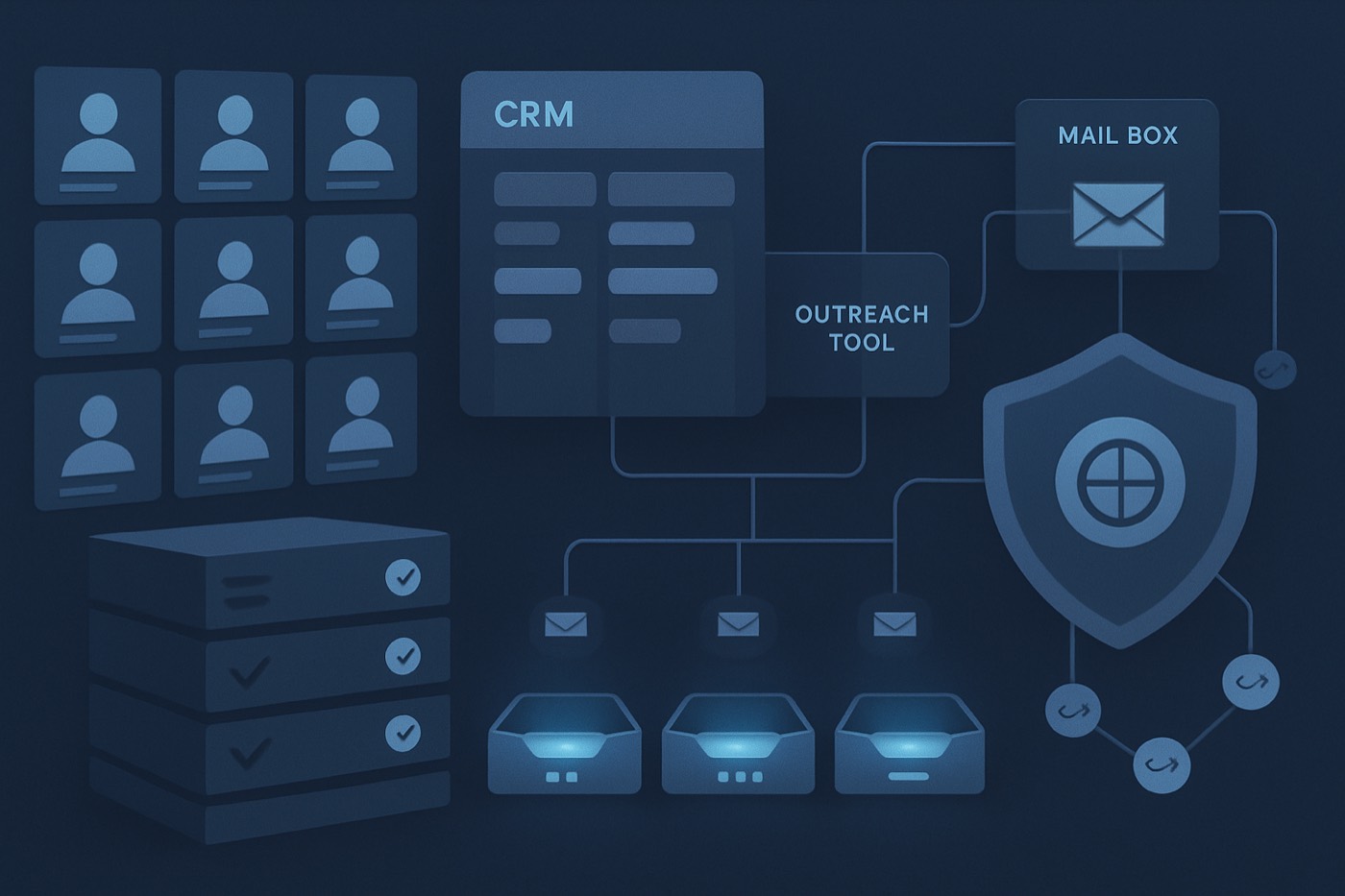
Cold email in 2026 is no longer "just send sequences." It is a data problem and a governance problem. Mailbox providers now publish hard requirements, and the teams winning outbound keep a clean record of every contact and enforce suppression before anything goes out. A CRM is one way to hold that record. Running an autonomous operator that owns the whole motion is another. This guide covers both.
A quick note on framing. A CRM stores and governs contacts; it does not, on its own, find prospects, write personalized email, warm mailboxes, or decide who to skip today. Cold email needs all of that. So "best CRM for cold email" really means "best CRM to sit at the center of an outbound stack you assemble and run yourself." If you would rather not run that stack, skip to the last section.
What "best CRM for cold email outreach" really means in 2026
In 2026, mailbox providers are explicit about requirements that directly affect outbound systems.
- Google's sender guidelines require authentication, a DMARC policy, keeping spam rates below 0.3%, and one-click unsubscribe for marketing messages. Your record-keeping and sending tools have to reliably capture unsubscribes and complaints, then enforce suppression at the data layer. (Google Workspace Admin Help, Google Workspace Admin Help)
- Yahoo's Sender Hub similarly calls for SPF and DKIM, a DMARC policy, one-click unsubscribe, honoring unsubscribes within 2 days, and keeping complaint rates below 0.3%. (Yahoo Sender Hub, Yahoo Sender Hub FAQs)
So "best" is not about who has the prettiest pipeline. It is about who can hold a clean record and enforce suppression without putting your domains and deliverability at risk.
Selection criteria that matter for cold email at scale
Use these to evaluate every option below.
1) Data hygiene: dedupe, validation, and controlled imports
Your CRM should support:
- Dedupe rules (by email, domain plus name, company plus website).
- Field-level governance: required fields, enums, and validation rules.
- Import controls: reject malformed emails, tag the source, record confidence.
Why it matters: dirty data inflates bounce rates and causes repeated sends to the same prospect across tools and teammates.
2) Deliverability fields: store signals where the team can use them
A cold-email-ready CRM needs structured fields like:
email_status(valid, risky, invalid, unknown)last_bounce_type(hard, soft, block)last_bounce_reason(mailbox full, user unknown, policy block)unsubscribe = true/falsecomplaint_flag = true/falsesuppression_reason(unsubscribed, complaint, hard bounce, do-not-contact, customer, partner)last_outreach_provider(Gmail API, Outlook, SMTP vendor, and so on)last_sequence_idandlast_sequence_step
This is how you build rules like "auto-suppress on hard bounce" or "pause when complaint_flag flips to true."
3) Two-way sync with your sequencer and email system
Look for:
- Native integrations or reliable middleware paths (Segment, Zapier, Make, webhooks).
- Two-way sync of status changes: unsubscribe, bounce, reply class, meeting booked.
- Clear field mapping so you do not create duplicates.
4) Auto-pause and suppression sync, without manual heroics
At scale, "someone will remember to pause" fails. You want:
- Auto-pause triggers (bounce spikes, complaint flags, domain-health changes).
- Suppression lists that sync back to sequencers and enrichment tools.
5) Activity logging without overcounting
Cold outreach produces a lot of events. Bad logging creates inflated activity numbers, messy timelines, and duplicate follow-ups. Your CRM should log sequence events as structured activities, and let you separate automated sends from human touches.
Decision matrix: 7 CRMs for cold email outreach (2026)
Scoring runs 1 (weak) to 5 (strong). These are practical, outbound-specific scores, not generic CRM scores.
| CRM | Best for | Data hygiene + dedupe | Deliverability field tracking | Sequencer integration | Auto-pause + suppression workflows | Activity logging control |
|---|---|---|---|---|---|---|
| Salesforce | Enterprise record + governance | 5 | 5 | 4 | 5 | 4 |
| HubSpot | B2B SaaS that wants adoption + guardrails | 4 | 4 | 4 | 4 | 4 |
| Close | High-velocity outbound + built-in email | 4 | 4 | 3 | 3 | 4 |
| Attio | Flexible object-based data modeling | 4 | 4 | 4 | 3 | 4 |
| Pipedrive | Simple pipelines + fast setup | 3 | 3 | 4 | 3 | 3 |
| Zoho CRM | Value-focused teams that need customization | 4 | 3 | 3 | 3 | 3 |
| Spreadsheet "CRM" | Solo consultants just starting outbound | 2 | 2 | 2 | 1 | 1 |
A note on Clay: it is not a CRM. It is the enrichment and list-building layer many teams put in front of their CRM. If you use it, your CRM still needs strict governance so enriched records do not bypass suppression.
1) Salesforce: strongest enterprise record for governed outbound
Salesforce remains the strongest choice when you need complex permissions, multi-team governance, rigorous data models, and auditability.
Why it works for deliverability-safe outbound. You can design strict suppression logic, validation rules, and field-level governance, backed by a mature workflow engine (Flows) and a deep integration ecosystem.
Trade-offs. You pay in implementation effort. If your outbound motion changes every week, you will need real RevOps support to keep up.
Pricing reference (editions and list prices): Salesforce publishes Sales Cloud suite pricing and tiers. (Salesforce pricing)
Best fit: enterprise and scale-up teams with RevOps capacity who want Salesforce as the record and specialized tools doing the sending.
2) HubSpot: best when you want adoption plus safety controls
HubSpot is often the fastest path to an organized record, especially for B2B SaaS.
Why it works for cold outreach. Practical CRM objects and properties, solid list segmentation, and workflow automation. It also documents daily send limits for connected emails, for example up to 500/day on Sales Hub Professional and 1,000/day on Enterprise. (HubSpot Knowledge Base) You can also set custom daily send limits to protect deliverability. (HubSpot Knowledge Base)
Trade-offs. Many teams bolt on an external sequencer anyway, which adds sync complexity. You need discipline around properties, dedupe rules, and lifecycle stages so outbound does not pollute your customer-marketing lists.
Pricing reference: HubSpot's published Sales Hub pricing includes Starter, Professional, and Enterprise seat pricing plus onboarding fees. (HubSpot blog)
Best fit: B2B SaaS teams that want one place sales and marketing can both live in, with strong guardrails.
3) Close: best when your team lives in one inbox
Close is built around high-velocity selling and ships with built-in email tooling.
Deliverability-relevant features. Close recommends including an unsubscribe link and can automatically add an opt-out link for connected accounts. (Close Help Center) It also documents how to manage unsubscribe requests and enable an unsubscribe link in bulk emails and workflows (plan dependent). (Close Help Center)
Trade-offs. If your stack already depends on an external sequencer, you may duplicate capabilities. For complex multi-brand outbound, you may want more object flexibility than Close offers.
Pricing reference: Close publishes its seat-based pricing tiers. (Close pricing)
Best fit: teams that want a single pane for calls and emails and are fine with a CRM that is also the engagement tool.
4) Attio: best modern CRM for flexible data modeling
Attio's object-based model is attractive for outbound because you can model accounts, contacts, buying committees, ICP-fit attributes, intent signals, and your own suppression and deliverability objects.
Outbound strengths. Modern data modeling that supports a clean outbound schema, and an easy path to reshape it as your strategy evolves.
Trade-offs. You still have to design the deliverability fields and suppression workflows yourself, and integrations and governance must be configured intentionally.
Pricing reference: Attio publishes plan pricing for Free, Plus, and Pro tiers. (Attio pricing)
Best fit: modern B2B teams comfortable designing their own outbound data model.
5) Pipedrive: best "simple pipeline" CRM in an outbound stack
Pipedrive stays popular when you want straightforward pipelines, fast onboarding, and a lot of integrations. It can hold the record while a sequencer does the sending. The open questions are whether you can enforce dedupe rules, suppression fields, and reliable two-way sync.
Trade-offs. You may outgrow it once you need heavy governance, custom objects, or complex routing logic.
Pricing reference: Pipedrive publishes plan pricing and tier breakdowns. (Pipedrive pricing)
Best fit: small to mid-sized teams that prize simplicity and already run a sequencer and enrichment layer.
6) Zoho CRM: best budget option with customization
Zoho often wins on value for teams that want customization but cannot justify Salesforce. Custom fields and automation are strong at the price point, and the Zoho ecosystem can cover adjacent needs.
Trade-offs. Integrations and workflow design take effort, and teams must avoid creating multiple sources of truth across Zoho modules.
Pricing reference: Zoho CRM pricing is published in ranges by tier, with reviews citing starts around $14/user/month (annual) depending on plan. (TechRadar Zoho CRM review)
Best fit: cost-conscious teams that still want workflow automation and customization.
7) Spreadsheet "CRM": where most solo outbound actually starts
A spreadsheet is honest about what it is: a list, not a system. It cannot dedupe reliably, store deliverability signals as enforced fields, or suppress before a send. That is fine for your first dozen prospects. It stops being fine the moment you have two senders, a second list, or a domain you care about.
Best fit: a solo consultant testing whether outbound works at all, with a plan to graduate within weeks.
The stack you are actually buying: record, sender, enrichment, monitoring
No single CRM does cold email by itself. The dominant architecture is a record system plus a sending system plus supporting layers:
- Record (governs contacts): Salesforce, HubSpot, Attio, Pipedrive, Zoho, Close
- Sequencer (sends): Instantly, Apollo, Smartlead, Lemlist, Outreach, Salesloft (capabilities vary)
- Enrichment + validation: Clay, Clearbit-style providers, internal data, verification tools
- Deliverability monitoring: inbox-placement tests, seed lists, domain-health tools
The whole thing lives or dies on the contract between the record and the sender:
- The record owns
suppression_status. - The sequencer must read suppression before sending.
- The sequencer must write events back: unsubscribes, bounces, replies, spam complaints (when available).
- The record must be able to auto-pause when high-risk signals appear.
Provider rules like one-click unsubscribe and the 0.3% complaint ceiling make this governance non-negotiable. (Yahoo Sender Hub, Google Workspace Admin Help)
Recommended stacks by team type
Agencies
Agencies need multi-client separation, strict suppression, and clean reporting.
- Record: Close or HubSpot (depending on client reporting needs)
- Sequencing: client-approved sequencer, or your standard
- Rules to enforce: separate workspaces or pipelines per client; a global suppression list per client; auto-pause on
complaint_flagor bounce spike; logging that separates automated sends from rep touches
B2B SaaS
B2B SaaS needs alignment across outbound, inbound, and lifecycle stages.
- Record: HubSpot or Salesforce
- Sequencer: a sales-engagement tool aligned to RevOps
- Rules to enforce: required lead source and acquisition channel; do-not-contact rules shared across marketing and sales; lifecycle stage that blocks outbound to customers and active trials
Consultants
Consultants need simple workflows, clean notes, and low overhead.
- Record: Pipedrive, Attio, or HubSpot Free/Starter
- Sequencer: a light sequencer with strong suppression support
- Rules to enforce: one master suppression field; dedupe on email; minimal activity types so the timeline stays readable
Implementation blueprint: set up a clean record in 7 steps
- Define your suppression taxonomy. unsubscribed, complaint, hard bounce, invalid email, customer, partner, internal.
- Create required deliverability fields.
bounce_type,bounce_reason,complaint_flag,unsubscribe,last_verified_at. - Set dedupe rules. Unique email for contacts; unique domain plus company name for accounts where possible.
- Set import gates. Reject accounts missing a website or domain; reject malformed emails; tag every import with
source. - Design two-way sync mapping. Record to sequencer: suppression, segments, ownership. Sequencer to record: events, replies, bounces, unsubscribes.
- Turn on auto-pause rules. Pause sequences when
complaint_flagis true, or when bounce rate crosses a threshold in a time window. - Fix activity logging. Log system sends as a sequence event; count only human touches for rep-productivity KPIs.
This architecture aligns with provider expectations around unsubscribe handling and complaint control. (Yahoo Sender Hub, Google Workspace Admin Help)
When you don't need a CRM for this at all
Everything above assumes you want to assemble and run the stack yourself: pick a record system, wire a sequencer, add enrichment and validation, design the suppression contract, and stay on top of domain health. That is real RevOps work, and for many founders and sellers it is the work they least want to do.
Chronic takes the other path. It is not a CRM and not a system of record. It is an autonomous revenue operator: you give it a revenue goal, and it runs the outbound motion end to end, finding prospects, enriching and scoring them, sending cold email from managed and warmed mailboxes, handling replies, and booking meetings. The suppression, deliverability, and governance discipline this guide says you must enforce is built into how the agent operates, and it surfaces approvals only for the decisions that actually need a human. It optimizes for qualified meetings held while protecting your domains, mailboxes, and customer relationships, not for emails sent or open rates.
So the choice is less "which CRM" and more "do I want to operate this stack, or have it operated for me." If you have RevOps capacity and want full control of the record, pick a CRM above and build the contract carefully. If outbound is your growth motion and you would rather set the goal and review the meetings, an autonomous operator removes the stack instead of adding to it. Many teams do both: keep a CRM as the long-term record, and let an operator run the outbound that feeds it.
FAQ
What is the best CRM for cold email outreach in 2026?
The best CRM for cold email outreach in 2026 is the one that keeps a clean record and syncs deliverability signals back into suppression and auto-pause workflows. Salesforce is the enterprise-governance pick, HubSpot is the adoption-plus-guardrails pick, and Close or Attio suit outbound-native teams. If you would rather not run the stack yourself, an autonomous operator like Chronic does the sending and governance for you.
Should my CRM send cold emails, or should a sequencer do it?
In most stacks, the sequencer sends and the CRM governs. The CRM owns suppression status, dedupe, segmentation, and logging rules, while the sequencer executes sending and writes events back. The alternative is an autonomous operator that owns both sides under one set of rules.
What deliverability fields should I store in my CRM?
At minimum: email validation status, last bounce type and reason, unsubscribe flag, complaint flag, suppression reason, and last outreach provider. Without these fields, you cannot reliably stop risky sending.
How do one-click unsubscribe rules affect CRM selection?
Google and Yahoo require one-click unsubscribe for marketing or subscription-style messages and expect complaint rates under 0.3%. Your record system must store unsubscribe status and enforce suppression across every sending tool. (Google Workspace Admin Help, Yahoo Sender Hub)
How do I prevent duplicate outreach across tools and teammates?
Make one system the record, with strict dedupe rules and a single suppression field set. Then require every sequencer and enrichment tool to read suppression before sending and write events back after.
Choose your path this week
- Pick Salesforce if you need enterprise permissions, governance, and deep customization, and you have RevOps to run it.
- Pick HubSpot if you want fast adoption across sales and marketing, plus built-in sending controls.
- Pick Close or Attio if your team is outbound-native and wants the record close to the work.
- Skip the build entirely if outbound is your main growth motion and you would rather set a goal and review meetings: let an autonomous operator run discovery, sending, replies, and booking inside the same suppression and deliverability rules.
Whichever path you choose, the non-negotiables are the same: a clean record, deliverability fields, enforced dedupe and import gates, two-way sync, and auto-pause. That is how you scale cold outreach in 2026 without putting your deliverability at risk.