Cold email reply rate dropped? 7 field-tested experiments to recover replies without burning deliverability
When your cold email reply rate drops, first decide whether the cause is deliverability, relevance decay, offer fatigue, or template fingerprinting. Then run controlled experiments, changing one variable at a time and judging on positive replies per delivered, not opens.
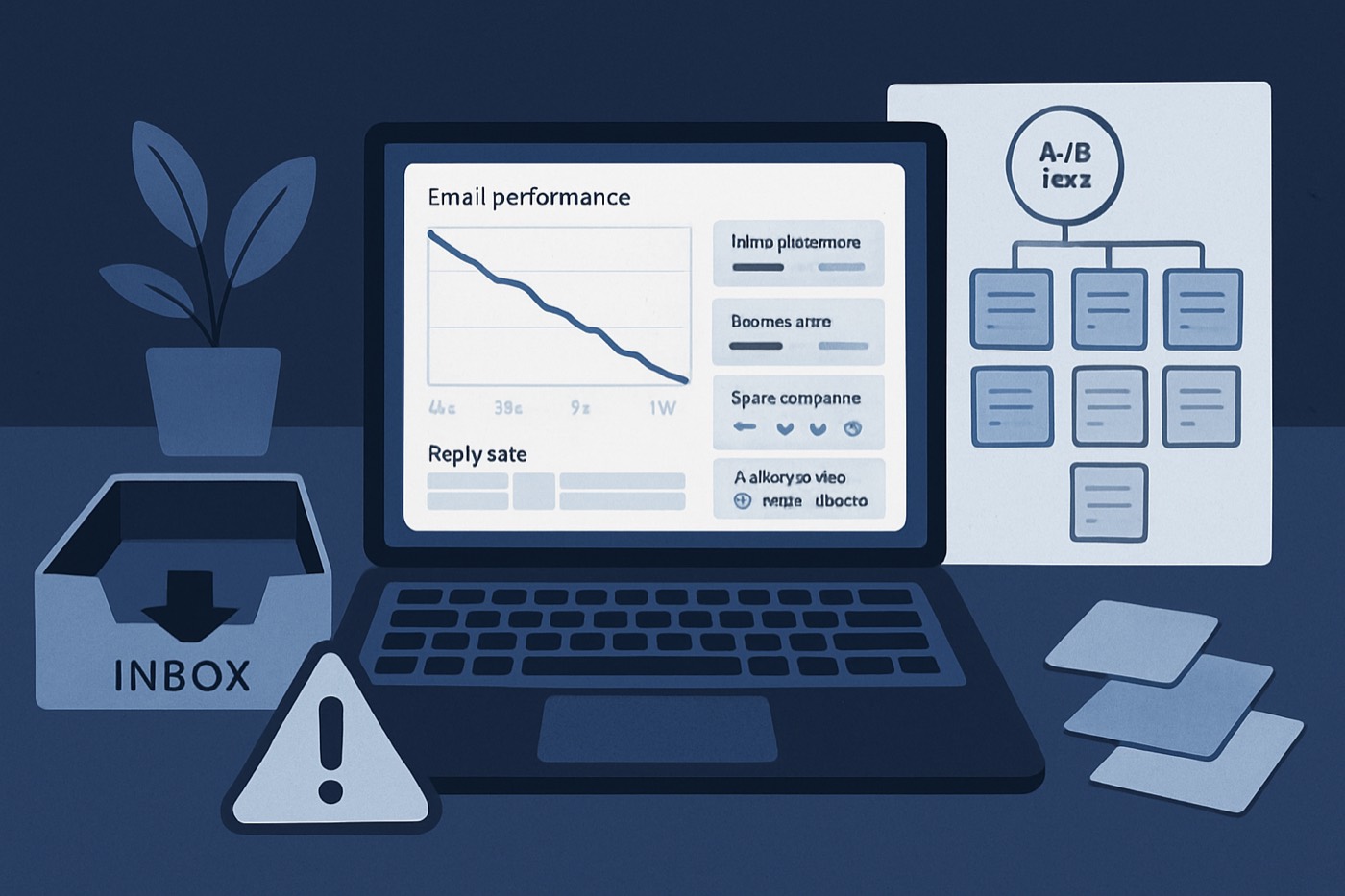
The same pattern keeps showing up across B2B outbound: deliverability looks "fine," opens are noisy or missing, but replies fall off a cliff. The story is not that cold email stopped working. It is that the margin for error collapsed. When your targeting is a little wider, your proof is a little weaker, or your template looks a little too familiar, you do not just lose a few replies. Filters get stricter, buyers get faster at pattern matching, and your "average" sequence starts performing like spam.
This is a guide to diagnosing the drop and recovering replies the disciplined way: small, controlled experiments instead of a panicked rewrite.
Why reply rates feel more fragile now
Even if you never touched your copy, the outbound environment kept moving:
Mailbox providers tightened bulk-sender expectations. Enforcement is tied to authentication, complaints, and unsubscribe handling. Gmail's sender guidelines call out a spam-rate target (keep user-reported spam below 0.1% and never hit 0.3%) and a one-click unsubscribe requirement for promotional mail. Microsoft moved to stricter enforcement for high-volume senders to Outlook properties, and Yahoo emphasizes one-click unsubscribe and sender reputation signals.
- Gmail sender guidelines FAQ: https://support.google.com/a/answer/14229414
- Yahoo Sender Hub (one-click unsubscribe / RFC 8058): https://senders.yahooinc.com/subhub/
- Yahoo FAQs (policy enforcement notes): https://senders.yahooinc.com/faqs/
- One-click unsubscribe standard (RFC 8058): https://www.rfc-editor.org/rfc/rfc8058
- Outlook bulk sender coverage (context and enforcement discussion): https://martech.org/new-rules-for-bulk-email-senders-from-google-yahoo-what-you-need-to-know/
Benchmarks stayed "okay," but averages hide the real problem. Many teams cluster in low single-digit reply rates, while top performers still hit strong numbers with tight data and real relevance. SalesHive cites cold email reply benchmarks around ~5%, with top teams higher, and Cognism's outbound report frames a wide gap between "industry average" reply rates and teams using verified data and better workflows.
- SalesHive cold outreach benchmarks: https://saleshive.com/blog/b2b-best-practices-email-outreach-2025/
- Cognism State of Outbound 2026: https://www.cognism.com/reports/state-of-outbound-2026
The takeaway: this is not a moment to "send more." It is a moment to learn faster than your list and your template decay.
First: diagnose which failure mode you have
When a team says "reply rates dropped," they usually mean one of four things. Your next steps depend on which one is true.
1) Deliverability decline (inboxing dropped, not interest)
Common symptoms
- Replies drop across all segments and personas at once.
- "Delivered" is stable but meetings and positive replies collapse.
- Bounces, spam complaints, or "this is spam" replies spike.
- Some inboxes (Gmail, Outlook) are disproportionately dead.
Fast check
- Compare reply rate by mailbox provider (Gmail vs Outlook vs custom domains).
- Check spam-complaint indicators and unsubscribe behavior against thresholds and requirements (Gmail specifically calls out the 0.1% target and 0.3% max for bulk senders). https://support.google.com/a/answer/14229414
Do not turn this into SPF/DKIM theater If you suspect deliverability, park the experiments for 48 hours and follow your engineering runbook:
- Cold email deliverability engineering: SPF, DKIM, DMARC, list-unsubscribe, and monitoring
- Email deliverability governance dashboard: a weekly scorecard template for RevOps
Then come back to the experiments below once inboxing is stable.
2) Relevance decay (your ICP drifted, your signals got noisier)
Common symptoms
- Replies drop mostly in specific industries, employee bands, or personas.
- You still get opens or clicks, but replies are "not relevant," "wrong person," "we don't do that."
- Segments that used to work now underperform.
Root cause Your segmentation logic is stale. The market did not "get harder." Your targeting got broader.
3) Offer fatigue (buyers recognize the pitch, even when it is valid)
Common symptoms
- Replies shift from curious to dismissive: "we already have this," "not a priority," "send info."
- Positive reply rate falls faster than raw reply rate.
- Competitors run similar angles, so your proof feels generic.
4) Template fingerprinting (structure-level sameness)
Common symptoms
- Your copy "sounds fine," but it is invisible.
- Multiple senders on your team use the same framework with minor synonym swaps.
- Prospects mention "AI email," "template," or respond with sarcasm.
Key point: filters and humans pattern-match structure, not adjectives. Rotating synonyms is not structural change.
For structures you can rotate into controlled tests:
The controlled-experiment approach
If your reply rate dropped, the fastest fix is not rewriting everything. It is running small experiments with explicit success criteria.
Rules
- Change one variable per experiment.
- Keep volume low enough to protect domains and learn cleanly.
- Judge on replies per delivered, not opens.
- Track both:
- Reply rate (all replies / delivered)
- Positive reply rate (qualified interest / delivered)
For what to watch weekly:
7 field-tested experiments to recover replies (with success criteria)
Each experiment is designed to separate signal from noise and avoid reputation damage.
Experiment 1: Rotate structure (not synonyms) to beat template fingerprinting
Hypothesis: Buyers and filters have seen your pattern. A structural rotation restores human novelty.
What to change (pick one structure, keep the offer constant)
- Observation-first: one specific observation, then a question.
- Contrarian: "Most teams do X, we see Y," then ask if it matches their world.
- Two-path: "Either you are doing A or B," ask which is true.
- Tiny case snippet: one metric, one sentence, one question.
Control
- Same ICP slice, same CTA, same sending schedule.
Success criteria
- A relative lift in reply rate vs control after 300-500 delivered per variant.
- No increase in negative replies ("stop spamming," "reporting") beyond your baseline.
Execution note If you need patterns that are structurally different, start here and build variants from it:
Experiment 2: Swap CTA type (reduce friction, increase specificity)
Hypothesis: Your CTA is too heavy for short attention spans, or too vague to answer quickly.
Test 3 CTA types (one at a time)
- Binary CTA: "Worth exploring, or not a fit?"
- Routing CTA: "Are you the right person for X, or should I talk to someone else?"
- Time-box CTA: "Open to a 10-minute sanity check next week?"
Control
- Keep the email body identical except the final sentence.
Success criteria
- Binary and routing CTAs should lift total replies (including "not interested").
- The time-box CTA should lift positive reply rate.
- Pick the winner by positive reply rate if pipeline is the goal.
Experiment 3: Tighten ICP bands (micro-segmentation, not "SaaS founders")
Hypothesis: Relevance decay is the real issue. Your segment is too wide, so your message is "kinda relevant" to nobody.
How to tighten
- Choose one dimension and narrow it:
- Employee count (e.g. 50-150 only)
- Funding stage (e.g. Seed to Series A only)
- Tech stack (e.g. HubSpot users only)
- Trigger window (e.g. hired first SDR in the last 60 days)
Success criteria
- If your segment is truly tighter, you should see:
- Fewer "not relevant" replies
- Higher positive reply rate
- Lower unsubscribe and complaint risk, because relevance improves
If you need segmentation recipes
Experiment 4: Change proof type (match buyer skepticism)
Hypothesis: Your proof is generic, so the offer feels like every other outbound pitch.
Proof types to test
- Customer proof: "We helped X reduce Y" (only if true and credible).
- Process proof: "Here's the 3-step audit we run" (no client name required).
- Artifact proof: "We can share the 1-page teardown" (deliver something tangible).
- Negative proof: "If you already have A and B, this is not for you" (ties into negative qualification).
Success criteria
- Proof-type changes should lift positive reply rate more than total replies.
- Watch for "send info" replies that do not convert. That is not a win unless it becomes a meeting.
Trust signals matter here If your offer is strong but prospects do not trust you, use this checklist:
Experiment 5: Introduce negative qualification (disqualify loudly to qualify faster)
Hypothesis: You are attracting polite non-buyers and training the market to ignore you.
How to do it Add one line like:
- "If you are not hiring SDRs this quarter, ignore this."
- "If outbound is not a channel you are willing to measure weekly, this will not help."
Why it works
- It signals confidence.
- It reduces "maybe later" dead replies.
- It often triggers the right prospect to respond: "We are hiring SDRs, but..."
Success criteria
- Total reply rate may stay flat.
- Positive reply rate should increase. That is the point.
- "Not a fit" replies should become cleaner and faster.
Experiment 6: Personalize with 1 strong signal (not 5 weak tokens)
Hypothesis: Your personalization is fake, too shallow, or too expensive to scale.
Pick one signal that correlates with need
- Hiring signal: "Saw you are hiring [role]."
- Tech signal: "Noticed you are on HubSpot + [tool]."
- Timing signal: "Congrats on the launch / funding / new geo page."
- Process signal: "Noticed your demo flow is [X]."
Rules
- One signal only.
- Tie it to the problem in one sentence.
- Do not add fluff ("love what you are doing").
Success criteria
- Lift in positive reply rate inside the same ICP band.
- Lower unsubscribe rate vs the generic variant.
Enablement note This is where it helps to have enrichment, signal scoring, and message generation working off the same data, so "one strong signal" is enforced as a requirement rather than left to whoever has time to research. For how to make that scoring trustworthy:
Experiment 7: Shorten sequences and run faster learning loops
Hypothesis: Your sequence is too long, so you accumulate risk (complaints, fatigue) before you learn what works.
What to test
- Replace an 8-touch sequence with:
- 3 emails over 7-10 days
- then stop
- recycle learnings into the next variant
Why it works
- You reduce fatigue on the domain and list.
- You get a quicker read on message-market fit.
- You avoid "dead weight" follow-ups that repeat the same pitch.
Success criteria
- Replies per 1,000 delivered should be equal or higher.
- Complaints and unsubscribes should drop.
- Time-to-first-reply should improve.
For scaling safely without torching reputation:
A measurement plan that keeps your experiments honest
You do not need a data warehouse to run clean outbound experiments. You need discipline in how you label and compare. The same structure applies whether you log it in a spreadsheet, a sales tool, or let an autonomous operator track it for you.
Tag every send so you can compare
Label each lead with the variables you are testing:
- ICP segment: e.g. "SaaS-Seed-50-150-HubSpot"
- Experiment ID: e.g. "E3"
- Variant ID: e.g. "E3-V1-tightband"
- CTA type: binary, routing, time-box
- Proof type: customer, process, artifact, negative
- Personalization signal: hiring, tech, timing, process, none
- Sequence version: e.g. "3-touch-10-days"
And capture the outcomes:
- Replied (any)
- Replied positive
- Replied negative
- Meeting booked
Hold out a control so you know if it's you or the market
For each ICP segment, hold back 10-15% of leads as a control:
- Same time period.
- No changes (or no send at all, depending on your baseline).
- Purpose: detect market-wide shifts and isolate the impact of your template.
Track each variant weekly
For every variant, report:
- Delivered
- Replies (any)
- Positive replies
- Meetings booked
- Unsubscribes (if available)
- Complaints (if available)
Then compute:
- Reply rate = replies / delivered
- Positive reply rate = positive replies / delivered
- Meetings per 1,000 delivered = meetings / delivered * 1,000
Decision rules (so you stop arguing)
- Promote a winner if:
- it shows a clear relative lift in positive reply rate, and
- no deterioration in unsubscribe or complaint trends.
- Kill a variant early if:
- negative replies spike, or
- "not relevant" replies dominate (re-segment instead of rewriting).
For a KPI stack built for the post-open-rate world:
FAQ
Why did my cold email reply rate drop even though deliverability looks fine?
Because "delivered" does not equal "seen." Even when inboxing is stable, relevance decay and template fingerprinting can suppress replies. Small mismatches in ICP and sameness in structure can cause outsized reply-rate drops.
Should I fix deliverability first or run experiments first?
If the drop hits every segment at once, check deliverability signals first (complaints, bounces, provider split). Gmail explicitly ties bulk-sender performance to user-reported spam-rate thresholds and unsubscribe handling. https://support.google.com/a/answer/14229414
What is the fastest experiment to run if I suspect template fatigue?
Rotate structure, not synonyms. Keep your offer constant and test a completely different framework (observation-first, two-path, contrarian). Structural change is what breaks pattern matching.
How many prospects do I need per variant to trust the results?
As a practical floor: 300-500 delivered per variant for directional confidence, assuming a stable ICP and stable sending conditions. If your list is smaller, run fewer variants and prioritize higher-signal changes like tighter ICP and CTA type.
How do I increase replies without increasing spam complaints?
Raise relevance and reduce friction: tighten ICP bands, use one strong personalization signal, add negative qualification to deter non-buyers, and shorten sequences to reduce fatigue. Also meet mailbox requirements for promotional mail, including one-click unsubscribe (RFC 8058). https://www.rfc-editor.org/rfc/rfc8058
A 14-day reply recovery sprint
- Day 1-2: Diagnose the failure mode (deliverability vs relevance vs fatigue vs fingerprinting).
- Day 3: Define one ICP band and set up your tags (experiment ID, variant ID, positive reply).
- Day 4-10: Run 2 variants only:
- Variant A: structure rotation
- Variant B: CTA swap
- Day 11: Pick the winner by positive reply rate, then roll it into:
- tighter ICP bands, or
- a proof-type swap
- Day 12-14: Shorten the sequence and re-run to learn faster, not louder.
If you would rather not run this by hand, that is the job Chronic is built for. It is an autonomous revenue operator: you set the goal, and it tightens the ICP, enriches each lead so every email carries one strong signal, sends from managed, warmed mailboxes, and tracks each variant's positive reply rate so you can see which experiments actually recovered replies. It surfaces the decisions worth your attention and keeps your domains and reputation safe while it learns.