The 2026 cold email stack: what an autonomous operator owns vs what you still bolt on
The 2026 cold email stack has four jobs: source and verify leads, send outreach, store outcomes, and protect deliverability. An autonomous revenue operator runs all four as one system, instead of you hand-wiring a CRM, a sequencer, and data tools.
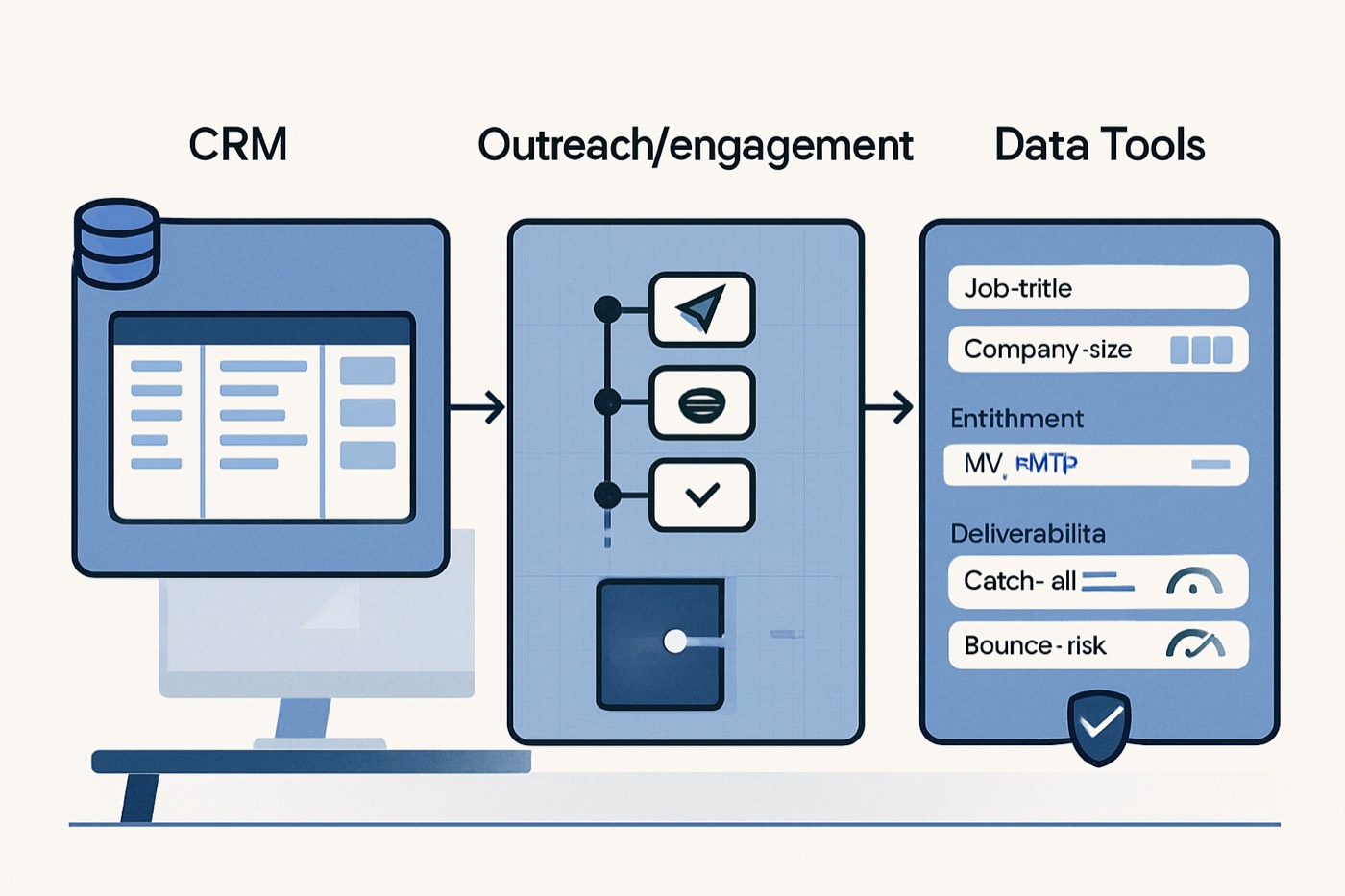
Most outbound teams keep breaking cold email by treating the stack as a pile of tools instead of a system. A CRM here, a sequencer there, two data vendors, a separate deliverability dashboard, and a person whose real job becomes keeping all of it in sync. The work that decides whether outbound works at all (who to contact, whether the data is fresh, whether the domain is healthy, what happens after a reply) gets spread across five tools that do not agree with each other.
There are two ways to make that stop. The traditional answer is to draw strict boundaries: pick one tool as the source of truth, govern the others from it, and accept the integration tax. The 2026 answer is to stop hand-wiring the layers at all and let an autonomous revenue operator run them as one loop, surfacing only the decisions that need a human.
This post maps both. First the four jobs every cold email system has to do, then which of those an operator can own end to end, and where you should still keep a specialist tool in the loop.
The four jobs in any cold email system
Strip away vendor names and every outbound setup is doing four things:
- Source and qualify. Find the right accounts and contacts, enrich them, verify the emails, and decide who is actually eligible to contact.
- Send and manage. Run the sequence: step timing, mailbox rotation, throttling, bounce handling, reply detection, and stop rules.
- Remember. Hold the truth: identity, ownership, lifecycle stage, suppression, reply outcomes, meetings, and pipeline, so attribution and prioritization are not guesses.
- Protect the channel. Keep domains and mailboxes healthy: authentication, warmup, reputation monitoring, and compliance with what inbox providers now enforce.
In the bolt-on world, those four jobs map to four (or more) tools, and the failures happen in the seams: a suppressed contact gets re-added by a data tool, a sequencer keeps emailing a closed-won customer, an enrichment field nobody trusts drives a send, a domain quietly degrades because nothing was watching it.
An autonomous revenue operator like Chronic exists to close those seams. It is not a CRM, and it is not a sequencer you point and click. You give it a revenue goal, a budget, an offer, and an approval level. It then runs discovery, enrichment, signal scoring, deliverability and infrastructure, outreach, reply handling, and meeting booking as one system, and brings you the decisions that matter instead of the dashboards.
Job 1: source and qualify (and the gates that protect it)
This is where most bad outbound starts. Teams store "email = a value" without storing "email = trustworthy," then wonder why bounce rates climb and reputation tanks.
The useful discipline, whoever owns it, is a set of pre-send gates. No contact enters a sequence until it clears all of them:
- Identity gate: the contact is matched to a real account domain (no "gmail.com CEO" unless that is deliberately the target).
- Enrichment gate: role, seniority, and company size are known, or explicitly marked "unknown but allowed."
- Verification gate: the email was verified recently, with syntax, MX, and risk classification (accept-all, disposable, role-based) on record.
- Suppression gate: the contact and account pass do-not-contact checks.
- Segmentation gate: the contact matches the ICP and the campaign's rules.
When a contact fails a gate, the rule is never "send anyway." It routes to an enrichment refresh, a manual research queue, or a different channel.
In the bolt-on stack, you build and enforce these gates yourself across a data tool, a verification tool, and your CRM, and hope the sync holds. An operator runs the gates as part of its own pipeline: it discovers and enriches, scores eligibility against the ICP you defined, verifies before sending, and only acts on contacts that clear the bar. The gate logic stops being five integrations and becomes one behavior you can inspect and adjust.
A practical decision rule worth keeping either way: if you cannot answer "where did this field come from and when," do not let it drive automation. Every field that gates a send should carry a source and a timestamp.
Job 2: send and manage
The sending layer owns the mechanics: step timing, variants, mailbox selection, daily caps, ramp schedules, reply detection, and automatic stops on reply, bounce, and unsubscribe. Modern outbound uses mailbox pools, sometimes across multiple domains, and the sending layer is what rotates and throttles across them.
The failure pattern here is letting the sending layer decide who is eligible. A sequencer that picks its own targets without an eligibility check will burn your best accounts with irrelevant touches and re-contact people who already opted out. Eligibility, suppression, and "what outcome moves someone to the next stage" have to be governed somewhere with the full picture.
This is the cleanest example of what an operator collapses. In a bolt-on stack, eligibility lives in one tool and execution in another, and the sync between them is where mistakes happen. An operator decides eligibility and runs the send from the same place, so a suppression or a reply changes behavior immediately instead of on the next sync. Chronic runs sending from managed, warmed mailboxes it provisions and maintains, so you are not buying domains, configuring DNS, or babysitting warmup yourself.
Job 3: remember (the outcomes that actually matter)
Engagement telemetry (opens, clicks, sends) is cheap and mostly vanity. The data that should drive routing, prioritization, and forecasting is a smaller, more durable set:
Per contact: delivered, bounced (hard/soft), replied, reply classification (positive, neutral, objection, out-of-office, unsubscribe), last touch, campaign or sequence ID.
Per account: accounts touched in the last 7 and 30 days, positive reply count, meetings booked, opportunities influenced or created.
Per campaign: reply rate by persona, positive rate, bounce rate, unsubscribe rate, time to first reply.
The decision rule: if a metric affects routing, prioritization, or forecasting, it has to be stored as truth, not left in a sequencer's reporting tab. If your record of truth is not receiving these, your scoring is guessing.
Note what is not on that list: emails sent and open rates as goals. Open rate stopped being a reliable signal once mail privacy features started pre-fetching images, and "emails sent" measures activity, not pipeline. The number that matters is qualified meetings held with relevant prospects, with your reputation intact. An operator optimizes for that outcome directly and keeps the outcome record itself; you read pipeline, not a feed of activity.
Job 4: protect the channel
Deliverability is the job most teams discover too late, usually after a domain is already cooked. The non-negotiables are now genuinely non-negotiable because the major inbox providers enforce them.
- SPF, DKIM, and DMARC must be configured and aligned. Google and Yahoo made these a requirement for bulk senders, and Microsoft has moved toward rejecting unauthenticated mail from high-volume senders (Microsoft Tech Community).
- One-click unsubscribe should follow the RFC 8058 standard for any stream that needs it (IETF RFC 8058).
- Reputation and compliance should be monitored with the providers' own tooling, not guesswork: Google Postmaster Tools and the related compliance dashboards (Google Workspace Admin Help, Postmaster Tools dashboards).
Underneath all of that sits infrastructure that is not a feature of any CRM: domain registration strategy, DNS, mailbox provisioning, warmup, and authentication alignment.
This is exactly the work the primary Chronic user does not want to do. Founders and sellers at high-value B2B companies have a real offer and a contract value that justifies outbound, but they are not deliverability specialists and should not have to become one. An operator owns the infrastructure layer: it manages domains and warmed mailboxes, keeps authentication aligned, watches reputation, and slows or pauses sending on a segment when health degrades, surfacing it to you as an approval or an alert rather than a metric you were supposed to be reading.
What an operator owns vs what you still bolt on
The honest version of "consolidation" is not "one tool does everything." It is: let the operator own the jobs where running the loop is the product, and keep a specialist where depth genuinely beats integration.
An autonomous revenue operator can own:
- Discovery, enrichment, and ICP-based eligibility (job 1)
- Verification gates before send (job 1)
- Sending, rotation, throttling, reply handling, and stop rules (job 2)
- The outcome record that drives prioritization and pipeline (job 3)
- Managed mailboxes, warmup, authentication, and deliverability protection (job 4)
You may still keep a specialist for:
- A niche data source for a specific industry or signal that general enrichment misses
- A standalone verification provider if you have a compliance reason to keep verification independent
- Your company-wide system of record (Salesforce, HubSpot) for post-meeting pipeline, finance, and customer data, with the operator handing qualified meetings into it
The test is simple. If the value of a tool is running the outbound loop, an operator should own it, because the seams between separate tools are where outbound breaks. If the value is depth in one narrow thing or a system the rest of the company already runs on, integrate rather than replace.
Suppression: one source, many enforcement points
One rule survives every architecture: one suppression source, many enforcement points. Whatever holds the truth (an operator, or your CRM if you keep one) is the single authoritative do-not-contact list. Every sending and data step enforces it, and nothing can override it.
Store the categories you suppress on:
- Global do-not-contact (never contact)
- Channel-specific: do-not-email, do-not-call, do-not-message
- Competitor and partner exclusions
- Customer exclusions (for expansion vs net-new segmentation)
- Legal or compliance requests
And store why each record is suppressed: unsubscribed, hard bounce, legal request, customer, not ICP, duplicate. The danger in the bolt-on world is "tool hopping": a data tool re-adds someone a sequencer suppressed because the two never reconciled. An operator removes that class of bug by enforcing suppression at the moment it acts, not on a nightly sync.
Common configurations (and who they fit)
Lean outbound, seed to Series A. Founder plus one or two sellers, low volume, high focus. Hand the whole loop to an operator with managed mailboxes and let it run discovery, sending, and reply handling against a clear goal. Keep your existing CRM only if the rest of the company already lives in it. Trade-off: fewer manual knobs, faster iteration.
Agency running multiple clients. Strict per-client separation is the whole game: separate domains and mailbox pools, separate suppression, per-client enrichment freshness, and audit logs. An operator that partitions cleanly by client workspace removes most of the ops burden, as long as identity and suppression stay isolated per client.
Scaled B2B SaaS with multiple seller pods. Territories, segments, and multiple offers. Here the operator runs the always-on outbound loop and books qualified meetings, while human sellers take the live conversations and own the late-stage pipeline in the company system of record. Map the handoffs and the approval level explicitly so the autonomous and human work do not collide.
FAQ
What is the 2026 cold email stack, in one definition?
It is whatever set of systems performs four jobs: source and verify leads, send and manage outreach, store outcomes for attribution, and protect deliverability. The shift in 2026 is that an autonomous revenue operator can run all four as one loop, instead of you wiring a CRM, a sequencer, and data tools together and maintaining the integrations.
Do I still need a CRM?
Maybe, but not as the engine of outbound. If your whole company runs on Salesforce or HubSpot for pipeline, finance, and customer data, keep it and let the operator hand qualified meetings into it. What you do not need is to make a CRM the place you manually govern suppression, eligibility, and sequencing, because an operator runs that loop directly.
Where should unsubscribes and suppression live?
In one authoritative list, enforced everywhere, with the reason stored. The principle is one suppression source and many enforcement points, so no tool can reactivate someone who opted out. An operator enforces it at the moment it acts rather than waiting on a sync.
What deliverability requirements must I have before scaling volume?
At minimum, correctly configured and aligned SPF, DKIM, and DMARC, plus reputation monitoring through provider tooling like Google Postmaster Tools. One-click unsubscribe should follow RFC 8058. References: Google Postmaster Tools help and RFC 8058. An operator that manages its own warmed mailboxes handles this for you.
Which outcomes actually matter?
Delivered and bounce status, reply and reply classification, meetings booked, and opportunities created or influenced. If a metric affects routing, prioritization, or forecasting, store it as truth. Open rate and emails-sent are activity, not pipeline; the goal is qualified meetings held with your reputation intact.
How is an autonomous revenue operator different from a sequencer with AI features?
A sequencer executes steps you configure. An autonomous revenue operator takes a revenue goal and runs the whole loop (discovery, enrichment, verification, sending from managed mailboxes, reply handling, and meeting booking), surfacing only the approvals and escalations a human should weigh in on. The difference is who owns the decisions: you, across several tools, or the operator, with you in control of the ones that matter.
Build your 2026 stack in five steps
- Write the four jobs down: source and qualify, send and manage, remember, protect the channel. Be honest about which tool does each one today and where the seams break.
- Implement the five pre-send gates (identity, enrichment, verification, suppression, segmentation) and the "never send on a failed gate" rule.
- Make one suppression list authoritative and enforce it everywhere, with a reason on every record.
- Decide your outcome record: the small set of metrics that drive routing and forecasting, and refuse to let activity metrics stand in for pipeline.
- Let an autonomous operator own the loop where running it is the product, keep a specialist only where depth or a company-wide system genuinely beats integration, and set the approval level you are comfortable with before you let it run.