Configure outbound in plain English: what "natural-language RevOps" really takes
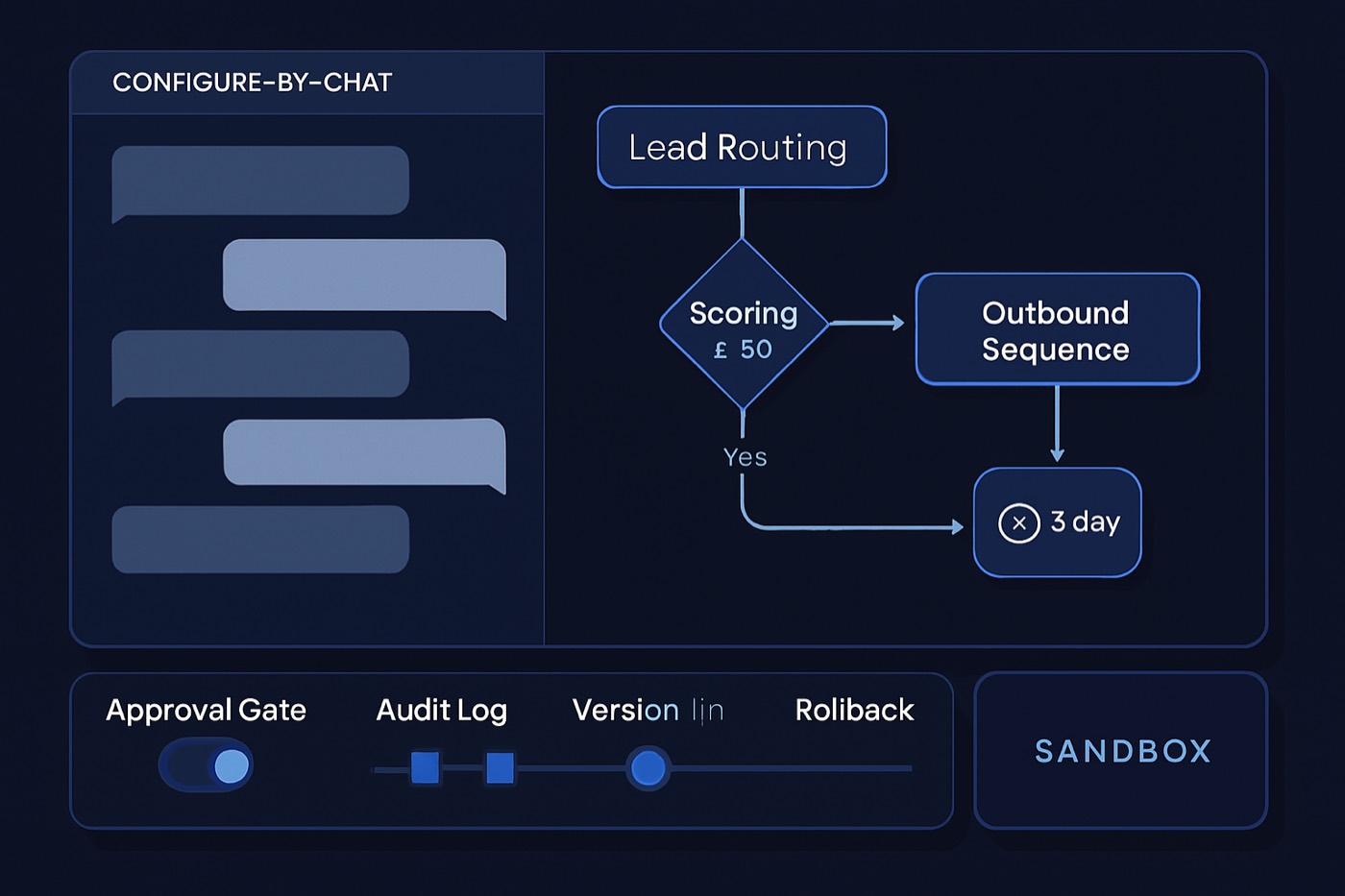
Configuring outbound in plain English only works if the system can act on the change, show a diff, and roll it back. Without approval gates, audit logs, and sandboxes, one chat message can break routing or torch a domain.
Tealium put a sharp stake in the ground: MCP as a bridge between AI and a real production system. Not a demo. Not "ask questions about your data." Actual two-way integration, so agents can pull governed data in real time and act on it. (tealium.com)
That matters for sales and RevOps because it signals the next step in go-to-market automation: agents that do not just analyze your funnel. They configure the machine that produces it.
Which is why this is now a real expectation: you should be able to configure outbound by describing the outcome in plain English and have the system do the work, safely.
The hook: Tealium + MCP is not "AI insight." It's "AI can touch the wires."
Tealium's announcement focuses on MCP connectivity to its Moments API, so AI models and autonomous agents can access consented, real-time customer data. (rss.globenewswire.com) That is the enterprise way of saying: we are making our platform programmable by agents.
Tealium also published a developer piece framing MCP as a standardized path for two-way exchange between models and its CDP. (tealium.com)
MCP is showing up everywhere because it standardizes how apps expose tools and context to language models. It turns one-off integrations into a repeatable pattern. OpenAI documents MCP support in its Agents SDK. (openai.github.io) AWS documents MCP usage with Amazon Q Developer. (docs.aws.amazon.com) Microsoft documents connecting Foundry agents to MCP servers. (learn.microsoft.com)
So the trend is not "Tealium did a thing." The trend is that the go-to-market stack is becoming conversationally programmable.
Plain-English configuration: what it is, and why it's coming
It means your outbound system (targeting, enrichment, scoring, routing, sequences, alerts) gets configured by describing outcomes in everyday language.
Not "build a workflow." Not "write a formula field." Not "create three objects and a junction table."
Just: "When a US fintech with 50 to 500 employees hits the pricing page twice in seven days, start the high-intent fintech sequence, and tell me before the first email goes out."
The interface shift is that configuration becomes a conversation. The agent translates intent into concrete changes: who to target, what to send, when to throttle, and what to escalate. This is bigger than "a copilot wrote my email." That era is already routine.
Why now: agents crossed the line from "answer" to "act"
Plenty of vendors have teased natural-language automation. Microsoft now documents building an agent flow by conversing about what you want it to do. (learn.microsoft.com) Power Automate positions Copilot as a way to create flows in natural language. (learn.microsoft.com) Salesforce's Agentforce content repeatedly frames agents as configurable with natural-language instructions. (salesforce.com)
Meanwhile the glue layer is standardizing. If apps expose tools in a consistent way, agents can reliably execute changes across systems, not just read them. So conversational configuration is not a UX trick. It rests on three things stacking up:
- Standard tool interfaces (MCP and similar patterns)
- Agents that can plan and invoke those tools
- Governance primitives that decide which changes ship
What sales teams actually mean
Sales does not care about workflows. Sales cares about outcomes:
- More qualified meetings
- Faster speed to lead
- Fewer leads dying in "new"
- Cleaner handoffs
- Less "hey, can you set this up" in Slack
So translate plain-English configuration into the work that eats your week.
Targeting and lists
- "Build a list of Series A devtools companies in North America hiring two or more sales roles."
- "Exclude current customers and open opportunities."
- "Refresh it nightly."
Sequences and plays
- "Write a seven-touch sequence for security leaders."
- "Use proof points for SOC 2 and SSO."
- "Stop the sequence when they reply or book."
Routing
- "Send inbound demos from healthcare to the pod that owns it."
- "If a company is over 1,000 employees, skip the SDR and go to the enterprise AE."
- "If no owner picks it up in five minutes, fall back to round-robin."
Scoring
- "Score fit on industry, size, and tech stack."
- "Score intent on page visits and keyword surges."
- "Cap the total at 100 and log the components."
Alerts
- "Tell the AE when an account shows high intent and is unworked for 72 hours."
- "Tell me when bounce rate exceeds 2% on a sending domain."
Guardrails and throttles
- "Throttle new domains to 20 emails per mailbox per day."
- "Pause sends if the spam-complaint rate spikes."
- "Ask me before sending to regulated industries."
That is what configuring outbound in plain English means in real life. Not vibes. Not "AI transformation." Just work that ships.
The upside: faster changes, fewer tickets, RevOps off the critical path
Plain-English configuration turns a change into a tight loop:
- You describe the outcome.
- The agent drafts the change set.
- A human approves.
- The system ships it.
- Metrics confirm it worked, or it rolls back.
What you get:
- Speed. Routing fixes in minutes, not next sprint.
- Consistency. Fewer one-off hacks, because the agent applies the same patterns.
- Less RevOps load. RevOps stops building every small tweak and instead reviews, approves, and governs.
- Cheaper experiments. A/B lanes become normal. "Try it" stops being expensive.
This is the shift DevOps lived through: fewer manual steps, more controlled automation. The teams that win ship more experiments with fewer incidents.
The downside: you can break your pipeline in one chat message
An agent that can configure systems is an agent that can misconfigure them. The failure modes are not theoretical:
- A routing rule sends everything to one rep.
- A scoring change quietly drops qualified-lead volume.
- A list includes your customers and you email your own accounts.
- A deliverability throttle gets removed "for speed" and your domain reputation tanks.
Without diffs, approvals, and rollback, you will not even know what changed. You will just feel it.
The non-negotiables
If you take one thing from this article, take this: configuring by chat needs the same controls as changing code.
Approval gates, by role and policy
No serious team should allow free-form, direct-to-production config writes from an agent. The minimum standard: the agent proposes, a human with the right role approves, and high-risk changes need a second approver.
Human-readable diffs
Every change needs a "what changed" view: before and after, scope, the entities affected, the reason, and who approved it. If a vendor cannot show you a diff, they are asking you to trust a black box. Pass.
One-click rollback
Rollback has to be fast, deterministic, and visible in the audit log. If rollback is "recreate what we think was there," you do not have rollback.
Sandboxing
Agents should default to generating config in a sandbox, running validation, simulating outcomes against historical data, and only then requesting approval to push to production. As natural-language creation goes mainstream, more people will configure more often, which makes sandboxing more important, not less. (learn.microsoft.com)
Scoped permissions
Give the agent the minimum set of actions it needs, then constrain them. No admin god mode. No cross-object writes without explicit scopes. No touching compliance settings unless that is explicitly allowed.
For a deeper view of what "agent-ready" controls look like, read Agent-ready CRM requirements: the non-negotiables.
Observability tied to changes
You need cause and effect: "after change X, reply rate moved from 1.2% to 2.0%," or "after routing update Y, median speed-to-lead dropped from 18 minutes to 6." Without it, teams argue about feelings, and feelings do not book meetings.
Analysis agents are table stakes. The operator that acts is the difference.
Everyone already ships "ask your CRM a question." Fine. The teams that pull ahead ship a system that can change itself, run the play, watch the outcome, and roll back when metrics break.
This is exactly why MCP-style tool standards matter. When the agent can reliably call tools, configuration stops being a bespoke project. And yes, the market is crowded. Gartner analysts have warned about a flood of agentic solutions and a likely consolidation phase. (itpro.com) Translation: vendors will slap "agent" on anything. You still need the controls.
What this means for RevOps
RevOps does not disappear. It stops being a configuration factory and becomes the control plane: policy author, data-governance owner, experiment designer, approval authority, and safety engineer for the pipeline. Less ticket queue, more judgment. If that sounds like a promotion, it is. If it sounds like more accountability, it is also that.
How Chronic thinks about this for outbound teams
Chronic is an autonomous revenue operator. You give it a revenue goal, and it builds and runs the outbound system end to end: discovery, enrichment, scoring, deliverability, outreach from managed warmed mailboxes, reply handling, and meeting booking. It surfaces approvals only for the decisions that matter, and it optimizes for one outcome, qualified meetings held, while protecting your domains, mailboxes, and customer relationships.
So "configure in plain English" is not a feature bolted onto a CRM here. It is how you direct an operator that already runs the machine:
- Targeting that feeds everything else, see ICP builder.
- Enrichment that makes segmentation and personalization real, see lead enrichment.
- Personalized outbound at scale, see AI email writer.
- Scoring that decides who gets worked now, see AI lead scoring.
- A pipeline view that stays clean because the system does the work, see sales pipeline.
For the broader stack argument, this pairs with All-in-one outbound vs best-of-breed in 2026: the real question is handoffs. Handoffs are where automation dies. Letting an operator make changes cheaply reduces handoffs, but only when governance is real.
Three plays a B2B team can run this month
These are practical, not future state. You can run them now.
Play 1: launch a new ICP lane in under an hour
Goal: stand up a new lane without a week of tickets.
What you say:
Create a new ICP lane called "mid-market fintech compliance." Criteria: US and Canada, 50 to 500 employees, industry fintech, titles including head of compliance, VP risk, chief compliance officer. Exclude existing customers, open opportunities, and companies under 10 employees. Enrich missing phone numbers and technographics. Add to the seven-touch fintech compliance sequence. Route replies to the pod that owns it. Tell the pod lead when 10 or more leads enter the lane in a day.
What the operator should generate:
- A list definition with exclusions
- An enrichment step (phone, tech stack)
- A sequence-enrollment rule
- Reply routing and ownership mapping
- An alert rule with a threshold
Approval checks (non-negotiable):
- List-size estimate and a preview of the top 20 accounts
- Exclusion validation (customers and open opps)
- An enrollment cap for the first 48 hours as a safety throttle
- A diff log of every object created or modified
This is the exact flow where ICP builder and lead enrichment do the heavy lifting, then outbound starts.
Play 2: enforce deliverability throttles automatically
Goal: protect your domains while still shipping outbound. Deliverability is not set-and-forget. It is a guardrail system.
What you say:
Enforce deliverability throttles across all outbound sequences. New sending domains: max 20 emails per mailbox per day for 14 days. Established domains: max 60 per mailbox per day. If bounce rate exceeds 2% in a rolling 24-hour window, pause sends for that domain and alert me. Log every pause with the reason, and require approval to resume.
What the operator should generate:
- Throttle rules by domain-age tier
- Bounce-rate monitoring
- An auto-pause action with alerting
- A resume workflow behind an approval gate
- An audit entry for every event
For a refresher on what still works operationally, pair this with 7 deliverability fixes that still work in 2026 (Microsoft included). Why does plain-English control matter here? Deliverability incidents move fast, and ticket-based governance reacts slow. Guardrails need to be easy to create and hard to bypass.
Play 3: build an intent-triggered play that actually routes and acts
Goal: turn intent signals into booked meetings, not dashboards. Tealium's MCP story is about feeding real-time, consented data to agents. (rss.globenewswire.com) The sales translation: when intent happens, the system should move.
What you say:
Create an intent-triggered play called "high intent: pricing and security." Trigger when an account visits pricing twice in seven days and views the security page, or searches for "SOC 2" on the site. Only trigger if the account is in ICP and not already in an active sequence. Then: create a task for the SDR within five minutes; enroll the top three matching contacts into the intent sequence; post an alert with the account, contacts, and last three intent events; and if there's no SDR activity within two hours, escalate to the manager.
What the operator should generate:
- A trigger with clear boolean logic
- Conflict rules to avoid double enrollment
- Contact-matching logic by title and department
- A task SLA and an escalation ladder
- An alert payload template
Approval checks:
- Test against the last 30 days of intent events to estimate volume
- Confirm exclusions (customers, open opps, active sequences)
- Validate that escalation does not spam leadership
For a full trigger-map mindset, this pairs with Signal-led sales cadence: the trigger map that replaces your 12-step drip.
Where Chronic fits against your options
- HubSpot, Salesforce, and others are moving toward conversational build and agent workflows. Salesforce's Agentforce messaging leans into natural-language configuration for agents. (salesforce.com) Microsoft documents natural-language flow creation. (learn.microsoft.com) The gap is that configuring a CRM is not the same as running the outbound motion for you.
- Clay is powerful, but complexity is the tax. You pay it up front, then again every time you tweak the machine.
- Instantly sends email. That is it. No routing, no governance, no scoring.
- Salesforce still prices like a platform you then buy four more tools around. See Chronic vs Salesforce.
- If you are HubSpot-heavy, see Chronic vs HubSpot.
- If Apollo is your current stack, see Chronic vs Apollo.
One line of contrast, then back to the point: plain-English control only works when the system runs end to end and the governance is real.
How to roll this out without breaking production
Here is the rollout that avoids the "agent changed prod at 2am" story.
- Start read-only. The agent drafts changes, humans implement, and you validate the prompt patterns.
- Move to propose mode. The agent creates a change set with diffs and tests, a human approves, and the system applies it.
- Limit scope. Begin with low-risk configs: lists, alerts, non-customer sequences. Then routing. Then scoring.
- Add thresholds and kill switches. If reply rate drops, pause. If bounce spikes, pause. If a routing backlog grows, roll back.
- Make governance visible. Publish a weekly change log: what shipped, why, and what moved the metrics.
For the guardrails checklist, use AI SDR governance: the 12 guardrails that prevent brand damage, spam, and CRM chaos.
FAQ
What does "configure outbound with natural language" actually mean?
You describe the outcome in plain English and the system generates the underlying configuration: lists, routing, scoring, alerts, and sequence enrollment. The best systems also generate a diff, test the change, and require approval before pushing to production.
Is MCP required for this?
No. But MCP makes it easier to standardize tool access for agents across systems. Tealium's MCP integration is a signal that vendors expect agents to act on production platforms through standardized interfaces. (rss.globenewswire.com)
What are the minimum safety controls before letting an agent configure anything?
Approval gates, human-readable diffs, one-click rollback, and sandboxing. If you cannot see what changed and reverse it quickly, do not let an agent write to production.
Does this replace RevOps?
It replaces the ticket factory. RevOps becomes governance: policies, approvals, audit trails, data hygiene, and experiment design. More control, less manual build work.
Where should a team start this quarter?
Start with one bounded workflow: build a single new list and sequence lane, add explicit enrollment limits and monitoring, require approvals, and measure outcomes for two weeks. Then expand into routing and scoring once your governance holds.
Run the three plays, then make it policy
Do this in the next 30 days:
- Launch a new ICP lane by chat. Ship it behind approvals.
- Lock in deliverability throttles. Automate pauses and resumes with audit logs.
- Build one intent-triggered play. Route, enroll, alert, escalate.
Then write the policy: what the operator can change, who approves, where it gets tested, and which metrics trigger a rollback. Configuring outbound in plain English is here. The only question is whether it ships pipeline, or ships incidents.