The context layer is the real story behind Ask Attio (and why an operator acts on it, not just answers from it)
Ask Attio turns a CRM into an "answer layer," but the real work is the context layer underneath: connected sources, clean identity, activity capture, governance. An autonomous operator needs that same spine to act on it, not just answer.
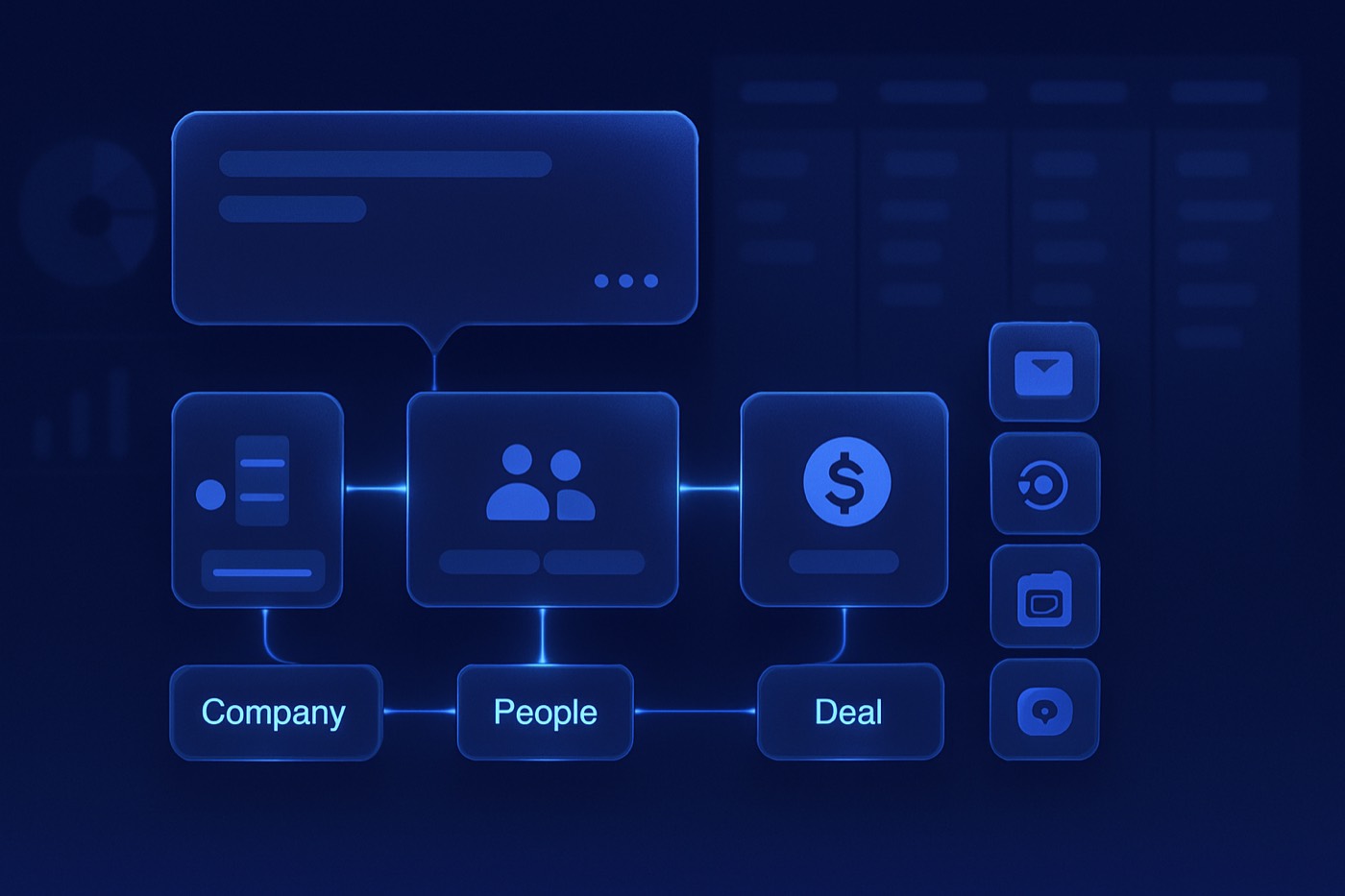
Attio's Ask Attio launch is a clean signal that the CRM is moving from "system of record" to "system of answers." Ask Attio is a conversational interface over everything you already did: records, calls, emails, web research, and connected sources, backed by what Attio calls a "Universal Context" layer that semantically indexes CRM data as an interconnected whole. The interesting part is not that it is Attio. It is the category direction, and the thing it quietly depends on. (attio.com)
The headline is the chat box. The real story is the context layer underneath it. And once you have a clean context layer, a question follows that the CRM vendors mostly don't answer: if the system already knows what to do next, why are you still the one doing it?
That is the line between an answer layer and an operator. An answer layer tells you the account is going cold and drafts a note. An autonomous revenue operator finds the account, writes the email, sends it from a warmed mailbox, handles the reply, and books the meeting, surfacing only the decisions that actually need you. Chronic is the second thing. This post is about the context layer both depend on, and where they part ways.
From record, to answer, to action
For 20+ years, most CRMs were optimized for three jobs:
- Data entry (forms, required fields)
- Pipeline reporting (stages, forecasts)
- Process enforcement (tasks, sequences, workflows)
Ask Attio pushes a different center of gravity: conversation as the primary way to retrieve and act. In its launch post, Attio frames Ask Attio as a way to talk to "your entire CRM," spanning records, calls, emails, web search, and connected data sources, enabled by a universal context layer. (attio.com)
This lines up with a broader market move. Major CRM vendors have been shipping conversational copilots that promise "trusted responses grounded in company data" plus the ability to execute tasks. Salesforce positioned Einstein Copilot explicitly as a conversational assistant grounded in company data, and the market has kept shifting toward agentic workflows. (salesforce.com)
A useful way to describe the progression:
- CRM as database: "What did we store?"
- CRM as context layer: "What do we know, and how confident are we?"
- CRM as answer layer: "What should we do next, and why?"
- Operator: "I did the next thing. Here's what needs your sign-off."
Most of the launches stop at the third line. The chat box gives you an answer; you still go do the work. The context layer is what makes the answer trustworthy, and it is also exactly what an autonomous operator needs before it is allowed to act on your behalf. So the practical question for any B2B team is not "which copilot," it is "do we have a context layer good enough to trust an answer, or to trust an action?"
What "universal context" actually requires
A vendor can market "Universal Context." Every team still has to earn it operationally. It is not magic. It is a set of plumbing decisions, and the bar is higher when something is going to act on the context, not just describe it.
Connected sources: you cannot summarize, or send, what you do not capture
The minimum sources for a real context layer:
- Email (inbound and outbound, threading, reply classification)
- Calendar (meetings, attendance, reschedules, no-shows)
- Calls (recording links, transcript, outcomes, objections)
- Product signals (activation, usage, feature adoption, expansion triggers)
- Website intent (pricing-page visits, docs views, return frequency)
- Useful extras: support tickets, invoices, security questionnaires
If the system only sees the deal object and a few notes, it will produce plausible nonsense. Pick one canonical store for each event type (calls from Gong or Zoom, intent from your data provider, product events from your warehouse) and make writeback a requirement for any new tool. If it cannot write back, it cannot be part of your context layer.
This is the same discipline Chronic runs on. Its lead enrichment keeps accounts and people accurate, and its prospecting and email writing only earn trust when they are grounded in real account context and intent signals rather than a thin record.
Identity resolution: people, accounts, and domains must match cleanly
Context breaks when identity is fuzzy. The usual problems:
- One person uses multiple emails (personal, work, alias)
- Parent and child accounts (holdco vs brand) get mixed
- A prospect changes companies and their activity stays on the wrong account
- The same company exists as duplicates from different domains or naming
An answer layer will confidently produce "account briefs" stitched from multiple entities. An operator will email the wrong contact at the wrong company. Treat identity resolution as an ongoing process, not a one-time cleanup.
Activity capture: "what happened," not just "what changed"
Records store state. Context needs events.
State: "Stage = Negotiation."
Events: "Legal requested a DPA on Feb 12, security review started Feb 15, the champion asked for SOC 2 on Feb 18."
If you do not capture events, the model fills the blanks with generic sales narrative. A workable activity model includes event type (call, email, meeting, note, task), timestamps (created_at, occurred_at, updated_at), actor (owner, participant), source system, and object links (Person, Account, Deal).
Permissions: answers, and actions, are only as safe as your access model
The moment "ask the system" or "let it send" becomes normal, permissions stop being IT overhead and become part of the product. You need role-based access for objects and fields, redaction for sensitive notes (pricing exceptions, HR, legal), partitioning for multi-team orgs, and audit logs for who asked what and which sources were used. This is where trust is won or lost. One leak and people stop using it.
The boring data model that makes answers accurate
Four things to standardize first.
Canonical objects: define what exists in your world
Most B2B teams need at least Account, Person, Deal, Activity, plus product-signal and intent-signal events or rollups. If you run ABM, add buying group, roles (champion, economic buyer, blocker), and a relationship-strength score. The more ad hoc objects a team invents, the less coherent the context.
Evidence fields, not vibes
Summaries should cite evidence, which means fields that map to proof: last meaningful touch, last inbound reply, next scheduled meeting, mutual-action-plan status, security-review status, stakeholders identified, primary pain (tagged), competitor mentioned (tagged), pricing range discussed (structured and permissioned). This structured spine is what keeps summaries from going fluffy, and it is also what a scoring or routing model needs to be trusted.
Timestamps: store occurred_at separately from created_at
This is one of the most common failure modes. A rep logs Monday's call on Friday. If the system sorts by created_at, the timeline is wrong, the risk flags are wrong, and the next action is wrong. Standardize occurred_at (when it happened), created_at (when it was logged), updated_at (when it changed), and a derived last_activity_at.
Ownership: one owner, plus explicit collaborators
Owner is not just a reporting field. It tells the system who to notify, who approves outbound, who to ask for missing context, and who is accountable for the next step. Add collaborator roles (SDR, AE, CSM, deal desk, solutions engineer) where the motion needs them.
Where teams get burned (and how to prevent it)
The context-layer shift is real, but the failure modes are predictable.
Hallucinated summaries: plausible, wrong, and dangerous
When a model lacks grounded context, it guesses. This is not theoretical. NIST's Generative AI Profile, part of its AI Risk Management Framework, explicitly calls out measuring and managing risks like factual inaccuracy and output integrity. If a summary is going in front of an exec, or worse, into an email that gets sent, you need guardrails. (nist.gov)
Controls to implement:
- Require citations: summaries link to the underlying activities (call, email, note)
- Confidence labels: "high confidence" only when evidence exists
- "Unknown" as an allowed output, which beats guessing
- Human approval gates for anything external-facing (email drafts, follow-ups)
This is why Chronic is built around "draft by the agent, approve by the owner" rather than fire-and-forget. The agent does the work; a person signs off on the decisions that touch a real prospect or a real domain.
Missing call notes and unlogged meetings: context holes
The answer layer punishes teams for poor capture. If reps do not log outcomes, objections, next steps, and stakeholder changes, the system overfits to email threads and pipeline stages, which are often incomplete. Treat call capture as required infrastructure with a minimum schema: outcome, top pains (tags), objections (tags), a single explicit next step, the date for that next step, and stakeholder changes.
Duplicate accounts and mismatched identities: poisoned context
Duplicates create a split brain where email history sits on Account A, calls on Account B, and the deal on Account C. The system produces a brief that looks coherent but is missing half the reality. Fix it with automated duplicate detection (domain plus company-name similarity), a clear merge policy, and a weekly hygiene cadence owned by ops, not by reps.
The 2026 reality check: deliverability failures create false signals
In 2026, outbound signals are increasingly shaped by deliverability policy. Microsoft has been enforcing bulk-sender requirements tied to authentication and complaint rates, which changes what "no response" even means. (proofpoint.com)
If email lands in junk or gets blocked, a context layer may flag accounts as cold when the real problem is channel health. So store sending health as context: mailbox reputation indicators where available, bounce types, spam-complaint flags, and authentication status (SPF, DKIM, DMARC).
This is the part most "answer layer" pitches skip, and it is the part an operator cannot. A system that sends has to own the consequences of sending. Chronic treats deliverability as a first-class job: managed, warmed mailboxes, authentication, and pacing, so a flat reply rate reflects the market and not a quietly broken channel.
A pragmatic blueprint you can copy this week
This is the "do it even if you never touch Attio" part. Treat it as a 30-day plan.
1. Map your context sources. Email, calendar, calls, product, website intent. Decide the canonical store for each.
2. Define identity rules. One account per root domain (document exceptions), a merge policy, and a single owner of hygiene.
3. Ship an activity event schema. occurred_at, actor, source, object links. This is the single most useful fix on the list.
4. Add five evidence fields to every active deal. Last touch, last reply, next meeting, stakeholders count, top risk tag.
5. Turn on governance. Permissions and field redaction, citations in every summary, and human approval for anything that leaves the building.
6. Track sending health as data. Authentication status, bounce types, complaint flags. Do not let a deliverability problem masquerade as a cold pipeline.
7. Publish a weekly quality dashboard and assign one ops owner: duplicate rate, percent of activities with occurred_at, percent of calls with an outcome, percent of deals with a dated next step, percent of records with a verified domain. What gets measured gets fixed.
Answer layer vs operator: which problem are you actually solving?
Attio is one signal. The direction is broader: CRMs and adjacent platforms are racing to sit between humans and business data, usually through copilots and agent frameworks. (salesforce.com)
The decision is less about which chat box and more about what you want done:
- If you want a modern, flexible data model and fast "ask the CRM" workflows, Attio is clearly pushing in that direction. (attio.com)
- If you are on an incumbent, you can still win by applying context-layer discipline: connected sources, standardized events, clean identity, and governance.
- If the actual job is qualified meetings, and you do not want to staff RevOps and deliverability to get them, you want a system that acts on the context, not one that hands you a better answer to act on yourself.
That last case is what an autonomous revenue operator is for. You give it a revenue goal; it runs discovery, enrichment, outreach, reply handling, and booking on top of a clean context spine, and surfaces approvals only for the decisions that matter. If you are weighing tools, these comparisons frame the trade-offs: Chronic vs Attio, Chronic vs Salesforce, Chronic vs HubSpot, and Chronic vs Apollo.
FAQ
What is a context layer?
A context layer unifies identities, activities, and signals across your tools so a system can do something trustworthy with them: produce an account brief, flag a risk, or take a grounded next action. It depends on connected sources, standardized event data, and governance, not just a chat interface on top of records.
Is Ask Attio just a chatbot inside a CRM?
The chat is the surface. Ask Attio is a conversational interface over CRM records plus calls, emails, web research, and connected sources, enabled by a universal context layer that semantically indexes the data. The part worth copying is the context stitching underneath, not the chat box itself. (attio.com)
What is the difference between an answer layer and an autonomous operator?
An answer layer tells you what to do and may draft it; you still execute. An autonomous revenue operator runs the work end to end, finds prospects, writes and sends from managed mailboxes, handles replies, books meetings, and asks for human approval on the decisions that carry real risk. Both need the same context spine; only one of them acts on it.
What data do we need before AI output is reliable?
At minimum: clean Account and Person identity, event-based activity capture (email, calendar, calls), and timestamps that reflect when things actually occurred. Then add product and intent signals. Without these, output is generic or wrong.
How do we prevent hallucinated briefs and risk flags?
Governance: source attribution (citations to emails, calls, notes), confidence labels, "unknown" as an allowed output, and human approval for anything external-facing. NIST's Generative AI Profile highlights the need to measure and manage factual-inaccuracy risk in these systems. (nist.gov)
What is the biggest mistake teams make adopting this?
Treating it as an AI feature rollout instead of a data-model and capture rollout. If call outcomes are unlogged, duplicates persist, and timestamps are wrong, the system will confidently amplify bad context, and people will abandon it. That is true whether the system answers or acts.
Get the context spine right and you get most of the upside everyone is chasing: faster ramp, fewer missed follow-ups, more honest pipeline, and next actions grounded in what actually happened. The only question left is whether you want the system to tell you the next action, or take it.