The outbound stack in 2026: 7 ways to collapse your tools into one operator that books meetings
Consolidating your outbound stack means collapsing the chain from "lead identified" to "meeting booked" into one system, so data stops bouncing between Apollo, Clay, Instantly, a CRM, sheets, and Zapier. Fewer handoffs means fewer dropped leads and more meetings.
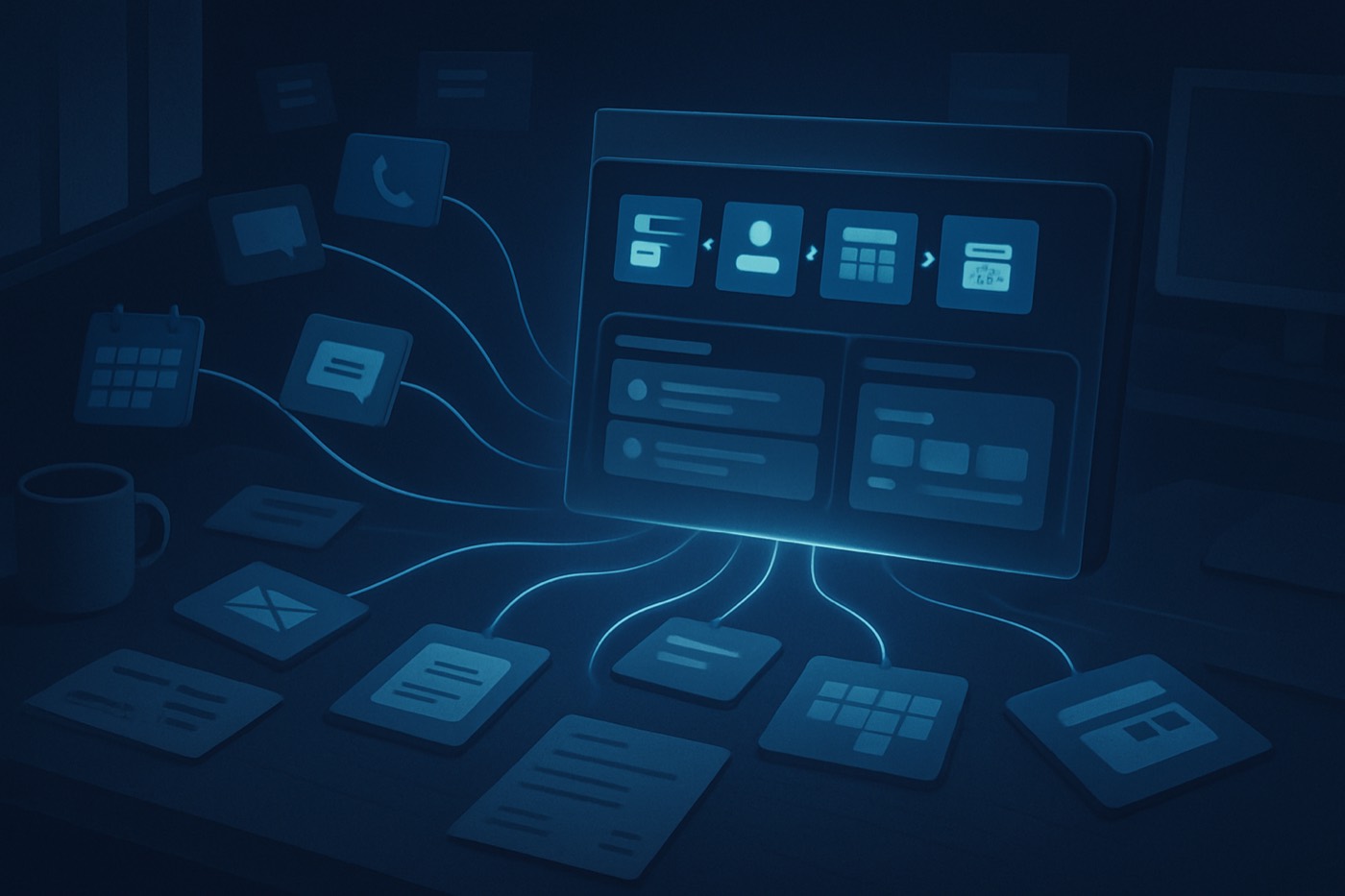
Your stack is not modern. It is just crowded.
SMBs in 2026 run dozens of apps. Okta's SMBs at Work report found small and mid-sized businesses average 58 apps, and companies around 500 employees average 93. That is not 58 options. That is 58 places for a lead to fall through a crack. (okta.com PDF, okta.com recap)
Most of that sprawl lives in one workflow: outbound. You build lists in one tool, enrich in another, validate in a third, send from a fourth, track in a CRM, and tape it together with sheets and Zapier. Every seam is a handoff, and every handoff is where a lead goes quiet.
This is a guide to closing those seams. The aim is not minimalism for its own sake. It is collapsing the chain from "lead identified" to "meeting booked" into fewer systems, so the work runs end to end instead of stalling between tabs.
What you are actually consolidating
The target is the outbound chain: discovery, enrichment, scoring, sending, reply handling, and booking. Consolidation means reducing the number of tools a lead passes through on the way to a meeting, while raising the automation and governance inside the systems that remain.
You consolidate for four things, in this order:
- Fewer handoffs. Data stops bouncing between tools and the staging spreadsheet.
- Higher throughput. More of the right leads get contacted correctly.
- Higher conversion. Better targeting, faster follow-up, cleaner routing.
- Lower spend. The obvious one, and the least important.
This is the shift from a stack of point tools to a single autonomous revenue operator: one system you give a goal to, that runs the chain and surfaces only the decisions a human should make.
Why messy stacks cost more in 2026
Two facts make a crowded outbound stack expensive this year.
Reps already lose most of their time to admin. Salesforce's State of Sales research, drawn from more than 5,500 sales professionals across 27 countries, reported sellers spend roughly 29% of their time actually selling in one 2024 release. Every extra tool that needs a copy-paste or a tab-switch eats into that 29%. (salesforce.com)
Email rules got stricter. Google and Yahoo began enforcing bulk sender requirements on February 1, 2024, pushing SPF, DKIM, DMARC, and easy one-click unsubscribe. A stack that spreads sending across random domains and tools turns inbox placement into a part-time job. (entrust.com, autospf.com)
Consolidation helps with both: fewer moving parts to keep in sync, fewer broken configs, fewer "we forgot to update the field mapping" failures.
Seven plays to collapse the outbound chain
Play 1: Put list building and enrichment in one system
If you prospect in one tool, enrich in a second, validate in a third, then import to the CRM, you are running a data pipeline with none of a pipeline's controls.
Before
- Apollo for prospecting
- Clay for enrichment
- A validation tool like NeverBounce
- A Google Sheet for staging
- The CRM (HubSpot, Pipedrive, Salesforce, Attio)
- Zapier holding it together
After
- One system that finds and enriches leads, landing clean records straight onto the contact that gets sequenced.
In Chronic, you set an ICP with the ICP builder, the agent runs lead enrichment on the matches, and clean records flow into the sales pipeline. What gets handled for you: ICP filtering and list creation, enrichment of firmographics, roles, and technographics, field normalization (industry, size, region), and duplicate rules.
This cuts at least two handoffs, the export/import and the sheet staging, and removes the mystery fields and broken merges that come with them. The test is simple: if enrichment does not land on the record that gets sequenced, it is theater.
Play 2: Put sequencing on the same record that owns the contact
Sequencing breaks when the sender is just a sender. If the tool that sends does not own the data, it cannot enforce quality, and it cannot stop in time.
Before
- Apollo for data, Clay for personalization, Instantly for sending, the CRM for tracking, and a sheet for the do-not-contact list and replies.
After
- One system owns the contact record, the sequence state, reply handling, and booking.
In Chronic, the AI email writer drafts copy, multi-step sequences run against the same enriched record, and outcomes land in the same pipeline. What gets handled: step progression based on engagement and replies, automatic stop rules (reply, bounce, meeting booked), and field-aware personalization without CSV gymnastics.
This kills the most common meeting-killer: outreach that keeps firing after a prospect has already replied. That is how you get marked as spam and remembered for the wrong reasons. For the sequence patterns themselves, see the cold email sequences that still book meetings.
Play 3: Replace the scoring spreadsheet with fit and intent scoring tied to routing
Most SMB lead scoring is a spreadsheet column labelled Hot or Cold that no one trusts, so the founder cherry-picks leads anyway.
Before
- Basic CRM scoring no one uses, a separate intent tool that is not connected, SDRs routing leads by hand in Slack, and a prioritization sheet.
After
- Fit and intent scoring that runs continuously, with routing rules that fire immediately: sequence, assign, or book.
In Chronic, AI lead scoring ranks leads by fit and intent, then routes to the right owner or sequence at set thresholds. What gets handled: score updates when new data arrives, priority routing so high-fit and high-intent leads get the fastest follow-up, and SLA rules that re-route if no one acts within a window.
That removes the RevOps spreadsheet and the Slack routing scramble. For the categories and how to apply them, see fit and intent scoring in 2026.
Play 4: Centralize follow-up so the system runs the boring parts
In 2026, deals are rarely lost for want of a clever growth hack. They are lost because no one followed up at the right time with the right message.
Before
- Instantly handles the first touches, reps handle follow-up by hand in Gmail, CRM tasks pile up, and meeting nudges happen when someone remembers.
After
- A follow-up layer the agent runs against explicit rules: if a prospect opened twice with no reply, send a short bump; if a reply asks about timing, propose times and push to the calendar; if a known buying signal appears, route to the right owner.
This is where end-to-end automation earns its keep: the system carries a thread until the meeting is booked. What gets handled: reply classification (interested, objection, not now), follow-up scheduling by reply type, no-show recovery, and re-engagement after a quiet period.
Left ungoverned, that same automation becomes AI spam at scale. Put gates in front of it first; the AI SDR QA checks are a good starting list.
Play 5: Move booking logic out of people's heads and into rules
Most "they ghosted" stories are really process stories. A prospect replies "sure, next week," the SDR answers six hours later, the thread cools, and the deal is gone.
Before
- Calendar links pasted by hand, the lead owner decided by who saw Slack first, and CRM updates that happen later, or never.
After
- Booking logic fires the moment a reply warrants it: propose times, confirm the timezone, write the invite with context, and move the pipeline stage automatically.
What gets handled: scheduling suggestions, a meeting record created in the pipeline, the thread context attached to the deal, and round-robin or territory-based assignment. Booking touches the CRM, the calendar, and the sequence state at once. When those live in three tools, you get drift. When they live in one, you do not.
Play 6: Bake in governance so consolidation is not just faster chaos
Consolidation without governance only means you make mistakes faster. Since Google and Yahoo's bulk sender rules took effect in 2024, authentication and compliance basics carry more weight than ever. (entrust.com)
Before
- Multiple senders across multiple domains, different unsubscribe behavior per tool, no central suppression list, and personalization tokens that break in production.
After
- One suppression list, one set of sending policies, one QA pass before sequences go live, and one place to audit what got sent to whom.
A governance checklist worth keeping:
- Data quality gates: no sequence enrollment without role, company, and a verified email.
- Compliance gates: a working unsubscribe, and suppression enforced across every sequence.
- Copy QA: fallback text when a token fails, and no invented "congrats on the funding" lines.
- Volume controls: daily caps per domain, with warm-up and ramp rules.
For more on the deliverability side, see the new outbound funnel: authentication, reputation, targeting, copy and the nine checks that prove your CRM is guessing.
Play 7: Stop paying for a platform that still needs four other tools
This is the hardest play, because it touches identity. People like saying "we're a HubSpot shop" or "we run Salesforce." Fair enough. The question is whether you are booking meetings or collecting subscriptions.
Gartner expects CRM spending to keep growing through 2027, even as buyers rationalize spend under cost pressure. The reading: people keep buying CRM, and they also keep cutting the surrounding tools that do not produce pipeline. (gartner.com)
Before
- A CRM as the source of truth, plus Apollo for data, Clay for enrichment, Instantly for sending, and more tools for routing, scoring, and scheduling, each with its own seat pricing and integration upkeep.
After
- One operator running the chain end to end to a booked meeting, with the CRM kept lean for what it does well: pipeline visibility, forecasting, and deal collaboration.
That is the case for an autonomous revenue operator over a stack of point tools. A heavyweight CRM costs a fortune and still needs bolt-ons to actually run outbound; Chronic runs the chain to a booked meeting on one flat plan with unlimited seats. If you are weighing a swap, the head-to-head pages lay it out: Chronic vs HubSpot, vs Salesforce, vs Apollo, vs Pipedrive, vs Attio, vs Close, and vs Zoho CRM.
How to pick your plays without blowing up the quarter
Do this in order. It keeps the risk low.
- Map the handoffs. Lead source to enrichment, enrichment to sequencing, sequencing to reply handling, reply to routing, routing to booking, booking to pipeline update.
- Count the failure points. Anywhere you hear "needs a manual export," "needs a Zap," "lives in a spreadsheet," or "owner unclear."
- Consolidate the worst handoff first. Usually enrichment to sequencing, sometimes scoring to routing.
- Add governance before you scale volume. Scale first and you only scale the mistakes.
The cost math, as a template
Use this to sanity-check a plan, not to quote precise savings. Published list prices move; check the current ones.
- Apollo: roughly $99 to $149 per seat
- Instantly: around $37 to $97 and up per month, by plan
- Clay: usage-based, often $200 and up once you run real enrichment
- CRM: $20 to $300 per seat, depending on vendor and tier
- Zapier: $30 to $100 and up per month
Wherever your numbers land, consolidation tends to save in three buckets: licenses (fewer subscriptions), ops time (fewer broken workflows), and opportunity cost (faster follow-up, fewer lost replies).
CRM ROI can be real, too. Nucleus Research has published a widely cited figure of $8.71 returned per $1 spent on CRM. Treat it as a benchmark, not a guarantee; your return depends entirely on whether the system actually moves pipeline. (nucleusresearch.com)
FAQ
What is the fastest win when consolidating an outbound stack?
Collapse enrichment and sequencing first. That handoff breaks constantly, and it sets both targeting quality and personalization quality, which together drive reply rates.
Will consolidating hurt deliverability if I send more from one place?
Volume does not kill deliverability. Sloppy sending does. Centralizing control over SPF, DKIM, DMARC, unsubscribe, caps, and suppression usually improves placement. Google and Yahoo's bulk sender rules made those basics non-negotiable as of February 2024. (entrust.com)
Do I still need a CRM if I run an autonomous outbound operator?
Often, yes. Many SMBs keep a CRM for pipeline visibility and forecasting. The mistake is forcing it to also be the enrichment engine, the sequencing engine, and the routing brain. That is how you end up with five add-ons and no meetings.
How do I keep autonomous follow-ups from turning into spam?
Governance. Hard gates on data quality, clear stop rules, enforced suppression lists, and a QA pass before anything reaches a real prospect. Start from a checklist like the AI SDR QA checks.
Which play usually adds the most meetings?
Fit and intent scoring tied to routing. Not because scoring is magic, but because it forces speed: high-intent leads get contacted right away and owned clearly, with no Slack scramble.
When should I not consolidate?
When your ICP is still unstable and you are guessing who to sell to. Fix targeting first, then consolidate. Otherwise you just automate the wrong outreach faster.
Pick two plays, ship them in 30 days
Trying to rebuild the whole stack at once means you will still be arguing about field mappings in 60 days. Do this instead:
- Days 1 to 7: consolidate enrichment and sequencing, and remove the staging sheet.
- Days 8 to 15: add fit and intent scoring tied to routing, and kill manual assignment.
- Days 16 to 30: turn on booking logic and governance gates, and scale volume only after QA.
Fewer tools, fewer cracks, more meetings.