Deal risk scoring: how it works, why reps don't trust it, and how to fix the inputs
Deal risk scoring predicts whether an open deal will slip or close-lost, from signals like stage aging, stakeholder coverage, and next-step quality. Reps trust it only when it is explainable, segmented, and tied to one clear action.
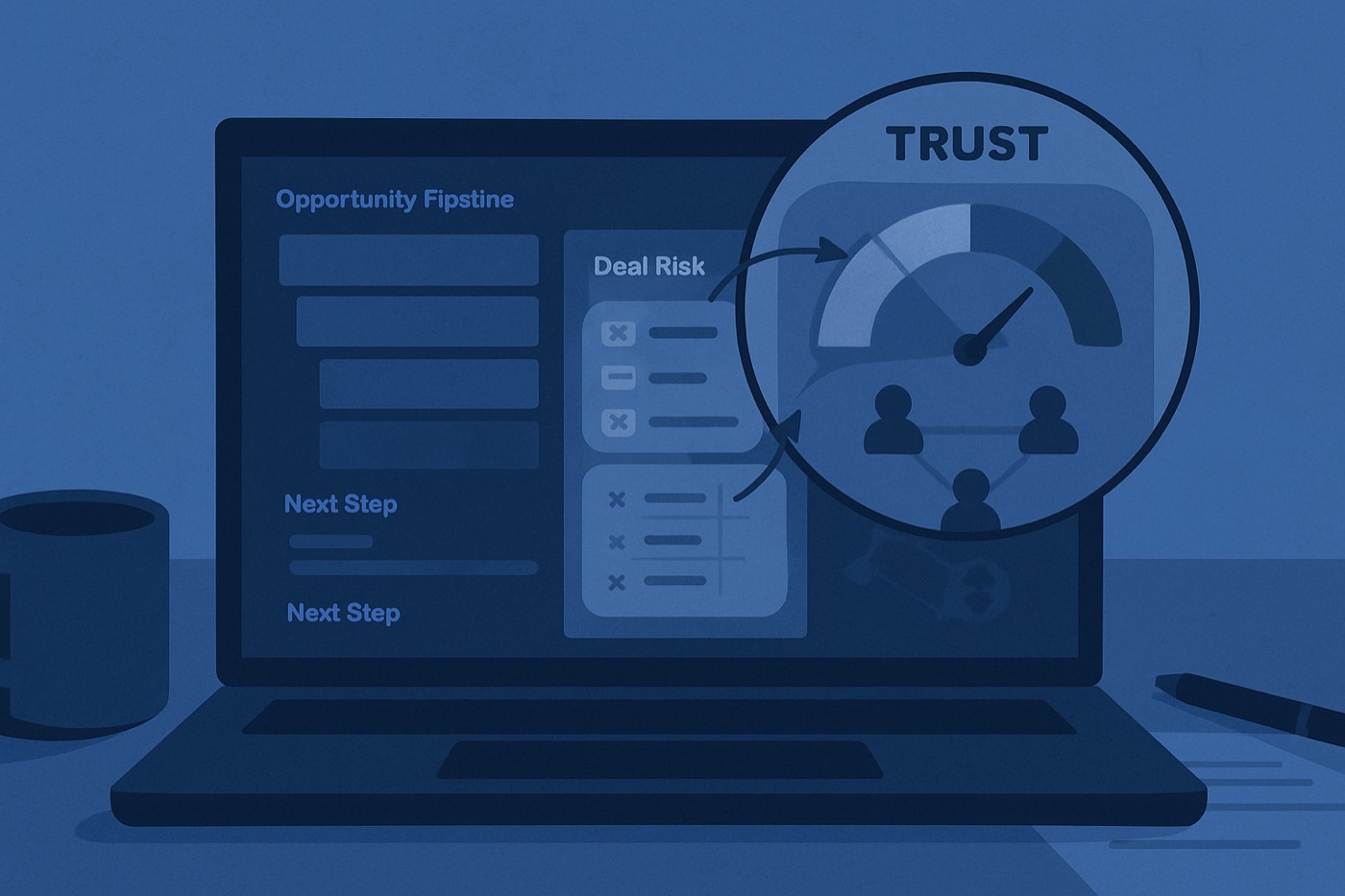
Deal risk scoring predicts the likelihood that an open opportunity will slip, stall, or close-lost by turning pipeline signals and buyer progress into a single, explainable rating (for example: Low, Medium, High risk). Unlike classic forecasting, which weights revenue by stage probability, deal risk scoring is built to answer a sharper question: “What is most likely to go wrong next, and what should the rep do about it?”
In practice, risk scoring is computed from a combination of activity signals (meetings, replies, calls), stage aging, stakeholder coverage, mutual action plan progress, and next-step quality. The credibility problem is that many teams ship it as a black-box number. Reps then ignore it because it flags the wrong deals (false positives), misses obvious risk (false negatives), or cannot explain what changed.
This guide covers how risk scoring works, why reps distrust it, the minimum inputs that make it real, and how an autonomous operator scores the signals that exist long before a deal does.
What is deal risk scoring
Deal risk scoring estimates the probability that an active opportunity will fail to close on time (slip) or fail to close at all (close-lost), using structured deal data and buyer-progress signals such as stage duration, engagement patterns, stakeholder mapping, mutual action plan completion, and next-step quality.
A risk score that reps actually use is:
- Predictive (it correlates with slip and loss)
- Explainable (it shows why the score changed)
- Actionable (it recommends a next best action)
- Hard to game (it cannot be inflated with empty activity)
Deal risk scoring vs forecast scoring (do not confuse these)
Most pipelines start with forecast math: amount x stage probability. HubSpot, for example, describes weighted forecasting as multiplying deal amount by stage probability, and uses deal stages and forecast categories to structure forecasts (blog.hubspot.com, knowledge.hubspot.com). That is forecasting, not risk scoring.
Deal risk scoring differs in three ways:
- It is diagnostic, not just arithmetic. It highlights what is broken: missing champion, no next step, stalled stage.
- It measures deal execution quality. It checks whether the buyer is progressing, not whether the rep feels optimistic.
- It should drive behavior this week. It changes what the rep does, not only what leaders report.
The 5 signal families that matter
If you want anyone to trust a risk score, the inputs need to map to how deals actually die. These are the five signal families most pipelines rely on, and what “good” looks like in each.
1) Activity and engagement (measured correctly)
Common inputs:
- Meeting volume and recency
- Email replies (not sends)
- Buyer-side attendance (who actually showed up)
- Thread depth (multi-person participation)
- Buyer-owned tasks completed
Why it often fails: most systems over-count rep output (calls placed, emails sent), which can be busywork and is not correlated with buyer intent.
How to make it credible, weight buyer-validated engagement higher than rep output:
- Replies over opens
- Meetings held over meetings scheduled
- Stakeholder attendance over “rep sent 12 follow-ups”
2) Stage aging (the strongest single signal for most teams)
Stage aging is simple and powerful. If your average deal spends 12 days in discovery and this one has been there 34 days, the risk is real.
HubSpot explicitly recommends flagging deals that spend longer than average in a stage, and provides time-in-stage reporting to set those baselines (blog.hubspot.com).
How to compute it (example):
- Baseline: median days-in-stage for closed-won deals, by segment (SMB vs mid-market vs enterprise)
- Risk rule:
- 1.0x to 1.5x baseline = Watch
- 1.5x to 2.0x baseline = At risk
- Over 2.0x baseline = Critical
Guardrail: never compare enterprise cycles to SMB baselines. Segment, or the model becomes noise.
3) Stakeholder coverage and role gaps
Complex B2B purchases involve a buying group, not one contact. Gartner has cited buying groups of roughly 6 to 10 stakeholders for complex B2B decisions, and multi-stakeholder dynamics remain the norm (gartner.com).
Risk scoring should reflect:
- Number of genuinely engaged stakeholders (not just contacts on the account)
- Role coverage: economic buyer, champion, technical evaluator, security/legal/procurement as relevant
- Single-threaded risk: one active contact carrying the whole deal
A rep-facing explanation that earns trust: “High risk because no economic buyer identified, only one active stakeholder in the last 21 days, champion unconfirmed.”
4) Mutual action plan (MAP) progress
A mutual action plan is a shared buyer-seller plan documenting milestones, owners, and dates. Salesforce defines it as a shared document that clarifies the critical steps and responsibilities to purchase and implement successfully (salesforce.com).
Treat MAP milestones as buyer-progress proofs:
- Security review scheduled and completed
- Procurement steps confirmed
- Contract redlines returned by date X
- Implementation kickoff booked
- Decision meeting set with required attendees
The nuance that matters: a MAP existing is a weak signal. MAP milestones completed on time is the strong one.
5) Next-step hygiene and close date integrity
Reps roll their eyes when a score nags them about “CRM hygiene.” But next-step hygiene is not cosmetic. It is a proxy for deal control.
Practical risk flags:
- Next step is empty or vague (“follow up”)
- Next step is stale (not updated in X days)
- No meeting booked inside the next Y business days
- Close date in the past on an open deal (an obvious quality issue)
HubSpot's forecasting guidance calls out close dates in the past and longer-than-average time in stage as clear signs something is wrong (blog.hubspot.com).
A simple, explainable model reps will actually use
If you are rebuilding trust, start with a model you can explain in one minute.
Starter scoring model
Score a deal 0 to 100 risk points (higher = riskier):
- Stage aging (0 to 30 points)
- Next-step freshness and specificity (0 to 20 points)
- Stakeholder coverage (0 to 20 points)
- MAP milestone progress (0 to 20 points)
- Close date integrity and push rate (0 to 10 points)
Map to labels:
- 0 to 24 = Low risk
- 25 to 49 = Medium risk
- 50 to 74 = High risk
- 75 to 100 = Critical
Explainability rules (non-negotiable)
Every score shown to a rep should include:
- Top 3 drivers, ranked
- What changed since last week, as a delta
- One recommended action, a single next best step
If the system cannot show those three things, reps are right to ignore it.
Why reps don't trust deal risk scoring (and how to fix each cause)
1) “It's a black box”
Symptoms: the score moves with no visible reason, and reps cannot dispute or fix it. Fix: show drivers, thresholds, and deltas. Put a “how to reduce risk” checklist on the deal record.
2) False positives (it flags the wrong deals)
Causes: over-weighting email volume, no segmentation by deal type or motion, penalizing deals that are quiet because procurement is doing its job. Fix: use buyer-validated engagement instead of rep output, add a “procurement/legal in progress” state that prevents panic scoring, and segment baselines by motion.
3) False negatives (it misses obvious risk)
Causes: the model ignores stakeholder roles (single-threaded deals look “active”), MAP and next-step fields are optional and empty, stage definitions are fuzzy so aging means nothing. Fix: make a few fields required at specific stage gates, add role-coverage requirements (even “unknown” beats blank), and tighten exit criteria per stage.
4) Gaming and score inflation
If reps can inflate the score with fake calls or filler emails, trust collapses fast. Fix: downweight rep-only activity, upweight buyer replies, meeting attendance, and milestone completion, and audit activity bursts that get no buyer response.
5) It's RevOps-only, not rep-facing
If the score lives only in leadership dashboards, reps read it as surveillance. Fix: put risk into the deal list, the pipeline board, and the weekly review workflow. Make it help reps win, not police them.
Minimum viable inputs: the 12 fields that make it real
Do not start by asking for 50 fields. Start with 12 that map to the five signal families.
Deal basics (3)
- Amount (or ACV)
- Close date
- Stage (with clear exit criteria)
Time and momentum (2)
- Stage entered date (auto-captured)
- Last meaningful buyer interaction (meeting held, reply, buyer task completed)
Next-step hygiene (2)
- Next step (specific): verb + date + owner. Example: “Buyer security lead to confirm SSO requirements by Feb 18.”
- Next-step due date
Stakeholder coverage (3)
- Champion identified? (Yes/No)
- Economic buyer identified? (Yes/No)
- Engaged stakeholders in last 30 days (auto-calculated from meetings, replies, or tracked contacts)
Mutual action plan (2)
- MAP exists? (Yes/No)
- MAP milestone progress (percent, or milestones completed / total)
Guardrails that reduce false positives without adding complexity
Guardrail 1: segment risk baselines. At minimum split by SMB vs mid-market vs enterprise, new logo vs expansion, and inbound vs outbound. Stage aging without segmentation produces bad alerts.
Guardrail 2: cap the influence of activity volume. After N touches without a buyer response, additional touches add little or no health benefit. Otherwise the noisiest rep gets the “healthiest” pipeline.
Guardrail 3: use proof-of-progress events. A meeting with the required stakeholder held, a buyer-completed MAP task, a started security questionnaire, a confirmed procurement timeline. These are hard to fake and correlate better with reality than raw activity.
Guardrail 4: allow a manual override, but log it. Let reps or managers set “override risk: Low/Med/High” with a required reason, and track override accuracy over time. Adoption rises because reps feel heard, and RevOps gets data to refine the model.
Operationalizing risk scoring in weekly pipeline reviews
A risk score only matters if it changes the pipeline review from “are you sure?” to “what is the constraint, and what are we doing next?”
A 30-minute weekly review agenda (per rep)
- Critical-risk deals first (10 minutes). For each: what is the score, what are the top 3 drivers, what changed since last week, and what is the one action due before next review?
- High value plus medium risk (10 minutes). This is where coaching pays off: stakeholder gaps, MAP slippage, next-step hygiene.
- Low risk but large (10 minutes). Prevent surprise slips: confirm the buyer timeline, stakeholder attendance on the next meeting, and the procurement path.
Rules that keep it practical
- High risk with no next-step due date: the only action is to add a real next step with a date.
- High risk and single-threaded: the only action is to name and engage two more stakeholders.
- Stage aging over 2x baseline: the only action is to re-validate exit criteria or re-stage the deal.
What “good” looks like: an output reps will trust
A trustworthy risk panel on the opportunity shows:
- Risk level: High
- Drivers:
- Stage aging: 28 days in discovery (baseline 12)
- No economic buyer identified
- Next step overdue by 9 days
- What changed: next step went overdue, close date pushed out 14 days
- Recommended action: book a decision-process call with the economic buyer and champion this week, confirm timeline and required steps
When the score does this consistently, adoption follows, because it reads like coaching, not judgment.
Where the riskiest deals are actually born: upstream of the pipeline
Every signal family above is a lagging measurement. Stage aging, single-threading, and a thin MAP are symptoms that the deal was built on weak ground long before it entered the pipeline: the wrong account, the wrong contact, a first conversation that never reached a real decision-maker.
This is the part most teams cannot reach with a CRM field. The CRM scores deals you already have. It does nothing about the upstream work that determines deal quality in the first place: choosing the right accounts, reaching the right people, and earning the first qualified conversation.
That upstream work is what Chronic, an autonomous revenue operator, runs end to end. You give it a revenue goal and the constraints you care about, and it handles discovery, enrichment, and signal scoring to find accounts that fit, then writes and sends cold email from managed, warmed mailboxes, handles replies, and books the meeting, surfacing approvals only for the decisions that matter. It scores prospects on buying signals before outreach, so the deals that reach your pipeline start with a real fit and a real conversation, not a contact added to hit a quota.
The practical handoff is clean. Chronic owns the work that decides whether a deal is healthy on day one. Your risk scoring then watches the open deals for the execution signals above. The fewer weak deals you let in at the top, the fewer false-positive fire drills you run later.
FAQ
What is deal risk scoring?
Deal risk scoring is a rating that estimates how likely an open opportunity is to slip or close-lost, based on signals like stage aging, stakeholder coverage, mutual action plan progress, and next-step quality.
How is deal risk scoring different from forecasting?
Forecasting estimates expected revenue, often using stage probabilities and weighted pipeline math. Risk scoring identifies execution risk: why a deal is likely to stall or fail, and what to do next.
Why do sales reps distrust deal risk scoring?
They distrust it when it is a black box, triggers false positives that penalize healthy deals, misses obvious risk, can be gamed with empty activity, or is used only for management reporting instead of rep coaching.
What inputs matter most for accurate risk scoring?
The most predictive inputs for many teams are stage aging (time in stage vs baseline), next-step freshness and specificity, stakeholder role coverage (champion and economic buyer), mutual action plan milestone completion, and close date integrity.
How do you reduce false positives?
Use segmented baselines (SMB vs enterprise), cap the value of raw activity volume, upweight buyer-validated engagement (replies, attendance, buyer tasks), and track proof-of-progress events like MAP milestone completion.
How should teams use risk scoring in weekly pipeline reviews?
Start with critical-risk deals, review top drivers and deltas, and assign one concrete action per deal. Keep it rep-facing by tying the score to a single next best step, such as multithreading, confirming the decision process, or updating the next step with a due date.
A 2-week, rep-first rollout
- Pick the 12 minimum viable inputs above and make four of them stage-gated required fields (next step, next-step date, champion, economic buyer).
- Launch an explainable scorecard: top 3 drivers, what changed, one action.
- Run reviews by risk band: critical first, then high value plus medium risk.
- Track overrides and outcomes: when reps disagree, log the reason and compare to results.
- Iterate monthly: adjust weights, refine stage definitions, and improve stakeholder and MAP tracking based on win-loss and slip analysis.