Fit, intent, and capacity scoring: the third variable that turns scores into booked meetings
Fit (do they match your ICP?) and intent (are they in-market now?) are only two-thirds of the picture. Capacity (can outreach actually go out today, on a healthy domain?) decides whether a high score becomes a booked meeting.
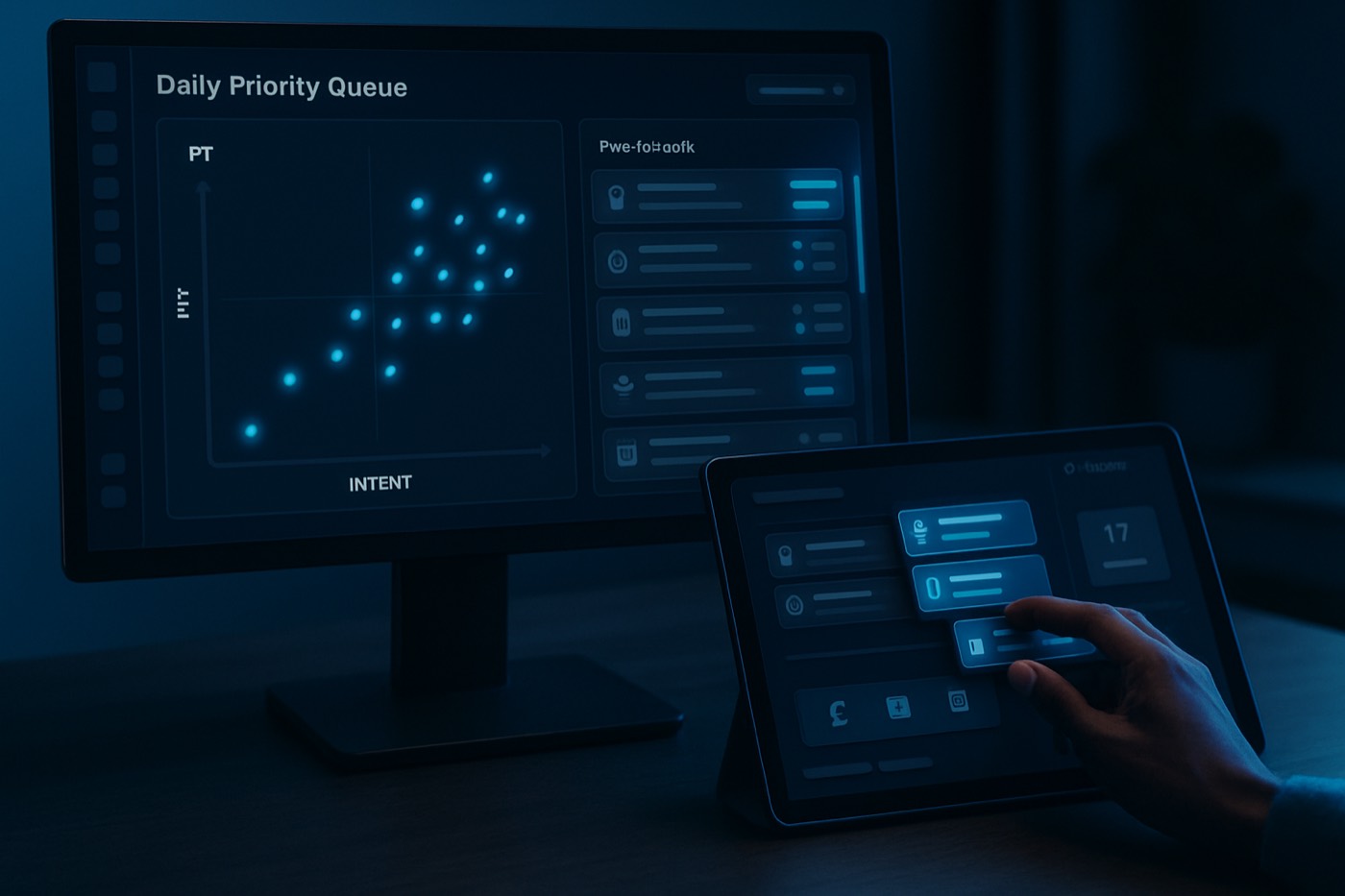
Most lead scoring fails for one reason. It picks "good leads" and then does nothing with them. The score lands on a record, and the actual outreach still depends on whoever has time and remembers to follow up.
A fit and intent scoring model is the right place to start. But two axes miss the variable that decides whether anything moves today: capacity. Not the team's mood, but the real ability to act now, with speed and quality, on the leads you just ranked. For a lot of teams that means a rep with bandwidth. For an autonomous operator like Chronic, it means a warmed mailbox with deliverability headroom, a clear persona, and a message ready to send.
TL;DR
- Fit answers "should we sell to them?" (ICP match)
- Intent answers "are they in-market right now?" (signals)
- Capacity answers "can we actually work this lead today, properly?" (bandwidth, deliverability, data)
- The output is not a dashboard. It is a daily priority queue that triggers real outreach, replies, and booked meetings.
- If scoring does not route action, it is just a number on a record.
Dual scoring (fit + intent), and why two axes still break
Dual scoring means you rank leads or accounts on two independent axes:
- Fit score (profile match)
- Intent score (behavioral likelihood to buy soon)
Most scoring tools do this. HubSpot supports a combined score with separate fit and engagement inputs (knowledge.hubspot.com). That is table stakes, and it is also where most teams stop.
The failure mode is familiar:
- Marketing builds a scoring spreadsheet.
- RevOps ports it into a tool.
- A tidy score shows up on records.
- Nothing changes in how leads actually get worked.
- High-intent leads sit untouched while reps cherry-pick the inbound they happen to notice.
So the score becomes a vanity metric. Then leadership asks why pipeline is flat, and everyone blames "lead quality." The quality was fine. The problem was that nothing acted on it fast enough.
Fit scoring: the definition that matters
Fit scoring measures how closely a lead or account matches your ICP.
Fit is mostly stable. It changes slowly. It answers: "Even if they wanted to buy, would this be a good customer?"
Common fit signals
Use what you can verify:
- Firmographics: industry, employee count, revenue band
- Geography: supported regions, compliance constraints
- Technographics: tools they run, platforms they integrate with
- Role and seniority: buyer, champion, blocker
- Use-case alignment: do they have the problem you solve
Fit scoring is why you do not spend a week selling enterprise security workflows to a 12-person agency running Gmail.
A simple fit rubric
Score fit 0 to 100. Keep it boring.
Fit Score = Industry (0-25) + Size (0-25) + Tech match (0-25) + Role/seniority (0-25)
Example:
- Industry match: exact target vertical = 25, adjacent = 15, not target = 0
- Company size: in ICP band = 25, close = 15, outside = 0
- Tech match: must-have present = 25, unknown = 10, incompatible = 0
- Role: economic buyer = 25, strong influencer = 15, junior = 5
This is the part most teams can do with basic enrichment.
If your data is thin, fix that first. Start with enrichment and standard fields, then score. No data, no score. Pair fit scoring with automated enrichment so the score fills itself: see Lead Enrichment and a written ICP definition with ICP Builder.
Intent scoring: what it is, and what it is not
Intent scoring measures whether someone is showing buying signals now.
Intent is time-sensitive. It decays fast. It answers: "Is this the right timing?"
Forrester's intent research breaks down the types of intent data and stresses using intent to prioritize and progress opportunities based on observed buying behavior (forrester.com).
Intent sources, ranked by usefulness
Not all "intent" is intent. Some of it is just curiosity.
Tier 1 (high intent, close to revenue)
- Demo request, pricing page visits, product comparisons
- Reply behavior: "send pricing," "what's implementation like," "can we talk this week"
- Direct engagement: email reply, booked call, inbound chat
Tier 2 (mid intent)
- Repeated visits to solution pages
- Webinar attendance with active Q&A
- Competitor keyword searches that land on your site
Tier 3 (weak intent)
- One blog post view
- A single LinkedIn like
- An email open, which is an unreliable signal and getting worse as mail clients pre-fetch images
Intent decays, or it lies
If intent does not decay, your pipeline fills with "hot leads" that went cold 90 days ago.
A basic decay rule:
- High-intent events decay 50% every 7 days
- Low-intent events decay 50% every 3 days
- Any lead with no activity for 30 days drops to near-zero intent
Gartner frames lead qualification around two categories, profile fit and behavioral fit, which maps closely to fit and intent (gartner.com).
The missing variable: capacity scoring
Capacity scoring measures your ability to act now on a lead with the right speed, channel, and personalization.
Capacity answers: "Even if this lead is a perfect fit and in-market, will it actually get worked today?"
Most teams ignore this, then wonder why their speed-to-lead is poor.
The Lead Response Management study (popularized by InsideSales) found that the odds of qualifying a web lead drop sharply as response time grows, with the first few minutes far outperforming an hour or a day (insidesales.com).
This is not a motivational poster. It is arithmetic:
- If nothing can respond fast, a high intent score is fiction.
- The lead does not wait for your next planning meeting.
This is also where an autonomous operator changes the equation. A human team's capacity is capped by headcount and working hours. An operator that owns its own warmed mailboxes can keep capacity high all day, as long as deliverability holds. Capacity stops being a staffing problem and becomes an infrastructure one.
Capacity signals to score
Capacity is operational, not a vibe.
Score capacity 0 to 100 on:
- Coverage: is there bandwidth to send and reply in the next window?
- Queue load: how many "must-touch-today" leads are already in flight?
- Channel readiness: deliverability headroom, dialing coverage, LinkedIn capacity
- Routing readiness: a correct owner exists, territory rules work, no duplicates
- Data readiness: email and phone present, persona clear enough to message well
Capacity is how you stop routing your best leads into a black hole.
A practical capacity rubric (0-100)
Use four components.
- Coverage (0-30)
- Within the response window (for example, 0 to 15 minutes) = 30
- Same day but outside the window = 15
- Not today (weekend, holiday, no coverage) = 0
- Queue load (0-30)
- Under 15 priority leads in flight = 30
- 15 to 30 = 15
- Over 30 = 0
- Data completeness (0-20)
- Email + phone + role known = 20
- Email only = 10
- Missing email = 0
- Channel health (0-20)
- Sending infrastructure healthy, no throttling = 20
- Throttled = 10
- Paused for reputation problems = 0
If you run cold email, capacity is mostly deliverability. If your domains are burned, your "sequence" is spam with extra steps. Run a weekly check: Deliverability ops in 2026.
The full model: fit + intent + capacity
The clean way to define it:
- Fit decides who belongs in your pipeline.
- Intent decides when they should be worked.
- Capacity decides whether you can act fast enough for it to matter.
Combine with multiplication, not addition
Most teams add:
- Fit (0-100) + Intent (0-100) = Combined (0-200)
That inflates junk. High fit with zero intent still bubbles up. High intent from a terrible-fit account steals attention.
Gate it instead:
Priority Score = (Fit × Intent × Capacity) / 10,000
Why: any dimension near zero collapses the total, which matches reality. If you cannot act, the lead dies. If they do not fit, do not chase. If there is no intent, do not pretend.
Routing bands
Define three:
- P1 (now): Priority Score 70 or higher
- P2 (this week): 40 to 69
- P3 (nurture): under 40
Then attach actions, covered below.
Example weights: SMB vs mid-market
If you prefer weighted addition (that is fine), match the weights to the motion.
SMB outbound: speed matters more than perfect fit
SMB wins on volume plus speed plus good-enough personalization.
Recommended weights:
- Fit: 35%
- Intent: 40%
- Capacity: 25%
SMB buyers move fast, and many SMB deals close because you showed up first and did not waste their time.
Mid-market outbound: fit matters more, intent still critical
Mid-market has more stakeholders and longer cycles, so bad fit wastes weeks.
Recommended weights:
- Fit: 45%
- Intent: 35%
- Capacity: 20%
Capacity still matters because speed-to-lead still matters. You just cannot afford to spray.
The math:
Weighted Score = 0.45(Fit) + 0.35(Intent) + 0.20(Capacity)
Then gate it:
- If Fit < 60, cap the Weighted Score at 49 (it cannot become P1)
- If Capacity < 40, downgrade one band (P1 to P2)
A rubric you can ship this week
Stop building a 90-signal model nobody trusts. Ship a v1.
Step 1: write your ICP on one page
Include:
- 3 target industries
- 1 to 2 size bands
- 1 must-have tech signal (or "unknown allowed")
- 2 target personas
Make it a living asset with ICP Builder.
Step 2: pick 6 fit rules, 6 intent rules, 4 capacity rules
That is it. No more.
Fit rules (example)
- Industry match: 0/10/20
- Employee band: 0/10/20
- Geo: 0/10
- Tech match: 0/10/20
- Persona: 0/10
- Competitor's existing customer: -10 (negative scoring is real)
Intent rules (example)
- Demo request: +40
- Pricing page: +25
- Case study view: +15
- 2+ product page visits in 7 days: +20
- Replied to email: +35
- Unsubscribed: -50 (they are not "in-market," they are done)
Capacity rules (example)
- Within the response window: +30
- Queue load under threshold: +30
- Email + phone present: +20
- No deliverability throttles: +20
Step 3: add decay
Decay intent weekly. Recalculate capacity daily. Recalculate fit when enrichment updates.
Step 4: calibrate on closed-won, not opinions
Pull your last 90 days of closed-won and closed-lost.
- What were their fit, intent, and capacity at first touch?
- Adjust thresholds.
- Repeat monthly.
With little data volume, keep it rules-based until you have enough. Predictive scoring without enough outcomes is expensive guesswork.
The operational output: a daily priority queue
Scoring without routing is decoration.
The model must produce a daily priority queue with explicit actions:
- Who gets worked today
- By whom (or by what)
- On which channel
- With which message angle
- In what order
What the queue looks like
Every morning, the queue produces, say, 25 records:
- P1 now (top 10): contact within the response window
- P2 this week (next 10): enroll in a multi-step sequence plus a LinkedIn touch
- P3 nurture (last 5): long-cycle nurture, no live time
Then the system pushes those leads into actual outreach.
This is the point where scoring becomes pipeline, and it is the part most teams never close. Chronic is built to run exactly this loop end to end: it scores fit, intent, and capacity, writes and sends the outreach from warmed mailboxes, handles the replies, and books the meeting, surfacing approvals for the decisions that matter. Start with AI Lead Scoring tied into your Sales Pipeline.
Routing rules that stop hot-lead rot
Two non-negotiables:
- Act on P1 immediately, based on territory and persona
- Re-route anything untouched inside the response window
That is how you keep "high intent" from dying in a queue while someone means to "circle back."
Turn the queue into outreach, fast
The queue should trigger:
- A sequence of 4 to 6 steps
- A personalized first line based on the intent trigger
- A channel switch if there is no engagement by step 2
Tie the channel switch to signals: The next-best-channel rulebook. And copy matters, but copy without prioritization is just more noise. Use a writer that pulls real context and writes to the trigger, not generic filler: AI Email Writer.
Common failure points
1. You score leads but never cap the queue
If every owner has 300 "hot" leads, none are hot. Cap P1 and P2.
Hard caps:
- P1: max 10 per owner per day
- P2: max 10 per owner per day
Overflow becomes P2 tomorrow. That is capacity scoring doing its job.
2. You treat "engagement" as intent
Webinars and ebook downloads can be intent, or they can be a student doing homework. Keep high-intent events scarce: pricing, demo, reply, competitor-comparison pages.
3. You ignore response time
Speed-to-lead is not just an inbound concern. It applies to any high-intent spike. If you wait a day to act on a lead who just signaled active buying, you volunteered to lose (insidesales.com).
4. You build the model around your tooling's limits
Do not. Build the operational workflow first, then map fields and automation onto it. If your current stack fights you, that is useful information about the stack.
If you are comparing options:
The contrast is about ownership of the work, not just price. Most stacks score the lead and hand it back to you to chase. Chronic runs the scoring, the sending, and the follow-up itself, and only pulls you in for approvals. Chronic's published price is $99/month with unlimited seats; verify the current details on pricing.
Build a fit + intent + capacity system in 7 days
Day 1: define ICP and disqualifiers
- ICP one-pager
- 5 disqualifiers (for example: industry no-go, too small, region unsupported)
Day 2: instrument intent events
- Identify your 6 intent events
- Track them consistently (page events, replies, form types)
Day 3: build a fit enrichment waterfall
- Firmographics
- Technographics
- Persona classification
This is what Lead Enrichment is for.
Day 4: add capacity inputs
- Coverage windows
- Queue limits
- Deliverability status (green/yellow/red)
If you run outbound email at any scale, read The 2026 outbound sending architecture.
Day 5: build the score and bands
- Fit 0-100
- Intent 0-100 with decay
- Capacity 0-100, recalculated daily
- Priority formula and thresholds
Day 6: build the daily queue and automations
- P1 acts immediately, creates tasks, triggers a sequence
- P2 enrolls in a sequence and schedules touches
- P3 nurtures, no live time
Day 7: QA and ship
- Test 20 real leads
- Confirm routing
- Confirm response timers
- Confirm sequences fire correctly
Then run it for two weeks and adjust weights based on meetings booked, not internal debates.
FAQ
What is a fit and intent scoring model?
A fit and intent scoring model ranks leads or accounts on two scores: fit (ICP match) and intent (buying signals). Tools like HubSpot support a combined score with separate fit and engagement inputs (knowledge.hubspot.com).
What is the difference between fit scoring and intent scoring?
Fit scoring measures whether the prospect matches your ICP (industry, size, tech, persona). Intent scoring measures whether they are showing signals of active evaluation (pricing views, demo requests, replies, comparison behavior). Forrester's intent frameworks focus on using intent signals to prioritize based on buying behavior (forrester.com).
Why add capacity scoring? Isn't fit + intent enough?
Because fit + intent does not guarantee action. If the team is overloaded, routing is broken, or sending domains cannot respond inside your window, "hot leads" rot. The Lead Response Management research shows qualification odds fall sharply as response time grows (insidesales.com).
How do I choose weights for SMB vs mid-market?
SMB usually needs more emphasis on intent and speed, so weight intent higher. Mid-market punishes bad fit, so weight fit higher. Start with SMB at Fit 35%, Intent 40%, Capacity 25%, and mid-market at Fit 45%, Intent 35%, Capacity 20%. Then recalibrate monthly against closed-won and closed-lost.
What should the scoring system produce in real operations?
A daily priority queue, not a report. The queue assigns P1/P2/P3 bands, sets ownership, and triggers sequences and tasks automatically. If a score does not trigger an action, it is just a number on a record.
How many signals should the model include?
Fewer than you think to start: 6 fit rules, 6 intent rules (with decay), and 4 capacity rules. Ship v1, then tune based on meetings booked and conversion, not internal opinions.
Build the queue, book the meetings
If your scoring model does not produce a daily list that actually gets worked, it is not doing anything.
Ship this instead:
- Score fit (ICP match).
- Score intent (time-decayed buying signals).
- Score capacity (coverage, queue load, data readiness, channel health).
- Combine into a Priority Score.
- Route into a daily priority queue that triggers outreach and meetings.
That last step is where most teams stall and where an autonomous operator earns its keep. Scoring only matters when something acts on it the same day, every day, without anyone needing a reminder to follow up.