Fit and intent scoring: the dual model that aims outreach without sending more email
Fit scoring answers whether an account is worth selling to; intent scoring answers whether to sell this week. Score both 0 to 100, route every account by a fit-by-intent matrix, and aim outreach instead of adding volume.
Most outbound teams do not have a reply problem. They have a targeting problem.
They keep working the same list. They keep writing "personalized" emails that reference the same generic pain. Then they keep reaching for the only lever that feels available: send more.
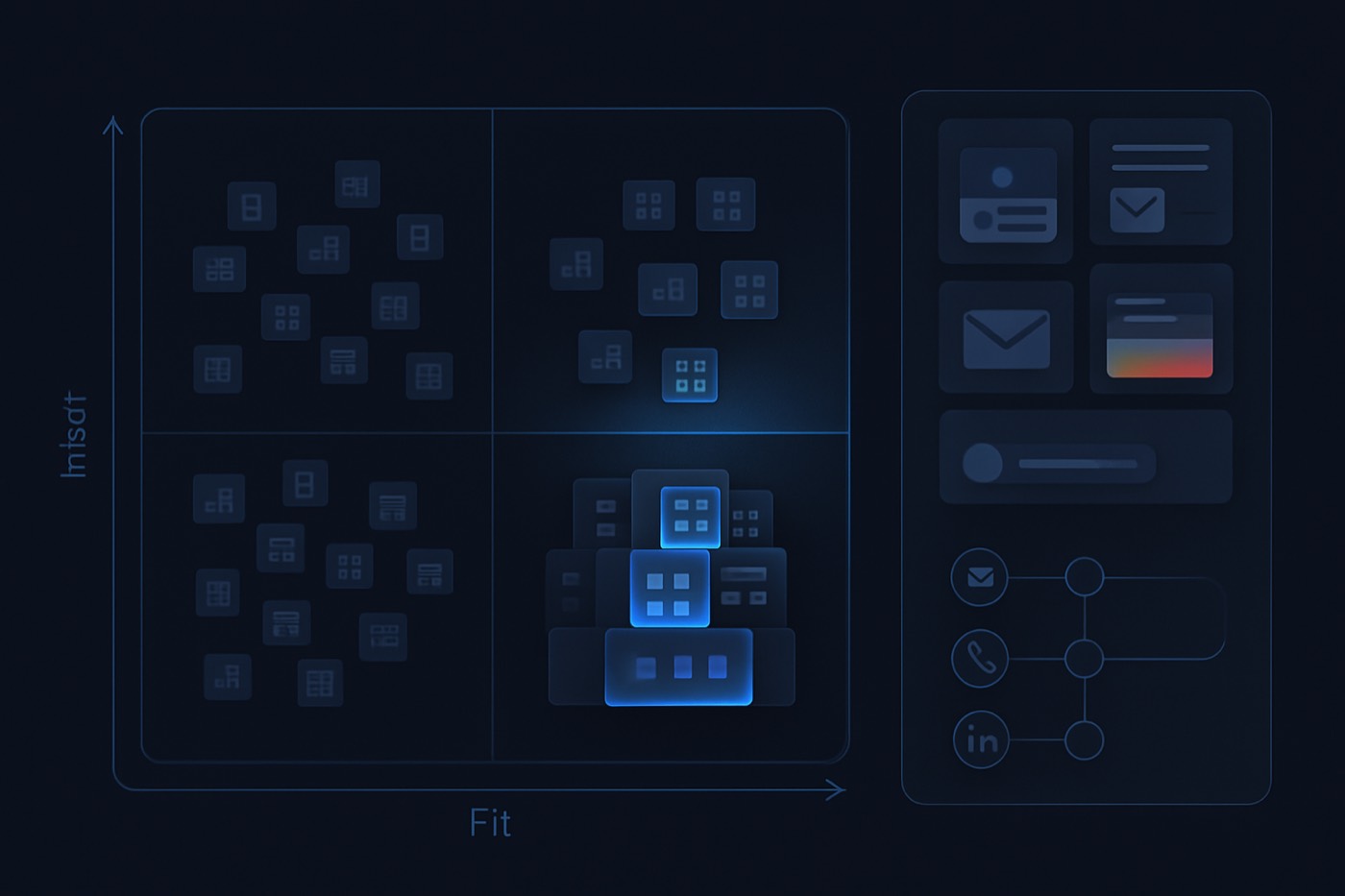
Dual scoring removes that reflex. Fit and intent scoring puts every account in one of four buckets, then changes both the channel and the message for each one. Same sending volume. Better-aimed outreach, so a larger share of it earns a reply.
What fit and intent scoring actually means
Fit score (ICP fit) answers: should we ever sell to them?
- Mostly static.
- Based on company and persona facts.
Intent score (in-market intent) answers: should we sell to them this week?
- Highly dynamic.
- Based on behavior and change events.
Most teams score one or the other, and both failure modes are predictable:
- Fit-only teams chase "perfect" accounts that are not buying.
- Intent-only teams chase noise from accounts that will never buy.
Dual scoring forces two rules that fix it:
- Fit gates intent. A signal from a bad-fit account is still a bad account.
- Intent triggers action. Good fit alone is a watchlist, not a reason to email today.
This is the work Chronic does as an autonomous revenue operator: it builds the fit and intent model with you, then runs discovery, enrichment, scoring, and outreach against it, surfacing only the approvals that matter. See AI lead scoring for how the dual model is wired in.
Why the timing matters now
Two facts about how B2B buyers actually behave make dual scoring the right move, not just a tidy framework.
1) Buyers avoid sales until they have to. Gartner found that 61% of B2B buyers prefer a rep-free buying experience (survey of 632 buyers, August to September 2024). A "just checking in" email to a cold account is not a service to them. It is friction. Source: Gartner press release (Jun 25, 2025)
2) Most buying activity is invisible. 6sense calls this the "dark funnel" and reports that buyers complete at least 70% of the journey in anonymous research before they engage a vendor. Source: 6sense - What is intent data?
Put together, the job is narrow:
- Stop emailing accounts that are not a fit.
- Stop calling accounts that show no intent.
- When intent does spike, send a message that names the signal, so the outreach reads as relevant instead of random.
The scoring model you can copy
You want something your team can run in a spreadsheet today and automate later. Two scores, each 0 to 100, then a 2x2 routing matrix. Keep it boring. Boring scales.
Fit scoring template (ICP fit dimensions)
Fit score is three buckets that together total 100.
1) Firmographics (0 to 45 points)
Pick what actually predicts conversion in your data, not what looks good on a slide.
- Industry match (0 to 15): target vertical +15, adjacent +8, non-target +0
- Employee count (0 to 10): sweet spot +10, slightly small or large +6, way off +0
- Revenue or budget proxy (0 to 10): clear budget for your category +10, possible +5, unlikely +0
- Geo or compliance fit (0 to 10): in-region and compliant +10, in-region but tricky +5, out-of-region +0
Rule: if geo or compliance makes the deal impossible, do not score it low. Kill it. Mark the account "do not prospect" so it never reappears.
2) Technographics (0 to 35 points)
Technographics are not trivia. They are constraints. The wrong stack means no deal; the right stack means a shorter cycle.
- Must-have integration present (0 to 15): yes +15, unknown +7, no +0
- Competing tool installed (0 to 10): direct competitor +10 (a displacement story), adjacent competitor +6, none +2
- Stack maturity (0 to 10): modern stack with a clear ops motion +10, mixed +6, spreadsheet-run +2
Doing this by hand across a real list does not scale. Chronic runs lead enrichment automatically, so fit scoring stays current instead of becoming a part-time job.
3) Role match (0 to 20 points)
If your contact cannot feel the pain and influence the purchase, replies drop.
- Title matches primary persona (0 to 10): exact +10, close +6, wrong +0
- Function matches workflow owner (0 to 5): yes +5, maybe +2, no +0
- Seniority matches deal size (0 to 5): right level +5, slight mismatch +2, off +0
If you do not have an ICP definition yet, build it once before you score anything. Chronic's ICP builder makes the dimensions explicit, so your team stops re-litigating them in Slack.
Intent scoring template (signals that actually mean something)
Intent is not "opened an email." It is behavior and change that correlate with active evaluation. Intent data is a real category for a reason: 6sense defines it around signals that show accounts researching topics tied to a purchase. Source: 6sense - What is intent data?
Use five buckets that together total 100. Score quality, not raw activity.
1) Website intent (0 to 30)
- Pricing page view: +15
- Integration or docs page view: +10
- Case study view in a target vertical: +8
- Careers page only: +0 (that is HR, not buying)
If you do not have page-level tracking yet, start with what you can see. You still route better than "everyone gets sequence A."
2) Job posts intent (0 to 20)
Hiring is a roadmap leak.
- Hiring for the exact function your product supports: +15
- Hiring RevOps, sales ops, or demand gen roles: +10
- Generic hiring surge: +5
3) Tech change intent (0 to 20)
Stack changes open buying windows.
- New data warehouse, CDP, or CRM migration: +15
- Added a tool adjacent to yours: +10
- Ripped out a tool you integrate with: +8 (pain or a rebuild)
4) Funding and expansion intent (0 to 15)
Money and expansion create urgency.
- New funding round: +12
- M&A: +10 (integration chaos works in your favor)
- New region launch: +8
5) Third-party research intent (0 to 15)
This is where intent providers live.
- Competitor comparison research: +15
- Category topic surge: +10 to +15
- Review site activity: +8 to +12
Many intent platforms model this as "surge" and staged buying activity. 6sense, for example, sorts accounts into buying stages based on signals and research behavior. Source: 6sense - Predictive buying stages
Tiers and decay
Fit tiers
- 80 to 100: Tier A fit
- 60 to 79: Tier B fit
- 40 to 59: Tier C fit
- 0 to 39: disqualify or park
Intent tiers
- 70 to 100: hot
- 40 to 69: warm
- 10 to 39: cool
- 0 to 9: cold
Intent decays, and fast. Treat hot as a 7 to 14 day window unless new activity refreshes it, and warm as 21 to 30 days. Skip this and you "follow up" with someone who stopped caring two weeks ago.
Routing matrix: who gets email, LinkedIn, a call, or nothing
This is where teams stop wasting effort. The combination of fit and intent decides the channel, not a rep's gut.
| Intent hot (70 to 100) | Intent cool or warm (0 to 69) | |
|---|---|---|
| Fit high (80 to 100) | All channels: email + LinkedIn + call | Email + LinkedIn, no call |
| Fit medium (60 to 79) | Email + LinkedIn; call only on a high-confidence signal (pricing, competitor compare) | LinkedIn only, or park |
| Fit low (0 to 59) | Ignore unless inbound. Exception: a sharp trigger like a competitor migration plus a real displacement play | Ignore |
Why this holds up:
- Calls are expensive. Spend them where timing is real.
- LinkedIn warms accounts; it does not resurrect dead ones.
- Email lands best when the intent signal makes the message feel inevitable rather than cold.
Chronic ties this scoring straight to its sequencing and meeting booking, so routing runs without a human re-sorting a list every morning. The whole loop, from signal to booked meeting, lives in the sales pipeline.
The weekly operating rhythm
Dual scoring fails when it lives in a dashboard no one opens. Run it like a process.
Monday: refresh intent, lock the hot list.
- Pull every account with intent 70 or higher.
- Filter to fit 60 or higher.
- Cap the list at what your team can actually work this week.
Daily: work by route, not by lead count.
- Hot and high fit: same-day touch.
- Warm and high fit: nurture sequence.
- Cool: a content touch or nothing.
- Low fit: do not "just try."
Friday: tune the weights against outcomes. Track:
- Reply rate by intent trigger type
- Meeting rate by route
- Spam complaints (poor list quality shows up here first)
For the measurement side of this, it pairs well with proof-metric reporting. See 7 metrics that prove your AI SDR actually works.
Score-to-message: outreach that changes with the trigger
This is the step most teams skip, then they conclude "intent didn't work." A score is only useful if the message changes with it. Every trigger-based email should do three things:
- Name the trigger.
- Make a plausible inference about why it happened.
- Offer a tight next step.
Chronic's AI email writer generates these per trigger from the same score, but the frameworks below are worth keeping whether you automate or not.
Framework 1: website intent (pricing or integration page)
When to use: visited pricing, integration docs, or implementation pages.
Subject options
- Quick question on {integration}
- Timing on {category}?
- Saw {company} looking at {integration}
Email (under 90 words) Hi {first},
Noticed {company} looking at {specific page or integration}. Usually that happens when a team is checking effort and risk before switching or adding a tool.
If {top ICP problem} is on your plate this quarter, I can send:
- a 2-minute setup map for {integration}
- what teams typically replace and keep
Worth a quick yes or no: are you evaluating {category} right now?
-{name}
Routing note: if fit is 80+ and the page is pricing, add a call within 24 hours.
Framework 2: job post intent (hiring for the pain)
When to use: hiring RevOps, an SDR manager, demand gen ops, or data roles tied to your workflow.
Subject options
- Saw the {role} hire
- Hiring signal at {company}
- {company} building {function}
Email Hi {first},
Saw {company} hiring a {role}. That usually means one of two things:
- the current process is manual and breaking at volume, or
- leadership wants tighter reporting and routing.
If you tell me which one is true, I will send a short playbook with:
- the fit and intent scoring model we see work
- what the first 30 days looks like operationally
Open to that?
-{name}
Routing note: strong for a LinkedIn plus email combo. Skip calls unless the role is senior and fit is high.
Framework 3: tech change intent (new tool, migration, replacement window)
When to use: new CRM, new sequencing tool, data provider swap, or a website rebuild.
Subject options
- Saw the {tool} change
- {tool} migration
- New stack, new routing?
Email Hi {first},
Looks like {company} recently added {tool} or started a {tool} migration.
In our experience that is the window where routing and outbound either gets cleaner fast or turns into five tools and a spreadsheet.
If you are reworking scoring and outbound this quarter, I can share:
- a simple fit and intent scoring template
- the routing matrix we use to decide email vs LinkedIn vs call
Should I send it?
-{name}
Routing note: if the change is CRM-related and fit is 80+, a call is fair game. Otherwise start with email.
The scoring-to-routing cheat sheet
Fit high, intent hot: email today, LinkedIn touch today, call within 24 hours.
Fit high, intent warm: email sequence, LinkedIn nurture, no call.
Fit medium, intent hot: email plus LinkedIn; call only for high-confidence triggers (pricing, competitor compare).
Fit low: ignore, unless inbound asks for it.
That is the whole playbook.
Common mistakes that make dual scoring useless
Treating intent like a personality trait. Intent is a moment, and it expires. Build the decay windows in from day one.
Scoring on opens and clicks. Apple Mail privacy killed open data as a signal, and a click is as likely to be someone heading for the unsubscribe link as a buying signal.
No negative scoring. Add penalties so the wrong accounts fall out:
- Students, consultants, or vendors selling to you: minus 20 fit
- Careers-only behavior: minus 10 intent
- Generic info-page visits: +0 intent
One message for every trigger. If the trigger is a pricing-page visit, do not send a thought-leadership email. Match the moment.
Too many tools, no owner. A scoring model spread across an enrichment tool, a sequencer, and a CRM tends to rot because no single system owns it end to end. The point of an autonomous operator is that one system pulls the leads, enriches them, scores fit and intent, runs the sequences, and routes the outreach without a person stitching it together.
If you are comparing where this work should live:
If your stack is already a mess, start here: How to build a sales stack cleanup plan in 30 days (and still book meetings).
Build it in 60 minutes
Step 1 (15 min): define your ICP dimensions. Write down 3 target industries, an employee range, the tech must-haves, and the primary buyer titles.
Step 2 (15 min): assign point ranges. Do not chase perfection. You are only separating yes-or-no fit from now-or-later timing.
Step 3 (10 min): pick 5 intent signals you can actually collect. Start with website pages, job posts, funding, tech changes, and third-party research if you have it. Providers formalize this by tracking research behavior and topic surges across networks. Source: 6sense - What is intent data?
Step 4 (10 min): create the routing matrix. Hard rules beat vibes.
Step 5 (10 min): write the three trigger-based emails. You already have them above. Lock them in.
If deliverability is shaky, fix list quality first. Dual scoring helps here too, because you stop hammering low-fit junk that draws spam complaints. For the deeper deliverability angle, see Cold email deliverability in 2026 is a targeting problem.
FAQ
What is fit and intent scoring?
Fit and intent scoring is a dual model that scores how well an account matches your ICP (fit) and how strongly it signals active evaluation (intent). Fit stays mostly stable; intent changes weekly. You route outreach based on the combination of the two.
What intent signals should I start with if I have no intent data vendor?
Start with first-party and public signals: pricing and integration page visits, job posts tied to your workflow, funding and hiring surges, and tech-stack changes visible through technographics tools. Add third-party intent later.
How do I stop reps from cherry-picking hot accounts and ignoring the rest?
Make routing non-negotiable. Hot plus high fit gets same-day SLA timing, warm gets a sequence, low fit gets ignored. Then measure compliance by activity and meetings booked per bucket. An autonomous operator enforces this automatically, because the routing rule, not a rep's preference, decides the channel.
Should I call on high intent even when fit is medium?
Only when the intent signal is high-confidence: a pricing page, a competitor comparison, or direct integration research. Otherwise lead with email and LinkedIn. Calls are expensive, so spend them where timing and fit both support the bet.
How often should we refresh intent scores?
Weekly at minimum, daily if you have enough volume and reliable signals. Intent decays fast, so treat hot as a 7 to 14 day window unless new activity refreshes it.
What is the fastest way to run this without hiring RevOps?
Use one system that pulls leads, enriches them, scores fit and intent, runs sequences, and routes outreach for you. Chronic does this as an autonomous revenue operator with AI lead scoring, lead enrichment, and the sales pipeline, so the scoring model turns into booked meetings instead of another dashboard.
Build the score. Route the work. Book the meetings.
Copy the model into a sheet today. Score 100 accounts. Route them with the matrix. Send the trigger-based emails.
Replies climb when the outreach matches reality, not when you send more email.