Microsoft bulk sender rules in 2026: the deliverability changes that actually hit outbound teams
Microsoft now expects high-volume senders to Outlook.com inboxes to authenticate with SPF, DKIM, and aligned DMARC, keep spam complaints low, and stop sending to bad lists. DMARC passing, not just present, is the bar.
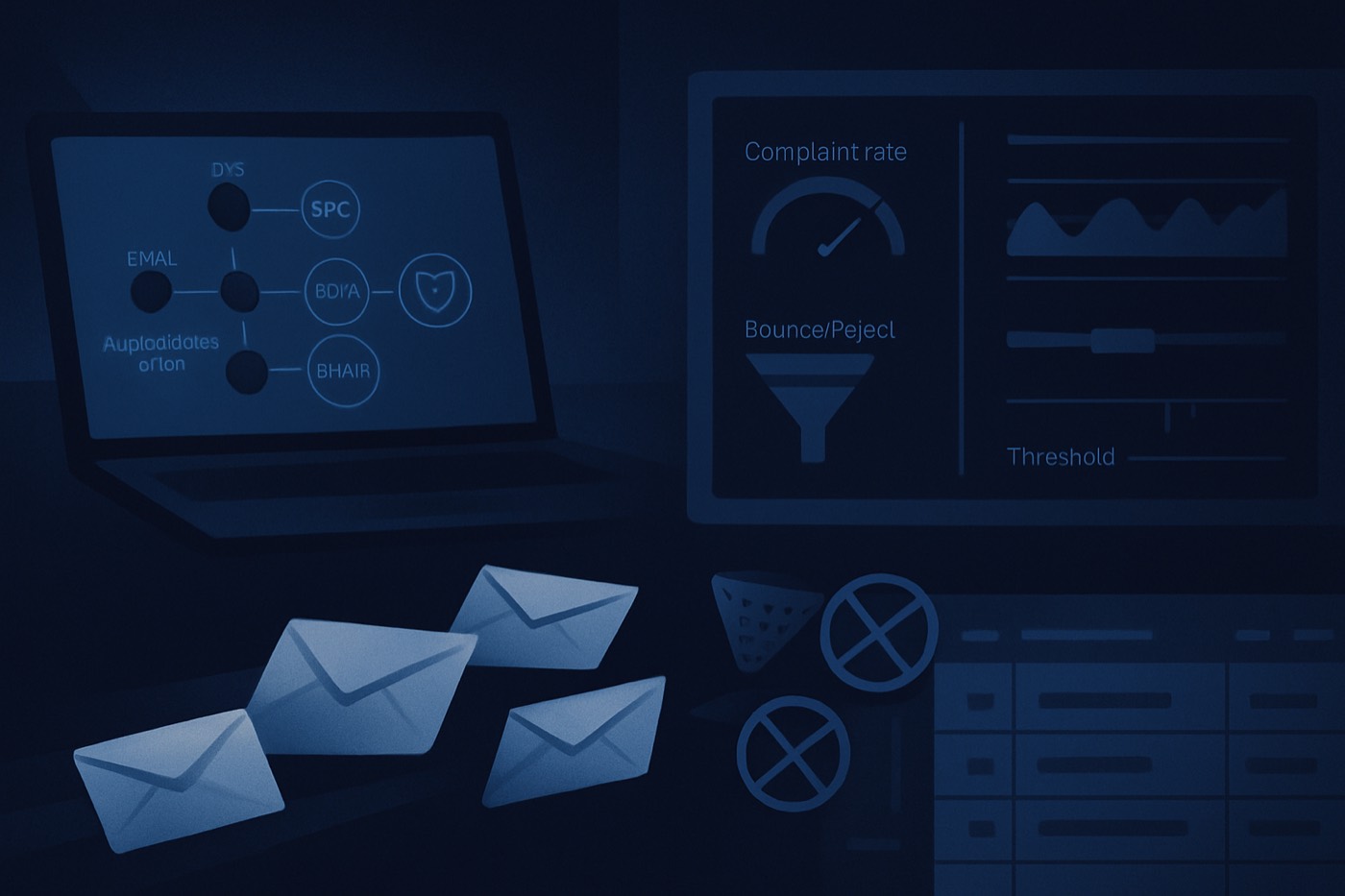
Microsoft did not kill outbound. It killed the lazy version of outbound: the kind that rotates domains like socks, leans on inbox warming as a substitute for relevance, and treats deliverability as a vibe. In 2026, Microsoft's bulk-sender enforcement makes one thing clear. The era of deliverability hacks is over, and sender accountability is the new filter.
This is a quick read on what changed, what it means for cold outbound, and the operating rules that keep your domains alive. If you run outbound through Chronic, the autonomous revenue operator handles most of this in the background, but the principles below are worth understanding either way.
Microsoft bulk sender DMARC 2026: what changed, in plain English
Microsoft's bulk-sender enforcement is part of a broader provider shift: stop trusting senders by default, and make them prove identity and behavior. Microsoft announced requirements for high-volume senders to Outlook.com consumer inboxes (Outlook.com, Hotmail.com, Live.com) that mirror the direction Gmail and Yahoo pushed earlier. (techcommunity.microsoft.com)
The enforcement angle matters more than the checklist. Providers do not care that your rep only sent 80 emails today. They care about:
- Authentication and alignment: are you who you claim you are?
- Recipient feedback: are people reporting you as spam?
- List quality signals: are you hitting dead inboxes and traps?
- Consistency: are you behaving like a stable sender or a pop-up scam?
The 2026 takeaway
Deliverability is now compliance plus reputation, not tricks.
The real requirements: SPF, DKIM, DMARC, and alignment
This is the part outbound teams love to ignore because it sounds like IT's problem. It is not.
SPF
SPF answers a single question: is this server allowed to send for this domain? If SPF passes but uses a different domain than the visible From domain, DMARC can still fail.
DKIM
DKIM signs the message. It answers: was this message altered, and does the signing domain match what we expect?
DMARC
DMARC ties everything to what the recipient actually sees in the From header, then applies policy and reporting. DMARC is standardized in RFC 7489, which describes identifier alignment and how receivers evaluate whether SPF or DKIM aligns with the RFC5322.From domain. (rfc-editor.org)
Alignment, the part that breaks outbound setups
DMARC passes when either SPF passes and aligns with the From domain, or DKIM passes and aligns with the From domain. Alignment is why "SPF and DKIM are green in my ESP" is meaningless if they are green for the wrong domain.
If you run outbound through a tool that sends from a different return-path domain, or signs with a vendor domain, you can pass authentication and still fail alignment. Then Microsoft treats you like a stranger, because you are.
Enforcement is about accountability, not boxes checked
Microsoft frames this as strengthening the email ecosystem for high-volume senders. That is polite language for the end of babysitting. (techcommunity.microsoft.com)
"We're not a bulk sender" is wishful thinking
Bulk thresholds are defined at the provider level. Microsoft's public communications and surrounding coverage reference roughly 5,000 messages per day to Outlook.com consumer domains as the line where stricter requirements apply. (mailgun.com)
But enforcement pressure does not stop at 4,999 a day. Filters learn patterns. If your domains act like bulk, you get bulk treatment.
Providers punish misalignment and bad behavior faster now
Once a domain earns a bad reputation, your fixes lag behind the damage. That is the death spiral: complaints rise, inboxing drops, you send more to compensate, complaints rise again, and now you are done. The only winning move is a stop rule that fires before you get there.
Complaint-rate reality: 0.3% is the line, and B2B often blows past it
Google explicitly states that bulk senders with a user-reported spam rate above 0.3% face consequences. (support.google.com)
Outbound teams routinely exceed that because they email cold lists with weak targeting, burn domains, keep sending after negative signals, and measure success with opens. Mainstream coverage has highlighted how rough the complaint-rate picture is in B2B, often well above 0.3%. (techradar.com)
Concrete math
If you send 1,000 delivered emails and four people mark spam, that is 0.4%. You are now the problem. And no, "but we booked two meetings" does not excuse poisoning the domain you need next month.
List quality in 2026: stop calling it data, start calling it risk
Authentication gets you in the game. List quality decides whether you stay. Bad list inputs create predictable outputs:
- hard bounces spike from dead mailboxes
- soft bounces repeat from temporary failures and throttles
- blocks increase from policy or reputation rules
- complaints climb from the wrong person, wrong timing, or wrong offer
If you buy lists, scrape aggressively, or run stale exports, you are not doing outbound. You are doing reputation self-harm.
What good list quality looks like for cold outbound
- Role and buying context fit your ICP, not just a job title
- Account-level intent signals, not random "VP" lists
- Prior complainers and chronic non-engagers suppressed
- Continuous pruning, not a quarterly cleanup
Chronic builds this into the workflow. The agent narrows to tight ICP slices first, enriches, scores, and only then sequences, so spray-and-pray never ships. Start with the ICP Builder, then Lead Enrichment, then prioritize with AI Lead Scoring.
Stop rules: the only deliverability hack that still works
Stop rules beat optimizations every time. These are the ones that prevent reputation death spirals.
Shut off immediately if any of these trip
- DMARC fail rate spikes on your outbound domain
- Hard bounce rate goes above 2% on a sequence, or spikes suddenly
- Spam complaints exceed 0.1% on any mailbox-domain pair
- Microsoft blocks or throttles show a pattern (repeat deferrals, 4xx, then 5xx)
- Reply quality collapses (more "stop," "remove," and "wrong person" than real conversations)
You do not push through. You stop, isolate, and fix.
Why 0.1% complaints as a stop rule?
Because 0.3% is the visible cliff in Gmail guidance. (support.google.com) Running operations at the cliff is how you fall off it. Run below it.
This is exactly the kind of judgment Chronic makes on its own. When a sequence or mailbox starts drifting toward a threshold, the agent pauses sends before reputation tips, and surfaces an approval rather than quietly burning a domain.
What outbound teams must track, or you are flying blind
Most CRMs were built to track humans doing manual sales. In 2026, outbound is a sending system, and someone has to watch it like one. A CRM that just stores contacts will not tell you a sequence is going toxic.
Whatever runs your outbound has to track, by mailbox, domain, and sequence:
Deliverability events
- Delivered
- Soft bounce (temporary)
- Hard bounce (permanent)
- Blocked (policy)
- Deferred or throttled (rate limiting)
- Spam complaint (via feedback loop where available, or inferred from provider signals)
- Unsubscribe (header-based one-click plus link-based)
Mapping and structure
- Domain to mailbox mapping: which domains and inboxes sent which sequences
- Mailbox health: rolling 7-day and 30-day bounce and complaint rates per mailbox
- Sequence-level health: a sequence can be toxic even when the domain is fine
- Throttle and block trendlines: if Microsoft starts deferring you, that is early smoke
Chronic treats this as operating infrastructure, not nice-to-have reporting. The agent owns the mailboxes and domains it sends from, watches these signals continuously, and acts on them. You see the pipeline it produces; it carries the deliverability accounting underneath so a clean-looking Sales Pipeline is not just optimistic fiction.
Authentication basics: the minimum that stops Microsoft from bouncing you at the door
If you want the checklist for Microsoft bulk sender DMARC 2026 compliance, here is the minimum bar that keeps you from being treated as spoofable junk.
Minimum technical baseline
- SPF published for the From domain
- DKIM enabled for the From domain
- DMARC record published, at least
p=none - Alignment confirmed: the From domain aligns with SPF and/or DKIM (preferably DKIM)
This is consistent across Microsoft's bulk-sender direction and the broader provider trend. (mailgun.com)
Practical stance
- Use DKIM alignment as your anchor. SPF breaks more easily with forwarding and routing complexity.
- Do not run strict alignment unless you understand every sender in your stack.
- DMARC reporting addresses matter. If you never read the reports, you are not running DMARC. You are decorating DNS.
Deliverability hacks are dead. Operational rigor wins.
Old playbook: warm 50 inboxes, rotate domains, randomize copy, pray.
New playbook: authenticate correctly, target better, monitor complaints and bounces, stop fast, and keep a stable sending identity.
If you want to see what tool sprawl does to this workflow, run the numbers. This is why the stack-cost conversation got loud in 2026. Start here: the 2026 outbound stack cost calculator.
One-page SOP: weekly deliverability ops (2026 edition)
If you run outbound by hand, print this and run it every Monday. If you run Chronic, the agent does most of these checks continuously and only pulls you in when a number crosses a line.
Weekly checks (30 to 60 minutes)
- DMARC pass rate by sending domain: look for sudden drops or any domain under 98% pass, and spot-check alignment failures
- Hard bounce rate: by sequence, by lead source, by mailbox
- Soft bounce and deferral trends: rising deferrals often show throttling before hard blocks
- Spam complaints: by mailbox and sequence, with any cluster triggering an immediate pause
- Block events: count and trend by provider (Outlook vs Gmail)
- List quality indicators: "wrong person," "not me," and "stop emailing me" are pre-complaints, so treat them like smoke
- Meetings booked per 1,000 delivered: the metric that does not lie
Shut off immediately, no debate
- Any sequence with complaint spikes
- Any mailbox with abnormal bounce-rate increases
- Any domain with DMARC alignment failures
- Any lead source producing garbage addresses
Fix order, fastest impact first
- Pause toxic sequences
- Suppress complainers and negative responders permanently
- Remove bad data sources and stale segments
- Verify authentication and alignment
- Reduce volume and tighten targeting
- Relaunch with smaller sends and higher relevance
Metrics that matter more than opens
- Meetings booked per 1,000 delivered
- Complaint rate, overall and by mailbox
- Hard bounce rate
- Block rate
- Reply quality rate (positive replies divided by delivered)
If your team still celebrates a 60% open rate, it is 2026, not 2016. For a deeper measurement model that maps to outcomes, see the 2026 email ROI measurement gap.
What this forces in your outbound stack
Microsoft's bulk-sender enforcement is a forcing function. Tools that only send email are now dangerous, because they encourage volume without accountability. Instantly sends. Clay builds lists. CRMs store records. None of those guarantee sequence health, and none of them will pause a send when your reputation is about to tip.
That gap is the whole reason Chronic exists. Instead of stitching a sender, an enrichment tool, a list builder, and a CRM together and hoping nothing degrades, you hand the agent a revenue goal. It owns the warmed mailboxes and domains, authenticates and aligns them, watches every deliverability signal, enforces stop rules, and books meetings, surfacing approvals only for the decisions that matter. For the long-form comparisons:
Chronic also covers the execution layer the others leave to you: enrichment, scoring, writing, and sequencing.
FAQ
What does "Microsoft bulk sender" mean in 2026?
It generally refers to high-volume senders to Outlook.com consumer mailboxes (Outlook.com, Hotmail.com, Live.com). Microsoft's public communications focus on that high-volume category and on authentication expectations. (techcommunity.microsoft.com)
What is the minimum DMARC requirement for Microsoft bulk sender DMARC 2026?
At minimum: publish DMARC for the domain in your visible From address, and make sure SPF and DKIM authenticate with alignment so DMARC passes. DMARC's alignment rules are defined in RFC 7489. (rfc-editor.org)
If SPF and DKIM pass, why can DMARC still fail?
Because DMARC is not "SPF and DKIM exist." DMARC requires identifier alignment with the RFC5322.From domain. SPF or DKIM can pass for a different domain and still fail DMARC alignment. (rfc-editor.org)
What complaint rate should outbound teams target in 2026?
Under 0.1% as an internal stop rule. Google explicitly references a 0.3% user-reported spam rate as a key threshold for bulk senders, and running close to that line is how domains get burned. (support.google.com)
What should we track instead of open rates?
Meetings booked per 1,000 delivered, complaint rate, hard bounce rate, block rate, and reply quality. Opens are noisy in 2026 because of client-side privacy behavior and filtering, and they do not predict reputation the way complaints do.
Do we need a different CRM because of Microsoft's bulk-sender enforcement?
Not necessarily a different CRM, but a different operating model. A CRM can stay your record of accounts and deals; what changes is that something has to run outbound with authentication, alignment, deliverability monitoring, and stop rules, and pause sends before reputation tips. That is what Chronic does as an autonomous revenue operator: it runs the sending system end to end and keeps your domains safe while it books meetings.
Run the playbook, keep the domain
Audit authentication and alignment this week. Put stop rules in place today. Make sure whatever runs your outbound is watching deliverability in real time, not just storing contacts. Then scale volume only after a sequence proves it can survive Microsoft, Gmail, and Yahoo without getting you quietly buried in Junk. If you would rather not run that system by hand, that is the job Chronic was built to take off your plate.