Multi-threading 13+ stakeholders in 2026: the workflow an autonomous operator runs for you (with templates)
A 2026 deal is a network of 13+ stakeholders, not a funnel. Multi-threading means mapping every buying role, scoring influence, tracking decision gates, and catching single-thread risk early, work an autonomous operator can run for you.
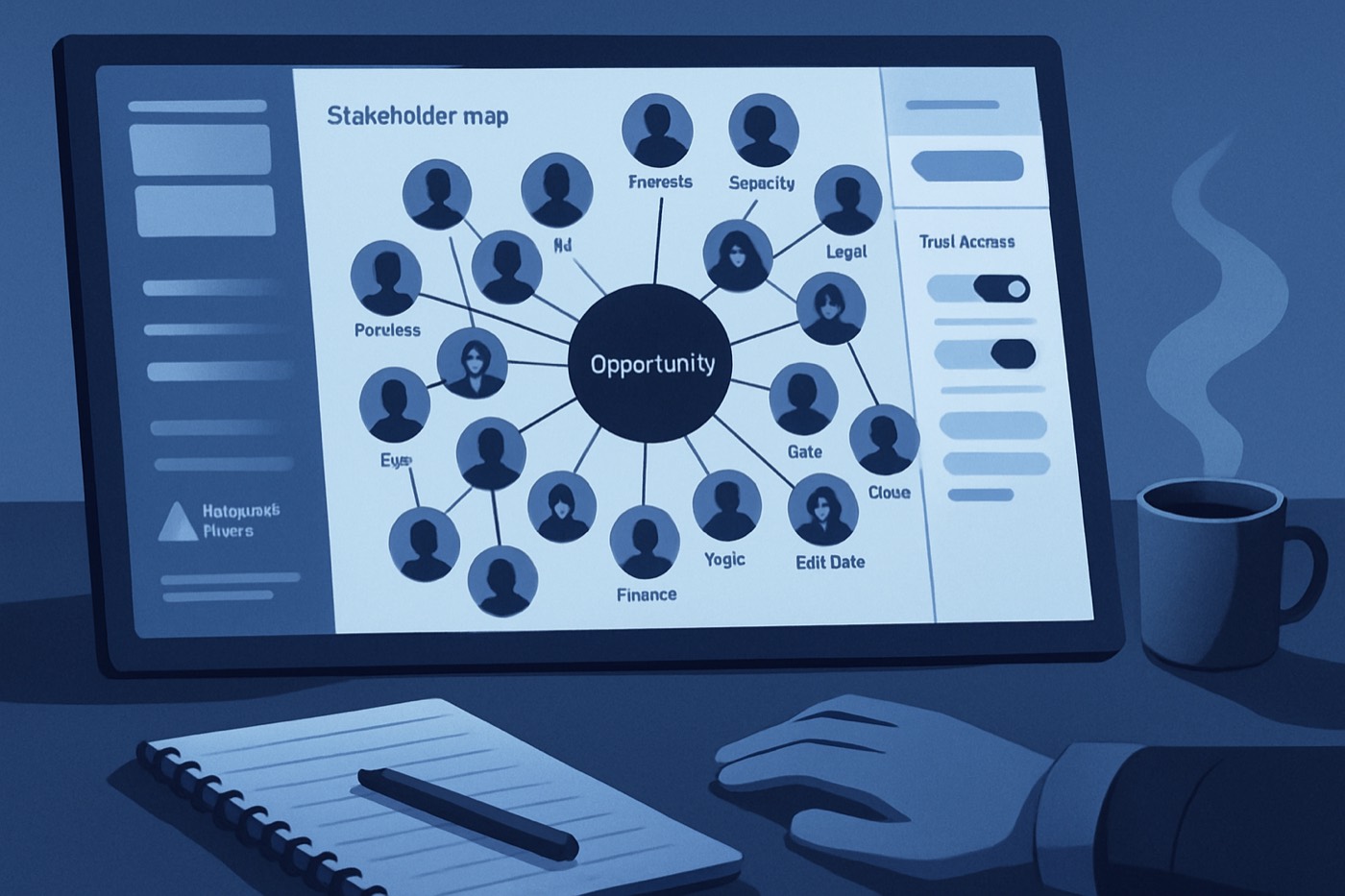
Buying committees got bigger, noisier, and more risk-driven in 2026. Forrester reports the typical business buying decision now includes 13 internal stakeholders and nine external influencers, and that trials have become essential for de-risking purchases. That is not “enterprise only”, it is the new default for any meaningful B2B deal. (Forrester press release, Jan 21, 2026; also summarized in Digital Commerce 360, Jan 22, 2026)
The hard part is not knowing this. It is keeping 13 threads alive across weeks of evaluation without a deal collapsing because one champion went quiet. That is operations work: mapping roles, scoring influence, watching decision gates, and re-engaging the right person at the right moment. This post lays out that workflow in full, and where an autonomous revenue operator can run most of it for you and surface only the calls that need a human.
The short version
- A modern deal is a network, not a funnel. You have to model stakeholders, influence, and decision gates, not just pipeline stages.
- The workflow is the same whether a rep does it by hand or an operator runs it: (1) map roles, (2) score influence, (3) enforce a minimum stakeholder record, (4) catch “single-thread risk” early, and (5) govern trials.
- Treat trials as a controlled risk-reduction program: entry criteria, a success plan, and named decision gates, so an evaluation does not drift into “play with it and get back to us.”
What “multi-threading” means (and what it is not)
Multi-threading is the discipline of building and maintaining active relationships with several stakeholders in the same account at once, each tied to a buying role, a risk area, and a decision gate.
It is not:
- “Adding more contacts to the account”
- “Spamming the org chart”
- “Letting your champion forward your deck internally and hoping for the best”
It is:
- Structured stakeholder mapping and influence scoring
- Role-based messaging and the specific proof each role needs
- Catching gaps early, especially the moment a deal becomes dependent on one person
- Trial governance that builds consensus instead of an uncontrolled evaluation
Why it matters now:
- Buying groups are large and cross-functional. Forrester’s 2026 research explicitly calls out larger buying groups and trials as risk reducers. (Forrester)
- Consensus is harder to reach: Gartner found 74% of B2B buyer teams demonstrate “unhealthy conflict” during decisions, and that consensus correlates with higher-quality deals. (Gartner press release, May 7, 2025)
- Typical buying groups hover around 10 in many datasets, with size rising by deal complexity and evaluation dynamics. (6sense buying group research; 6sense benchmark)
Chronic is an autonomous revenue operator: you set the goal and constraints, and it runs discovery, outreach, reply handling, and meeting booking, surfacing approvals for the decisions that matter. It is not a CRM. It works alongside whatever system you record deals in, and the structure below is what it tracks and acts on across the buying committee.
The stakeholder model you need for 13+ people
If multi-threading is going to be repeatable, you need fields, not vibes. Here is a practical schema, whether you maintain it by hand or let the operator populate and keep it current.
Step 1: Define buying roles (use a fixed picklist)
Use one stable Contact Role field. Single-select keeps reporting clean. These roles cover most B2B deals:
Core buying roles
- Champion (drives internal momentum)
- Economic buyer (budget authority, ROI owner)
- Business owner (day-to-day operational owner)
- Technical evaluator (architecture, integration, feasibility)
- Security / risk (security review, compliance, data handling)
- Legal (MSA, DPA, liability)
- Procurement (process owner, negotiation, vendor onboarding)
- Finance (budget timing, payment terms, ROI scrutiny)
- Executive sponsor (top-down priority and escalation)
- End-user lead (adoption, workflow fit, change management)
Add when relevant
- IT ops / RevOps (systems ownership, permissions, governance)
- Data / analytics (data access, instrumentation, reporting)
- Vendor management (third-party risk, onboarding requirements)
Keep the list stable. Add nuance through secondary fields, not 30 roles.
Step 2: The minimum record per stakeholder
For multi-threading to work, every stakeholder needs consistent metadata. An operator can fill most of this from enrichment and from what happens in the thread; the judgment fields (stance, what they care about) get confirmed as you go.
Required, minimum
- Role (picklist)
- Department / function
- Seniority (IC, manager, director, VP, C-level)
- Decision stance (supporter, neutral, skeptic, blocker, unknown)
- Influence score (0-100, see next section)
- Priority risk area (security, ROI, implementation, legal, procurement, adoption)
- Last meaningful interaction date (auto)
- Preferred channel (email, phone, Slack/Teams, in person)
- “What they care about” (1-2 sentences)
Strongly recommended
- Success metric (what must be true for them to say yes)
- Objection theme (short text)
- Proof needed (case study, security doc, ROI model, pilot results)
- Relationship owner (AE, SE, CSM, exec)
- Mutual action item (next step with due date)
Influence scoring: a model you will actually use
You want influence scoring that is fast to assign, easy to audit, and useful for prioritizing outreach and spotting concentration risk.
A practical influence score (0-100)
Use a weighted formula so the score is not just a gut feeling. An autonomous operator can compute and update it; a human should be able to override it.
- Authority (0-35)
- Economic buyer: 35
- Procurement lead: 28
- Security lead: 28
- Legal: 25
- Exec sponsor: 25
- Technical evaluator: 22
- Business owner: 18
- End-user lead: 12
- Proximity to decision (0-25)
- Owns a required gate (security review, legal redlines, procurement): +25
- Strong influencer to a gate owner: +15
- Indirect: +5
- Engagement strength (0-20)
- Attended 2+ meetings or replied in last 14 days: +20
- Some engagement: +10
- Silent: +0
- Sentiment (0-20)
- Supporter: +20
- Neutral: +10
- Skeptic: +5
- Blocker: +0
Keep the score editable, but compute a recommended value so it stays consistent across deals and reps.
A meeting-notes structure for stakeholder-driven deals (copy/paste)
Unstructured notes are where multi-threading quietly collapses. This template forces clarity by role and gate, and it gives an operator a clean signal to act on.
Meeting notes template: “Stakeholder brief + gate impact”
Attendees (with roles):
- Name (role, dept, seniority)
- Name (role, dept, seniority)
Purpose of meeting (1 sentence):
- Example: validate security posture and confirm review timeline for Q2 close.
What changed since last touch (facts only):
- Budget status:
- Timeline:
- Vendor shortlist:
- Internal constraints:
Stakeholder-by-stakeholder snapshot
- [Name]
- Stance (supporter / neutral / skeptic / blocker):
- Their success metric:
- Their top concern:
- Proof requested:
- Next step + due date:
Decision gates impacted
- Gate: security review
- Status (not started / in progress / approved / blocked):
- Owner:
- ETA:
- Gate: procurement
- Status:
- Owner:
- ETA:
Single-thread risk check
- Do we have 2+ active threads? (Y/N)
- If no: which role is missing?
Next meeting and who must be there
- Date:
- Required roles:
The multi-threading workflow: a 7-step playbook
This is the operating loop. A human can run it; an autonomous operator runs the repetitive parts continuously and surfaces the judgment calls for approval.
Step 1: Build a “buying committee map” for each account
In one place, you (or the operator) should see all stakeholders, their roles, influence scores, stance, last touch, and which gates they own.
Operating rule: every deal above your threshold (for example, $15k ARR or any annual plan) should have a populated committee map within 10 business days of entering the stage.
Step 2: Set minimum stakeholder coverage by stage
Make coverage a condition of advancing, so a deal cannot inflate on one champion’s optimism.
Example coverage requirements
- Discovery
- Champion identified
- Business owner identified
- At least 3 stakeholders logged
- Evaluation
- Economic buyer or finance identified
- Technical evaluator identified
- At least 6 stakeholders logged
- Security / legal
- Security and legal contacts identified (even if not engaged yet)
- At least 9 stakeholders logged
- Procurement / commit
- Procurement owner confirmed
- At least 13 internal stakeholders mapped (or a documented exception)
This matches Forrester’s 2026 reality of larger groups and prevents stage inflation. (Forrester)
Step 3: Track decision gates on every opportunity
Make the gates explicit:
- Technical validation
- Security review
- Legal review (MSA / DPA)
- Procurement / vendor onboarding
- Budget approval
- Trial success approval (if a trial is used)
Each gate needs an owner (a named contact), a status, required artifacts (links), a due date, and a blocker reason if it is stuck.
Step 4: Catch single-thread risk early
Single-thread risk is when a deal depends on one thread, usually the champion, and you have not built redundancy across power and gates. This is the highest-value thing to automate, because it is the failure mode that kills late-stage deals.
Trigger an alert (to the rep, and to a manager if it persists) when:
- Stage is evaluation or later and the number of active stakeholders (a meaningful interaction in the last 21 days) is below 3.
- A required role is missing by its stage: missing technical evaluator at evaluation, missing security or legal at the security/legal stage, missing procurement at commit.
- The champion has gone silent: champion’s last interaction is more than 14 days ago and no other stakeholder engaged in the last 7 days.
- Influence is too concentrated: the top stakeholder scores above 80 while the next highest is below 50.
The alert should name the missing role, suggest the next action with a template, and propose the next-best stakeholder to engage based on influence and gate ownership. If you run an autonomous operator, these are exactly the conditions to wire as approval prompts and stop rules, so it acts on the routine cases and pauses for you on the rest. (See AI governance for RevOps in 2026 and the AI SDR workflow pod.)
Step 5: Role-based outreach when coverage gaps appear
Tie sequences to missing roles or stalled gates rather than to time alone. Two that do the most work are below: re-activating a silent stakeholder, and a procurement-first sequence.
Step 6: Govern trials as controlled risk reducers
Forrester is explicit that trials are now essential to reducing risk in 2026 buying. (Forrester) So a trial is a mini-program, not a giveaway: entry criteria (who approves starting), a success plan (what must be proven), instrumentation (how you measure it), and decision gates (who signs off). Details below.
Step 7: Measure multi-threading health weekly
Track:
- Stakeholders mapped per opp (median, by segment)
- Active threads per opp (meaningful interactions in the last 21 days)
- Gate aging (days in status for security / legal / procurement)
- Single-thread risk alerts per rep (a leading indicator of pipeline quality)
If you run an operator, design the KPIs deliberately so you can tell real progress from activity. (See AI sales agent KPIs: 21 metrics that prove value and catch failure early.)
Templates: stakeholder map, fields, and influence scoring
Template 1: “Buying committee map” table
| Contact | Role | Dept | Seniority | Stance | Influence (0-100) | Risk area | Gate owner? | Last touch | Next step |
|---|---|---|---|---|---|---|---|---|---|
| Champion | Adoption | ||||||||
| Economic buyer | ROI | Budget | |||||||
| Technical evaluator | Integration | Tech validation | |||||||
| Security | Security | Security review | |||||||
| Procurement | Commercials | Procurement | |||||||
| Legal | Contract | Legal review | |||||||
| Finance | ROI | Budget |
Template 2: Stakeholder record checklist
For every stakeholder you add, confirm:
- Role
- Department
- Seniority
- Stance
- Influence score
- Risk area
- “Care-about” note (1-2 sentences)
- Next step with due date
The alert logic, written out
These are the rules behind Step 4, whether you build them in your CRM or set them as guardrails for an operator.
Rule A: Missing-role task
If stage = evaluation and there is no contact with role = technical evaluator,
then create a task to add a technical evaluator and send the technical-validation intro, and start the technical-evaluator sequence. Repeat for security, procurement, and legal at their later stages.
Rule B: Single-thread risk
If active stakeholders in the last 21 days is below 3 and stage is evaluation or later,
then create a single-thread-risk task (due in 24 hours), notify the manager, and suggest inviting the economic buyer and security to a success-plan review.
Rule C: Gate aging
If the security gate has been in progress for more than 10 days,
then task the rep to confirm required artifacts, schedule the security review call, and ask for a target approval date, and notify the SE owner.
Rule D: Trial governance
If a trial is active and no success plan exists within 48 hours,
then create the success-plan template and, optionally, block stage movement until it is filled in.
Trials as risk reducers: entry criteria, success plans, and decision gates
Buyers use trials to reduce risk, but sellers often lose control because the trial becomes “play with it and get back to us.” Treat it as a governed project instead.
Trial entry criteria (capture these before you start)
Do not start a trial until these are true:
- A named owner on the buyer side (end-user lead or business owner).
- Success metrics defined (2-4 measurable outcomes).
- Data and access approved (SSO, sandbox, permissions).
- A decision-gate calendar agreed: a midpoint review date and a final readout date.
- Who signs off on the result (economic buyer plus technical and champion, minimum).
Success plan template
Trial goal (1 sentence):
In-scope use cases (max 3):
1)
2)
3)
Out of scope (explicit):
Success metrics (measurable):
- Metric 1: baseline, target, measurement method
- Metric 2:
- Metric 3:
Stakeholders required at readout:
- Economic buyer:
- Champion:
- Technical evaluator:
- Security (recommended):
- Procurement (recommended):
Decision gates and dates:
- Technical validation by:
- Security approval by:
- Legal redlines by:
- Procurement start by:
- Target signature date:
Keep the readout visible as a gate
Treat “trial readout” as a gate, not an activity. Gate owner: economic buyer (or business owner if delegated). Artifact: a one-page results doc with adoption metrics and a short risk register.
Outreach templates (copy/paste)
Template 1: re-activate a silent stakeholder (email)
Subject: Quick check: are you still a stakeholder on [project/initiative]?
Hi [first name], looping back because we have not heard from you in a bit, and I want to make sure we are not missing a risk area you own.
From our notes, your focus was [their priority: security / ROI / integration / contracting]. Since we last spoke, the main change is [one factual update: timeline, scope, stakeholders, trial result].
Two quick questions:
- Are you still involved in the decision for [initiative]?
- If yes, what would you need to see to be comfortable with a [date] decision?
If it helps, I can send:
- [artifact A] (for example: security overview, DPA outline, ROI model)
- [artifact B] (for example: implementation plan, integration diagram)
Want to do a 15-minute alignment this week: [two time options]?
Thanks,
[Name]
Log the reply as a stance change and update the proof they need.
Template 2: “procurement-first” sequence (3 steps)
Email 1: start procurement early
Subject: Align on the procurement path for [company] + [your product]
Hi [first name], before we get too deep, I want to align on your procurement process so we can work backwards from your target date.
Can you point me to:
- Your vendor onboarding steps (security, legal, finance)
- Whether you require MSA / DPA templates
- Typical cycle time for a new vendor
To make this easy, here is what we can provide right away:
- Security packet: [link or “available on request”]
- DPA: [link or “available on request”]
- Insurance and SOC 2 / ISO (if applicable): [availability]
If you share your steps, I will map them into a dated plan and confirm who owns each gate.
Best,
[Name]
Email 2: confirm gate owners and dates
Subject: Proposed procurement timeline (gate owners + dates)
Hi [first name], based on what you shared, here is a proposed timeline:
- Security review owner: [name], target approve: [date]
- Legal redlines owner: [name], target approve: [date]
- PO / vendor setup owner: [name], target complete: [date]
Anything missing, or should we adjust dates?
Thanks,
[Name]
Email 3: unblock with binary choices
Subject: To keep [date] on track, which path should we take?
Hi [first name], to stay on track for [date], which option fits best?
A) We use your MSA / DPA and return redlines by [date].
B) We use our paper and you redline by [date].
Reply with A or B and I will coordinate the next step with [legal owner] today.
Best,
[Name]
Where an autonomous operator takes this off your plate
A rep can run this workflow by hand. The point of an autonomous revenue operator is that it runs the repetitive, easy-to-drop parts continuously and only asks for you when judgment is needed. Across a buying committee, that looks like:
- Enrichment that fills department, seniority, and a role hypothesis for each new stakeholder, so the committee map is populated, not blank.
- Account-level scoring that reads stakeholder density and engagement as signals, not just a single lead score.
- Gate and risk tracking that watches gate aging and single-thread risk, and proposes the next-best thread to open.
- Role-based outreach that fires the right sequence (silent-stakeholder re-activation, procurement-first) when a coverage gap appears, drafted to each role’s concern (security vs ROI vs adoption) and sent from managed, warmed mailboxes.
- Approvals on the calls that matter: who to add, what to send a skeptical security lead, when to escalate a stalled gate. The routine actions run; the consequential ones wait for your yes.
For a clean rollout so the workflow sticks instead of decaying back to one-thread deals, see the 30-day rollout checklist.
FAQ
What is a multi-threading workflow?
A multi-threading workflow keeps several stakeholders engaged in parallel within one account by mapping buying roles, scoring influence, tracking decision gates, and raising an alert the moment a deal becomes dependent on a single contact. An autonomous operator can run most of it and surface the judgment calls for approval.
How many stakeholders should we map in 2026?
Forrester’s 2026 research puts the typical buying decision at 13 internal stakeholders and nine external influencers. Use 13 as your default target for meaningful deals, then document exceptions. (Forrester)
What is “single-thread risk”?
Single-thread risk is when a deal’s progress depends on one relationship, usually the champion, while key gate owners (economic buyer, security, procurement, legal) are not engaged. You can detect it with simple rules: fewer than 3 active stakeholders in 21 days, or a missing procurement contact at the commit stage.
How do we score stakeholder influence without it being subjective?
Use a 0-100 model that weights authority, gate ownership, engagement recency, and sentiment. Compute a recommended score automatically, allow human overrides, and use it to prioritize outreach and flag concentration risk.
How should we run trials so we do not lose control of the deal?
Treat trials as governed risk reducers: enforce entry criteria, write a success plan with measurable outcomes, and track decision gates (technical, security, legal, procurement) on the opportunity so trial activity becomes a dated path to signature. Forrester notes trials are essential to de-risk buying in 2026. (Forrester)
What is the fastest way to improve multi-threading without a big project?
Add four things: a contact-role field, a minimum stakeholder record, minimum coverage per stage, and a single-thread risk alert. Those create immediate pressure to multi-thread without rebuilding anything.
Deploy this workflow this week (checklist)
- Add the contact-role field and the minimum stakeholder record.
- Stand up a buying committee map on every account and opportunity.
- Set minimum stakeholder coverage by stage, and enforce it.
- Turn on single-thread risk and gate aging alerts.
- Install the two sequences: silent-stakeholder re-activation and procurement-first.
- Govern trials with entry criteria, a success plan, and a readout gate.
- Review weekly: stakeholder count, active threads, gate aging, and alert volume.
If you would rather not run this by hand, this is the kind of operations work an autonomous revenue operator handles end to end, asking for you only on the decisions that move the deal.