System of record vs system of action: what AI copilots and unified data hubs mean for outbound in 2026
A system of record stores the truth about your accounts; a system of action decides what to do next and does it. In 2026 the deciding factor is not copilots, it is whether the action layer runs on clean data.
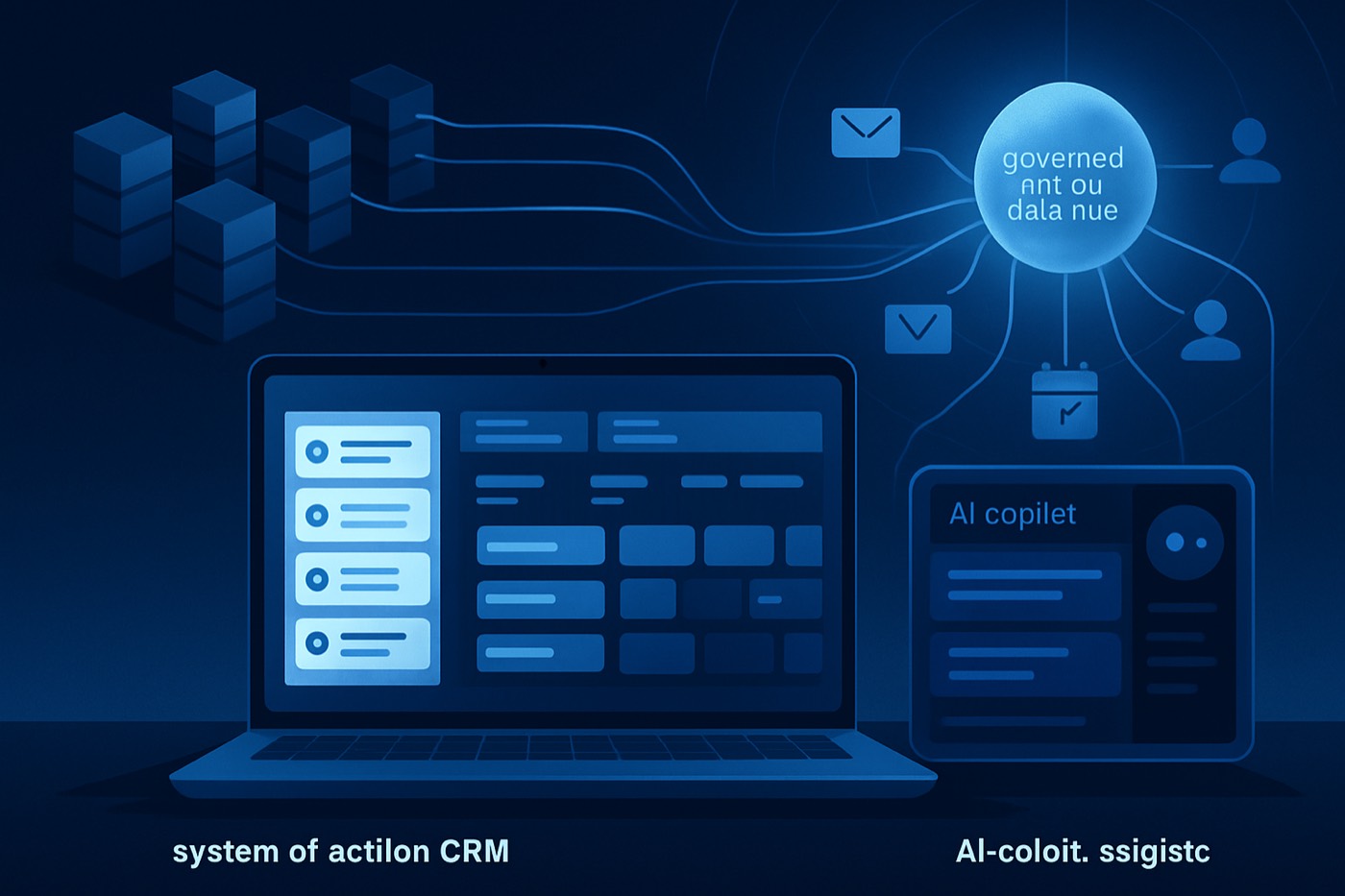
Copilots, agents, and "unified data hubs" have become the default sales-software language in 2026 because buyers are no longer shopping for a better database. They are shopping for an execution layer that turns messy go-to-market signals into consistent next steps: discovery, enrichment, follow-ups, and pipeline progression.
That shift maps onto an old distinction that suddenly matters again: the difference between a system of record and a system of action. This post explains both, why "unified data" is a concrete set of capabilities and not a slogan, and how the same data quality that makes a copilot useful is what an autonomous outbound operator quietly depends on.
The 2026 messaging shift: from "manage records" to "take action"
Across CRM and adjacent platforms, marketing has converged on three phrases:
- Copilots: embedded assistants that draft, summarize, and recommend so a person can move faster inside an existing workflow.
- Next-best-action: ranked recommendations (or automatically triggered steps) based on signals, history, and context.
- Unified data hubs: "one customer view" messaging, usually tied to an identity layer that feeds AI more complete context.
This is visible in mainstream releases and positioning:
- Freshworks positions Freddy AI as a copilot that supports lead scoring, insights, and workflow efficiency, including help with duplicate contact resolution. (Freshworks Freddy AI for Sales)
- Salesforce ties Einstein Copilot to unified data via Data Cloud, positioning trusted, unified profiles as the foundation for AI-driven experiences and next-best interactions. (Salesforce press release, May 22, 2024)
- HubSpot expanded its agent strategy with Breeze Agents and tied usage to a credit-based monetization model. (HubSpot investor release, May 8, 2025; HubSpot Spotlight release, Spring 2025)
The practical takeaway for buyers in 2026: an AI feature is no longer a differentiator. Execution is. A copilot bolted onto incomplete data and no workflow enforcement usually becomes a nice demo that does not move pipeline.
System of record vs system of action
What a system of record is (and is not)
A system of record (SOR) is an authoritative source of business data: verified records of customers, accounts, opportunities, and activities. IBM describes a system of record as an authoritative source that helps ensure other systems reference the most up-to-date, verified versions of key data elements. (IBM: What is a system of record?)
In sales terms, a system of record is optimized for:
- Data modeling (objects, fields, schemas)
- Data integrity (permissions, validation, audit trails)
- Reporting (dashboards, forecasting, pipeline inspection)
- Historical truth (what happened, when, and by whom)
A system of record is the right tool for those jobs. It is the wrong tool for being your daily execution engine. The workflow it produces is: find record, interpret, decide, create tasks, write emails, update fields, repeat. Correct, but slow, and inconsistent from one person to the next.
What a system of action is
A system of action is built to drive outcomes, not just store facts. One common framing: systems of record are passive repositories, while systems of action are active and proactive, prompting or automating tasks. (Forbes: "The Rise Of AI Systems Of Action")
A system of action in 2026 typically includes:
- Prioritized work based on conversion likelihood and timing
- Routing and sequencing (who gets worked, with what, and when)
- Enrichment and normalization triggered at the moment of need
- Activity capture that reduces manual logging and missing context
- Workflows that execute follow-ups and data fixes, with approvals and an audit trail
The difference in one line:
- System of record answers: What is true about this account or lead?
- System of action answers: What should we do next, and can it happen without a person babysitting it?
Chronic sits firmly on the system-of-action side. It is not a place to store records and run reports. It is an autonomous outbound operator: you give it a revenue goal, and it runs discovery, enrichment, signal scoring, deliverability, outreach, and reply handling against your existing system of record, surfacing approvals only for the decisions that matter. The record stays where it is. The action moves.
Why "unified data hub" became the new baseline (and why it is often misread)
The "unified data hub" message is a reaction to a real problem: AI is only as good as the context it is grounded in.
Unified profiles and identity resolution are core ideas in the CDP category. Adobe, for example, describes actionable unified customer profiles as a single view updated with data from all sources and ready for activation. (Adobe Real-Time CDP: Unified customer profiles)
In B2B revenue workflows, "unified data" is not just "all tools connected." It means:
- You can identify the same person across systems.
- You can attach that person to the correct account and buying committee.
- You can trust timestamps on activities and changes.
- You can explain where each field value came from and when it expires.
If any of those fail, scoring gets noisy, routing gets unfair, and anything acting on the data starts acting on the wrong context. This is the part most relevant to an autonomous operator: the more of the work you hand off, the more a single bad field can quietly compound into a wrong account, a wrong contact, or a wrong message sent under your name.
What "unified data" must mean for scoring accuracy: a buyer checklist
Use this in evaluations. It is biased toward what actually affects scoring accuracy and outbound execution, not architecture diagrams.
1) Identity resolution (who is this, really?)
Identity resolution is the process of matching and unifying records that refer to the same real-world person or entity across multiple datasets. (CDP.com glossary)
Baseline in 2026
- Deterministic rules (email, domain, CRM ID, MAP ID, billing ID)
- Probabilistic support (name + company + LinkedIn + phone patterns) with confidence scoring
- A persistent identifier that survives a change of email or title
- The ability to keep source records intact while building a unified view
What to test
- Import the same lead from two sources (a form fill plus an enrichment vendor). Does it merge cleanly?
- When a lead changes jobs, does the system preserve history without corrupting account mapping?
2) Contact-to-account mapping (the B2B golden link)
In outbound, your scoring and routing is only as good as your account association.
Baseline in 2026
- Domain-based mapping with exceptions (Gmail, subsidiaries, holding companies)
- Account hierarchies (parent-child) and rollups
- Multi-account contacts (consultants, advisors) without duplication chaos
- Buying committee mapping (several contacts tied to one opportunity)
What to test
- Create two accounts that share a parent domain or brand. Can you prevent a wrong merge?
- Map a consultant with multiple clients. Does the system keep one contact with multiple relationships, or duplicate the person?
3) Activity capture (what happened, across channels)
Anything that acts depends on complete timelines: email sends and replies, meetings booked and held, calls and outcomes, and intent signals when they are relevant.
Baseline in 2026
- Automatic logging with user-level permissions and opt-outs
- De-duplication of activities (no double-logging from plugins and sequences)
- Thread-level email context so summaries are accurate
- A canonical "last touch" that is consistent across tools
What to test
- Run a campaign, book a meeting, and close a deal. Does the timeline show one coherent story or five partial ones?
4) Enrichment round-trips (and provenance)
Enrichment is now always-on, and without provenance it becomes a silent data-corruption engine.
Baseline in 2026
- Enrichment that writes into staging fields first, or at least stores previous values
- Field-level provenance: source, timestamp, confidence
- Overwrite rules: only if blank, only if newer, never over a manual edit
- Audit trails for enrichment writes
What to test
- Enrich a record twice with different vendors. Which value wins, and can you explain why?
5) Freshness windows (data-decay controls)
B2B data decays fast: titles change, tech stacks evolve, headcount shifts. Unified data without freshness is just a unified museum.
Baseline in 2026
- A freshness target per field (for example: title 60-90 days, email validity 7-30 days, technographics 30-90 days, headcount 30-60 days)
- Automatic re-enrichment when a field goes stale
- Scoring that downweights stale signals
What to test
- Set title freshness to 60 days and run scoring. Does an 18-month-old "VP Marketing" carry the same weight as a recent update?
6) Field governance (who can write what, and why)
Unified data fails when everyone can write everything.
Baseline in 2026
- A data dictionary: definitions, allowed values, owners
- Validation rules and controlled picklists for routing fields
- A source-of-truth priority order per field (manual > billing > enrichment vendor, etc.)
- Permissioning for automated and AI writes
- A defined answer for what happens when sources conflict
What to test
- Create conflicting employee-count values across tools on purpose. Can you see both, pick a winner, and keep the system stable?
Copilots, agents, and the action layer: what is real, what is marketing
Category 1: Copilots (assist, draft, summarize)
Copilots are now standard. They draft emails, summarize calls or threads, answer "what happened?" and suggest next steps. Freshworks markets Freddy as a copilot for lead scoring, content creation, insights, and duplicate resolution. (Freshworks Freddy AI for Sales)
Where copilots fall short
- They rarely enforce execution; a person still has to do the thing.
- They lean on activity timelines that are often incomplete.
- They can generate plausible but wrong context when data is missing.
Category 2: Agents and autonomous operators (execute multi-step work)
The action layer goes past drafting. It triggers enrichment when a record enters a segment, routes leads by fit and capacity, launches sequences with guardrails, creates follow-ups when signals appear, and escalates to a human for approval. HubSpot's Breeze Agents messaging is a clear signal that this is mainstream. (HubSpot Spotlight release, Spring 2025)
The distinction worth drawing in 2026 is between an agent that fires a single step and an autonomous operator that owns an outcome. Chronic is the second kind. You set the target, budget, offer, and approval level; it builds and runs the whole outbound motion toward qualified meetings, and it is judged on pipeline held, not emails sent.
Where the action layer fails in the real world
- If unified data is weak, it executes confidently on bad context.
- If governance is weak, it writes garbage into core fields.
- If approvals and auditability are missing, teams turn the autonomy off.
The lesson is the same in every case: autonomy is only as safe as the data and controls under it. That is why Chronic treats data quality, deliverability, and approvals as part of the product, not an afterthought, and keeps a pause, kill switch, and "why this happened" log within reach.
Category 3: Unified data hubs (ground AI in trusted profiles)
Salesforce explicitly ties Copilot innovation to unified data and trusted AI through Data Cloud. (Salesforce press release, May 22, 2024)
Reality check. A unified hub is necessary but not sufficient. A pile of clean, unified context does nothing on its own. Something still has to turn that context into prioritized work, prevent scoring drift over time, and actually execute the repetitive, failure-prone outbound steps.
Pitfalls that break unified data (and how to spot them fast)
Pitfall 1: Duplicate records (the silent scoring killer)
Duplicates inflate activity counts (false engagement), put multiple owners on the same person, split timelines so AI sees partial truth, and corrupt attribution.
Signals: same email across multiple contact IDs, same LinkedIn URL across contacts, multiple accounts with near-identical domains.
Fix requirements: deterministic dedupe rules (email, domain, external IDs), ongoing prevention rather than one-time cleanup, and merge workflows with audit trails.
Pitfall 2: Conflicting sources (the "last writer wins" trap)
Conflicts happen when an enrichment vendor says "Industry: Software," billing says "Financial Services," and a rep manually set "Healthcare" six months ago. If your stack uses last-write-wins, scoring becomes a roulette wheel.
What good looks like: field-level source priority, confidence plus timestamp, and human-override rules so manual edits persist.
Pitfall 3: Hallucinated enrichment (confident nonsense)
This is the newer failure mode: a model can generate plausible firmographics, technographics, or "about" blurbs that are not verifiable. It shows up as "this company uses X" with no source, "headcount 500-1000" with no timestamp or provider, or "they are hiring SDRs" with no verifiable jobs signal.
Controls to demand: enrichment sourced from verifiable providers or your own first-party data, generated text clearly labeled as generated rather than treated as a field of truth, and provenance for any enriched claim that affects scoring, routing, or what gets sent.
The buyer baseline for 2026 (scannable)
Use this as a requirements doc for your next stack refresh.
Action-layer requirements for outbound teams
- Lead scoring that updates automatically (behavior, firmographics, fit)
- Explainability: top drivers per score, and what data changed
- Automated routing by ICP fit, territory, capacity, and timing
- Enrichment on demand and on triggers, with freshness windows
- AI-written outreach tied to ICP, account context, and prior touches
- Sequence automation with guardrails (do-not-contact logic, throttles, exclusions)
- Pipeline and deal-risk signals that tie to concrete next steps
- Activity capture and timeline coherence across email, meetings, and calls
- Governance: permissions, audit logs, and approvals for autonomous actions
- Deliverability ownership: warmed mailboxes, domain protection, and sending limits the system manages for you
Unified-data requirements that directly affect scoring
- Identity resolution with deterministic and probabilistic matching
- Contact-to-account mapping and account hierarchies
- Activity capture that avoids duplicates and missing context
- Enrichment provenance, overwrite rules, and rollback
- Freshness windows and automatic re-enrichment
- Field governance: data dictionary, controlled values, owners
If a vendor has copilots but cannot prove unified data governance and real execution, it is not a 2026 baseline. It is a UI assistant.
How Chronic fits: the operator that runs the action layer
Most B2B teams already have a system of record, or are stuck with one. The 2026 opportunity is not to replace it. It is to put an operator on top of it that actually does the outbound work:
- Decides who to contact next with scoring and ICP matching, and shows why
- Keeps data usable through governed enrichment with provenance and freshness
- Runs outreach with AI-written email from managed, warmed mailboxes
- Handles the replies and books the meetings, escalating the judgment calls
- Protects your reputation by owning deliverability, domains, and sending limits
Chronic is judged on one outcome: qualified meetings held with relevant prospects, while your domains, mailboxes, and customer relationships stay safe. It does not chase emails-sent or open rates.
If you want deeper playbooks that pair data quality with outbound execution, these are directly relevant:
- Lead scoring trust and adoption: Dynamic Lead Scoring in 2026: The Model, the Signals, and the Playbook to Make Reps Trust It
- Outbound performance tracking: Outbound Ops Metrics That Actually Predict Pipeline: 12 Numbers to Track Weekly (With Targets)
- Scale without burning deliverability: Instantly Hypersend Mode and the Rise of Extreme-Scale Outbound: What Breaks First (and How to Scale Without Tanking Reputation)
- Agent guardrails and auditability: Agentic CRM Workflows in 2026: Audit Trails, Approvals, and "Why This Happened" Logs (A Practical Playbook)
- Enrichment strategy for lower bounce and higher reply rates: Waterfall Enrichment in 2026: How Multi-Source Data Cuts Bounces and Increases Reply Rates
A practical implementation blueprint
If you want to modernize without ripping everything out, use this sequence.
Step 1: Declare your system of record (and freeze schema chaos)
- Pick the authoritative objects and fields (contacts, accounts, deals)
- Name owners for critical fields (industry, employee count, lifecycle stage)
- Lock down write access to routing fields
Step 2: Build the unified-data checklist before you buy more AI
- Identity resolution rules and exceptions
- Contact-to-account mapping logic
- Activity capture coverage targets
- Enrichment overwrite rules and provenance
- Freshness windows by field
- Conflict resolution policies
Step 3: Put an operator on the work that actually happens
- Turn on scoring and prioritized work, with explanations
- Set routing and follow-up rules
- Let AI write and send outreach within segmentation guardrails
- Keep approvals on the decisions that matter, and an audit log on the rest
Step 4: Measure action quality, not activity volume
Track speed-to-lead by segment, score-to-meeting conversion, enrichment freshness compliance, and duplicate and conflict rates. For weekly targets and operating rhythm, use the metrics playbook linked above.
FAQ
What is the difference between a system of record and a system of action?
A system of record stores the authoritative truth about your accounts, contacts, and history, and is built for data integrity and reporting. A system of action drives outcomes: it prioritizes and executes the next steps (routing, enrichment, follow-ups, outreach), usually with approvals and an audit trail. Most teams keep their system of record and add an action layer on top.
Do I need to replace Salesforce or HubSpot to add a system of action?
Not necessarily. Many teams keep their existing system of record for governance and reporting, then add an operator on top that improves data quality, prioritizes work, and runs outbound. The key is clean integration, clear field ownership, and write permissions.
What does "unified data hub" actually mean in 2026?
It should mean you can reliably identify the same person across systems (identity resolution), map contacts to the right accounts, capture activities into a coherent timeline, manage enrichment provenance and overwrite rules, enforce freshness windows, and govern critical fields so scoring and routing stay stable.
How do duplicates and conflicting sources hurt lead scoring?
Duplicates inflate engagement signals and fragment timelines, which causes false positives. Conflicting sources cause unstable scores because the model is constantly fed changing firmographics. Both reduce trust, and once people stop trusting scores, execution quality drops fast.
How do you prevent hallucinated enrichment from corrupting your data?
Require provenance for enriched fields, keep generated text separate from authoritative fields, apply overwrite rules (manual wins, stale loses), and use approvals for autonomous changes. Any field used in scoring, routing, or sending should be traceable to a deterministic source with a timestamp.
Upgrade your baseline this quarter
If you are evaluating tools in 2026, stop asking "does it have a copilot?" and start asking:
- Can it prove unified data with identity resolution, freshness windows, and governance?
- Can it act as a system of action that executes routing, enrichment, and follow-up without creating data debt?
- Can it show the auditability and controls that keep autonomy safe?
Make your shortlist earn the right to automate. If you want the action layer run for you, that is what Chronic is built to be: an autonomous operator that turns outbound signals into scored priorities, clean data, and meetings booked, while keeping your reputation intact.