Agentic CRM platforms in 2026 (and how to spot agent-washing)
An agentic CRM doesn't just draft text. It takes real actions across your revenue workflow (enrich, route, update, sequence, schedule) with permissions, audit logs, and approval gates. If it can only chat or suggest, it's agent-washing.
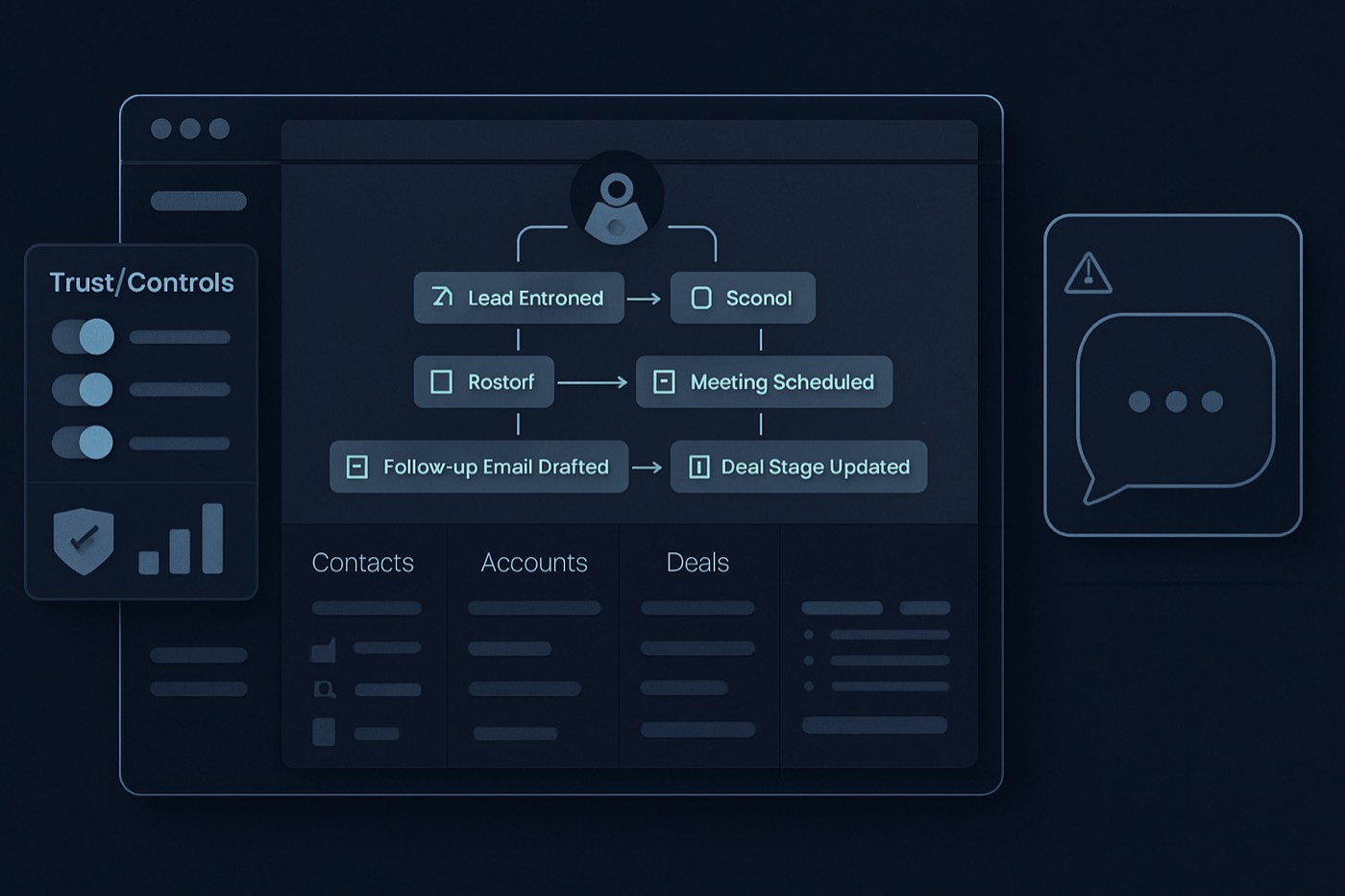
"Agentic CRM" is the label vendors reach for once "AI inside the CRM" stops sounding new. The honest version of the idea is simple: instead of answering questions or drafting copy, the software takes real actions across your revenue workflow with write access, guardrails, and outcomes you can measure. That is the line between an AI copilot, which suggests, and an AI coworker, which does the work.
This guide ranks the platforms that are genuinely moving in that direction in 2026, shows you how to spot the ones that aren't, and explains where an autonomous operator like Chronic fits, which is a different category than a CRM.
What "agentic" actually means (and what it doesn't)
A short, testable definition:
An agentic system executes multi-step revenue workflows with write access (create or update records, trigger automations, send messages), while providing governance (permissions, logging, approvals) and outcomes you can measure (time saved, meetings booked, pipeline created).
Three things have to be true, or it is just an LLM with a marketing label.
- Write access and tool use. It can do things: update fields, create tasks, enrich records, enroll sequences, schedule meetings. Not narrate them.
- Human-in-the-loop controls. Approval gates for risky actions (email sends, stage changes, data overwrites), a clear draft mode, and a way to roll back.
- Measurable outcomes. You can tie its work to speed-to-lead, meeting conversion, pipeline velocity, or SLA adherence, not "AI usage."
How the platforms below are scored
Each platform is scored across four criteria, 10 points each, 40 total:
- Actions supported (10): enrich, route, update, sequence, schedule, multi-step workflows
- Integrations (10): email and calendar, enrichment and data providers, MCP and tooling, APIs
- Governance (10): roles and permissions, audit trail, policy controls, logging and observability
- Time-to-value (10): how fast a lean B2B team ships a real win, in weeks rather than quarters
The platforms, ranked
1) Salesforce (Agentforce): best for enterprise-grade agent governance and ecosystem depth
Score: 36/40
Salesforce is pushing hardest on "agentic" as a default CRM roadmap, and it shows. Agentforce is positioned as an AI agent platform with governance controls and an ecosystem few vendors can match. Salesforce also leans into MCP for connecting agents to external tools and data sources. (salesforce.com)
Where it is genuinely agentic
- Workflow execution through the Salesforce platform and Flow.
- An explicit focus on auditability and tracking agent actions, including audit-trail messaging in the Agentforce launch. (salesforce.com)
- MCP support across Salesforce, including Salesforce-hosted MCP servers in beta, which matters if you want agent toolchains that reach beyond CRM. (developer.salesforce.com)
Trade-offs
- Time-to-value is slower unless you already have admin and developer resources.
- More agentic power means more governance work. You need permissioning and logging designed from day one.
Best fit: mid-market to enterprise B2B with complex routing, multi-team handoffs, strict compliance, or heavy integration requirements.
2) HubSpot (Breeze agents and workflows): best for SMB and mid-market that wants agents inside everyday workflows
Score: 33/40
HubSpot's product direction is clear: agents that take actions directly on CRM records and inside workflow automation. Its materials and partner writeups emphasize agents moving from standalone tools into workflow primitives, which is the practical test of "agentic" for most teams. (ir.hubspot.com)
What looks genuinely agentic
- The Breeze Customer Agent is described as taking actions directly in HubSpot records, not just chatting. (huble.com)
- Workflow-level AI actions (the Data Agent prompt action), which is the right abstraction if you care about repeatable outcomes. (knowledge.hubspot.com)
Trade-offs
- Some AI workflow actions are prompt-scoped, so you have to design prompts carefully to avoid missing context or overwriting fields. (knowledge.hubspot.com)
- Governance can be less explicit than enterprise-first stacks, depending on your plan and setup.
Best fit: B2B SaaS and agencies that want fast implementation, clean workflow automation, and agents that execute inside the CRM.
3) Apollo: best for agentic outbound execution inside a prospecting-first system
Score: 29/40
Apollo has historically been prospecting plus sequencing plus data, and in 2026 it is leaning into agent tool use more explicitly. Its 2026 release notes describe an MCP and Claude integration (early-access beta) that can enrich, create or update contacts, and enroll contacts in sequences, which is close to what "agentic" means day to day for outbound teams. (knowledge.apollo.io)
Agentic strengths
- Actions SDRs care about: enrich records, create or update contacts, enroll in sequences.
- Agent access to tools, rather than a chat box bolted onto search. (knowledge.apollo.io)
Trade-offs
- Governance and auditability are less mature than enterprise stacks.
- If your CRM is your system of record elsewhere, Apollo becomes the system of action, which is fine, but you have to design sync and ownership rules.
Best fit: high-velocity outbound teams that prioritize data, sequences, and speed-to-lead over deep CRM customization.
4) Zoho CRM (Zia agents): best budget-friendly path to agent features
Score: 26/40
Zoho has discussed native agents in Zoho CRM, including an SDR agent and a sales-coach agent, and Zia can create or update records from extracted information in some workflows. (zoho.com)
Agentic strengths
- Native AI across CRM modules, plus a stated agent direction. (zoho.com)
- Record creation and updates via intelligent extraction, which cuts manual data entry. (zoho.com)
Trade-offs
- The gap is usually governance transparency and deterministic controls for agent behavior.
- Integrations are strong inside the Zoho suite, but cross-vendor agent toolchains take more engineering.
Best fit: cost-sensitive teams that want a broad suite and will invest in configuration to make agents safe and repeatable.
5) Pipedrive: best lightweight AI assistant for simpler pipelines (less agentic than the tier above)
Score: 23/40
Pipedrive's Sales Assistant is positioned as insights and guidance more than autonomous execution, though it can access account information and Pipedrive markets the ability to "automatically update contact and lead information." (support.pipedrive.com)
Strengths: fast onboarding, strong pipeline UX, AI guidance for prioritization and next steps.
Limitations: assistant-style experiences drift into copilot territory when they do not reliably execute multi-step actions with logging and permissioning.
Best fit: smaller teams with straightforward sales motions that want lighter AI help without agent orchestration.
Where an autonomous operator fits (a different category than CRM)
Every platform above is a CRM that is adding agent features to a system of record. That is the right shape if your core need is storing, reporting on, and customizing customer data, and you want AI to help inside it.
But a lot of teams searching for an "agentic CRM" don't actually want a better database. The real request is: stop making me run outbound. Stop the research, the list-building, the personalization, the mailbox warming, the deliverability babysitting, the follow-up. For that job the unit of value is not a CRM with bolted-on agents. It is an autonomous revenue operator: software you give a goal, that then builds and runs the whole outbound system and asks for approval only on the decisions that matter.
That is the category Chronic is in, and it is worth being precise about the difference:
- A CRM agent acts inside your CRM. It works on the records and workflows you have already built, when you (or a workflow) trigger it. You still own strategy, list-building, copy, and infrastructure.
- An autonomous operator owns the motion end to end. You set the revenue goal, offer, budget, and how much you want to approve. It runs discovery, enrichment, signal scoring, deliverability and mailbox infrastructure, outreach, reply handling, and meeting booking, and it improves as it goes. Approvals surface only where a human judgment call is genuinely needed.
The practical tells of an operator, versus a CRM with agent features:
- It optimizes for qualified meetings held, not emails sent or open rates.
- It treats deliverability, domains, and mailbox reputation as its own responsibility, not a setup task it hands back to you.
- Its default posture is confident delegation: quiet while it works, loud only when it needs a decision (a risky send, a new segment, an ambiguous reply).
- You can always reach the controls: pause, kill switch, exclusions, approve or block, and the autonomy level itself.
Neither shape is automatically "better." If you need a deeply customized system of record across marketing, sales, and service, a CRM platform is the foundation. If your bottleneck is generating qualified pipeline without becoming a RevOps and deliverability shop, an operator is the better fit, and the two can coexist with the CRM as the system of record and the operator as the system of action. The mistake is buying one expecting the job of the other.
If you are mapping that split deliberately, this blueprint covers "CRM as system of record, outreach as system of action" without breaking ownership rules: Outbound stack blueprint for 2026.
How to spot agent-washing (the 2026 checklist)
Agent-washing is when a vendor calls something an agent, but it is really a chat box, a content generator, or a rules engine wearing an LLM label.
Red flags
- Chat-only AI with no real actions. If it can't create or update records, route leads, enroll sequences, or schedule meetings, it isn't agentic.
- "Autonomous" with no boundaries. If they can't describe tool permissions, scopes, and safe modes, treat it as marketing.
- No audit trail. If you can't see what the agent did, to which record, with which inputs, it is risky and not ready for production.
- No deterministic controls. You need explicit stop rules, approval gates, and fallbacks, not "it usually behaves."
- No safe fallback. When the agent fails, there must be a defined outcome: create a task, route to a human, pause the sequence, log the error.
The 10-minute demo script
Ask the vendor to do this live:
- Enrich a lead from a bare email domain.
- Write back to the record (company size, industry, HQ, tech stack).
- Route the lead to the right owner based on ICP criteria.
- Enroll the lead in a sequence, but require approval for the first send.
- Log every action with timestamp, agent or user identity, and the record changes.
If any step turns into "we can export a CSV," "use Zapier," or "our AI suggests what to do," that is assistance, not agentic execution.
What to prioritize when you buy
1) Actions: pick the two workflows you'll automate first
Most teams fail by trying to agent-ify everything at once. Start with two flows that produce a measurable result in 30 days:
- Inbound speed-to-lead: route in minutes, enrich automatically, schedule instantly.
- Outbound pipeline creation: ICP match, enrich, personalize, enroll with approvals.
2) Integrations: email, calendar, enrichment, and tool protocols
In 2026, integrations are not just native connectors, they are the surfaces an agent uses as tools.
- Email and calendar matter most, because scheduling and follow-up are the actions that move the needle.
- Tooling standards like MCP are increasingly used to connect agents to external systems in a structured way; Salesforce has invested heavily here. (developer.salesforce.com)
3) Governance: treat it like deliverability and security, not a nice-to-have
If agents can send email and update records, governance is part of brand safety. A baseline:
- Role-based access for agent actions.
- Approval gates for external sends and irreversible changes.
- Audit logs for every write action.
- A safe-fail behavior: pause, assign, or draft.
4) Time-to-value: your first win should ship in weeks
If a vendor can't define a 14-day rollout with two workflows, three dashboards, and one approval pattern, expect a long implementation.
Implementation notes that make this useful
Autonomous outbound that doesn't wreck deliverability
Outbound is where teams get burned, because "autonomous" sending can create volume spikes, spam complaints, and policy violations. Microsoft has enforced bulk-sender requirements (SPF, DKIM, DMARC) for high-volume senders, with industry writeups pointing to a May 5, 2025 enforcement timeline and documenting the operational impact. (mimecastsupport.zendesk.com)
That means whatever you run outbound through should support throttling and stop rules, approval gates for first touch, bounce and complaint monitoring, and a "pause sequence" action when risk signals appear. This is exactly the part an autonomous operator is built to own rather than hand back to you. For a weekly ops cadence, see Outbound deliverability operations in 2026: the weekly checklist.
Make measurable outcomes non-negotiable
Don't buy agents for vibes. Buy them for a metric. A simple way to frame ROI: hours saved per rep per week, and how reliably that saved time converts into meetings booked and pipeline created. You can model it with the AI sales agent ROI calculator.
Human-in-the-loop patterns that scale
If you take one best practice from this guide: approval gates beat "prompt guardrails." Pick a pattern and start there.
- Draft-first: the agent drafts, a human approves.
- Auto-update, human-send: the agent enriches and updates records, humans control outreach.
- Confidence thresholds: the agent acts on its own only above a set confidence or rule match.
- Escalation paths: the agent assigns a task when it is uncertain.
These are detailed in Human-in-the-loop AI SDR: the 4 approval patterns.
FAQ
What is the difference between an AI CRM and an agentic CRM?
An AI CRM usually helps you write, summarize, or find information (copilot behavior). An agentic CRM executes workflows with write access, such as enriching records, routing leads, updating fields, enrolling sequences, and scheduling meetings, with auditability and approval controls.
Is an autonomous revenue operator the same as an agentic CRM?
No. An agentic CRM adds agent features to a system of record you still manage. An autonomous revenue operator (the category Chronic is in) takes a revenue goal and runs the whole outbound motion (discovery, enrichment, deliverability, outreach, reply handling, booking) with approvals, rather than acting inside your CRM. They can run together, with the CRM as the system of record and the operator as the system of action.
How do I test for agent-washing in a live demo?
Ask for a five-step workflow live: enrich a lead, write back to the record, route it, enroll it in a sequence with an approval gate, and show the audit log of every action. If they can only suggest or draft in chat, it isn't agentic execution.
Do agents increase security and compliance risk?
They can, because they act at scale. The risk is manageable when the platform supports least-privilege permissions, audit logs, approval gates for high-risk actions (email sends, data overwrites), and safe fallback behavior when the agent is uncertain.
Which option is best for an SMB that wants fast time-to-value?
It depends on the job. If you want AI inside a CRM your team already lives in, HubSpot tends to win on speed and workflow usability. If the real goal is qualified meetings without running outbound yourself, an autonomous operator is a better fit than any CRM. Salesforce wins when enterprise governance and ecosystem depth matter most.
What metrics prove a rollout worked?
Track activity and outcomes together: speed-to-lead (inbound), meetings booked per rep per week, reply and positive-reply rate (outbound), pipeline created and pipeline velocity, and the share of records auto-enriched and correctly routed. Tie agent actions to those outcomes so you are measuring revenue impact, not "AI usage."
Can outbound email run autonomously in 2026?
Only with constraints: approval gates for first touch, throttling, stop rules, and deliverability monitoring. Bulk-sender policies and authentication requirements make "send everything automatically" a risky default, so look for a system that can pause, reroute, and log actions as conditions change. (mimecastsupport.zendesk.com)
A 30-day rollout plan
- Pick two workflows only: one inbound (route and schedule), one outbound (ICP match, enrich, sequence with approvals).
- Define governance before autonomy: permissions, approvals, audit-log requirements, rollback.
- Instrument outcomes: dashboards for speed-to-lead, meetings, pipeline, and error rates.
- Run a two-week pilot: two or three reps, one segment, clear stop rules.
- Scale only after you hit target metrics: for example, a meaningful cut in manual research time, a faster routing SLA, and a measurable lift in meetings booked.
If you want the architecture behind "CRM as system of record, outreach as system of action," start with the Outbound stack blueprint for 2026.