Outbound sales stack blueprint for 2026: one operator running the motion, your CRM kept in sync
An outbound stack for 2026 works best with one operator running discovery, outreach, reply handling, and meeting booking, while your CRM stays the record it syncs to. Define a tight data contract and sync only decision-grade events.
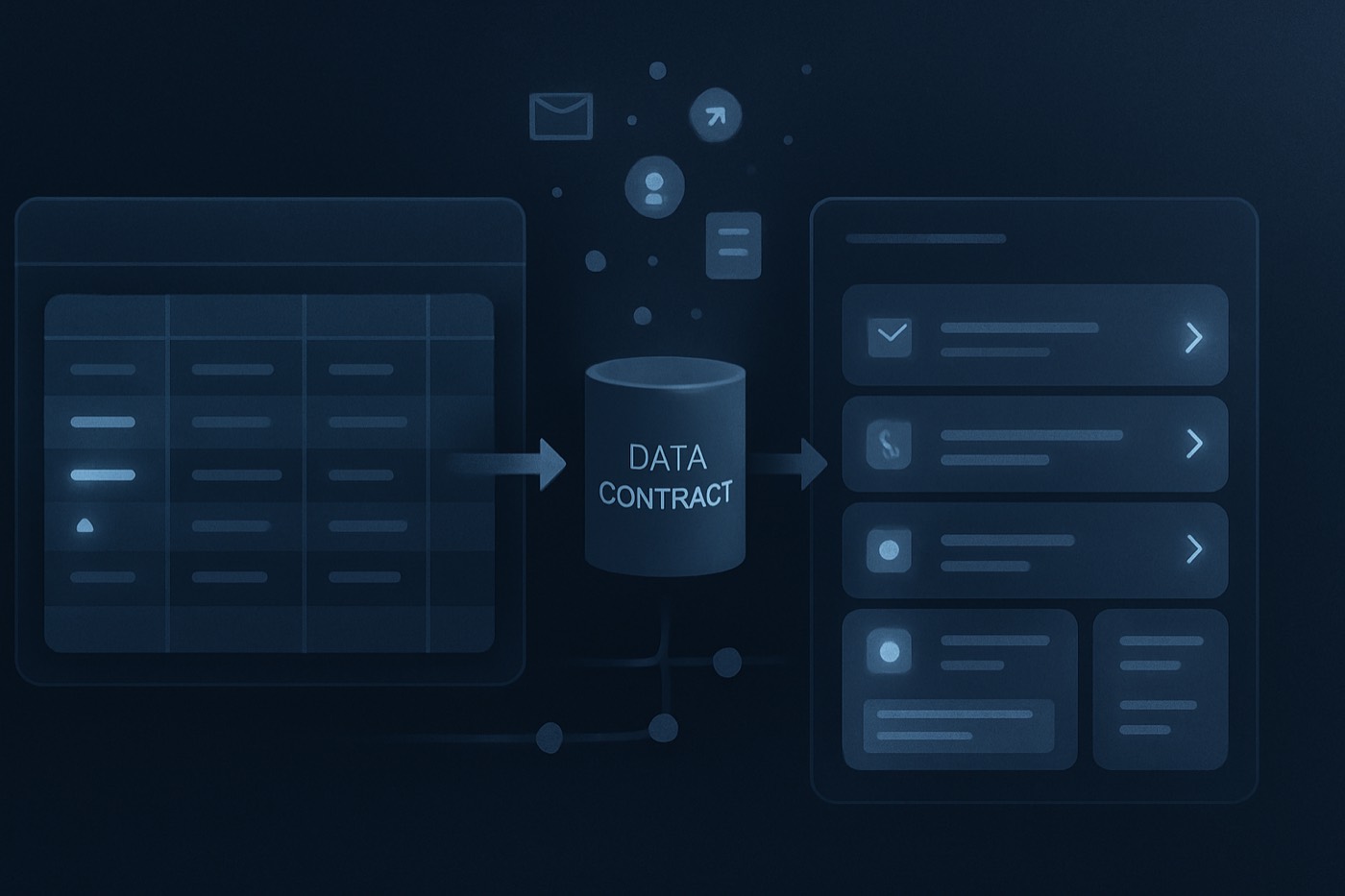
Your outbound motion in 2026 lives or dies on one thing: whether the system running it and the system reporting on it share the same truth.
Most teams still stitch outbound together by hand:
- CRM holds "accounts and deals"
- A sequencer holds "tasks and emails"
- An enrichment tool holds "facts"
- Calendly holds "meetings"
- A dialer holds "calls"
- Deliverability tools hold "warnings"
...and none of it reconciles cleanly. The result is duplicate records, mismatched attribution, broken suppression, and a pile of point tools that each know a fraction of the picture. Someone, usually a founder or a lone SDR, spends their week being the human integration layer.
The shift in 2026 is to stop being that integration layer. Instead of buying six tools and a sequencer and wiring them together, you give one operator the goal and let it run the work:
- The operator runs the motion: discovery, enrichment, signal scoring, deliverability and infrastructure, outreach, reply handling, and meeting booking, with approvals on the decisions that matter.
- Your CRM is the record: identity, ownership, deals, compliance, and reporting. The operator keeps it in sync.
- A data contract defines what gets written back, when, and how conflicts resolve, so the record never drifts from reality.
This guide is your outbound sales stack 2026 blueprint: the operator-led model, the data contract that keeps your CRM honest, the exact fields and events worth syncing, two practical "minimum viable stacks" (SaaS and agencies), and a consolidation path that cuts tool sprawl.
The 2026 model: one operator runs it, the CRM holds the record
For a decade the standard advice was to treat the CRM as the "system of record" and a sequencer as the "system of action," then spend RevOps time keeping the two in sync. That advice assumes a team of specialists doing the wiring. Most high-value B2B teams, the founder-led agency, the boutique consultancy, the lean B2B SaaS, do not have that team and do not want to become one.
The operator-led model collapses the busywork:
- Chronic is the autonomous revenue operator. You set the target, budget, offer, constraints, and approval level. It finds the right prospects, enriches and scores them, manages warmed sending infrastructure, writes and sends the outreach, handles replies, and books the meetings. It optimizes for one outcome: qualified meetings held with relevant prospects, while protecting your domains, mailboxes, and reputation. It does not chase opens or volume.
- Your CRM stays the authoritative record for identity, ownership, lifecycle stage, deals, compliance, and reporting. The operator writes back the decision-grade events so the CRM reflects what actually happened.
Why this split matters more in 2026
- Mailbox providers enforce stricter standards for bulk senders. Suppression and unsubscribe handling have to be consistent everywhere, which is far easier when one operator owns sending rather than three disconnected tools. Yahoo's Sender Hub calls out a spam complaint rate below 0.3%, authentication, and one-click unsubscribe for bulk senders. (senders.yahooinc.com)
- Automation is only as good as its data. If "meeting booked" lives in Calendly, "reply positive" lives in a sequencer, and "SQL" lives in the CRM, any scoring or routing becomes guesswork. An operator that owns the full motion already has these signals in one place.
- Attribution is multi-touch by default. Outbound now spans email, calls, and intent signals. Without event-level write-back you cannot answer the only question that matters: which play created pipeline?
How the operator runs and what it writes back
Here is the high-level flow. Chronic ingests signals, runs the motion, and writes a clean record into your CRM and reporting layer.
             +-----------------------------+
             |  Signals / Sources           |
             |  - Lead lists                |
             |  - Website intent            |
             |  - Funding / hiring / stack  |
             |    changes                   |
             +--------------+--------------+
                            |
                            v
+-----------------------------------------------------------+
| Chronic (Autonomous Revenue Operator)                     |
| - ICP matching                                            |
| - Lead enrichment                                         |
| - Signal scoring + explainability                         |
| - Deliverability / sending infrastructure                 |
| - Outreach: writing, sending, reply handling              |
| - Meeting booking                                         |
| - Approvals on the decisions that matter                  |
+--------------+----------------------------+---------------+
               |                            |
               v                            v
   +----------------------+     +---------------------------+
   | CRM (the record)     |     | Reporting / BI            |
   | - Accounts/Contacts  |     | - Pipeline per play       |
   | - Stages + deals     |     | - Conversion by segment   |
   | - Compliance + audit |     | - Deliverability health   |
   +----------------------+     +---------------------------+
Key idea: the operator is where the work happens. The CRM is where the record lives. The contract below is what keeps them aligned.
The data contract: objects, IDs, and conflict rules
Clean sync needs an explicit contract. Here is the minimum.
Canonical objects (and who owns them)
- Account (company): owned by the CRM for dedupe, territory, parent-child mapping, and reporting.
- Contact: identity owned by the CRM, enriched by Chronic.
- Lead (optional): in the CRM if you use a Leads object, otherwise skip it and go Contact-only.
- Opportunity / Deal: owned by the CRM pipeline; the operator proposes stage moves from real events.
- Outreach state: owned by Chronic (the operator runs the sequences), mirrored to the CRM as a summarized state.
- Activity events: produced by the operator (sends, replies, calls, meetings), normalized into the CRM or a warehouse as event records.
- Deliverability entities: owned by the operator's sending layer, but status syncs to the CRM as risk flags.
Identity keys (do not skip this)
Use a 3-key strategy:
- Primary key: CRM record ID (AccountId, ContactId)
- Secondary key: normalized email (lowercase, trimmed)
- Tertiary key: domain + company name fingerprint (for prospects not yet in the CRM)
For agencies, add a ClientId or WorkspaceId to every record to prevent cross-client contamination.
Conflict resolution rules (simple and enforceable)
- Ownership fields (owner, team, territory): CRM wins.
- Lifecycle stage (Prospect, Engaged, Meeting Set, SQL): CRM wins, but events from the operator can propose updates under governed rules.
- Enrichment fields (industry, headcount, tech stack): the operator's value wins if its timestamp is newer.
- Suppression fields (unsubscribed, do-not-email, do-not-call): always "most restrictive wins."
Sourcing and enrichment (and what to sync)
What "sourcing" means in 2026
Sourcing is not just list building. It is:
- identity resolution (matching a person to a company)
- relevance filtering (ICP match + intent)
- compliance filtering (suppression, region rules)
- deliverability filtering (role accounts, risky domains, invalids)
The enrichment workflow the operator runs
- Ingest leads or accounts (lists, partner data, inbound handoffs)
- Normalize company domain and person email
- Enrich company and contact
- Attach technographics and triggers (hiring, funding, stack changes)
- Only then evaluate ICP match and score
Chronic runs this enrichment step with Lead Enrichment, then immediately applies ICP rules and scoring.
Minimum enrichment fields to sync to the CRM
Account fields
- website domain (canonical)
- industry
- employee count range
- HQ country/state
- tech stack tags (limited to high-signal categories)
- last_enriched_at (timestamp)
- enrichment_source
Contact fields
- email (canonical)
- email_quality_status (valid, risky, unknown)
- job title
- seniority
- department/function
- linkedin_url (optional)
- last_enriched_at
ICP matching (and why it belongs next to enrichment)
What ICP matching is
ICP matching classifies an account or contact as a fit based on firmographics, technographics, triggers, and exclusions, using both deterministic rules and probabilistic signals.
In 2026, ICP must be:
- explainable (why is this a match?)
- versioned (ICP v1 vs v2)
- auditable (who changed the rule?)
Use the ICP Builder to formalize your rules so the operator works from a definition you can inspect.
What to sync
- icp_profile_id (which ICP definition)
- icp_match_tier (A, B, C)
- icp_match_reasons (top 3 reasons as text)
- icp_exclusion_reason (if excluded)
- icp_last_evaluated_at
This prevents the classic error: outreach keeps sequencing leads that no longer fit because the exclusion never propagated. When one operator owns both the ICP and the sending, that gap closes by design.
Scoring and routing: signals, not vibes
What scoring should do
- prioritize what to work today
- decide which play to run
- decide what not to touch (suppression)
- when you have a team, decide who works it
Chronic provides AI Lead Scoring with explanations attached, so the priority order is something you can question rather than a black box.
Routing rules (simple and effective)
Route based on:
- territory (geo)
- segment (SMB, mid-market, enterprise)
- intent tier (high, medium, low)
- relationship status (existing customer, open opp, closed-lost)
- deliverability risk (pause high-risk senders)
What to sync
- lead_score (numeric)
- score_band (P0, P1, P2, P3)
- score_version
- score_explanations (structured)
- routed_to_user_id (when a human owns the next step)
- routed_at
- routing_reason
Outreach: the operator runs the touches, the CRM gets the state
This is where hand-stitched stacks get messy, because people try to sync everything. Don't.
The outreach contract: sync state, not noise
Sync these "sequence state" fields into the CRM:
- sequence_id, sequence_name
- enrolled_at
- current_step
- sequence_status (active, paused, finished, removed)
- removal_reason (reply, bounce, unsubscribe, manual, compliance)
Sync these "event outcomes" (high-signal only):
- reply_received (boolean)
- reply_category (positive, neutral, objection, unsubscribe request, out-of-office)
- reply_at
- bounce_type (hard, soft)
- bounce_at
- unsubscribe_at
- spam_complaint_at (if available)
- last_touch_at
Capture only these and your pipeline reporting stays accurate while the operator drives the rest safely.
How Chronic handles outreach
- Writes and personalizes at scale with the AI Email Writer, grounded in the enrichment and signals it already gathered.
- Sends from managed, warmed mailboxes so you are not buying and warming domains by hand.
- Reads and categorizes replies, then either advances, pauses, or escalates for approval.
Related deep dive: Adaptive outreach sequences with multi-signal plays
Calling: outcomes, dispositions, and recording governance
Calling still matters in 2026, but only if it feeds the same record.
The call data contract (minimum viable)
For every outbound call attempt, sync:
- call_started_at, call_ended_at
- call_direction (outbound)
- call_outcome (no answer, voicemail, connected, busy, failed)
- call_disposition (custom taxonomy, see below)
- call_recording_url (optional, access controlled)
- call_notes (optional)
- caller_user_id
- contact_id/account_id linkage
Disposition taxonomy (example)
- Connected - discovery scheduled
- Connected - not a fit
- Connected - follow up requested
- Voicemail left
- Gatekeeper
- Wrong number
- DNC requested (critical flag)
Best practice
Keep dispositions consistent. If every rep invents their own outcomes, your scoring and routing degrade.
Meeting booking: status is an event stream, not a field
A meeting is not "a date." It is a lifecycle:
- booked
- rescheduled
- canceled (by rep or prospect)
- no-show
- completed
Calendly webhooks fire invitee.created on scheduling and a canceled status on cancellations, and reschedules trigger both created and canceled events. (developer.calendly.com, developer.calendly.com)
What to sync (meeting event schema)
- meeting_id (Calendly invitee UUID or provider ID)
- meeting_status (scheduled, canceled, rescheduled, completed, no_show)
- scheduled_start_at, scheduled_end_at
- booked_at
- canceled_at, canceled_by (prospect vs rep)
- rescheduled_from_meeting_id (if available)
- meeting_type (discovery, demo, follow-up)
- meeting_owner_user_id
- meeting_source (outbound, inbound, partner)
This gives you:
- accurate conversion rates (reply to meeting, meeting to SQL)
- better scoring (a no-show should downscore)
- correct removal logic (stop sequencing once a meeting is booked)
Deliverability monitoring: treat it like production telemetry
Deliverability is no longer "set up SPF once." It is ongoing monitoring with automated safeguards, and it is the part most teams get wrong. When the operator owns sending, this becomes its job rather than yours.
Requirements to align with (email)
Yahoo's Sender Hub states:
- Keep the spam complaint rate below 0.3%
- Authenticate mail (SPF or DKIM at minimum for everyone; SPF, DKIM, and DMARC for bulk senders)
- Provide one-click unsubscribe via list-unsubscribe headers and honor unsubscribes within 2 days for bulk senders (senders.yahooinc.com)
What to sync into the CRM (as risk flags, not raw DNS data)
Per sending domain or mailbox:
- sending_domain
- deliverability_risk_status (green, yellow, red)
- spam_rate_estimate (if available)
- hard_bounce_rate_7d
- complaint_rate_7d
- dmarc_policy (none, quarantine, reject)
- dmarc_alignment_status (pass/fail/unknown)
- last_deliverability_check_at
- sending_paused (boolean)
Safeguards the operator runs automatically
- If the hard bounce rate spikes, pause that mailbox.
- If the unsubscribe rate spikes on a sequence, throttle and flag it.
- If DMARC misalignment is detected, stop sends from that domain until it is fixed.
Related: Cold email deliverability mistakes and fixes for 2026 and DMARC policy choices for cold email
Attribution: make outbound measurable without drowning in activity
The mistake
Teams sync every open, click, and micro-event into the CRM. That creates storage bloat, reporting lag, meaningless dashboards, and scoring that learns from noise.
The 2026 approach
Store raw events in the operator's logs or a warehouse, and write only decision-grade events into the CRM:
- reply (with category)
- meeting scheduled/canceled/no-show/completed
- bounce (hard vs soft)
- unsubscribe
- call connected and disposition
- opportunity created/advanced/closed
Attribution model suggestion
- Primary source: the meeting-booked event, because it is a real conversion
- Assist: the last 3 touches before the meeting (email + call), stored as IDs and timestamps
This keeps reporting honest and kills the false "open rate wins."
Governance: the rules that protect your brand
Governance is not bureaucracy. It is reputation protection, and it is exactly why an operator should run with approvals rather than free rein.
Areas you need
- Suppression governance: a global unsubscribe must suppress across every sequence and mailbox.
- Action governance: where the operator can act on its own, where it must ask first, and what it must never do.
- Auditability: who enrolled someone, who changed a stage, what copy went out.
- Data retention: call recordings, email content, and PII.
Human-in-the-loop approvals (recommended)
Keep approvals on:
- first-touch copy for a new persona
- high-risk segments (regulated industries)
- follow-ups after a negative reply
This is the heart of confident delegation: the operator runs the volume, and you only see the decisions that matter. Related: Human-in-the-loop AI SDR approval patterns and Action-taking AI and its failure modes
The blueprint by layer (with the operator's role)
- Sourcing + enrichment: takes lead lists, intent, and inbound handoffs, returns normalized accounts and contacts with quality flags. Operator role: Lead Enrichment.
- ICP matching: returns an ICP tier and reasons. Operator role: ICP Builder.
- Scoring + routing: returns priorities, plays, and owners. Operator role: AI Lead Scoring.
- Outreach: produces touches and outcomes. Operator role: AI Email Writer plus managed warmed sending. Weighing a tool-by-tool approach instead? See how an operator-led model compares to Apollo, HubSpot, Salesforce, Pipedrive, Attio, Close, and Zoho CRM.
- Calling: produces dispositions and conversion to meeting. Contract: consistent outcomes, minimal required fields.
- Meeting booking: produces meeting status events from your calendar tool's webhooks.
- Deliverability: produces sending risk flags and automatic throttles that feed suppression and routing.
- Attribution + BI: produces pipeline per play, per persona, per segment. A warehouse helps once you scale.
- Governance: produces safe automation, an audit trail, and compliant suppression.
Minimum viable outbound stack (2026) for SaaS
The simplest setup that stays reliable past your first 2-3 SDRs.
Tools (categories)
- Operator: Chronic, running enrichment, ICP, scoring, outreach, reply handling, deliverability, and meeting booking
- CRM: your record for accounts, deals, and reporting
- Meeting booking: Calendly or similar (the operator reads its webhooks)
- Dialer: optional at first, useful as volume grows
- Warehouse: only if you need multi-touch BI beyond CRM reporting
Minimum viable workflow
- List or signal comes in -> enrich -> ICP match -> score
- Operator enrolls the fit accounts in the right play and sends from warmed mailboxes
- Replies, bounces, and unsubscribes sync to the CRM within minutes
- Meeting booked triggers: stop sequencing, propose a stage update, create a prep task
- Bounce/unsub triggers: suppression updated everywhere
Minimum viable outbound stack (2026) for agencies (multi-client)
Agencies fail on outbound ops when they reuse one messy schema across clients.
Add these requirements
- strict workspace segregation
- per-client sending domains and suppression lists
- per-client attribution and audit logs
- a templated data contract, cloned per client
Minimum viable "agency contract"
Every record must include:
- client_id
- client_owner_user_id
- approved_copy_version_id (so you can prove what was sent)
- compliance_status
Tool consolidation path: cut spend without breaking your motion
Most teams consolidate too early and lose capability, or too late and drown in tools. A safer path:
Phase 1: stop the sync chaos
- Define the contract (fields, events, conflict rules)
- Normalize identities (domain, email)
- Centralize suppression
- Make meeting status event-driven
Phase 2: hand decisioning to the operator
Move enrichment, ICP logic, scoring, routing, and play selection to Chronic. This raises consistency even while some execution tools stay where they are, and lets the operator keep deal hygiene tidy via Sales Pipeline.
Phase 3: hand execution to the operator
Move email writing and personalization with the AI Email Writer, sending and reply handling, and meeting booking into the operator. Phase 3 retires duplicate enrichment vendors, multiple sequencers, and brittle automation chains, and replaces the human integration layer with approvals.
The "what to sync" map
Chronic (the operator)                           CRM (the record)
----------------------                           ----------------
sequence.enrolled  --------------------------->  contact.last_touch_at
reply.received     --------------------------->  contact.reply_status, reply_at
bounce.hard        --------------------------->  contact.email_status=invalid + suppression
unsubscribe        --------------------------->  contact.do_not_email=true + suppression
call.connected     --------------------------->  contact.last_call_at + call_outcome
meeting.scheduled  --------------------------->  meeting object + stage suggestion
meeting.canceled   --------------------------->  meeting_status=canceled + reason
opportunity.created <--------------------------  triggers sequence removal + play change
owner.changed      <--------------------------  re-route tasks + pause sequences
The checklist: fields and events to sync (copy/paste spec)
Use this as your implementation checklist. Keep it tight.
A) Identity and lifecycle (CRM authoritative)
Account
- account_id
- account_name
- website_domain (canonical)
- account_owner_user_id
- account_status (prospect, engaged, customer, churned)
- territory/segment
- created_at, updated_at
Contact
- contact_id
- account_id
- email (canonical)
- first_name, last_name
- title, department, seniority
- contact_owner_user_id
- lifecycle_stage
- do_not_email (boolean)
- do_not_call (boolean)
- suppression_reason (enum)
- created_at, updated_at
B) Enrichment and fit (operator authoritative where applicable)
- last_enriched_at
- enrichment_source
- firmographics (industry, headcount_range, geo)
- technographics tags (high-signal only)
- icp_profile_id
- icp_match_tier
- icp_match_reasons (top 3)
C) Scoring and routing (operator)
- lead_score
- score_band
- score_version
- score_explanations (structured or top reasons)
- routed_to_user_id
- routed_at
D) Outreach state (operator authoritative, mirrored to CRM)
- sequence_id, sequence_name
- enrolled_at
- sequence_status (active/paused/finished/removed)
- current_step
- removal_reason
E) Activity events (normalized)
Sync these events with timestamps:
- reply_received (plus reply_category)
- bounce (hard/soft)
- unsubscribe
- spam_complaint (if available)
- call_outcome (connected/no answer/voicemail/etc.)
- call_disposition
- meeting_scheduled
- meeting_canceled
- meeting_rescheduled
- meeting_no_show (if your booking tool supports it, otherwise mark via CRM process)
- meeting_completed
F) Deliverability monitoring (risk flags)
- sending_domain
- deliverability_risk_status
- spam_rate_estimate
- bounce_rate_7d
- complaint_rate_7d
- dmarc_policy
- dmarc_alignment_status
- last_deliverability_check_at
- sending_paused
How to roll this out with Chronic
If you want Chronic to run the motion (the fastest path to consistency), bring it online in this order:
- Normalize identity: domain and email canonicalization.
- Enrich and attach fit: use Lead Enrichment and define ICP via ICP Builder.
- Score and route: use AI Lead Scoring.
- Run the plays: let the operator write with the AI Email Writer and send from warmed mailboxes.
- Keep the record clean: manage deals in Sales Pipeline and sync the decision-grade events back.
- Set the approval level: start with approvals on first-touch copy and risky segments, then widen autonomy by play type as trust builds.
For the wider context: The AI integration gap in 2026
FAQ
What is the best outbound sales stack 2026 setup for a small team?
Optimize for consistency, not feature breadth. The simplest reliable setup is one operator running discovery, outreach, reply handling, and meeting booking, one CRM as the record, one meeting tool, and a deliverability layer the operator manages for you. Then enforce a tight sync contract: replies, bounces, unsubscribes, call outcomes, and meeting statuses. That prevents duplicate outreach and broken suppression as volume grows.
Which events matter most to sync back to the CRM?
Decision-grade events that change what happens next: replies (with category), hard bounces, unsubscribes, call connected plus disposition, meeting scheduled/canceled/rescheduled, and opportunity created plus stage changes. Avoid syncing every open and click unless you have a specific use case.
How do Yahoo and Gmail requirements affect outbound deliverability in 2026?
Yahoo's Sender Hub emphasizes authenticated email and user control: spam complaint rates below 0.3%, easy unsubscribe handling, and for bulk senders, DMARC plus one-click unsubscribe and honoring unsubscribes within 2 days. (senders.yahooinc.com) In practice your stack must sync bounces and unsubscribes reliably everywhere, which is much easier when one operator owns sending instead of three disconnected tools.
Should the CRM or the operator own lifecycle stage changes like Engaged or Meeting Set?
In most B2B teams the CRM should own lifecycle stage for reporting and governance. The operator publishes the events that justify a change (reply positive, meeting booked) and proposes the stage move, then it is applied in the CRM under governed rules or an approval, so a human can always override.
How do agencies prevent cross-client suppression and compliance mistakes?
Make suppression multi-tenant by design: every contact and event carries a client_id, suppression and sending infrastructure are per client, domains are never shared across clients, and there is an audit trail of who enrolled whom and what was sent. This is the most common failure mode for outbound agencies at scale.
What is the safest path to tool consolidation without losing pipeline?
Consolidate decisioning first (ICP, enrichment, scoring, routing), then execution (sending, reply handling, meeting booking). Consolidating execution first tends to cost you routing nuance, scoring explainability, and governance. Start by enforcing the data contract and centralizing suppression, then retire redundant tools one layer at a time.
Your 30-day rollout plan (ship the contract first)
- Week 1: define the contract. Canonical objects, IDs, required fields, event schema, conflict rules. Decide "most restrictive wins" for suppression.
- Week 2: wire core sync. Outreach state to the CRM; replies, bounces, and unsubscribes to CRM suppression; call outcomes to the CRM; meeting webhooks to a CRM meeting object.
- Week 3: add scoring and routing. Set ICP tiers and reasons, turn on scoring and route rules, and add auto-pause for deliverability risk flags.
- Week 4: run the plays. Stand up 3-5 plays by persona, set approvals on operator-written copy, and build dashboards for meeting rate, bounce rate, unsubscribe rate, and pipeline per play.
If you do only one thing: ship the sync contract and suppression governance first. Everything else, including handing the motion to an operator, gets easier from there.