The composable outbound stack in 2026: four jobs, and who should still own them
A 2026 outbound stack does four jobs: target, send and follow up, enrich, and verify. You can glue four tools together, or hand all four to one autonomous operator that runs the loop and surfaces only what needs your approval.
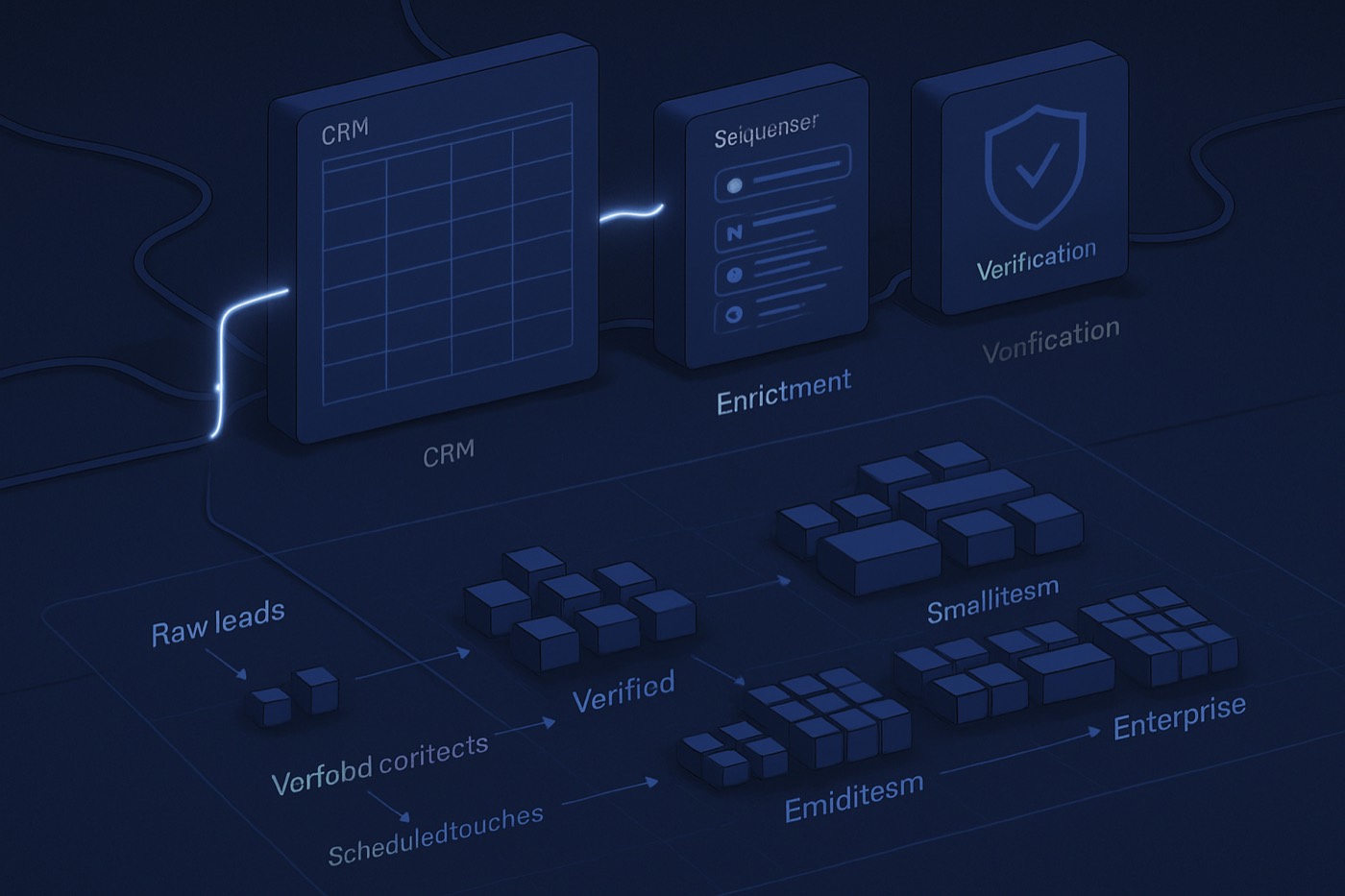
Outbound teams in 2026 are converging on a single reality: deliverability is harder, contact data decays faster, and the "one tool does everything" suite keeps breaking at the seams. The pattern that holds up is a composable outbound stack, where four distinct jobs each get done well and the data between them stays consistent.
The open question is not which tools. It is who runs them. A small team can wire best-of-breed pieces together and babysit the integrations. Or you can hand the whole loop to an autonomous revenue operator that does targeting, sending, follow-up, and hygiene as one job, and surfaces only the decisions a human should make. This post lays out the four jobs, how to assemble them by team size, and where the assemble-it-yourself approach stops paying off.
The four jobs every outbound stack has to do
Strip the category names away and outbound comes down to four jobs:
- Targeting: decide who is worth contacting and why, keep one canonical record per person and company, and track suppression (unsubscribed, do-not-contact, competitor, existing customer).
- Sending: run multi-step email sequences, throttle and time them, rotate mailboxes to protect deliverability, and read replies.
- Enrichment: attach the firmographics, role data, and signals that make targeting and personalization accurate, and refresh them before they rot.
- Verification: check addresses close to send time so you do not bounce, hit catch-all domains, or burn a sending reputation.
In 2026 the shift is not "more tools." It is clean boundaries between two kinds of behavior:
- System-of-record work: canonical entities, lifecycle stages, dedupe rules, suppression lists, attribution.
- System-of-execution work: sending sequences, rotating mailboxes, adjusting cadence, routing replies, booking meetings.
When those boundaries are blurry, the same failure modes repeat across teams: duplicate contacts, suppression drift, and lost attribution. Whether a human or an agent runs the stack, the fix is the same: one place owns identity and suppression, and execution tools only act and report back.
What is forcing the issue is mailbox-provider enforcement. Gmail and Yahoo began enforcing bulk-sender requirements in February 2024, including SPF, DKIM, DMARC, and one-click unsubscribe for bulk senders. That turned hygiene from a nicety into a gate. (Blueshift Help Center)
Microsoft is the other constraint. Proofpoint reported Microsoft moving to enforce bulk-sender requirements of its own, which raises the operational bar for any team sending to Outlook and Microsoft 365 inboxes. (Proofpoint)
Job 1: Targeting, where truth lives
Something has to own the canonical answer to "who, and why." That layer holds:
- Canonical account and contact IDs (one record per person, one per company)
- Lifecycle stage (prospect, active, disqualified, customer)
- Suppression state (unsubscribed, do-not-email, do-not-call, competitor, existing opportunity)
- Attribution and source (campaign, list, inbound vs outbound)
- Outcomes (meetings, qualified leads, opportunities, closed-won)
In a traditional stack this is the CRM's job, and the CRM is a filing cabinet a human keeps tidy. An autonomous revenue operator does the same bookkeeping, but it also acts on it: it scores who to contact next and can explain the reasoning, builds and refines the ICP from what actually replies, and writes outreach that stays consistent with your offer and proof points. The record is not a place you maintain. It is the operator's working memory.
Job 2: Sending, where action happens
Sending should specialize in execution:
- sequence logic, throttling, sending windows
- mailbox rotation and deliverability controls
- reply classification
- step-level analytics (useful, but never the source of truth)
A useful tell: if reps spend more time in the sending tool than in the system of record, the sync is too loose, and the answer is a tighter model, not more dashboards. When an operator owns both, the question disappears, because targeting and sending are the same loop and reply handling feeds straight back into who to contact next.
Job 3: Enrichment, where targeting accuracy comes from
Enrichment is not one thing. Mature teams in 2026 split it into tiers:
- Tier A (cheap, always on): company size, industry, location, role, LinkedIn URL normalization
- Tier B (campaign-specific): technographics, job openings, funding, compliance posture, tools in use
- Tier C (expensive, strategic): intent, buying signals, deeper org charts
The catch is decay. Third-party sources regularly put list churn at roughly a quarter of a database per year, which means enrichment is a refresh cycle, not a one-time pull. (ZeroBounce 2025 statistics report coverage) A human team schedules that refresh and hopes it runs. An operator does it on a cadence keyed to segment value and re-checks records before they age out.
Job 4: Verification, where you protect deliverability
Verification is the circuit breaker:
- prevents hard bounces
- flags catch-all domains and risky inboxes
- skips role accounts when your policy says to
This matters more every year because the inbox you are trying to reach is not uniform. Validity's 2025 benchmark put inbox placement at major providers far from even, with Microsoft among the harder destinations to reach, so volume without hygiene produces uneven, unpredictable results. (Validity 2025 benchmark report) The reliable move is to verify as close to send time as possible, which is exactly the kind of always-on discipline an autonomous operator is built to enforce and a human is prone to skip under deadline.
Blueprint by team size
Three practical setups, with decision rules for when to add each piece, and where the operator model changes the math.
1 to 5 reps: minimum viable stack
This is where the build-it-yourself stack is most tempting and most fragile, because one person is doing the gluing between selling calls.
If you assemble it yourself
- System of record: one tool that owns canonical accounts, contacts, and suppression
- Sending: one tool, one workspace, minimal integrations
- Enrichment: always-on basics, then campaign enrichment only for high-value lists
- Verification: verify net-new addresses before first send, re-verify stale records
The small-team flow: a lead source (list, inbound, referral) feeds the record layer, which holds the canonical account, contact, suppression, and score. The record layer pushes contacts to the sending tool, which executes and writes events back (sent, reply, bounce, meeting booked, unsubscribe). Verification sits as a pre-send gate between them.
Decision rules (1 to 5 reps)
Add capabilities only when you hit a trigger:
- Add verification now if: hard bounces exceed roughly 2% on any campaign, you are sending to Microsoft-heavy segments (common in mid-market and enterprise), or you are importing lists older than 30 to 60 days.
- Add enrichment now if: you cannot segment by ICP reliably, personalization needs more than name and company, or you are launching a new vertical and need targeting accuracy fast.
- Do not add a warehouse yet unless: you have multiple motions with conflicting definitions of "qualified," or you need multi-touch attribution across tools.
Common failure modes (1 to 5 reps)
- Duplicate creation: importing CSVs into both the record layer and the sending tool
- Suppression drift: unsubscribes live only in the sending tool
- Attribution loss: meetings booked in a calendar never map back to a campaign
The fix is the same regardless of which tools you pick: contacts are created in exactly one place, and the sending tool only receives them via sync and must write events back. This is also the case for the operator model. At 1 to 5 reps, the strongest argument against assembling four tools is that nobody on the team wants to be the integration babysitter. An autonomous revenue operator collapses all four jobs into one loop, so there is no sync to maintain, no suppression to reconcile, and the only thing the founder touches is approvals.
6 to 25 reps: operational stack
At this size you move from rep craftsmanship to process reliability.
Recommended setup
- System of record: owns canonical IDs, scoring, segmentation, and suppression; scoring decides who reps work next
- Sending: multi-inbox support, team throttles, reply routing
- Verification: an automated policy (pre-send plus periodic refresh)
- Intent (optional): only if deal sizes justify it and you can act on it
- Dialer (optional): if calls are a real step in the sequence
The mid-team event loop: data sources (enrichment vendors, intent, website signals) feed the record layer, which holds canonical IDs, scoring, segmentation, and suppression. It pushes to the sending tool and an optional dialer; both stream events back (sent, delivered, bounce, reply type, call outcome). A verification policy sits as a gate before sending.
Decision rules (6 to 25 reps)
When to add intent: when you already have a proven playbook converting, you can define what "intent-qualified" means in fields and automation, and you can route a signal to the right owner within minutes. Intent without governance just creates high-priority clutter that burns rep trust.
When to add a dialer: when calling is part of the designed sequence, you can enforce consistent dispositions, and call outcomes sync back without manual entry.
When to add a warehouse: when you must reconcile activity across multiple sending tools or regions, you need finance-grade reporting on payback by segment, or you are running experiments that need cohort analysis (subject lines, angles, steps).
When to add governance: as soon as more than one person can import data, or you run more than one motion (SMB vs mid-market vs enterprise). At this size governance means field standards (job level, persona, ICP fit, region), dedupe rules, suppression policy (global, per domain, per brand), and clear "do not contact" reasons (competitor, partner, existing customer, legal).
The operator model is still in play here, but the trade changes: a 6-to-25-rep team may want humans on calls and negotiation while the operator runs everything upstream of the meeting. The point of approvals is exactly this division of labor, the agent handles the repeatable loop and hands you the judgment calls.
25+ reps: scalable stack with data contracts
At 25+ reps the hard problem is no longer sending. It is consistency across teams, territories, and tools.
Recommended setup
- System of record: unifies enrichment, scoring, sequencing automation, and pipeline reporting
- Sending: enterprise controls, deliverability management, workspaces separated by region or business unit
- Verification: multi-step plus catch-all handling and refresh SLAs
- Intent: integrated with routing rules and ownership
- Dialer: tightly integrated for dispositions, recordings, QA
- Data warehouse: canonical analytics, multi-touch attribution, cohort retention
- Governance: data contracts, audit trails, role-based permissions, change management
The enterprise picture: the record layer sits at the center. Acquisition inputs (enrichment tiers, intent, product signals) feed it from one side; execution systems (sending, dialer, LinkedIn actions, scheduling) sit on the other; an analytics layer (warehouse plus BI) sits underneath. Entities and suppression sync by reference; activity syncs as events.
Decision rules (25+ reps)
- Add a warehouse when: leaders distrust funnel metrics because each tool reports differently, you need to attribute pipeline to plays rather than people, or you must enforce governance with auditable transformations.
- Add strict verification SLAs when: you run large net-new list pulls weekly, you see bounce spikes after enrichment refreshes, or you send across many providers and domains with uneven reputation risk.
- Add governance when: you have multiple admins across multiple tools, you operate across jurisdictions or strict compliance constraints, or you are seeing suppression drift, duplicate explosions, or territory conflicts.
Integration patterns that hold up in 2026
Integration design is where most assembled stacks fail. The fix is choosing a primary direction for each class of data.
Pattern 1: push entities, pull actions (small teams)
- Push from the record layer to the sending tool: contacts, accounts, campaign membership, owner, segmentation fields
- Pull from the sending tool to the record layer: replies, bounces, unsubscribes, meetings, step completion
Best for 1 to 10 reps and low admin overhead. The risk is delay or missing events if the pull job fails.
Pattern 2: event-based sync (6+ reps)
Use an event stream or webhooks: the sending tool emits events (sent, delivered, bounced, replied, unsubscribed) and the record layer ingests them into the activity timeline and reporting. Treat each event as immutable and add an idempotency key so replays do not create duplicates.
Pattern 3: data contracts (25+ reps)
A data contract is a written, enforced spec: field definitions (what counts as "persona," "ICP fit," "verified email"), accepted values, ownership rules, dedupe rules, and suppression precedence (global suppression overrides everything). Best for large teams with multiple tools and regions.
The six failure modes, and the fixes
1) Duplicate creation
What happens: imports occur in multiple tools, reps create contacts ad hoc in the sending tool, and enrichment writes partial records that spawn new contacts. Fix: one layer creates entities; the sending tool never creates net-new contacts unless it returns a create request to the record layer.
2) Attribution loss
What happens: meetings and opportunities get created without campaign metadata. Fix: write campaign membership at the moment of enrollment, and store "first outbound touch campaign" and "most recent outbound campaign" separately.
3) Suppression drift
What happens: unsubscribes live in one tool while others keep sending. Fix: keep one global suppression object, and sync it to every execution tool daily plus on every change. Gmail and Yahoo's one-click unsubscribe expectations make this operational hygiene, not a marketing nicety. (Blueshift Help Center)
4) Stale enrichment
What happens: titles change, companies migrate stacks, champions leave, and segments rot. Fix: set refresh SLAs by segment, monthly for enterprise target accounts, quarterly for mid-market, on demand for long-tail. List churn is repeatedly cited as a persistent drag, which makes refresh a lifecycle rather than a project. (ZeroBounce coverage)
5) Verification gaps
What happens: teams trust a provider's "verified" flag, then send weeks later. Fix: verify as close to send time as possible, quarantine risky and catch-all addresses, and route them to another channel (call, LinkedIn, retargeting).
6) Activity fragmentation
What happens: the sending tool holds engagement, the record layer holds pipeline, the dialer holds calls, and nobody has the end-to-end view. Fix: make the record-layer timeline the single activity narrative; every tool writes events back with consistent IDs and campaign keys.
Every one of these failure modes is a seam between tools. The operator model removes the seam by removing the tool count: when one agent owns targeting, sending, enrichment, and verification, there is no second place for suppression to hide or a duplicate to spawn.
When to add each layer: a 2026 decision matrix
Add enrichment when ICP segmentation needs more than firm size and industry, reps need personalization beyond the basics, or routing depends on firmographic rules (region, revenue band, tech stack).
Add verification when you scale past a few hundred net-new sends a day, bounce rates creep up, or you are targeting Microsoft-heavy audiences, which benchmark reporting shows are harder to place. (Validity 2025 benchmark report)
Add intent when you have message-market fit, you can respond fast, and you can measure lift with holdout tests.
Add a dialer when calling is a designed step, you can enforce dispositions and QA, and you have call-to-meeting benchmarks and coaching loops.
Add a warehouse when you need consistent attribution across business units, you run experiments needing cohort analysis, or your record-layer reports disagree with your sending-tool reports.
Add governance when more than one person can change automations or field mappings, you have multiple segments and territories, or compliance requires auditability. Governance is not red tape. It is how you protect deliverability, suppression, and attribution.
Where Chronic fits: one operator instead of four seams
The common 2026 failure is too many point solutions glued together, with a human keeping the glue from cracking. Chronic takes a different shape. It is not a CRM you assemble a stack around. It is an autonomous revenue operator that does all four jobs as one continuous loop:
- finds and scores who to contact next, and can explain why
- builds and runs the sequences, from managed warmed mailboxes it protects
- keeps contact data fresh and verifies addresses before sending
- handles replies and books meetings, surfacing only the approvals that need a human
You give it a revenue goal, the offer, the budget, and the constraints. It runs discovery, enrichment, deliverability, outreach, reply handling, and booking, and it keeps the canonical record, the suppression, and the attribution consistent because it is the only thing touching them. The decision rules in this post still apply, you just are not the one executing them.
If you are weighing the assemble-it-yourself path against an operator, it is worth comparing how each handles integration brittleness and reporting consistency:
For the execution side, these Chronic posts go deeper on hygiene and deliverability:
- Cold email in 2026: deliverability mistakes and fixes
- AI lead scoring in 2026: signals that predict pipeline
- CRM data hygiene checklist for outbound teams (2026)
FAQ
What is a composable outbound stack?
A modular architecture that does four jobs with the right tool for each: targeting (identity, scoring, suppression, reporting), sending (sequence execution and deliverability), enrichment (context and segmentation), and verification (deliverability protection), connected with reliable sync so data and outcomes stay consistent. An autonomous revenue operator is the same four jobs run as one loop instead of four integrated tools.
Should the record layer or the sending tool own unsubscribes and do-not-contact rules?
The record layer should own suppression as the canonical truth and sync it outward to every sending tool and dialer. If suppression only lives in the sending tool, other tools keep sending, which gets more damaging as mailbox providers enforce stricter requirements. (Blueshift Help Center)
When do we need event-based syncing instead of batch syncing?
Move to event-based syncing when volume makes delays risky, usually around 6 to 10 reps or several campaigns running daily. Events reduce attribution loss and keep bounces, replies, and unsubscribes updating suppression and reporting quickly.
How often should we re-enrich and re-verify contacts in 2026?
Tie refresh to risk. Re-verify net-new addresses right before first send. Re-verify stale records if they have not been checked in 30 to 90 days, depending on volume and segment risk. Re-enrich high-value target accounts monthly and mid-value segments quarterly. This matches the reality that lists churn materially over time, so one-time cleaning is not enough. (ZeroBounce coverage)
What is the biggest hidden risk in a composable outbound stack?
Duplicate identity. If the same person exists as several records across tools, you get double sends, broken attribution, and suppression failures. The fix is a canonical ID strategy in one record layer plus idempotent event ingestion, or an operator that keeps a single record because it is the only thing writing to it.
What is a practical first step to simplify a brittle stack without ripping everything out?
Make one layer the canonical owner of three things: accounts and contacts (with dedupe rules), suppression (unsubscribe, do-not-email, do-not-call), and campaign membership keys for attribution. Then change the sending integration so it only executes and emits events back. From there, the larger move is deciding whether you keep maintaining that loop or hand it to an operator that runs it for you.
A 30-day rollout checklist
- Week 1: define canonical objects. Contact and account identity rules, suppression fields and precedence, campaign membership fields.
- Week 2: lock integrations. The record layer pushes entities; the sending tool emits events back (sent, bounce, reply, unsubscribe); add idempotency keys for replays.
- Week 3: add verification gates. Pre-send verification for net-new, a quarantine policy for catch-all and risky addresses, bounce-monitoring thresholds.
- Week 4: add scoring and segmentation. Implement ICP rules, use scoring queues to focus reps, connect pipeline outcomes to campaign keys.
If you do one thing in 2026, make your outbound measurable end to end. That is the line between busy outbound and predictable pipeline, whether your team runs the loop or an operator does.