AI lead scoring in 2026: the 15 signals that actually predict pipeline (with an explainability template)
Pick one goal metric like opportunity created, score on a few inputs across fit, intent, engagement quality, and risk, gate bad data out first, and ship an explainability layer (reasons, confidence, next action) so reps trust the rank.
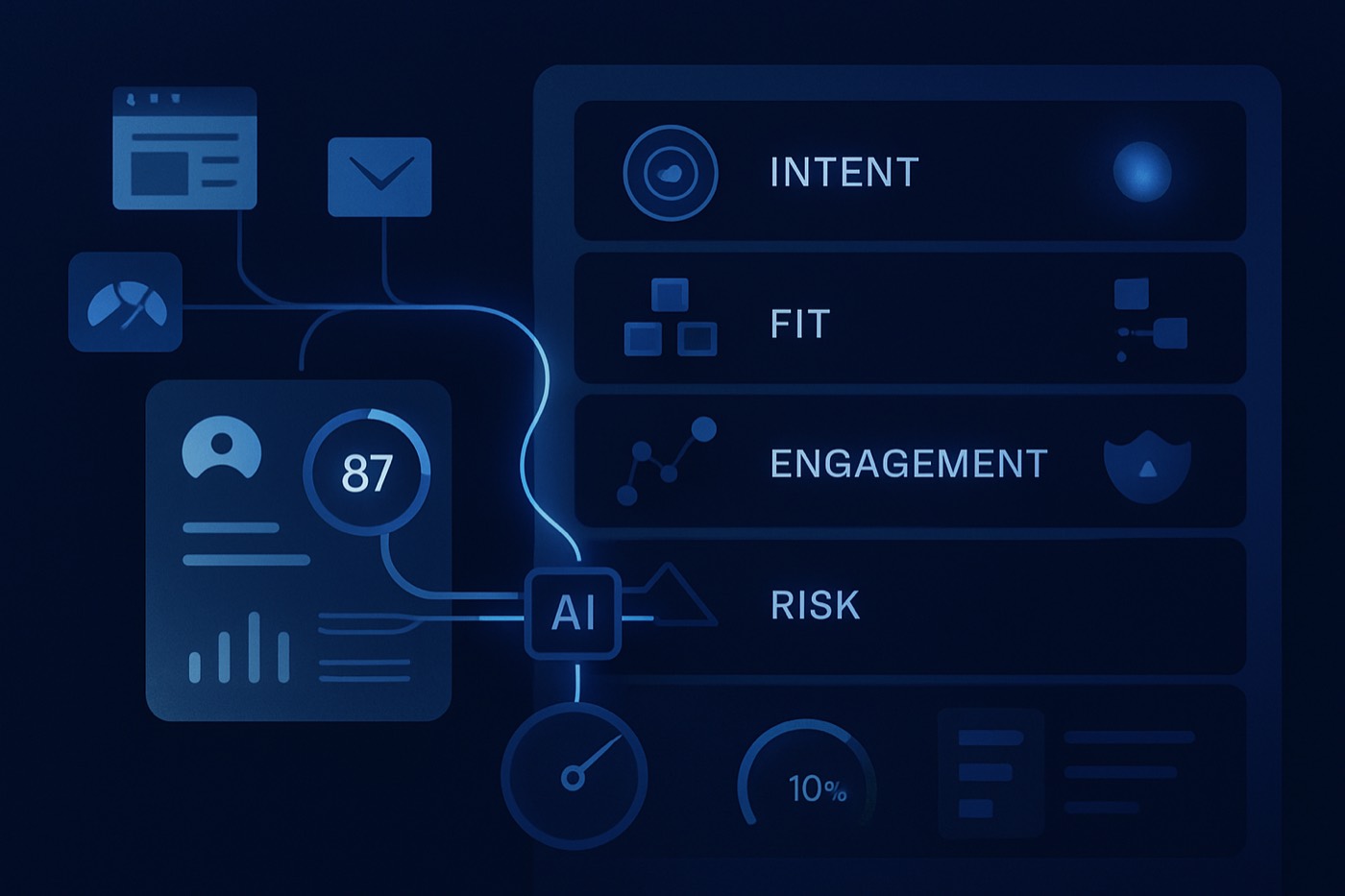
In 2026, "AI lead scoring" is not a magic ranking list. It is a measurable contract between the people who run revenue operations and the people who sell: when a lead ranks higher, it is genuinely more likely to create pipeline, and you can explain why in plain language.
This guide is the practical version of that contract: pick one goal metric, score on a small set of inputs that actually correlate with pipeline, decide rules vs. model based on how much clean data you have, and ship an explainability layer so the rank gets trusted instead of ignored. Then roll it out with a pilot, weekly calibration, and hygiene gates that stop you from scoring junk.
Step 1: pick the goal metric (and stop arguing about "lead quality")
A scoring model is only as good as the outcome it predicts. In B2B, you usually have three workable options:
SQL (sales qualified lead)
- Pros: easy to capture.
- Cons: often subjective, varies by rep or manager, prone to score gaming.
Meeting held (not booked)
- Pros: less subjective, closer to real buyer intent than "scheduled."
- Cons: can be influenced by outbound quality and deliverability.
Opportunity created (recommended for most 2026 teams)
- Pros: closest to pipeline creation, harder to game, aligns marketing and sales on one definition.
- Cons: needs consistent opp creation rules and clean lifecycle timestamps.
Practical recommendation (most B2B SaaS, agencies, consultants): Start with opportunity created within 30 days of first touch as the target. If your opp creation is messy, use meeting held as a stepping stone for 4 to 8 weeks, then switch.
Define the prediction window
Choose a window that matches your sales cycle and prevents "infinite credit":
- Fast outbound motion: 14 to 30 days
- Mid-market: 30 to 60 days
- Enterprise: 60 to 120 days
Minimum data requirement (so your model is not guessing)
Before you do model-based scoring, you want at least:
- 200+ positive outcomes (e.g. opps created) in the last 6 to 12 months for stable training.
- If you have less, use weighted scoring first, then graduate to a model.
Step 2: build your signal inventory (the 15 that actually predict pipeline)
This is the core idea: stop over-indexing on clicks and vanity engagement. Your strongest predictors typically come from a blend of:
- Fit (firmographics + ICP match)
- Intent (first-party and third-party)
- Engagement quality (not quantity)
- Technographics (stack match and change events)
- Risk flags (deliverability and data hygiene)
Below are 15 signals that, in practice, tend to correlate with pipeline creation across many B2B motions. You will tune weights by segment, but the categories hold.
The 15 signals to use (with positives and negatives)
1) ICP match score (fit composite)
What it is: a single "fit" score based on your ICP dimensions (industry, size, geography, role, sales motion, compliance needs). Why it predicts pipeline: if the account cannot buy, intent does not matter.
Implement: use enrichment to score:
- Industry match
- Employee range or revenue
- Region and time zone fit
- Buyer role present (title and seniority)
This is the input layer an autonomous operator like Chronic builds first: it discovers and enriches accounts against your stated ICP, so the fit score is grounded in real firmographics rather than a rep's memory.
2) Buying committee coverage (persona completeness)
What it is: whether you have at least 2 to 3 of the typical roles for the deal type. Why it predicts pipeline: more stakeholders discovered early increases the odds of a real evaluation.
Positive signals
- You have the economic buyer plus a champion persona
- You have a security or procurement persona for enterprise motions
Negative signals
- Only one junior contact at a large org
3) Recent first-party high-intent page visits
What it is: visits to pages that imply evaluation, not casual reading.
High-intent examples
- Pricing page
- Integration pages
- Security and compliance pages
- Comparison pages
- Implementation docs
Tip: weight by recency (last 7 days beats last 30 days). Use "last seen" and "count of distinct high-intent pages," not raw pageviews.
4) Demo or trial start (or "request access") event
What it is: a product-qualified motion. Why it predicts pipeline: it is a self-serve version of raising a hand.
Add nuance: score higher if the signup uses a corporate domain and a role in your ICP.
5) Third-party intent surge (category + competitor topics)
What it is: account-level research spikes on relevant topics. Why it predicts pipeline: it indicates active exploration beyond your site.
Bombora positions intent as predictive through account-level topic spikes and "surge" behavior (bombora.com).
Best practice: split third-party intent into:
- Category topics (e.g. "sales engagement," "outbound automation")
- Competitor topics (e.g. "Apollo alternatives," "AI SDR")
- Trigger topics (e.g. "DMARC compliance," "sales pipeline forecasting")
6) Engagement quality: replied, asked a question, or forwarded
What it is: natural-language signals that a real conversation is starting.
Examples
- Reply contains questions about pricing, timeline, security, or integration
- "Can you send this to X?" or "Looping in my colleague."
How to implement in 2026: use an LLM to classify replies into:
- Positive intent
- Objection
- Not now
- Wrong person
- Unsubscribe or complaint risk
Then score by tag, not by the fact of "a reply." An autonomous operator does this inline: it reads each reply, classifies it, and routes the positive ones toward a meeting while quietly suppressing the complaint-risk ones (more on the human-vs-agent split in AI SDR vs human SDR in 2026).
7) Engagement quality: meeting scheduled plus attendance probability
What it is: a meeting booked is good, a meeting held is better, and in 2026 you can score "likelihood to show."
Inputs
- Calendar acceptance from multiple attendees
- Reply confirms the agenda
- Prior no-show history at the domain or account
8) Technographic fit: must-have systems present
What it is: do they run the tools you integrate with or sell alongside?
Examples
- Using Salesforce or HubSpot (if you integrate)
- Using a relevant data warehouse or CDP (if you sell data tooling)
- Using outreach tools that align with your motion
This is where enrichment matters. The data layer should populate "CRM used," "email provider," "web stack," and similar fields so the fit score is more than a guess.
9) Technographic change: new tool adoption or migration event
What it is: stack changes often precede buying decisions.
Examples
- Hiring for revenue operations, switching CRM, new marketing automation platform
- New outbound infrastructure tooling
Why it predicts pipeline: budget and attention are already allocated.
10) Hiring velocity in the target function
What it is: job postings in sales, revenue operations, demand gen, or your buyer's org. Why it predicts pipeline: growth pressure and new headcount correlate with tool spend.
Implementation: score by:
- Count of relevant job posts in the last 30 days
- Seniority of roles (director and VP postings matter)
11) Account trigger: funding, acquisition, or leadership change
What it is: major company events that create urgency. Why it predicts pipeline: new priorities, new budget cycles, forced tool consolidation.
Tip: do not overweight these without fit and intent. Funding does not mean "your category."
12) Data hygiene flag: missing or risky data that predicts wasted cycles
What it is: leads that look "hot" but are operationally broken.
Examples
- Missing last name, missing company, no LinkedIn, generic email
- Duplicate contact across accounts
- Conflicting country or time zone
This keeps your scoring trustworthy. See: CRM data hygiene checklist for outbound teams (2026).
13) Deliverability risk flag: authentication and unsubscribe compliance exposure
Outbound and lifecycle emails are increasingly gated by mailbox provider rules. Gmail requires bulk senders (5,000+ messages per day to personal Gmail accounts) to authenticate with SPF and DKIM, keep spam complaints low, and support one-click unsubscribe, with enforcement starting February 2024 (support.google.com). Yahoo's Sender Hub describes the same enforcement timeline and emphasizes authentication and DMARC posture (senders.yahooinc.com).
What to score (negative)
- Domains with repeated hard bounces
- Recipients at domains with a high spam complaint history for your org
- Leads sourced from risky lists (unknown consent, stale data)
Why it predicts pipeline: poor deliverability means "no response," which kills pipeline even for good-fit accounts. This is exactly the kind of risk an autonomous operator should own rather than the seller: it manages warmed mailboxes, watches bounce and complaint rates, and pulls outbound from risky domains before they damage your reputation. For the underlying mechanics, pair this with how to build a deliverability tracking system and the Microsoft bulk-sender enforcement playbook (2026).
14) Negative intent: explicit "no," competitor lock-in, or wrong segment
What it is: strong disqualifiers you want surfaced immediately.
Examples
- "We just renewed X for 12 months"
- "We are too small," "we do not sell B2B," "no outbound allowed"
- "Stop contacting me" (also route to compliance and suppress)
Why it predicts pipeline: it predicts the absence of pipeline and protects rep time.
15) Sales motion mismatch: self-serve vs high-touch
What it is: a high-intent lead that does not match your selling motion.
Examples
- A tiny team requesting enterprise procurement artifacts
- A large enterprise browsing pricing but with no champion role identified
Why it predicts pipeline: motion mismatch drives stalls and false positives.
Step 3: decide weighting vs model-based scoring (and when to use both)
Option A: weighted scoring (rules-based)
Best when:
- You have limited historical outcomes
- Your timestamps are messy
- You need fast iteration in weeks, not months
How to structure it:
- Fit score (0 to 40)
- Intent score (0 to 35)
- Engagement quality score (0 to 25)
- Risk penalties (0 to -40)
This makes it simple to explain and tune in calibration.
Option B: model-based scoring (logistic regression, gradient boosting, or similar)
Best when:
- You have enough outcomes and clean data
- You need non-linear interactions (intent only matters for ICP-fit accounts)
Model-based benefits:
- Learns interactions and diminishing returns (10 visits is not 10x one visit)
- Automatically finds which signals matter in your data
Trade-offs:
- Needs ongoing monitoring for drift
- Needs an explainability layer, otherwise reps distrust it
Option C: hybrid (recommended for 2026 rollout)
- Use rules-based gating and risk controls (data hygiene, deliverability risk).
- Use a model to rank within the "eligible" leads.
This is often the fastest path to accuracy plus trust. An autonomous operator runs this loop end to end: it gates, ranks, decides the next action, and feeds outcomes back into the score, so the contract from the intro keeps holding as your data grows.
Step 4: add the explainability layer reps actually use
Explainability is not a compliance checkbox. It is a workflow requirement. If a rep cannot see why a lead ranks high, they will work it last.
Your scoring output should include:
- Score (0 to 100)
- Top 3 reasons (human-readable, tied to fields and events)
- Confidence (high, medium, low) based on signal completeness and model certainty
- Recommended next action (what to do now)
A practical explainability format
Example for one lead:
- Score: 86 (high)
- Top reasons:
- ICP match: B2B SaaS, 200 to 500 employees, VP Sales contact identified
- High-intent behavior: pricing and security pages visited in the last 5 days
- Third-party intent: category surge on "outbound automation" this week
- Confidence: high (12 of 15 signals present)
- Next action: send a 3-sentence email addressing the security review and suggest a 15-minute fit call
This is where the operating model pays off: an autonomous operator does not just surface the "next action," it drafts and sends that first message from a warmed mailbox, logs the rationale, and brings you the reply, so the score turns into a booked meeting instead of a task in a queue.
Copy-paste lead scoring spec template (the scoring contract)
Use this as a shared doc between revenue operations, sales, and marketing.
1) Objective
- Primary outcome metric: (meeting held / opp created / SQL)
- Prediction window: (e.g. 30 days from first touch)
- Segment(s): (SMB / mid-market / enterprise, inbound vs outbound)
2) Eligibility gates (do not score unless true)
- Corporate email present (no free domains): yes / no
- Company identified and enriched: yes / no
- Contact role is in target personas: yes / no
- Deliverability compliance checks passed: yes / no
- Dedupe completed: yes / no
3) Signal definitions and scoring
Create a table like this:
| Category | Signal | Definition (field/event) | Positive criteria | Negative criteria | Weight / model feature |
|---|---|---|---|---|---|
| Fit | ICP match | ICP score from enrichment | ICP >= 80 | ICP < 50 | +0 to +40 |
| Intent | 1P high-intent pages | Pricing/security/integrations | >= 2 pages last 7d | none | +0 to +15 |
| Intent | 3P intent surge | Bombora/G2/etc | Surge >= threshold | none | +0 to +12 |
| Engagement | Reply quality | LLM reply tag | "pricing/timeline" | "not now" | +10 / -10 |
| Risk | Deliverability | bounce/complaint flags | none | high risk | -0 to -25 |
| Hygiene | Missing firmographics | no size/industry | complete | incomplete | -0 to -15 |
4) Explainability output requirements
For every scored lead or account, output:
- Score (0 to 100)
- Top 3 reasons (each must map to a field or event)
- Confidence tier and why
- Recommended next action (email, call, sequence, enrich, disqualify)
5) Operational workflows
- If score >= X: route to the outbound queue, SLA = 15 minutes
- If score between Y and X: enroll in a nurture sequence
- If score < Y: enrichment-only or archive
- If deliverability risk is high: suppress outbound, route to ops
6) Monitoring and calibration
- Weekly: score-to-outcome conversion by decile
- Weekly: false positives reviewed by pilot reps
- Monthly: retrain the model (if model-based)
- Quarterly: refresh ICP assumptions
Step 5: a rollout plan that prevents distrust (pilot, feedback loop, weekly calibration)
Week 0: baseline and instrumentation
- Confirm lifecycle definitions and timestamps (lead created, first touch, meeting held, opp created).
- Ensure enrichment fields populate reliably.
- Ensure deliverability flags are available.
Weeks 1 to 2: pilot team (small, serious, measurable)
Pick:
- 2 to 4 SDRs and 1 AE
- A manager who will enforce the workflow
- An owner who will do the weekly updates
Pilot rules:
- Reps work top-scored leads first (with an SLA).
- Every "bad top score" gets tagged with a reason code:
- Wrong ICP
- No authority
- No response (deliverability suspected)
- Timing
- Competitor lock-in
Weeks 3 to 4: weekly calibration cadence
In a 30-minute weekly meeting:
- Review conversion by score decile (top 10% vs bottom 50%).
- Review the top 10 false positives and top 10 false negatives.
- Make one change only:
- adjust one weight,
- add one negative flag,
- tighten one gate,
- or redefine one signal.
This "one change per week" rule prevents chaos and helps you learn causality.
Weeks 5 to 8: expand, then automate
- Expand to the full team.
- Add automation:
- Auto-generate "next best action" tasks
- Auto-enroll mid-score leads into sequences
- Auto-suppress high-risk deliverability leads
If you are moving toward an agentic motion, this is the point where the score stops being a list a human works and becomes the input an autonomous operator acts on directly: it ranks, drafts, sends, handles replies, and books, surfacing only the decisions that need you.
How an autonomous operator closes the loop (scoring + enrichment + action)
A lead score is only useful if it drives an action inside the same workflow. The gap on most teams is the handoff: marketing scores, sales works the list, and the outcome rarely makes it back into the model.
Chronic is built to remove that handoff. You give it a revenue goal and it runs the whole loop:
- Discovers and enriches accounts against your ICP, so the fit score is grounded in real firmographics, roles, and technographics.
- Scores leads on transparent signal inputs and surfaces the top reasons, confidence, and next action.
- Writes and sends the first touch from a managed, warmed mailbox, then reads and classifies replies.
- Protects your domains and reputation by owning deliverability risk, not pushing it onto the seller.
- Books qualified meetings and feeds the outcome (meeting held, opp created) back into the score, so the next batch ranks better.
You set the target, budget, offer, and approval level; the operator does the rest and brings you the decisions that matter. If you are comparing approaches, see Chronic vs Apollo, Chronic vs HubSpot, and Chronic vs Salesforce.
FAQ
What is the best goal metric for AI lead scoring in 2026?
For most B2B teams, opportunity created is the best target because it is closer to pipeline and harder to game than SQL. If your opp creation rules are inconsistent, start with meeting held for 4 to 8 weeks to stabilize your data, then switch.
How many signals should I actually use?
Start with 10 to 15 signals at most. More than that usually reduces trust because the score becomes impossible to explain, and you start scoring noise (like low-quality clicks). The list in this guide is designed to be sufficient without becoming brittle.
Should I use weighting or a machine learning model?
If you have fewer than roughly 200 positive outcomes in the last year, or your data is inconsistent, use weighted scoring first. If you have enough clean data, use a hybrid approach: rules-based gating for hygiene and risk, then model-based ranking within the eligible pool.
How do I make reps trust the score without a long enablement program?
Ship the explainability layer in the score itself: top 3 reasons, a confidence tier, and a recommended next action. Then run a pilot where reps tag false positives weekly. Trust comes from fast, visible improvements, not slides.
Which deliverability requirements matter for outbound scoring?
Gmail's bulk sender requirements (enforcement starting February 2024) emphasize SPF/DKIM authentication, low spam complaints, and one-click unsubscribe (support.google.com). Yahoo's Sender Hub describes the same enforcement timeline and highlights authentication and DMARC posture (senders.yahooinc.com). In practice, score negative for leads and domains that correlate with bounces, complaints, or suppression, because "no inbox" equals "no pipeline."
How often should we recalibrate the scoring model?
Weekly at first. Run a 30-minute calibration meeting reviewing conversion by score decile plus a small set of false positives and false negatives. After 6 to 8 weeks you can move to biweekly or monthly, but keep a lightweight weekly dashboard.
Implement it this week: a 7-day build plan
- Day 1: choose the goal metric and prediction window (write it down).
- Day 2: define eligibility gates (enrichment required, dedupe required, suppress deliverability risk).
- Day 3: implement the 15-signal inventory as fields and events.
- Day 4: launch v1 weighted scoring and the explainability output (top 3 reasons, confidence, next action).
- Day 5: pilot with 2 to 4 SDRs and enforce "work top scores first."
- Day 6: collect false-positive tags and reply-quality labels.
- Day 7: calibrate one change, publish the changelog, and repeat weekly.