AI SDR vs human SDR in 2026: the handoff rules, QA checklist, and operating model
In 2026, the AI SDR handles high-volume work like prospecting, enrichment, drafts, and reply triage, while human SDRs handle high-trust work: qualification, objections, and executive outreach. Winning teams write that handoff as a spec and run one governed operator.
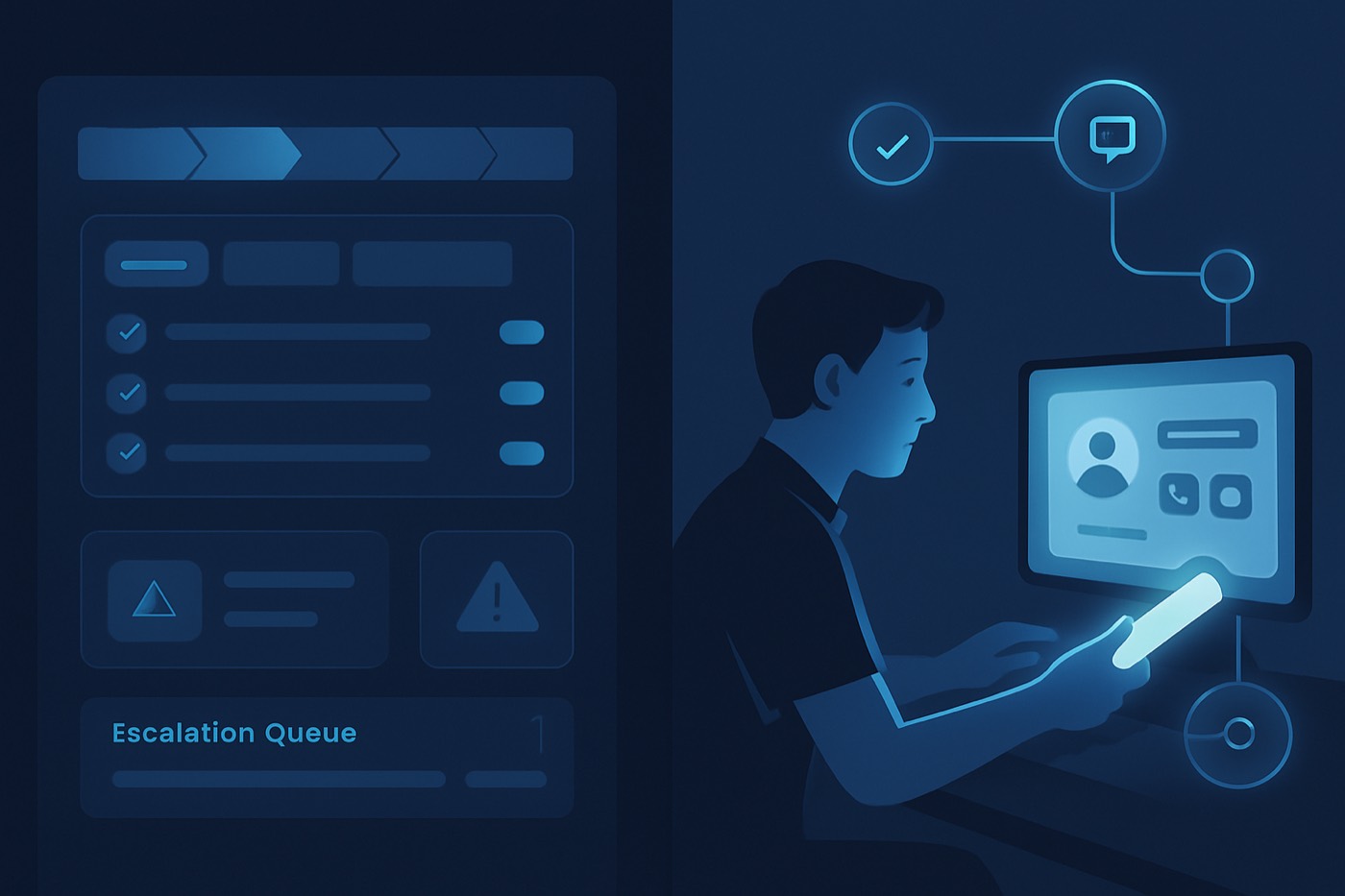
In 2026, the “AI SDR vs human SDR” debate is no longer about whether AI can write emails. It is about whether you can run a safe, measurable system where AI handles the high-volume, low-trust parts of the funnel and humans step in exactly when risk, nuance, or brand exposure spikes.
The teams winning right now are doing three things consistently:
- They treat AI SDR output like production work, not creative writing.
- They define handoff rules by funnel stage and risk level, not by job title.
- They run the whole motion through one governed operator: scoring, stages, approvals, and audit trails in a single place, not scattered across disconnected tools.
This shift is happening alongside clear signals from research and platform policy. Gartner has predicted that embedded generative AI will reduce the time sellers spend on prospecting and customer meeting preparation by more than 50% by 2026, which is exactly where SDR teams spend much of their week. (Gartner press release) Salesforce reporting has tied AI usage to a higher likelihood of revenue growth and shows AI adoption is now mainstream in sales orgs. (Salesforce State of Sales, 2024) At the same time, inbox providers are tightening enforcement against high-volume, low-quality sending, with Microsoft actively enforcing bulk sender requirements. That makes governance and QA non-negotiable for any AI-driven outbound motion. (Proofpoint on Microsoft enforcement, Feb 27 2026)
The short version (2026 operating model)
- AI SDR is the default for prospecting, list building, enrichment, first drafts, and low-risk follow-up.
- Human SDR is the default for objection handling, nuanced qualification, meeting orchestration for high-value accounts, and any compliance-sensitive outreach.
- The handoff must be a spec, not a vibe: confidence thresholds, disqualification reasons, escalation triggers, exclusions, tone and compliance QA, and audit trails.
- One governed operator runs the system: scoring, stages, routing rules, approvals, and a full audit log of every agent action.
The rest of this piece is the spec itself: definitions, the division of labor by funnel stage, a copy-and-run handoff template, a pre-send QA checklist, and a 14-day rollout.
The 2026 trend: AI SDR becomes default, governance becomes the differentiator
In 2024 and 2025, many teams judged AI SDRs on output quality: “Does it sound human?” In 2026 the bar is different: “Does it produce pipeline safely, repeatedly, and measurably without burning domain reputation or wasting AE time?”
Two external forces are pushing this change:
- Productivity pressure. Sales orgs are trying to do more with fewer heads. Gartner’s prediction of a 50%-plus reduction in prospecting and meeting-prep time is most relevant to SDR workflows, because that is where the time goes. (Gartner)
- Channel enforcement. Inboxes are penalizing indiscriminate volume. Microsoft is now enforcing bulk sender requirements in practice, not theory, and teams that fail authentication or generate complaints see filtering, junking, or rejections. (Proofpoint) Google and Yahoo bulk sender requirements also codified spam complaint thresholds and one-click unsubscribe expectations, which raises the cost of sloppy outreach. (Validity overview)
The implication: an AI SDR is not a tool you “add” to outbound. It is a system you operate, and the safest version of that system is one autonomous operator that owns discovery, sending, reply handling, and the audit trail end to end.
Definitions: AI SDR vs human SDR in 2026
What “AI SDR” means in 2026
An AI SDR is an agentic system that can:
- select and rank prospects,
- enrich records,
- generate tailored first-touch messaging,
- run follow-ups based on signals,
- triage and route replies,
- and escalate to a human based on confidence and risk rules.
This is different from “AI assist,” which just drafts copy inside a rep’s workflow. A true AI SDR owns the motion under guardrails; AI assist only speeds up a human who is still doing the motion.
What “human SDR” means in 2026
Human SDRs increasingly specialize in:
- navigating ambiguity,
- interpreting messy org charts and internal politics,
- handling objections and multi-threading,
- qualifying by business pain and urgency,
- and protecting the brand in high-visibility segments.
The best human SDRs are becoming deal-side orchestrators, not list grinders.
The new division of labor by funnel stage and risk level
Below is a practical, stage-by-stage model you can implement. The rule of thumb: AI does volume and consistency, humans do judgment and trust.
1) Prospecting (list building and account selection)
AI SDR should own:
- ICP matching and segmentation at scale
- account and contact discovery
- dedupe checks and field normalization
- technographic and firmographic enrichment
- prioritization and queue building
Human SDR should own:
- defining ICP hypotheses and exclusions
- validating early segments, especially when entering a new vertical
- account-level strategy for top tiers
How an autonomous operator runs this stage:
- It builds the matched list from your ICP definition, applying the same criteria every time so the list is consistent and explainable.
- It enriches each record before personalizing, so the agent is not guessing personalization tokens off thin data.
- It scores and ranks who gets first-touch and who gets nurtured, and it shows you why.
Practical benchmark: in 2026, average cold email reply rates are still low for most teams. One dataset puts the average reply rate around 3.1%, with top performers at 8 to 12%. That gap is usually targeting and data quality, not clever copy. (Cleanlist benchmarks, 2026)
2) First-touch (initial email and LinkedIn touch)
AI SDR should own:
- generating first drafts with structured personalization
- testing hooks and value props
- enforcing formatting and compliance templates
- sending at scale within deliverability guardrails
Human SDR should own:
- messaging strategy for each segment
- final approval for high-risk segments (regulated industries, exec outreach, strategic logos)
- voice, positioning, and competitive claims
Why: first-touch is repetitive, measurable, and template-friendly. It is also where your complaint rate is made or broken. Governance matters more than “sounding human.”
The operator should enforce, before anything goes out:
- approved templates by segment,
- required personalization fields,
- and a no-send rule when enrichment is missing.
If you want a practical token library for enrichment-driven first-touch, pair this with Chronic’s post on cold email personalization examples.
3) Qualification (is this worth a meeting?)
AI SDR should own:
- extracting qualification signals from replies (budget timing, current vendor, use case)
- classifying intent and routing to the right queue
- proposing next steps (calendar link, questions, “send a deck?”)
Human SDR should own:
- discovery when the signal is weak or contradictory
- gray-area qualification (political blockers, internal champions, evaluation committees)
- navigating procurement and legal constraints early
Risk-based rule:
- Low-risk, SMB, inbound-like replies: AI can qualify and schedule.
- High-risk enterprise or strategic: AI triages, a human runs the qualification.
4) Meeting setting (calendar coordination and prep)
AI SDR should own:
- proposing times
- confirming attendance
- sending an agenda, prep questions, and a concise “why us”
- attaching relevant collateral based on persona
Human SDR should own:
- securing meetings with executives or skeptical buyers
- re-framing when a prospect resists a meeting
- aligning AE, SDR, and specialist attendance
Gartner’s estimate that generative AI will cut prospecting and meeting-prep time by more than 50% by 2026 is most directly realized here: an agent can generate account briefs and agenda drafts instantly, but you still want human judgment when the stakes are high. (Gartner)
5) Routing (reply triage and ownership assignment)
AI SDR should own:
- reply categorization: positive, negative, objection, out-of-office, referral, unsubscribe
- entity extraction: competitor names, timelines, stakeholder names
- routing to the right owner: SDR, AE, AM, support, partner, or nurture
- SLA enforcement, for example a five-minute response target on hot replies
Human SDR should own:
- crafting sensitive responses (legal, security, pricing pushback)
- handling escalation calls (angry replies, reputation risk)
To operationalize this, use a strict reply taxonomy and routing rules. Chronic has a tactical playbook here: reply routing rules for outbound.
6) Follow-up (nurture, no-response, and post-meeting)
AI SDR should own:
- no-response follow-ups that are policy-compliant and varied
- light nurture based on signals (new hire, funding, product launch)
- post-meeting recap drafts and next-step nudges
Human SDR should own:
- objection-specific sequences where credibility and nuance matter
- multi-threading into adjacent stakeholders for enterprise deals
- re-engaging stalled late-stage deals, in coordination with the AE
Deliverability note: follow-up volume can push you into bulk sender classifications and complaint thresholds fast. This is where enforcement changes matter most. Microsoft is actively blocking or junking bulk mail that fails authentication or exceeds complaint thresholds. (Proofpoint) Google and Yahoo requirements emphasize authentication and low complaint rates, with strong guidance around one-click unsubscribe and complaint monitoring. (Validity) An autonomous operator that manages its own warmed mailboxes and throttling can keep volume inside these limits without a human watching the dials.
The handoff spec (copy this into your RevOps SOP)
If you want “AI SDR becomes default” without chaos, you need a written handoff spec. Below is a template you can run with any autonomous operator that supports scoring, stage-based ownership, and an audit log.
A. Disqualification reasons (standardize them)
Make the disqualification reason a required, controlled field. Minimum recommended list:
- Not ICP (industry, size, or geo mismatch)
- No relevant team or function
- No budget or no initiative
- Under contract until a stated date
- Using a competitor and happy
- Student, job seeker, or vendor solicitation
- Spam trap or invalid contact pattern
- Compliance exclusion (regulated segment, sensitive persona)
- Do-not-contact request
Rule: the agent can only mark a record “disqualified” if the reason is selected, the evidence snippet is stored (the quoted reply text or the enrichment attribute), and the record is tagged for audit sampling.
B. Confidence thresholds (what the agent is allowed to do)
Define confidence bands for key actions. Example thresholds you can deploy:
- Confidence below 0.70
- The agent can draft, enrich, and suggest a next action.
- The agent cannot send outbound without approval.
- The agent cannot book a meeting.
- 0.70 to 0.85
- The agent can send first-touch in low-risk segments.
- The agent can route replies to queues.
- The agent can ask one or two qualification questions.
- Above 0.85
- The agent can book meetings for SMB and mid-market.
- The agent can advance the lifecycle stage automatically.
- The agent can generate an AE briefing note and recommended agenda.
Tie “confidence” to your scoring so it reflects propensity signals, not just reply classification.
C. Escalation triggers (when humans must take over)
Escalation triggers should be explicit and measurable.
Intent and revenue triggers:
- any positive reply from a Tier 1 or Tier 2 account
- any mention of budget, timeline, or an active evaluation
- multi-stakeholder indicators (“looping in procurement,” “my VP,” “security review”)
Risk triggers:
- legal, compliance, or security language
- press, public sector, healthcare, financial services, or minors
- angry responses, threats of complaint, or brand-damaging replies
- unsubscribes not processed within SLA (should be near zero)
Deliverability triggers:
- a spam complaint spike above your threshold
- a bounce rate increase above baseline
- domain reputation warnings from your monitoring
D. Account-level exclusions (where the agent is restricted)
Maintain a dynamic exclusion list:
- current customers (prevent cross-fire)
- open opportunities (avoid conflicting messaging)
- past do-not-contact accounts
- named strategic accounts owned by AEs
- regulated segments that require human review
- competitor domains, partners, and press
This is where most teams fail: they exclude individual contacts but forget to exclude at the account level.
E. Tone and compliance QA (non-negotiable in 2026)
Apply a QA checklist before any agent sends at scale. Minimum checks:
Tone:
- no false familiarity (“Loved your post” with no evidence)
- no invented facts; claims must cite enrichment fields
- no pressure language that increases complaints
Compliance and policy:
- an unsubscribe mechanism where applicable
- respect for do-not-contact and suppression lists
- no sensitive personal data
- no deceptive subject lines
Deliverability hygiene:
- authenticated sending domains (SPF, DKIM, DMARC)
- a consistent From-name policy
- throttling rules and warm-up logic
Microsoft’s current enforcement makes this operationally urgent for any team that depends on Outlook deliverability. (Proofpoint)
For a deeper deliverability system design, see how to build a deliverability tracking system for outbound.
F. Audit trails (treat agent actions like financial controls)
Store these fields on every agent action, at minimum:
- model or agent version
- prompt template ID or workflow ID
- enrichment sources used, with timestamps
- confidence score at the time of the action
- approval status and approver, if one was required
- a content hash of the message, to prove what was sent
- the routing decision and its reason code
If you cannot reconstruct what the agent did, you cannot debug deliverability or prove compliance.
QA checklist: “ready to let the AI SDR send”
Use this as a weekly or pre-launch gate. It is intentionally strict, because inbox enforcement and brand risk are strict in 2026.
Data quality (pre-send):
- ICP fields are defined and enforced (industry, size, geo, role)
- Dedupe rules are active for accounts and contacts
- Required enrichment fields exist for each segment (at least three tokens)
- Suppression lists are synced (customers, open opps, do-not-contact)
- A random sample of 50 records shows accurate titles and companies
If your enrichment is inconsistent, your AI personalization becomes confident nonsense. Pair this with the data hygiene checklist for outbound teams.
Messaging (pre-send):
- Approved value props exist per segment
- At least three tested hooks exist per segment, not one master sequence
- Claims require evidence fields; no fabricated metrics
- No fake-personalization phrases without supporting data
Deliverability (pre-send):
- SPF, DKIM, and DMARC are configured and aligned
- One-click unsubscribe is present where required
- Complaint-rate monitoring is in place
- Sending volumes and ramp schedules are documented
- Microsoft, Google, and Yahoo deliverability requirements are reflected in policy
Workflow:
- Scoring thresholds map to allowed agent actions
- Stages define ownership: AI vs SDR vs AE
- Escalation triggers are configured
- Audit-log fields are stored and accessible
- Stop rules exist for when the agent must pause
For teams deploying autonomous behavior, you will also want a guardrail SOP. Chronic has a practical version here: autonomous SDR agent SOP: guardrails, approvals, and stop rules.
Operating model: how to run AI SDR and human SDR as one team
The core idea: one queue, multiple executors
Instead of an “AI SDR team” versus a “human SDR team,” run one unified outbound queue with executor assignment based on risk and confidence. This avoids duplicated outreach and an inconsistent buyer experience.
Recommended roles (lean, 2026-friendly)
- RevOps owns the system: fields, routing, exclusions, QA gates.
- The SDR manager owns the playbooks: talk tracks, objections, escalation norms.
- Human SDRs own the high-trust moments: qualification, objection handling, exec outreach.
- The autonomous operator owns throughput: enrichment, drafts, low-risk sends, triage, and follow-up, all under the guardrails above.
The agent’s permissions should be governed by:
- scoring, for prioritization and what actions it is allowed to take,
- stage-based ownership, for handoffs, SLA tracking, and “who owns this now” clarity,
- and controlled generation, using approved templates and tokens, so the message it sends is always one you would have approved.
Stage-based routing (example)
Define stages like:
- Target identified (AI-owned)
- Enriched and scored (AI-owned)
- First-touch sent (AI-owned, behind a QA gate)
- Reply received (AI routes)
- Human qualification (human-owned for Tier 1 and Tier 2)
- Meeting scheduled (AI or human, by segment)
- Handoff to AE (human-owned, agent assists with the brief)
What this means for tooling: one governed operator, not a pile of disconnected tools
In 2026, the biggest tooling mistake is letting AI run across a scatter of disconnected tools: a list builder here, a sender there, a separate reply inbox, and a CRM that finds out last. That is how you lose:
- auditability,
- suppression integrity,
- consistent stage definitions,
- and the feedback loop that improves scoring and messaging.
The alternative is a single autonomous operator that owns the whole motion: it finds and enriches the leads, writes and sends from warmed mailboxes it manages, handles replies, books the meetings, and logs every action, surfacing approvals only for the decisions that matter. That is the difference between “we tried an AI SDR” and “the AI SDR is now our default motion.” Governed execution, not a faster spray-and-pray.
If you are comparing stacks, this is where an autonomous operator diverges from legacy CRMs and prospecting tools. With a governed operator, you care less about raw database size and more about field standards, routing controls, approval gates, and a complete audit trail. If you are evaluating alternatives, use these as starting points for requirements mapping:
FAQ
What is the biggest difference between an AI SDR and a human SDR in 2026?
AI SDRs are best at high-volume, structured work: enrichment, ranking, first drafts, follow-ups, and reply triage. Human SDRs are best at high-trust work: nuanced qualification, objection handling, exec outreach, and anything that could create compliance or brand risk. Gartner’s expectation of large time reductions in prospecting and meeting prep is consistent with this division of labor. (Gartner)
Can AI SDRs fully replace human SDRs in B2B SaaS?
For low-ACV, low-risk segments, AI can handle most top-of-funnel motions. For mid-market and enterprise, full replacement is rarely the best model, because qualification and meeting orchestration depend on judgment, credibility, and stakeholder navigation. The more complex the buying committee, the more valuable human SDR time becomes.
What handoff rules should we implement first?
Start with three:
- Account-tier escalation: any positive reply from a Tier 1 account routes to a human within minutes.
- Disqualification taxonomy: the agent cannot disqualify a record without a reason code plus evidence.
- Confidence-based permissions: below a threshold the agent drafts only; above it the agent can send or book depending on the segment.
How do we stop AI SDR outreach from hurting deliverability?
Treat deliverability as a QA gate, not a metric you check later. Microsoft is actively enforcing bulk sender requirements, and failures can lead to junking or rejection. (Proofpoint) Require authentication, complaint monitoring, unsubscribe compliance, suppression lists, and throttling before you let the agent send at scale. An operator that manages its own warmed mailboxes and ramps volume on its own keeps this safe by default.
What metrics should we track to evaluate AI SDR vs human SDR performance fairly?
Track end-to-end funnel metrics, not just reply rate:
- data quality: bounce rate, enrichment completeness
- deliverability: complaint rate, inbox placement proxies
- efficiency: time-to-first-touch, time-to-first-response
- conversion: positive reply rate, meeting-booked rate, meeting-held rate
- quality: SQL rate, opportunity-creation rate, pipeline per 1,000 sends
Also track handoff accuracy: how often the agent’s escalations were correct versus noise.
Where should the AI SDR live: in a prospecting tool or in one governed operator?
In one governed operator, if you want control. A single system that owns discovery, sending, reply handling, and the audit log is where you can actually enforce exclusions, routing, stage definitions, and approvals. When AI runs across disconnected tools, teams lose suppression integrity and create duplicate or conflicting outreach.
Put this into production: a 14-day rollout you can run
- Days 1 to 2: define your ICP and exclusions. Document Tier 1 to 3 accounts, regulated exclusions, and customer and open-opp suppression.
- Days 3 to 5: standardize fields and disqualification reasons. Add required reason codes and evidence capture.
- Days 6 to 7: build the scoring-to-permissions mapping. Use scoring to decide what the agent can do at each confidence band.
- Days 8 to 10: create segment playbooks and QA gates. Approved templates, token requirements, tone rules, and compliance checks.
- Days 11 to 12: implement routing and SLAs. Positive-reply routing, escalation triggers, and response-time targets.
- Days 13 to 14: launch with audit sampling. Review a random sample of agent sends and disqualifications weekly until it is stable.
Run this operating model and “AI SDR vs human SDR” stops being a philosophical debate. It becomes an engineered system: AI handles throughput, humans handle trust, and one governed operator, with scoring and stage-based ownership, keeps the whole machine safe and compounding.