Context engineering for sales: the 21-item checklist before you let an agent run outbound
Context engineering for sales is designing the data, events, signals, and governance rules an autonomous operator needs to decide who to contact, why now, and what to say. You do not need perfect data, just minimum viable context with source-of-truth rules.
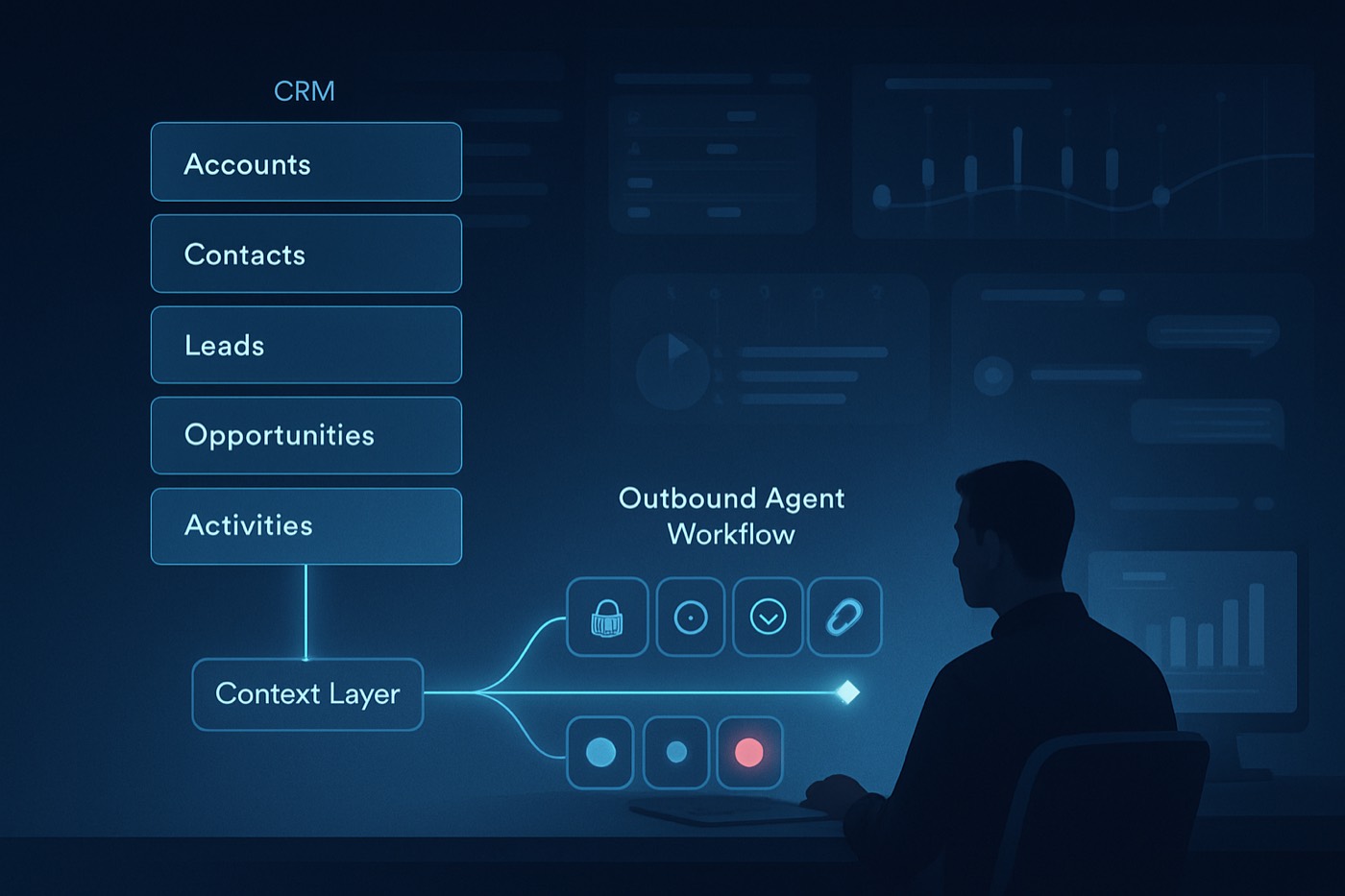
If you point an autonomous sales agent at outbound without doing the context work first, you get the usual circus: fake personalization, bad targeting, risky sends, and a pipeline full of “we should not have emailed that person.”
Context engineering for sales is the fix. It is the work of giving an operator a usable memory instead of a junk drawer, so the decisions it makes on your behalf are ones you would have made yourself.
Chronic is an autonomous revenue operator: you hand it a revenue goal and it runs discovery, enrichment, outreach, reply handling, and meeting booking, surfacing approvals only for the decisions that matter. None of that works on guesswork. It works on context. This checklist is how you get the context right.
What “context engineering for sales” actually means (no fluff)
Context engineering for sales is the operational discipline of making the data an operator reads:
- Complete enough to drive outbound decisions
- Fresh enough to reflect reality
- Structured enough to use without guessing
- Governed enough to prevent dumb, expensive mistakes
You are not “adding more fields.” You are creating decision-grade context: the facts, events, and rules that let an agent reason about who to contact, why now, and what is true.
Why this matters now:
- Gartner predicts that by 2028, AI agents will outnumber sellers by 10x, yet fewer than 40% of sellers will report that agents improved their productivity. Translation: most teams will feed agents garbage and blame the agent. (Gartner, Nov 18, 2025)
- Salesforce’s State of Sales 2026 calls out data quality as a direct drag on teams that have put agents to work. (Salesforce State of Sales 2026)
- Bad data is not a rounding error. Gartner estimated the average cost of poor data quality at $12.9M per year. That was 2020, and it did not get cheaper. (Gartner: data quality)
Context engineering is how you avoid pointing an autonomous spam cannon at your market.
The model: objects, events, signals, governance
An operator needs four layers of context:
- Objects: accounts, contacts, leads, opportunities (your core nouns)
- Events: what happened (site visits, email engagement, job changes, meetings, product usage)
- Signals: what it implies (intent, fit, technographics evidence, buying-committee movement)
- Governance: what is true, what is allowed, and what gets logged
Most data systems have layer 1. Some have layer 2. Almost nobody operationalizes layer 4. Then everyone wonders why AI outbound feels like a prank.
If you want the deeper view on permissions, approvals, and audit trails, this ties directly into how you govern an agent. Internal reference: agent governance in sales.
The 21-item checklist before an agent touches outbound
Objects: make the core records decision-grade (9 items)
1) Account: ICP fit (structured, not vibes)
Requirement: a single ICP fit score (A-D or 0-100) plus the drivers.
- Industry
- Employee range
- Geography
- Funding stage (if relevant)
- Core use case match
Rule: fit is not free text. An agent cannot rank free text.
If you want this automated, this is exactly what an ICP builder and scoring pipeline should output.
2) Account: firmographic freshness
Requirement: a “last verified” timestamp for key firmographics.
- employee_count_last_verified_at
- industry_last_verified_at
Rule: if older than 180 days, treat it as stale context, not truth.
3) Account: buying stage (simple, enforced)
Requirement: a controlled picklist.
- Not a fit
- Fit, no intent
- Fit, light intent
- Fit, active intent
- In pipeline
- Customer
Rule: the agent does not invent stages.
4) Account: source-of-truth domain and website
Requirement: one canonical website domain per account.
- canonical_domain
- domain_confidence (0-1)
- domain_source
Why: domain mismatch causes duplicates and bad enrichment merges. It also breaks event attribution.
5) Contact: role clarity, seniority, function
Requirement: structured fields:
- function (IT, RevOps, marketing ops, sales, finance)
- seniority (IC, manager, director, VP, C-level)
- department
- persona_tag (economic buyer, champion, user, blocker)
Rule: if seniority is unknown, the agent defaults to lower-risk sequences.
6) Contact: permissionable channels (email, phone, LinkedIn)
Requirement: channel fields with verification status:
- email_status (verified, risky, unknown)
- phone
- phone_status
- linkedin_url
Rule: the agent does not send to “unknown” without an explicit policy exception.
Deliverability is not optional in 2026. If you need current baselines, internal reference: cold email deliverability in 2026.
7) Lead: lead vs contact policy (pick one reality)
Requirement: a documented rule for what a lead means in your org. Examples:
- Lead = unqualified person, not yet associated with an account
- Contact = qualified or account-linked person
Rule: the agent does not create both a lead and a contact for the same human.
8) Opportunity: the “why now” fields (mandatory for follow-ups)
Requirement: if an opp exists, it must store:
- primary_pain (picklist)
- trigger_event (picklist)
- next_step (text)
- next_step_due_at (date)
Rule: the agent never follows up without a real next_step_due_at.
9) Opportunity: stage hygiene that maps to outbound actions
Requirement: stages map to allowed plays. Example:
- Discovery scheduled: agent can send a prep email plus stakeholder mapping
- Proposal sent: agent can send a legal and security pack, not “want a demo?”
Rule: no stage, no action.
Events: stop guessing, start logging (6 items)
10) Web events: page-level intent, not vanity traffic
Requirement: track at least:
- pricing page view
- integrations page view
- security or compliance page view
- product docs view (if applicable)
Minimum fields:
- event_type
- event_time (UTC)
- source (analytics tool)
- matched_account_id (with confidence)
Rule: events without a time are gossip.
11) Email engagement: capture engagement safely
Requirement: track:
- delivered (hard or soft bounce)
- reply (positive, neutral, negative)
- meeting booked
- unsubscribe
Rule: opens and clicks are optional now. Privacy changes made them unreliable. Replies and meetings are reality.
If you want reply rate benchmarks for 2026 so you stop celebrating noise, internal reference: what a “good” reply rate looks like in 2026.
12) Meeting events: the meeting is a first-class object
Requirement: log:
- scheduled_at
- held_at
- no_show (boolean)
- attendees (linked contacts)
- meeting_outcome (picklist)
Rule: the agent optimizes for held meetings, not calendar invites.
13) Job change events: title and company changes with timestamps
Requirement: store:
- previous_company
- new_company
- change_detected_at
- source
Play: “congrats on the move” outreach is only valid inside a tight window (7-21 days). Past that it becomes cringe.
14) Product usage events (if PLG or trial)
Requirement: minimum:
- signup
- activated (your definition)
- feature_used (top 3 features)
- usage_last_7_days
Rule: the agent does not pitch onboarding to power users.
15) Activity events: tasks, calls, notes
Requirement: log enough to prevent duplicate touches:
- last_outbound_touch_at
- last_inbound_touch_at
- touch_count_30d
Rule: the agent does not email someone your AE spoke to two hours ago.
Signals: turn events into decisions (4 items)
16) Intent scoring: dual fit and intent, not one magic number
Requirement: two independent scores:
- fit_score
- intent_score
Rule: intent without fit is wasted sends. Fit without intent is nurture, not an outbound blitz.
This is the practical reason to use AI lead scoring that separates fit and intent inputs.
For a concrete model, internal reference: fit vs intent scoring, a 7-day model.
17) Technographics evidence: store “what,” “where you saw it,” and “when”
Requirement: for each key technology:
- tech_name (for example HubSpot, Salesforce, Segment)
- evidence_type (script tag, job post, builtwith, partner list)
- evidence_url
- observed_at
- confidence
Rule: the agent cannot claim a tech stack without evidence. That is how you avoid sending “saw you use Salesforce” to a company that does not.
18) Trigger signals: define your “go now” list
Requirement: a controlled trigger taxonomy. Examples:
- Hiring spike in RevOps
- New VP of sales
- Funding announcement
- Security or compliance page visit
- Competitor migration signal (careful)
Rule: every trigger must map to a specific outbound angle and sequence.
19) Buying-committee map: count stakeholders, track gaps
Requirement: per account, store:
- known_stakeholders_count
- missing_roles (array or picklist: economic buyer, security, RevOps, champion)
Rule: the agent should stop hammering one contact when the committee is missing.
For the macro trend, Forrester’s 2025 B2B predictions highlight more digital self-serve buying. Your outbound has to show relevance, fast. (Forrester predictions)
Governance: the part everyone skips, then regrets (2 items, but they are heavy)
20) Source-of-truth rules (per field), plus audit trail
Requirement: for every critical field, define:
- authoritative_source (CRM user, enrichment vendor, product telemetry, website analytics)
- overwrite_policy (never, newest_wins, highest_confidence_wins)
- change_log (who or what changed it, when)
Rule: the agent can write data only if you can trace it.
If you want the operational blueprint, this aligns with agent governance in sales.
21) Dedupe, timestamping, and confidence scores (mandatory trio)
Requirement:
- dedupe keys (domain, linkedin_url, email)
- updated_at and observed_at (keep them separate)
- confidence_score per enriched attribute
Rule: if confidence is below threshold, the agent can use the field for internal ranking, not for an outward claim.
Reality check: B2B data decays fast. “Nearly 30% of records become inaccurate over a year” is a commonly cited ballpark. (Lead411 on B2B data decay, 2026) Treat anything old as suspect until it is re-verified.
Minimum viable context for teams with messy data
You do not need a pristine enterprise data warehouse. You need enough context to not embarrass yourself.
Here is the minimum viable context (MVC) bundle. If you only do this, you can still let an operator run safely.
MVC: the 8 fields that stop 80% of outbound disasters
- canonical_domain (account)
- industry + employee_range (account)
- fit_tier (A-D) (account)
- contact_role_function + seniority (contact)
- email + email_status (contact)
- last_outbound_touch_at (contact or account rollup)
- intent_score (0-100) (account)
- source_of_truth + last_verified_at (for email and domain at minimum)
MVC: the 3 events to start with
- Pricing, integrations, or security page visits (rolled up to account)
- Replies (positive, neutral, negative)
- Meetings held
That is it. Everything else comes later.
If you want to build this without stitching five tools together, Chronic does it as one operator:
End to end, until the meeting is booked.
How to operationalize the checklist (a simple rollout plan)
Step 1: pick one outbound motion
Choose one:
- New-logo outbound
- Expansion outbound
- Win-back outbound
Do not boil the ocean. An operator needs a lane.
Step 2: define your decision policy (in writing)
An agent needs explicit rules:
- If fit A/B and intent > 70, run sequence A
- If fit A/B and intent 40-70, run sequence B
- If fit C/D, suppress or nurture
- If email_status is not verified, suppress
Step 3: set your confidence thresholds
Example thresholds:
- Tech stack claim: confidence >= 0.8
- Persona match: confidence >= 0.6
- Account match from a web event: confidence >= 0.7
Below threshold, the agent can still rank, it cannot say it.
Step 4: run a 7-day context burn-in
For 7 days:
- The agent drafts, humans approve
- Track: false personalization rate, wrong-person rate, duplicate-touch rate
- Fix the data rules, not the prompts
This is where most teams discover their data is lying to them.
Fake personalization dies when context gets specific
Bad personalization sounds like:
- “Love what you’re doing at [Company].”
- “Saw you’re using [Tool]” (you didn’t)
- “Congrats on the recent funding” (from 18 months ago)
Context engineering replaces that with:
- Timing: “Your team hit the pricing page twice this week.”
- Relevance: “Hiring 3 RevOps roles in the last 30 days.”
- Accuracy: “Your job post mentions Salesforce CPQ.”
Even when the copy stays short, the reason is real.
Risk controls: fewer risky sends, fewer compliance headaches
An operator should never be able to:
- Email suppressed industries without approval
- Email contacts without a verified email status
- Email accounts whose active opp stage prohibits outbound
- Exceed frequency caps (per contact and per domain)
Because when an agent scales, mistakes scale too. Gartner’s data-quality cost estimate is already ugly. (Gartner: data quality) Now imagine that cost with autonomous action attached.
The economic point still favors getting this right: Litmus cites an average return of $36 for every $1 spent on email marketing. (Litmus ROI) Cold outbound is a different motion than marketing email, but the lesson holds. Sending is cheap, so the quality of what you send is what decides the outcome.
Where Chronic fits
Most tools own one slice and leave you to wire the rest:
- Clay is powerful, and it is a spreadsheet with a pilot’s license. Strong for ops-heavy teams, easy to misconfigure.
- Instantly sends emails. It does not run your process end to end.
- Salesforce can do nearly anything, including consuming your budget at a high per-seat price while still requiring four other tools around it.
Chronic is not another tool to operate. It is the operator. You set the goal, the offer, and the approval level; it does discovery, enrichment, scoring, deliverability, sending from managed warmed mailboxes, reply handling, and booking, end to end until the meeting is on the calendar.
If you are sizing it up against what you run today:
One line of truth: tools do not fix context. Operators do.
FAQ
What is context engineering for sales?
Context engineering for sales is the practice of structuring objects, events, signals, and governance rules so an autonomous operator can make correct outbound decisions. It focuses on freshness, evidence, timestamps, confidence scores, and source-of-truth policies, not “more fields.”
How is context engineering different from prompt engineering?
Prompt engineering changes how an agent writes. Context engineering changes what the agent knows and what it is allowed to do. Prompts without context produce confident nonsense at scale.
What is the minimum viable context to start outbound with an agent?
At minimum: canonical domain, basic firmographics, fit tier, contact function and seniority, verified email status, last outbound touch timestamp, an intent score, and source-of-truth plus last-verified timestamps. Add pricing, integrations, and security page visits, replies, and meetings held as your first events.
How do confidence scores work?
A confidence score is a numeric estimate (often 0 to 1) of how likely a field value is correct, based on evidence and source reliability. Use it to control what an agent can claim externally versus what it can only use internally for ranking.
How often should we refresh context for outbound?
Refresh cycles depend on your market, but treat core contactability and role data as perishable. A common rule: re-verify key fields every 90-180 days, and always require timestamps so the agent can discount stale context. B2B data decay is real and widely acknowledged. (Lead411 on B2B data decay)
What is the fastest way to reduce fake personalization?
Force evidence and recency:
- No tech stack mention without an evidence URL and an observed_at timestamp
- No job-change outreach past a defined window
- No “trigger” without a logged event Then suppress anything below your confidence threshold.
Run the checklist, then let the operator book meetings
Do context engineering for sales right and the agent stops being a copy generator. It becomes an operator you can step back from.
You get:
- Better prioritization: fit plus intent beats spray and pray
- Less fake personalization: evidence-only claims, timestamped
- Fewer risky sends: channel permissions, suppression rules, audit trail
- More meetings booked: outbound runs on signals, not guesses
Print this checklist. Audit your data this week. Fix the top five gaps. Then let the operator run, with guardrails.
End to end, until the meeting is booked.