Lead scoring with bad data: 12 data confidence signals to check before an agent acts on a score
A data confidence score (0-100) measures how trustworthy the inputs behind a lead score are. Compute it from 12 signals, then gate the agent: send on high confidence, enrich or escalate on medium, quarantine on low.
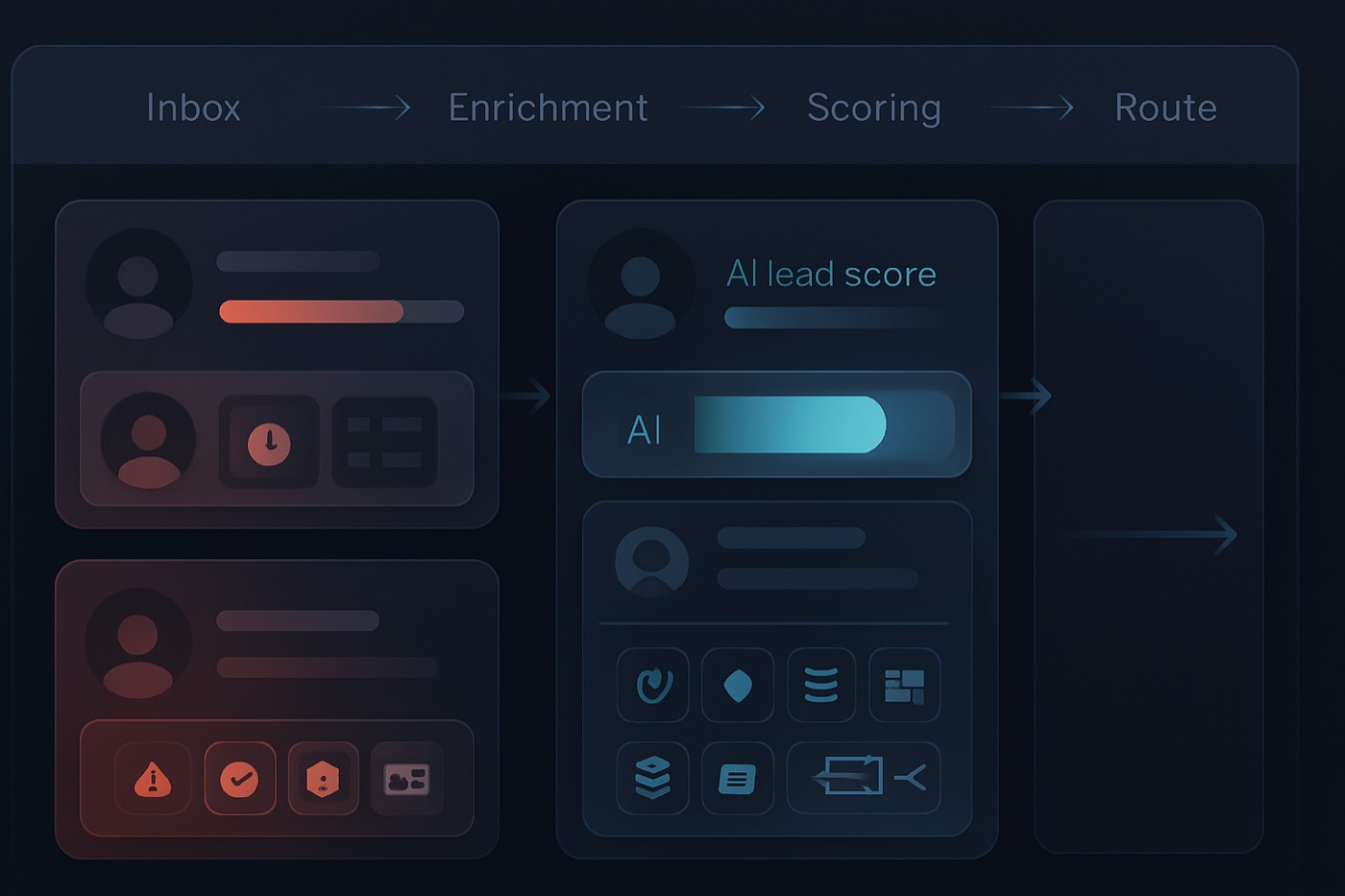
Bad lead data does not just lower AI lead scoring accuracy, it amplifies the wrong action. The wrong lead gets contacted, the wrong sequence launches, the next ten touches chase a ghost, and a dead address quietly dents your sending reputation. When a person is doing the sending, that damage is slow. When an autonomous agent is sending, scoring, and booking on your behalf, a bad score executes at machine speed. Gartner estimates poor data quality costs organizations $12.9 million per year on average, which is why a confidence layer in front of any automated action is no longer optional. Gartner data quality overview
TL;DR
- Build a data confidence score for lead scoring before an agent acts on any AI score.
- Compute 12 confidence signals (freshness, source reliability, match quality, validity, certainty, conflicts, and more).
- Use confidence to decide what the agent does on its own versus what it surfaces for approval: send vs hold, throttle vs scale, and block pipeline pollution before it forecasts.
What a "data confidence score for lead scoring" actually is (and why an agent needs one)
A data confidence score for lead scoring is a numeric measure (often 0-100) of how trustworthy the inputs are that your lead score depends on.
Think of it as two separate questions:
- Lead score answers "How likely is this lead to buy?"
- Data confidence score answers "How much should we trust the data used to answer that?"
With a lead score alone, a system cannot tell apart:
- a high-intent buyer with verified data, from
- a high-intent signal attached to the wrong contact, wrong company, or a dead mailbox.
A human rep catches that mismatch by instinct. An autonomous operator cannot, unless you give it the second number. Confidence is what lets an agent decide for itself when it is safe to send, route, or book, and when it should stop and ask.
This matters because B2B contact data decays fast. Industry sources commonly cite annual decay in the 20-30% range, meaning a meaningful slice of your records goes stale every year. Cleanlist, for example, cites ~22.5% B2B data decay per year. Cleanlist B2B data decay stats
The stack: confidence first, then the score, then the action
For scoring you can safely automate, structure it as a gate the agent passes through before it does anything:
- Data confidence score (0-100): do we trust the inputs?
- AI lead score (0-100): given trustworthy inputs, how good is the fit and intent?
- Action policy: what is the agent allowed to do at this confidence and score, and what does it escalate?
Run scoring without the confidence layer and you get what RevOps teams call "pipeline pollution": junk records that look healthy on a dashboard and quietly destroy conversion downstream. With an autonomous agent, that pollution does not just sit in a report. It gets emailed.
For a reference architecture covering signals, queues, SLAs, and stop rules, see How to build a right-time outbound engine.
12 data confidence signals to check before an agent acts on a score
Below are 12 practical signals an operator can compute, how to score each one, and how it should change the agent's behavior.
1) Field freshness (per-field TTL, not per-record)
What it measures: How recently each critical field was verified or updated.
Why it matters: "Last modified date" is a trap. A note edit should not "refresh" an email address or a job title. Freshness has to be tracked per field, or the whole record reads as fresher than it is.
How to compute (example):
- Assign a TTL (time-to-live) per field:
- Email: 30-90 days depending on source quality
- Title and role: 60-120 days
- Headcount and industry: 90-180 days
- Tech stack: 30-120 days (changes often)
- Score each field 0-1 by age against its TTL, then weight.
Agent rule:
- If
freshness_score < 0.6, hold the send. Re-enrich and re-verify before the agent enrolls the lead in any outreach.
Related: Lead enrichment
2) Source reliability (where the data came from, and how)
What it measures: Trust level of the originating source and collection method.
Why it matters: Not all inputs are equal. A self-reported form is not a scraped list, and a first-party signup is not a guessed-pattern email. The agent should weight them differently before it commits to an action.
How to compute (example): Assign base trust by source type:
- First-party form or inbound request: 0.9-1.0
- Verified enrichment provider match: 0.7-0.9
- Scraped or unknown provenance: 0.2-0.5
Then adjust:
- If the source is older than its TTL, multiply by the freshness factor.
- If the source has a history of conflicts (see signal 12), downgrade it.
Agent rule:
- Low source reliability caps the agent at draft-and-suggest. It can prepare an email and a next step, but a human approves before anything sends, instead of the agent running the sequence unattended.
Related: AI lead scoring
3) Contact-to-account match quality (entity resolution confidence)
What it measures: Probability that the contact belongs to the correct company record.
Why it matters: A mis-mapped contact poisons everything downstream: ICP fit, routing, personalization tokens, and attribution. An agent personalizing off the wrong company writes a confident, wrong email.
How to compute (example): Score from several checks:
- Email domain matches the account domain (+)
- Known subsidiary or parent mapping (+)
- Free email domain such as gmail.com (-)
- LinkedIn company conflicts with the account record (-)
- Multiple accounts share one domain (-)
Agent rule:
- If
match_quality < 0.7, route to a data review queue with the conflict attached, before any outreach.
4) Email validity and bounce risk (verification tier, not just "looks valid")
What it measures: Likelihood the mailbox exists and can receive mail.
Why it matters: Outbound is constrained by deliverability. A great message on a bad list still tanks domain reputation, and an autonomous sender amplifies that risk because it sends at volume without a human eyeballing each address. Google and Yahoo bulk sender requirements (enforced from 2024) raised the operational cost of sloppy sending. Validity frames the stakes around complaint-rate thresholds such as keeping complaints below 0.3%. Validity 2025 Email Deliverability Benchmark Report
How to compute (example): Use a tiered verification result:
- Verified deliverable: 1.0
- Risky or unknown: 0.4-0.7
- Invalid, disposable, or role inbox: 0.0-0.3
Then add recency decay: verification older than 30 days reduces the score.
Agent rule:
- If
email_validity < 0.8, the agent does not enroll the lead in volume sequences. It runs a verify-first step or switches to another channel.
Related: The engagement-quality deliverability playbook (2026)
5) Role certainty (title parsing and seniority confidence)
What it measures: Confidence that the contact's role matches your buying-committee assumptions.
Why it matters: "Head of Growth" can mean budget owner, influencer, or a startup generalist. A score that assumes title equals buying power over-scores noise, and the agent then over-prioritizes it.
How to compute (example):
- Parse the title into a standardized role and seniority.
- Add confidence from:
- title clarity ("VP Finance" high, "Team Lead" medium, "Ninja" low)
- company size (a VP at a 20-person startup is not a VP at a 2,000-person org)
- department match to your ICP
Agent rule:
- If
role_certainty < 0.6, surface the lead for persona confirmation before the agent treats it as a buying contact.
Related: ICP builder
6) Geo certainty (location accuracy for compliance and timing)
What it measures: Confidence in country, region, and time zone for the account and the contact.
Why it matters: Wrong geo breaks territory assignment, sending and calling hours, regional messaging, and compliance. An agent that schedules sends by time zone needs to actually know the time zone.
How to compute (example):
- Compare contact location, company HQ, first-party IP geo, and phone country code.
- Penalize conflicts, missing fields, and "remote/anywhere" ambiguity.
Agent rule:
- If geo certainty is low, the agent does not auto-assign territory or auto-schedule by local time. It holds for a routing review.
7) Technographic confidence (how sure are you about their stack)
What it measures: Probability that detected technologies are actually in use and still current.
Why it matters: Technographics drive segmentation and personalization, but they are noisy because of cached scripts, legacy tags, agency tools, and subdomains that do not represent the core product. A wrong tech claim in a cold email reads as a lie.
How to compute (example):
- Confidence rises when multiple sources agree, the tech appears on multiple pages, and detection is recent.
- Confidence falls when it only appears on a blog page, was detected once long ago, or conflicts with other sources.
Agent rule:
- Low technographic confidence is allowed only as soft personalization, never as a hard qualifier the agent uses to decide who to sequence.
Related: Lead enrichment
8) Website domain quality (is this a real business you should trust?)
What it measures: Whether the company domain is credible, reachable, and aligned with the account.
Why it matters: Garbage domains create garbage accounts. Typos, personal sites, parked domains, and contractor sites all sneak in and the agent will happily build a record on them.
How to compute (example):
- Valid DNS and MX records
- Normal HTTP response (200/301, not endless redirects)
- Domain age above a minimum threshold (optional)
- Clear company branding rather than a generic template
Agent rule:
- If domain quality is low, block automatic account creation and require manual verification.
9) Duplicate risk (probability this record already exists)
What it measures: Likelihood that this lead, contact, or account is already in your system.
Why it matters: Duplicates inflate pipeline, break attribution, and produce the worst kind of mistake an autonomous sender can make: messaging the same person twice from two records.
How to compute (example):
- Fuzzy match on email, domain, normalized company name, phone, and LinkedIn URL.
- Assign a duplicate probability (0-1).
Agent rule:
- If duplicate risk is high, the agent pauses and routes for merge or review before any outreach.
For how modern methods improve entity matching, see this arXiv paper on duplicate detection with generative methods. Duplicate detection with GenAI (arXiv)
10) Suppression history (do-not-contact, prior complaints, prior bounces)
What it measures: Whether you already have a reason not to message this lead.
Why it matters: An autonomous sender that ignores suppression history will automate its way into reputation and compliance damage. This is the single most important signal to enforce as a hard block, not a soft penalty.
How to compute (example): Binary flags with heavy penalties:
- Unsubscribed
- Marked as a spam complaint (where available)
- Hard bounced in the last 180 days
- Legal suppression list match
Agent rule:
- If suppressed, the lead score can still exist for reporting, but outreach is blocked by policy. No score is allowed to override this.
11) Engagement recency and event integrity (do you trust the behavioral signals?)
What it measures: Whether engagement events are recent and attributable to the right person and account.
Why it matters: "High intent" is often "high noise" when anonymous traffic is mis-attributed, reverse-IP mapping is wrong, or one person's activity is pinned to a shared account. An agent that auto-creates opportunities off inferred intent inflates the forecast.
How to compute (example):
- Apply recency decay to events (visits, replies, form fills).
- Boost confidence when identity is confirmed (a form fill or an authenticated product event).
- Penalize identity that is only inferred (IP or cookie match without an email).
Agent rule:
- If engagement is inferred rather than confirmed, the agent treats it as a prioritization hint, not a trigger to create an opportunity.
Related: Revenue context metrics: the 2026 event model for agents
12) Enrichment conflict count (how many fields disagree across sources)
What it measures: Number and severity of contradictions in enriched data.
Why it matters: Conflicts are the hidden killer of scoring. If one source says "200-500 employees" and another says "1-10," ICP fit swings wildly, and the agent picks one at random with full confidence.
How to compute (example):
- For each key attribute (industry, headcount, HQ country, title, department), count exact conflicts, range conflicts, and null-versus-populated mismatches.
- Weight conflicts by importance.
Agent rule:
- A high conflict count triggers a "refresh and reconcile" step before the record becomes eligible for any automated action.
Related: Sales data enrichment: 9 freshness rules that prevent bad scoring and misrouted leads
A practical model: combining the 12 signals into one confidence number
You want a model that is:
- simple enough to explain
- strict enough to protect an autonomous sender
- flexible enough to vary per segment
Example weighted formula (0-100)
Weight each signal by the downstream damage it prevents:
- Email validity: 15
- Suppression history: 15
- Contact-to-account match: 12
- Freshness: 10
- Duplicate risk: 10
- Role certainty: 8
- Source reliability: 8
- Engagement integrity: 7
- Geo certainty: 5
- Technographic confidence: 5
- Domain quality: 3
- Enrichment conflict count: 2
Then:
- Normalize each signal to 0-1.
- Multiply by its weight.
- Sum to get a 0-100 confidence score.
Confidence tiers mapped to agent autonomy
- 80-100: runs unattended. The agent can enroll, send, personalize, and book on its own. It still logs what it did.
- 60-79: assist. Enrich and verify first, run lower volume, and surface key steps for a quick approval.
- 40-59: human review. Confirm identity, merge duplicates, and reconcile conflicts before the agent touches the lead.
- 0-39: quarantine. No sending, no opportunity creation. The data gets fixed first.
How to use confidence to route, throttle, and prevent pipeline pollution
Route to review versus let the agent run
Build queues around the reason confidence failed, not just a low number. A reason code lets the agent hand off a precise problem instead of a vague one:
- Match QA queue: low contact-to-account match
- Deliverability QA queue: email validity issues or recent bounces
- Dupes queue: high duplicate risk
- Persona QA queue: low role certainty
- Geo QA queue: low geo certainty for routing
This is where an autonomous operator earns its keep. It attaches the reason code and the recommended fix, so a human reviews "email unverified, last bounce 12 days ago" rather than a bare "confidence = 52."
Related: Sales pipeline
Throttle send volume by confidence
A simple throttle table the agent enforces automatically:
- Confidence 80-100: 100% of normal send volume
- Confidence 60-79: 50% volume, verification step first
- Confidence 40-59: 10-20% volume, manual 1:1 sends only
- Confidence below 40: 0% volume
This protects domain and mailbox reputation and keeps your sequence analytics meaningful, because you are not measuring sends into dead inboxes.
For message quality on the sends that do go out, pair this with 7 'personalization theater' patterns to stop using.
Prevent pipeline pollution (when to block opportunity creation)
Let low-confidence leads become opportunities and you inflate pipeline and sabotage the forecast. Have the agent block "create opportunity" unless:
confidence >= 70, and- either inbound intent is confirmed or an outbound reply is confirmed.
Then let the lead score drive prioritization inside the eligible set, where you can trust it.
Related: AI lead scoring
Where Chronic fits (and what to compare if you are evaluating alternatives)
Chronic is an autonomous revenue operator: you give it a goal, and it runs discovery, enrichment, scoring, sending from managed warmed mailboxes, reply handling, and meeting booking, surfacing approvals only where they matter. A confidence layer is what makes that delegation safe, and it spans the same pieces you would otherwise wire together by hand:
- enrichment that supports freshness and conflict detection
- scoring that incorporates confidence as a feature
- routing and policy to operationalize "review versus run"
- ICP definition so the agent scores the right universe in the first place
The relevant pieces:
- AI lead scoring for B2B teams
- Lead enrichment with company data and technographics
- ICP builder to define and match your ideal customer
- Sales pipeline with AI deal predictions
- AI email writer for personalization at scale
If you are benchmarking outbound and CRM platforms, compare how each handles data hygiene, dedupe, enrichment conflicts, and the guardrails around automated sending:
- Chronic vs Apollo
- Chronic vs HubSpot
- Chronic vs Salesforce
- Chronic vs Pipedrive
- Chronic vs Attio
- Chronic vs Close
- Chronic vs Zoho CRM
FAQ
What is the difference between a lead score and a data confidence score for lead scoring?
A lead score estimates likelihood to convert. A data confidence score for lead scoring estimates whether the inputs behind that lead score are trustworthy. You need both before letting an agent route, send, or book on the result.
How often should we recompute confidence signals?
At minimum, daily for active outbound segments and on any enrichment update. Also recompute on key events: hard bounces, unsubscribes, merges, or account domain changes.
Which confidence signals matter most for cold outbound?
Email validity, suppression history, and contact-to-account match quality. If those three are wrong, you risk deliverability damage, compliance trouble, and wasted touches even when the lead score is high.
Can we start simple, or do we need all 12 signals?
Start with five and expand: freshness, source reliability, email validity, match quality, and duplicate risk. Add role certainty and conflict count next. The point is to connect confidence tiers to agent actions immediately, not to ship all 12 at once.
How should confidence change what an autonomous agent does?
Use it as a gate. High confidence: the agent enrolls, sends, and personalizes on its own. Medium: it enriches and verifies, then surfaces key steps for approval. Low: it quarantines the lead and fixes the data before any send or opportunity.
How do we prove this improves revenue, not just data hygiene?
Track outcomes by confidence tier: bounce rate, complaint rate, reply rate, meetings booked per 100 leads, opportunity-to-close rate, and pipeline created versus closed. When high lead score paired with low confidence produces low conversion and high bounces, you have quantified pipeline pollution.
Build your confidence layer this week
- Name your automation risk points. Where can the agent act without a human: enroll sequences, route to AEs, create opportunities?
- Pick your first five signals. Freshness, source reliability, match quality, email validity, duplicate risk.
- Define four tiers and attach agent actions. Run unattended, assist, human review, quarantine.
- Add reason codes. "Low confidence: email unverified" beats "confidence = 52" every time.
- Run a 14-day test. Control: current scoring and routing. Test: confidence-gated scoring and routing. Measure bounces, replies, meetings, and opportunity conversion.
From there, you can extend the same 12 confidence fields across your Lead, Contact, Account, and intent records with per-field TTLs, so the agent always knows how much to trust what it is about to act on.