Per-seat CRM pricing is breaking. Buyers want outcomes, not logins.
Per-seat CRM pricing assumes humans do the work, but agents now run the outbound loop, so seat count no longer tracks value. Buyers are shifting to unlimited seats, usage, outcome-based, and hybrid pricing, and comparing cost per booked meeting.
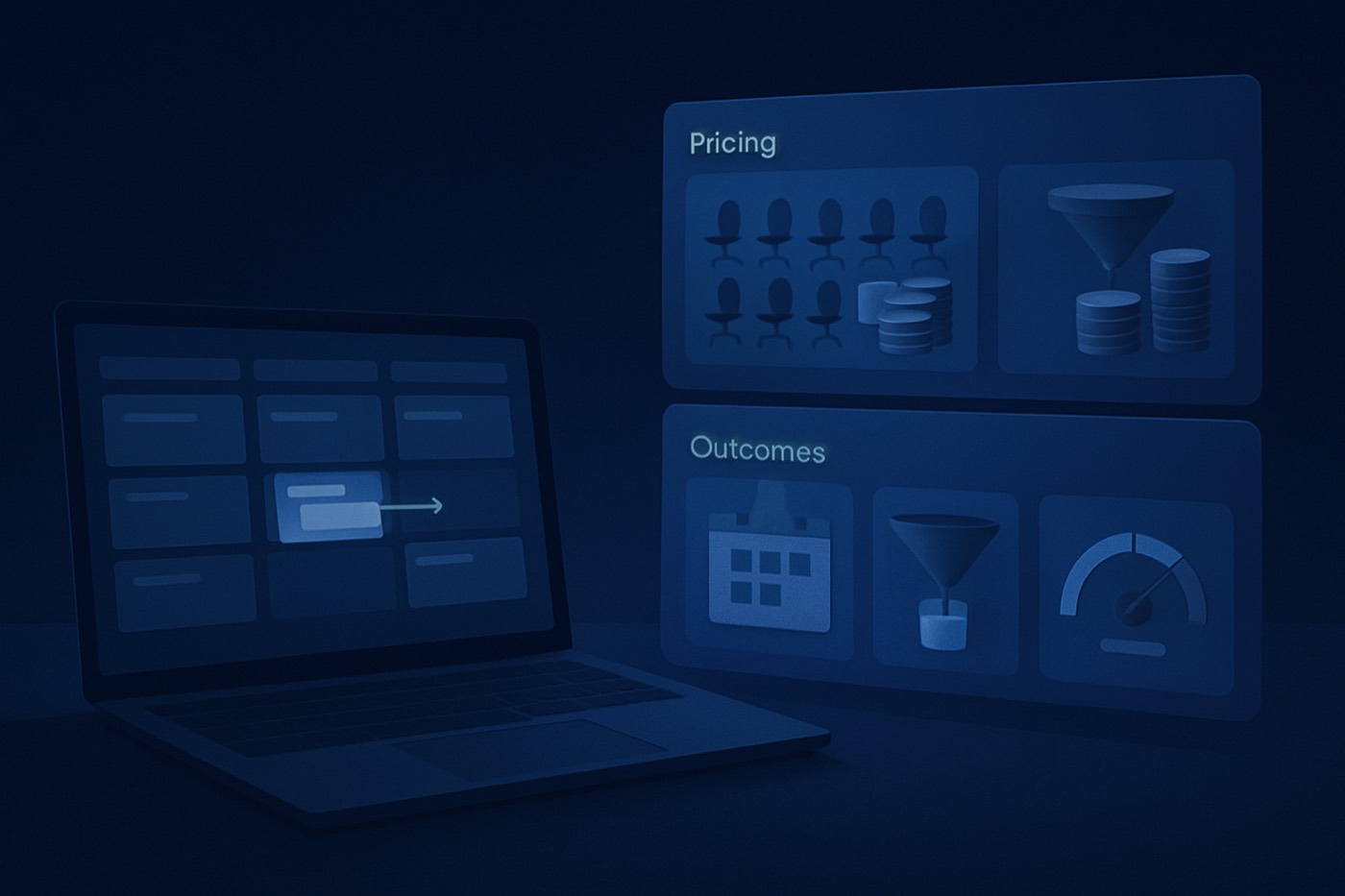
Per-seat CRM pricing is breaking down because a login stopped being the unit of work.
An autonomous sales agent finds the accounts, enriches the contacts, writes the email, sends it from a warmed mailbox, and works the replies. A human shows up for the meeting and closes. Charging "per user" in that world is like charging "per keyboard": the count you are billing for no longer maps to the value being produced.
Gartner expects task-specific AI agents to appear inside 40% of enterprise apps by the end of 2026, up from less than 5% in 2025. (Gartner press release) When agents do the clicking, a pricing model built on counting human clicks starts to come apart.
The trend: per-seat pricing breaks the moment agents do the work
Per-seat pricing worked under three assumptions:
- Every unit of value required a human.
- More value meant more humans.
- You could count humans by counting seats.
Agentic systems delete all three.
Why "logins" stopped matching value
In modern outbound, the expensive work is not clicking around a CRM. It is:
- Finding the right accounts.
- Finding the right contacts.
- Enriching with firmographics, technographics, and buying signals.
- Writing copy that does not get deleted in two seconds.
- Running the sequence and the follow-ups.
- Routing and answering replies.
- Booking the meeting.
When an autonomous operator runs that loop, seat count does not scale with output. Output scales with how much work the agent does.
That is where per-seat pricing starts punishing the buyer for success. If the pipeline machine works, you want to add more stakeholders, reviewers, and closers to watch it. Seat-based pricing turns each of those people into another line item, so collaboration becomes a tax.
Meanwhile, legacy CRMs still price like it is 2016. Salesforce lists its core Sales tools per user, per month, with Enterprise and Unlimited tiers that climb quickly. (Salesforce pricing page)
So buyers do what buyers always do. They resist. They down-seat. They share logins. They limit who gets access. Then the vendor calls it a "change management" problem. It is not. The pricing caused the behavior.
Packaging pressure: buyers want predictable spend and measurable output
AI did two things at once. It increased what software can execute, and it increased how volatile usage can get.
That splits buyer preference down the middle:
- Finance wants predictability.
- The go-to-market team wants throughput.
So the market is converging on models that try to satisfy both.
Usage-based pricing is no longer fringe, either. OpenView benchmark data, widely cited, found that 61% of SaaS companies used usage-based pricing in some form as of 2022. (TechCrunch summary of OpenView) More recent industry surveys keep pointing the same direction. (Metronome, "State of Usage-Based Pricing 2025")
This is not a future trend. This is what procurement is already doing.
What replaces per-seat pricing (and the trade-off in each)
1) Unlimited seats (the anti-seat tax)
Unlimited seats is the cleanest answer to the collaboration problem. It removes the entire negotiation:
- Who gets a seat?
- Do we pay for RevOps?
- Do we pay for leadership?
- Can CS see pipeline?
- Can the founder jump in?
It also fits how teams actually work: a lot of part-time viewers, a few heavy operators.
Trade-off: the vendor still needs a meter somewhere. If they do not meter seats, they meter contacts, automation runs, email volume, enrichment, or AI usage. If they claim to meter nothing, wait for the surprise invoice.
Chronic's stance is straightforward: $99, unlimited seats, with the agent running the outbound loop end-to-end until a meeting is booked. Adding more people to watch the work should not raise your bill.
2) Usage credits (meter the work, not the humans)
Usage credits price the system on consumption: leads found, records enriched, emails generated, workflow runs, signals processed, sequences executed. This fits agentic systems because the agent is the consumer, not a rep at a keyboard.
AWS publishes guidance on agentic economics that names usage and outcome models as the explicit pricing direction for agentic AI. (AWS Prescriptive Guidance)
Trade-off: if the metering is unclear, usage turns into billing chaos. If you cannot forecast usage, finance will not sign off.
3) Outcome-based pricing (pay for meetings, pipeline, or revenue events)
Outcome-based pricing says: pay when a defined result happens. In sales tooling, that usually means:
- meeting booked
- qualified meeting booked (the definition matters)
- sales-accepted opportunity created
- pipeline dollars influenced
This is where buyers are pushing, because it maps to their only real KPI: revenue. Gartner has put a name to the shift, framing "Outcome as Agentic Solution" as contracting for outcomes rather than tool access. (ITPro overview)
Trade-off: measurement fights. If the vendor controls the definition, you can end up paying for "outcomes" that feel like vanity.
4) Hybrid models (base subscription + usage + optional outcomes)
This is where the market lands most often, because it satisfies both sides. A base fee buys predictability, usage captures the heavy value, and an outcome component can sit on top as a performance bonus.
Bain has called out AI as the forcing function here, arguing that per-seat models are not dead but are becoming misaligned, with usage and outcome models gaining ground. (Bain) Hybrid is also the model most likely to survive procurement: it reads as normal while still pricing the work.
Trade-off: complexity. Hybrid requires clean instrumentation and honest contracts. Plenty of vendors have neither.
Why big vendors keep per-seat pricing (even when it hurts buyers)
Legacy CRMs hold onto per-seat pricing for three reasons:
- Revenue predictability. Seats are stable and easy to forecast.
- Sales incentives. Account execs already know how to upsell seats.
- Procurement muscle memory. Buyers already know how to negotiate them.
But even the incumbents are adjusting around the edges. HubSpot removed seat minimums for some hubs and split paid and view-only seats as part of a pricing overhaul. (HubSpot announcement) The plain reading: the market complained loudly enough that "every user must be a paid seat" stopped holding. That is the same pressure every seat-based CRM will face as agents replace human clicks.
The real shift: buyers want outcomes, not a toolchain
Seat pricing got worse because the CRM stopped being one product. Most outbound teams now pay for a stack:
- CRM
- lead database
- enrichment
- email sequencer
- intent data
- analytics
- calendar booking
- an AI writing layer
So even if a single CRM seat looks reasonable, the stack cost is not. It is death by a thousand line items, and most of those line items also meter something.
This is why "pipeline on autopilot" wins as a buying narrative. It collapses the toolchain into one accountable system with one owner. If you want the consolidation playbook, see the 2026 CRM stack for SMBs: 7 tool consolidation plays that cut costs and book more meetings.
Buyer cheat sheet: what to demand in contracts
The one thing to remember: vendors hide cost in the meter. Seats used to be the meter. Now it is "credits," "actions," "workflows," "AI runs," or "contacts." So you demand clarity.
1) Define the billable units in plain English
Make the vendor define each unit with an example. Ask for a table like this:
- 1 enrichment credit = which fields, from which sources, per contact?
- 1 email generation = per draft, per sequence step, or per contact?
- 1 automation run = per workflow execution, per task, or per API call?
If they cannot define it, they cannot fairly bill it. This applies to any agentic tool, Chronic included: the meter has to be explicit before you sign.
2) Demand hard limits and predictable overages
Your contract needs included usage amounts, an overage price per unit, a real overage cap, and "no retroactive billing" language. Overages without a cap are just per-seat pricing wearing a disguise.
3) Data ownership and export rights (non-negotiable)
An outbound agent generates valuable artifacts: enriched fields, scoring signals, message variants, reply labels, routing decisions, playbooks. Get this in writing:
- You own your data.
- You can export it in a usable format.
- You can export at termination without paying for professional services to get it out.
Also ask where derived data lives. In the CRM record? A separate database? A vendor-only layer you cannot reach?
4) Automation caps and throttles
If a vendor sells "autonomous" anything, demand the controls: max sends per day, max enriches per day, rate limits, safety checks, and the ability to pause all automation instantly. For autonomous outbound this is not optional, since a runaway agent can burn domains and mailboxes. For the deeper version of this, see the agent control plane: permissions, audit logs, and kill switches for autonomous outbound.
5) Support tiers that map to revenue impact
Seat-based tools love support tiers that only matter after something breaks. Pin down the specifics: response-time SLA, escalation path, whether deliverability support is included or paid, and whether onboarding is included. Outbound is operations. If deliverability fails, pipeline fails, so this is not a nice-to-have. The weekly version of that work is here: cold email deliverability ops in 2026: the SOP your team runs weekly.
6) Auditability: prove what the agent did
If you pay for usage or outcomes, you need logs: event logs for actions taken, reason codes for scoring decisions, and traceability for sequences and routing. If the system cannot explain itself, it cannot be trusted with your pipeline.
How to compare total cost when you stop paying for five tools
Buyers keep making the same mistake: comparing CRM price instead of pipeline price. Here is the comparison that actually holds up.
Step 1: List your current stack by function
A typical outbound stack: CRM (pipeline and reporting), lead sourcing, enrichment, sequencing, an AI writing layer, scheduling, intent and signals, integrations.
Step 2: Convert to monthly cost with real seat counts
Use your actual active users, not the org chart. Then add platform fees, onboarding fees, mandatory add-ons, contact tiers, and email-volume tiers.
Step 3: Add the hidden ops labor
Count the hours per month spent on list building, data cleanup, enrichment retries, personalization research, sequence QA, and deliverability firefighting. If you do not price that labor, you are lying to yourself about the real cost.
Step 4: Compare cost per booked meeting (not cost per seat)
The formula is simple:
- (total monthly GTM tooling + ops labor) / meetings booked
That number exposes seat-based math instantly. An autonomous operator changes the denominator: it runs the loop end-to-end, so the cost per booked meeting is a function of the agent's work, not how many people hold a login.
That is the work Chronic does: ICP definition with the ICP Builder, lead sourcing and enrichment, fit and intent scoring with AI Lead Scoring, copy generation with the AI Email Writer, and pipeline visibility in the Sales Pipeline, end-to-end until the meeting is booked. The unit buyers actually want is the meeting, not the seat.
What "outcomes" should mean in a sales contract
If a vendor offers outcome-based pricing, pin the definitions down before you agree.
Define "meeting booked"
Specify that it is booked on a real calendar, with the right persona (a title range), within your company-size and ICP constraints, for a minimum duration. It should not be a reschedule loop, an internal meeting, or an existing customer unless you agree to count those.
Define "qualified"
If they claim "qualified meetings," add the qualification criteria your team actually uses, the disqualification reasons, a dispute process, and a credit policy for no-shows. Outcome pricing without dispute mechanics turns into a standoff every billing cycle.
Where this is going: the CRM becomes a work engine
The CRM UI used to be the product. Increasingly, the UI is the receipt. The agent does the work, humans approve the decisions that matter, and the system ships the outcome, so pricing follows execution rather than headcount. You can see the direction in how the market talks about autonomous CRM and agentic layers; for a sharper read, start with ServiceNow's autonomous CRM is the warning shot: CRMs just became work engines.
Per-seat pricing does not vanish overnight. It erodes in renewals, in procurement redlines, and the moment RevOps refuses to buy 30 seats for software that two people and an agent actually operate.
FAQ
What is per-seat CRM pricing?
Per-seat CRM pricing charges a fixed recurring fee for each user login, usually per month and often in tiered editions. It assumes value scales with the number of humans using the tool.
Why is per-seat CRM pricing breaking down now?
Agents now do work that used to require more humans, so seat count can stay flat or shrink while output rises. That breaks the link between price and value, which triggers buyer pushback and down-seating.
What pricing model is most buyer-friendly for agentic sales tools?
A hybrid model usually wins: a predictable base subscription plus clearly defined usage, sometimes with an outcome component. It matches how usage spikes while keeping finance comfortable.
What contract terms matter most when moving off per-seat pricing?
Five non-negotiables: plain-English definitions for every billable unit, hard usage limits with capped overages, data ownership and export rights, automation caps with a kill switch, and audit logs that show exactly what the system did.
How do I compare CRM costs if I am consolidating multiple tools?
Compare total cost per booked meeting. Add up tooling (CRM, outbound, enrichment, data), platform and onboarding fees, and ops labor, then divide by meetings booked. Seats are a distraction from that number.
How is Chronic different from CRMs that charge per user?
Chronic is an autonomous revenue operator, not a CRM. It runs outbound end-to-end until a meeting is booked, at $99 with unlimited seats, so adding collaborators does not raise spend. It also folds the usual five-tool stack into one workflow: ICP, lead sourcing, enrichment, scoring, sequencing, and pipeline tracking. For the side-by-side reads, see Chronic vs Salesforce and Chronic vs HubSpot.
Run the pricing reset
- Stop asking "what is the price per seat?"
- Ask "what is the price per outcome, and what is the meter?"
- Redline the contract until limits and overages are boring.
- Compare stacks by total cost per booked meeting.
- Then buy the system that ships pipeline without charging you for every human who looks at it.