ServiceNow’s “Autonomous CRM” Is a Shot at Salesforce. Here’s What Actually Matters.
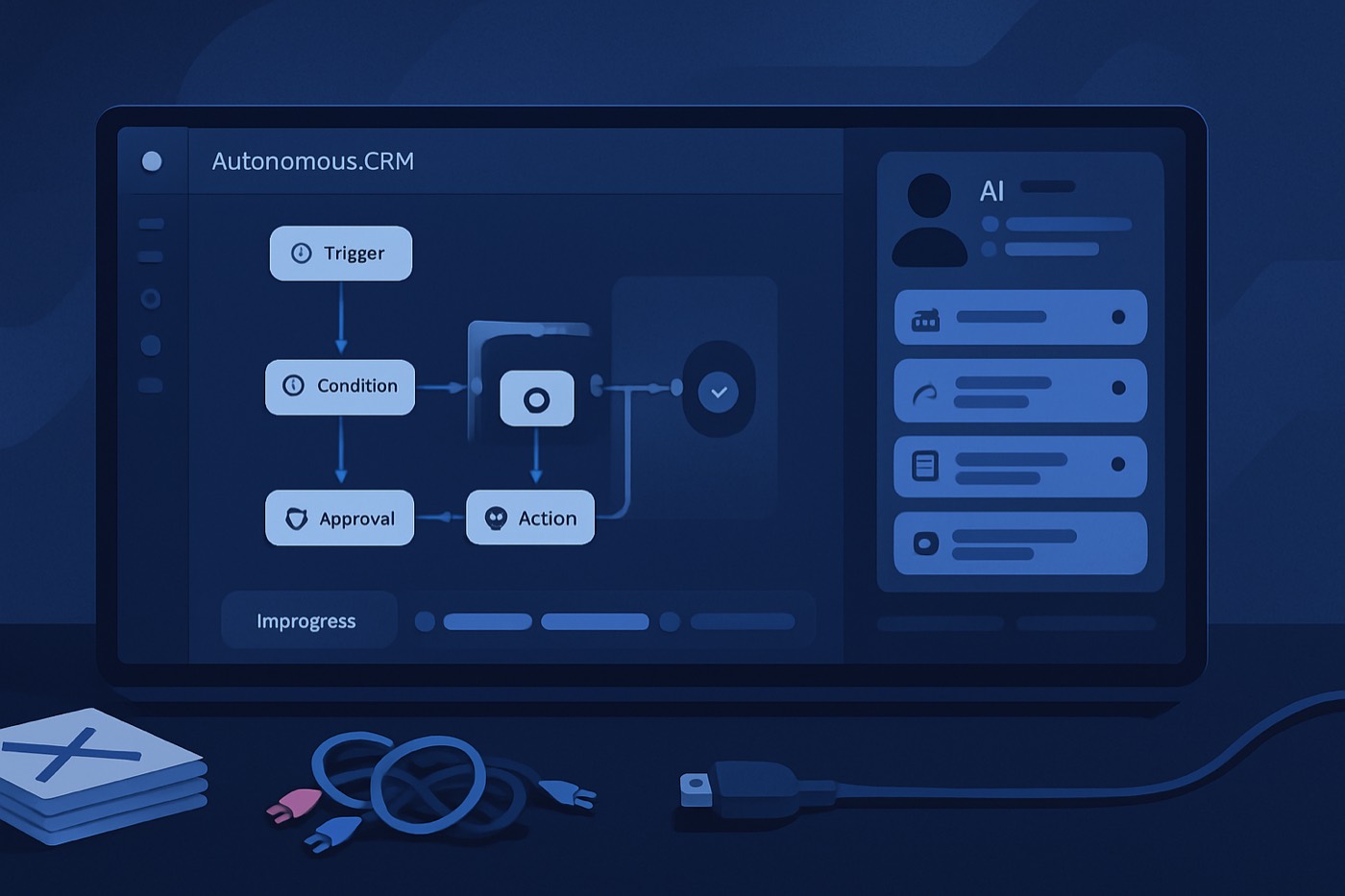
ServiceNow’s “Autonomous CRM” messaging is a direct shot at Salesforce. Not because ServiceNow suddenly wants to be a prettier contact database. Because they want the control plane.
They are selling an operating model: the CRM that does work, not the CRM that stores work.
TL;DR
- “ServiceNow Autonomous CRM” is really “system of action CRM.” Workflow first. Agents execute. Records follow. ServiceNow is saying that out loud. (techtarget.com)
- Buyer reality comes down to 3 layers: data, guardrails, workflow. If any layer is weak, “autonomous” becomes “autocorrect with opinions.”
- Vendors will hand-wave the hard parts: approvals, write-permissions, rollback, audit logs, exception handling, and human override.
- The evaluation framework is simple: Can it find leads, enrich, message, prioritize, and book meetings without a Frankenstack?
- Salesforce still sells a suite. You still buy add-ons. Even Salesforce lists Sales Cloud up to $350/user/month, plus AI tiers like Agentforce at $550/user/month. (salesforce.com)
- Chronic runs outbound end-to-end till the meeting is booked. $99. Unlimited seats. No stack archaeology.
ServiceNow Autonomous CRM: what they’re actually claiming
ServiceNow has been building toward this for a while. Their CRM narrative is consistent:
- Traditional CRM = system of record (front office tracking).
- ServiceNow = system of action (orchestrate work across teams and tools).
- AI agents = the execution layer that turns “next best action” into “done.” (newsroom.servicenow.com)
That framing matters. Because the real enemy is not Salesforce’s UI. It’s the reality that “CRM” usually means:
- A sales rep updates fields.
- Ops builds rules.
- RevOps buys 4 tools to plug the holes.
- Leadership calls it “process.”
ServiceNow is saying: stop worshipping the database. Start running the business.
Their own press and coverage ties Autonomous CRM to broader “Autonomous Workforce” and agent execution, plus management controls for agents. (newsroom.servicenow.com)
Good. Now let’s translate that into buyer reality.
Why “autonomous CRM” is an operating model, not a feature
Most CRMs were designed as systems of record:
- Contacts
- Accounts
- Deals
- Activities
- Forecasts
Autonomous CRM is a system of action:
- Sense signals
- Decide next step
- Execute a workflow
- Update the record
- Escalate exceptions
If you treat “autonomous” like a feature checkbox, you will buy a chatbot glued to a form.
The shift is bigger than UI. It changes who does the work:
- Humans become exception handlers and closers.
- Agents become doers.
- Workflow becomes the product, not the admin config.
ServiceNow keeps using “system of action” language, and analysts are repeating it because it is the right axis to compete on. (cloudwars.com)
The 3 layers that matter (and where “autonomous CRM” dies)
1) Data layer: garbage in, confident garbage out
Autonomous systems do not fail politely. They fail at scale.
You already know your data is messy. Here’s the part people ignore: AI makes messy data impossible to hide.
- Gartner pegs the average cost of poor data quality at $12.9M per year. (gartner.com)
- HubSpot survey reporting via TechRadar: 92% say valuable insights sit outside the CRM, and 34% report revenue loss from fragmented customer data. (techradar.com)
Autonomous CRM needs more than “integration.” It needs data contracts:
- What fields are required to act?
- What source wins when systems conflict?
- What freshness window is acceptable?
- What gets written back, and when?
If the agent cannot trust the inputs, it will “solve” the wrong problem faster.
Buyer test for the data layer
- Show me the exact objects and fields your agent needs to book a meeting.
- Show me how it handles duplicates.
- Show me how it handles missing phone, missing title, missing ICP fit.
- Show me what happens when the enrichment source conflicts with the CRM record.
If the answer is “we’ll configure it,” translate that to “you’ll babysit it.”
2) Guardrails layer: approvals, permissions, rollback, audit
This is where the marketing gets vague.
Agents that can act introduce “AI action risk.” TechRadar described the shift bluntly: the risk moves from content to action, including privileged workflow execution and impersonation style failure modes if controls are weak. (techradar.com)
So when a vendor says “autonomous,” you ask:
Approvals
- Which actions require human approval?
- Can approvals be conditional by segment, deal size, region, or risk score?
- Can you do “approve once for this account” vs “approve every email”?
Write permissions
- What can the agent write to CRM?
- Can it create new objects?
- Can it change stage?
- Can it edit owner, pipeline, forecasting category?
Rollback
- If the agent sends the wrong sequence, what is the rollback?
- Can you revert field changes?
- Can you cancel queued actions?
Audit logs
- Do you get an audit trail that shows:
- Prompt/context used
- Tools called
- Data read
- Data written
- User identity or service account identity
- Timestamp
- Outcome
Exception handling
- What happens when:
- enrichment fails
- email bounces
- contact replies with “wrong person”
- prospect asks for SOC 2
- calendar link fails
- CRM is down
- a tool rate-limits API calls
If the demo never shows failure paths, that is not a product. That is theater.
3) Workflow layer: the agent is only as good as the playbook
Autonomous CRM lives or dies on workflow design.
ServiceNow’s core strength is workflow. That’s their home turf. Their CRM push is basically, “we already run the work, now we will run the revenue work too.” (newsroom.servicenow.com)
But buyers still need to separate:
- A workflow engine that can route tasks
- Versus an outbound engine that can generate pipeline
Because “workflow” in enterprise often means internal coordination:
- order capture to fulfillment
- service request to resolution
- approvals and handoffs
Outbound is different:
- lead sourcing
- data hygiene
- deliverability constraints
- personalization at scale
- reply handling
- meeting booking
If the workflow layer cannot execute outbound end-to-end, you end up with the usual mess: CRM + sales engagement + enrichment + intent + sequencing + calendar + routing + logging.
That is the Frankenstack.
What vendors will hand-wave (because it’s hard and boring)
Here’s the stuff that decides whether “autonomous” is real.
“It can write emails”
Cool. Can it stay out of spam?
Cold email lives under hard constraints:
- bounce rate
- complaint rate
- authentication
A practical benchmark many deliverability teams track is keeping spam complaints under 0.1%, with healthier targets even lower. (suped.com)
If your “autonomous CRM” cannot control list quality and targeting, it will torch domains with perfect grammar.
“It enriches records”
With what source? With what confidence scoring? What happens when enrichment conflicts?
If enrichment is not deterministic and auditable, you cannot debug it. You just get weird.
“It prioritizes leads”
Based on what? Fit only? Intent only? Both?
If scoring does not split fit and intent, reps waste time on:
- high-fit, zero-timing accounts
- high-intent, terrible-fit accounts
Chronic’s stance is simple: dual scoring wins. If you want the model, read Inbound Intent Scoring vs Outbound Fit Scoring. (Internal: fit vs intent scoring model)
“It logs everything”
Where? With what schema? What is the source of truth?
If your CRM is the system of record, logging must be reliable. If logging fails, forecasting becomes fan fiction.
“It has guardrails”
Show the guardrails. Not a slide.
If you need a checklist, use this: (Internal: Autonomous CRM guardrails questions)
ServiceNow Autonomous CRM vs Salesforce: what’s really being contested
Salesforce still dominates CRM mindshare. Their pricing also makes the “autonomous” pitch expensive fast.
Salesforce publicly lists Sales Cloud pricing tiers up to $350/user/month and an AI tier like Agentforce 1 Sales at $550/user/month. (salesforce.com)
Even if you negotiate, the buying pattern stays the same:
- CRM license
- sequencing
- enrichment
- intent
- dialer
- routing
- reporting
- data warehouse or CDP if you want “one view”
ServiceNow is attacking that stack cost and complexity by claiming:
- unified workflow platform
- agent orchestration
- enterprise-grade controls
That’s credible, especially in big enterprises that already run IT, HR, and service workflows in ServiceNow.
But if you are buying for pipeline creation, you still need to ask one question:
Does it actually generate booked meetings, or does it orchestrate the work around selling?
Those are different outcomes.
The simple evaluation framework: “Can it book meetings without a Frankenstack?”
Use this framework in every demo. Make them walk through it live.
1) Can it find leads that match your ICP?
- Can it define ICP beyond firmographics?
- Can it build lists from technographics, hiring signals, and stack signals?
- Can it refresh automatically?
If it cannot source leads, you are still paying for Apollo or Clay.
(Chronic: ICP Builder)
2) Can it enrich leads to outbound-ready quality?
Outbound-ready means:
- verified email
- correct title and function
- company size and industry
- location if relevant
- tech stack if relevant
- phone when you need it
If enrichment is partial, reps fill the gaps. That’s not autonomous. That’s delegation.
(Chronic: Lead enrichment)
3) Can it message with real personalization that does not read like AI?
Personalization is not “Hi {firstName}.”
It is:
- why this company
- why now
- why you
- one sharp CTA
Also, it must respect deliverability basics. If you need a hard checklist, use: (Internal: DMARC in 2026 for cold email)
(Chronic: AI email writer)
4) Can it prioritize with a model you can explain?
Ask for:
- fit score inputs
- intent score inputs
- weights
- thresholds for “send,” “hold,” “research,” “route to human”
If the scoring is a black box, you cannot manage it. You can only hope.
(Chronic: AI lead scoring)
5) Can it book meetings end-to-end?
This is the only outcome that matters.
Booking means:
- detects positive replies
- proposes times
- routes to the right rep
- books on calendar
- updates pipeline
- follows up on no-response
- handles reschedules
- logs everything
If the workflow stops at “draft an email,” you do not have autonomous CRM. You have autocomplete.
(Chronic: Sales pipeline)
The buying reality: “autonomous” is earned in production, not announced on stage
Here’s the operator take:
- ServiceNow is serious. They have workflow DNA, and CRM is a logical expansion. (newsroom.servicenow.com)
- The winners will ship boring capabilities:
- permissioning
- auditability
- rollback
- exception handling
- monitoring
- The losers will ship demos.
If you want one litmus test, it’s this:
When the agent makes a mistake, can your team prove what happened, fix it fast, and prevent it forever?
If not, “autonomous” becomes “we turned it off.”
Where Chronic is different (clean contrast, no smoke)
ServiceNow and Salesforce are fighting over the enterprise suite.
Chronic is solving a narrower problem with zero patience for stack bloat:
Outbound pipeline. Booked meetings. End-to-end, till the meeting is booked.
Most teams still run:
- Salesforce or HubSpot for CRM
- Apollo for data
- Clay for enrichment workflows
- Instantly or Outreach for sequences
- a separate scoring tool
- calendar routing
- spreadsheets for sanity
That stack is expensive, fragile, and always “almost working.”
Chronic collapses it:
- Finds leads matching your ICP
- Enriches records
- Writes and sends sequences
- Scores with fit + intent
- Prioritizes and books meetings
$99. Unlimited seats.
If you are comparing categories, start here:
And if you want the macro trend behind all of this, read: (Internal: The 2026 outbound stack collapse)
FAQ
What does “ServiceNow Autonomous CRM” mean in plain English?
It means ServiceNow wants CRM to run as a workflow system where AI agents can take actions, not just store customer data. Think “system of action,” not “system of record.” (newsroom.servicenow.com)
Is autonomous CRM real today, or mostly marketing?
Pieces are real: agent execution, workflow orchestration, and AI controls are improving fast. But autonomy is earned in production through guardrails, auditability, and exception handling. Demos rarely show failure paths, and that’s where autonomy breaks.
What are the non-negotiable guardrails for an autonomous CRM?
At minimum: role-based write permissions, approval workflows for risky actions, rollback for changes and queued actions, and audit logs that show what data the agent used and what it changed. Action risk is the real risk. (techradar.com)
Why does data quality matter more with autonomous CRM?
Because bad data no longer just hurts reporting. It triggers wrong actions at scale. Gartner cites poor data quality costing organizations $12.9M per year on average. (gartner.com)
How do I evaluate an “autonomous CRM” vendor without getting trapped in a Frankenstack?
Force an end-to-end demo: lead sourcing, enrichment, messaging, scoring, reply handling, and meeting booking. Then test exception paths: bounces, enrichment conflicts, approval gates, and rollback. If they cannot show it, you will be the integration layer.
Salesforce already has AI agents. Why isn’t that enough?
Salesforce’s AI can be strong, but buyers still face suite economics and add-on sprawl. Salesforce lists Sales Cloud tiers up to $350/user/month and an AI tier like Agentforce 1 Sales at $550/user/month. (salesforce.com)
Even with AI, most teams still bolt on data, sequencing, enrichment, and routing tools.
Run this evaluation in your next demo
Bring this checklist. Do not negotiate with the slide deck.
- Show lead sourcing. Not imports.
- Show enrichment with conflicts. Two sources disagree. What wins?
- Show a sequence sending. With domain protections and suppression logic.
- Show fit + intent scoring. Explainable. Adjustable. Auditable.
- Show booking. Positive reply to booked meeting, logged in pipeline.
- Show failure. Bounce, missing data, tool downtime. What happens?
- Show controls. Approvals, write permissions, rollback, audit logs.
If a vendor clears all seven, you are looking at autonomy.
If they clear three, you are looking at a CRM with a narrator.
And if you want outbound that actually ends in booked meetings without the Frankenstack, Chronic runs it end-to-end for $99 unlimited seats.